The question
Does the way DNA folds control which genes turn on?
This is the specific idea being tested.
Does the way DNA folds control which genes turn on?
What you need to knowDNA folding helps some genes turn on, but it is not a master switch for all gene activity.Relative explanatory fit: Alternative ranked ahead
Why the alternative fits better: Some gene activity continues after folding changes. A model that also allows other controls fits this better.
Claim assessed: Three-dimensional genome folding is a primary causal determinant of transcriptional regulation across mammalian loci.
Finding: The preregistered scope-matched gate is SC3, yielding Γ. SC2 reaches Ζ through independent endogenous boundary edits, allele-resolved human/mouse developmental tests and locus-directed functional rescue, interpreted as architectural contribution rather than a sole switch. SC1 is an existence statement: Β records robust structural observation without pretending existence itself proves regulatory causality. Its empirical reality is well established and is not refuted by this causal ladder.
Evidence scope: 60 primary reports; literature cutoff 2026-10-08; source examination UTC date 2026-10-09; bounded critical review, not exhaustive systematic review.
The grade applies to the stated claim. Model rankings and individual subclaim grades remain separate from the overall causal-evidence grade.
Full scientific assessment and references · Scorecard (JSON) · Review source (Markdown)
THE MAIN FINDING
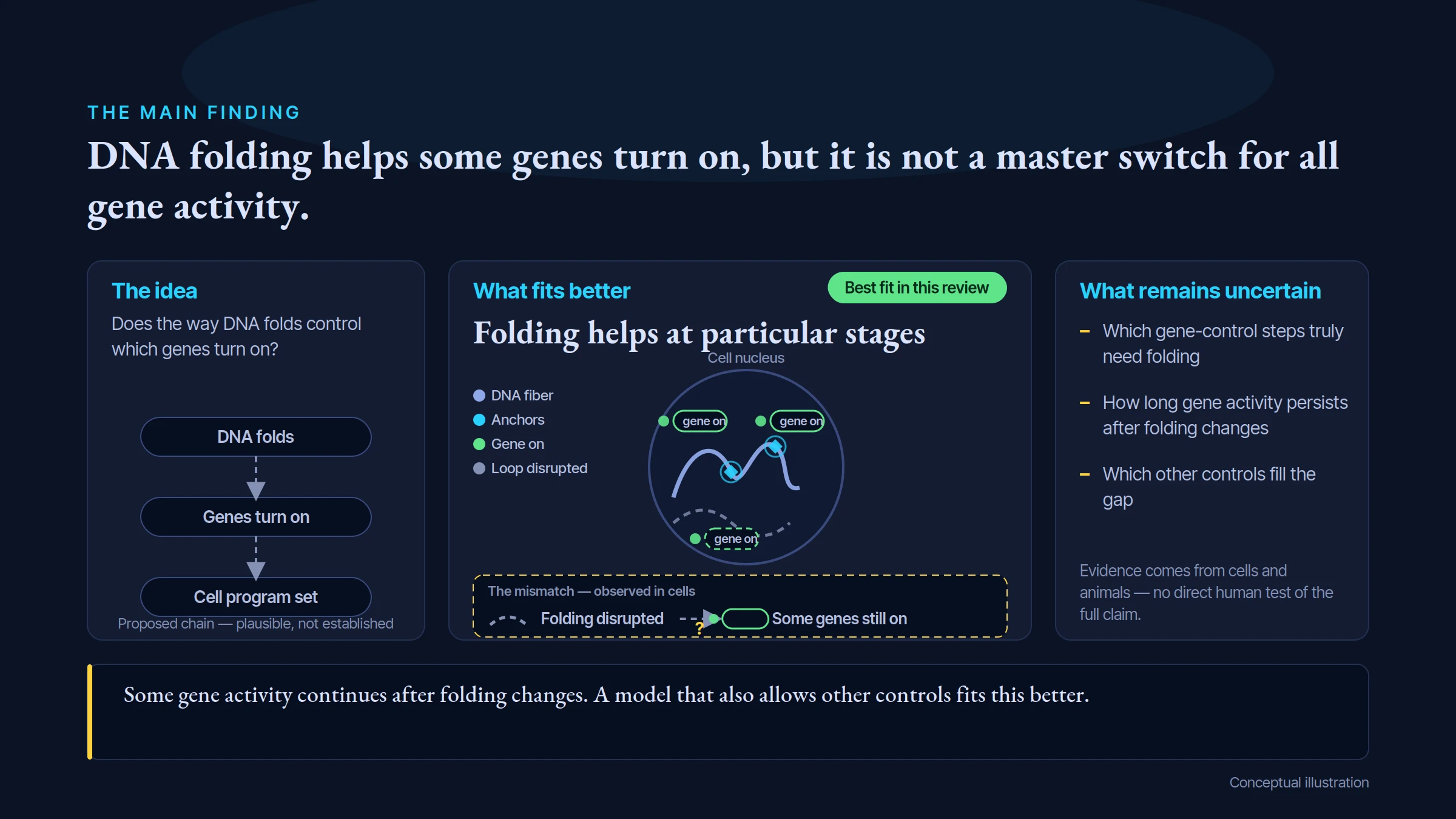
DNA folding helps some genes turn on, but it is not a master switch for all gene activity.
The idea
Does the way DNA folds control which genes turn on?
DNA folds
Genes turn on
Cell program set
Proposed chain — plausible, not established
What fits better
Folding helps at particular stages
Best fit in this review
Cell nucleus
gene on
gene on
DNA fiber
Anchors
Gene on
Loop disrupted
The mismatch — observed in cells
Folding disrupted
Some genes still on
What remains uncertain
Which gene-control steps truly need folding
How long gene activity persists after folding changes
Which other controls fill the gap
Evidence comes from cells and animals — no direct human test of the full claim.
Some gene activity continues after folding changes. A model that also allows other controls fits this better.
Conceptual illustration
This is the specific idea being tested.
Some gene activity continues after folding changes. A model that also allows other controls fits this better.
A higher rank means a better fit to the evidence in this comparison. It does not prove every part of the leading explanation.
The reviewed hypothesis ranks 5 among 5 models compared; 1 alternative model(s) hold first rank for this stated claim.
Claim under review: rank 5 among 5 compared models.
Leading explanation: Transition-dependent architecture with maintenance redundancy.
Position in this comparison: Last recorded rank.
The causal grade asks how well the stated causal claim is established. This comparison asks which of the assessed explanations fits the reviewed findings better. A leading explanation can remain unproven. Models can overlap or include the tested mechanism; an alternative ahead does not make that mechanism irrelevant. These ordinal ranks apply within this review; they do not measure the size of a difference or rank scientific strength across topics.
TWO EXPLANATIONS, COMPARED
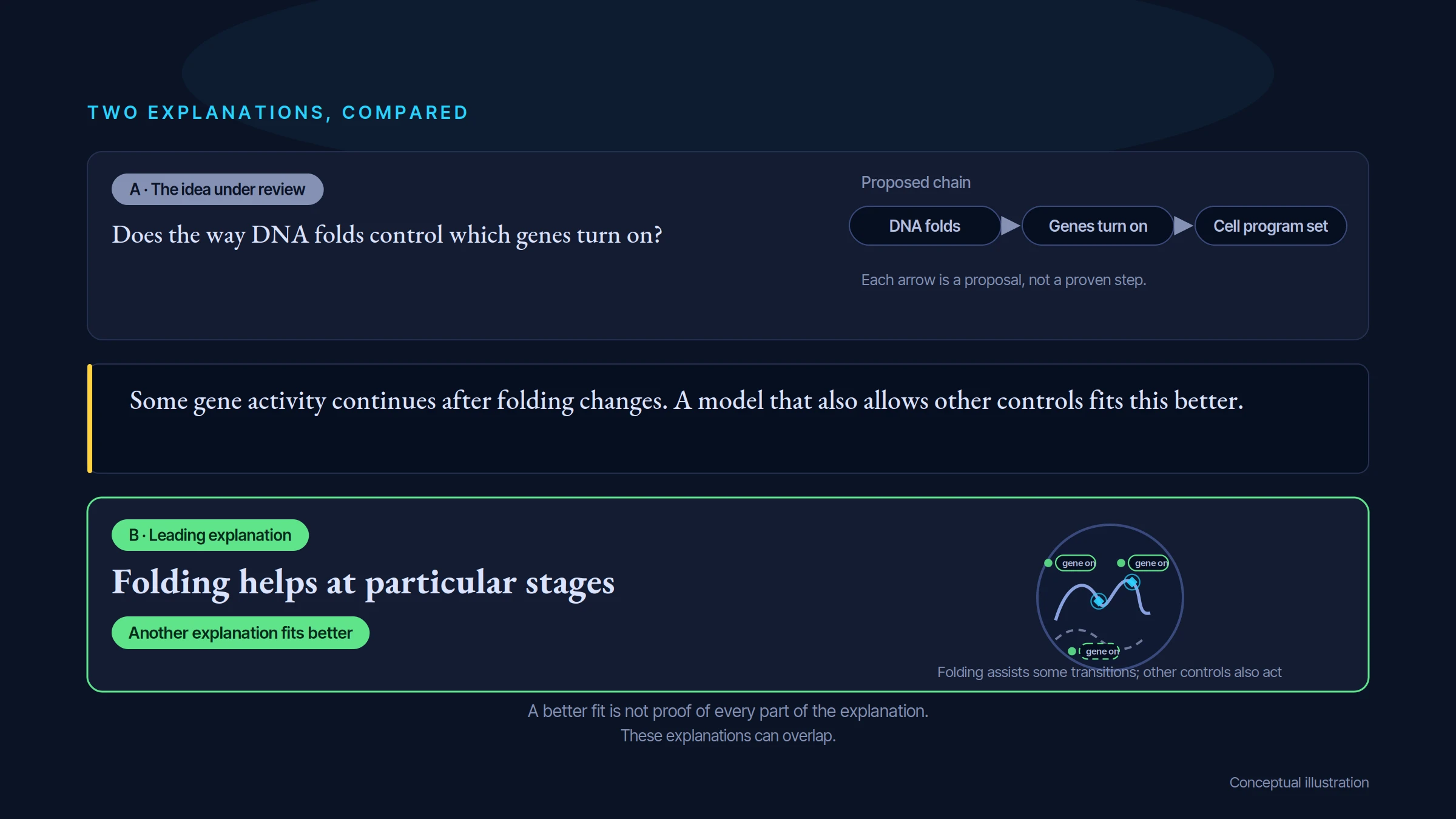
A · The idea under review
Does the way DNA folds control which genes turn on?
Proposed chain
DNA folds
Genes turn on
Cell program set
Each arrow is a proposal, not a proven step.
Some gene activity continues after folding changes. A model that also allows other controls fits this better.
B · Leading explanation
Folding helps at particular stages
Another explanation fits better
gene on
gene on
Folding assists some transitions; other controls also act
A better fit is not proof of every part of the explanation.
These explanations can overlap.
Conceptual illustration
Plausible, not established for the stated claim.
Some gene activity continues after folding changes. A model that also allows other controls fits this better.
These explanations can overlap. Ranking their fit to the evidence is separate from deciding how firmly a cause has been established.
Rank 1: Transition-dependent architecture with maintenance redundancy — Architecture facilitates particular activation transitions while established output can persist.
Rank 2: Permissive enhancer access with biochemical compatibility — Architecture shapes opportunities and insulation, while competent enhancer/promoter biochemistry determines output.
Rank 3: Transcription-first architectural remodeling — Transcription can generate or alter fine chromatin features, creating reciprocal causality.
Rank 4: Affinity-driven compartmentalization — Compatible chromatin states and regulatory factors coalesce independently of loop extrusion.
Rank 5: Topological primary switch — Folding broadly initiates and rate-limits mammalian transcription.
Evidence rating: Γ · Moderate confidence. How the evidence was assessed.
Some gene activity continues after folding changes. A model that also allows other controls fits this better.
The preregistered scope-matched gate is SC3, yielding Γ. SC2 reaches Ζ through independent endogenous boundary edits, allele-resolved human/mouse developmental tests and locus-directed functional rescue, interpreted as architectural contribution rather than a sole switch. SC1 is an existence statement: Β records robust structural observation without pretending existence itself proves regulatory causality. Its empirical reality is well established and is not refuted by this causal ladder.
Look for the proposed factor and the outcome, in the people or systems covered by the claim.
Folding helps at particular stages. Some gene activity continues after folding changes. A model that also allows other controls fits this better.
Change DNA folding without changing gene-control proteins, then check which genes turn on.
WHAT WOULD MAKE THE ANSWER CLEARER
A research question
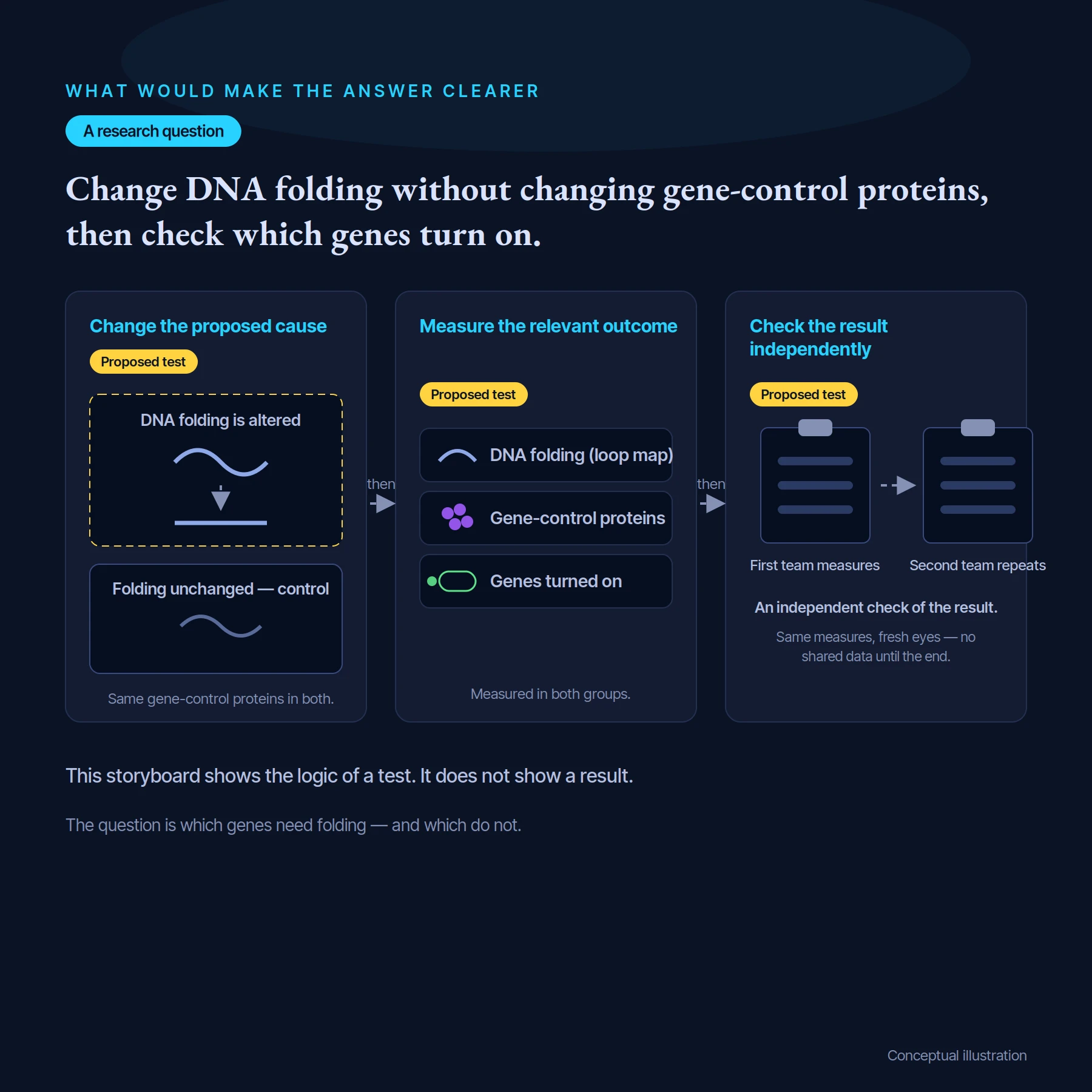
Change DNA folding without changing gene-control proteins, then check which genes turn on.
then
then
Change the proposed cause
Proposed test
DNA folding is altered
Folding unchanged — control
Same gene-control proteins in both.
Measure the relevant outcome
DNA folding (loop map)
Gene-control proteins
Genes turned on
Measured in both groups.
Check the result independently
Proposed test
First team measures
Second team repeats
An independent check of the result.
Same measures, fresh eyes — no shared data until the end.
This storyboard shows the logic of a test. It does not show a result.
The question is which genes need folding — and which do not.
Conceptual illustration
Change DNA folding without changing gene-control proteins, then check which genes turn on.
Check that the intended change really happened.
Allow for other factors and compare with suitable controls.
Look for independent confirmation and the limits of the effect.
These are questions for research, not a claim that the proposed studies have already succeeded.
Proposed tests: 1 test design(s) are registered in the scorecard.
In plain terms, researchers would change the proposed cause, check that it changed as intended, then measure a meaningful outcome while controlling plausible alternatives. The result should be able to support or count against the claim—not only show that a pathway exists.
Study design: Preregister representative endogenous loci across two mammalian lineages, proximal/distal enhancers and activation/maintenance. Cross acute topology-specific edits or separation alleles with biochemical-only defects, and independently restore architecture without restoring original cofactor surfaces.
What would be measured: Nascent transcription/burst kinetics, enhancer activity, direct factor occupancy, live distances/contact probabilities, cell cycle and viability during perturbation and recovery
Important controls: Expression/binding-matched alleles, untagged drug control, promoter competence, replication-stress control, unchanged enhancer sequence, and timed activation history
Result that would support the claim: Topology-specific loss systematically changes preregistered output and orthogonal topology rescue restores it despite matched chemistry, establishing necessity and rate limitation within stated scope
Result that would count against it: Output persists or is rescued by biochemical competence without restored topology; effects occur only after general collapse or selected responder loci
Follow the studies, detailed comparisons and evidence ratings behind this guide.
Open the scientific review →