The Hypothesis Critic · visual review series

Popular claims, shown at the scale the evidence can support.

These pages put the verdict first, then compare explanations. The causal evidence grade and relative explanatory fit answer different questions; a leading model can still remain unproven.

Completed reviews
Plausible, not established · HSEF Γ · 2 subclaim cards

Amyloid Cascade Hypothesis

Relative explanatory fit: Alternative ranked ahead

Amyloid matters, but a model with several interacting causes fits better than an amyloid-first explanation.

Reader-first lay guide Expert critique with citations
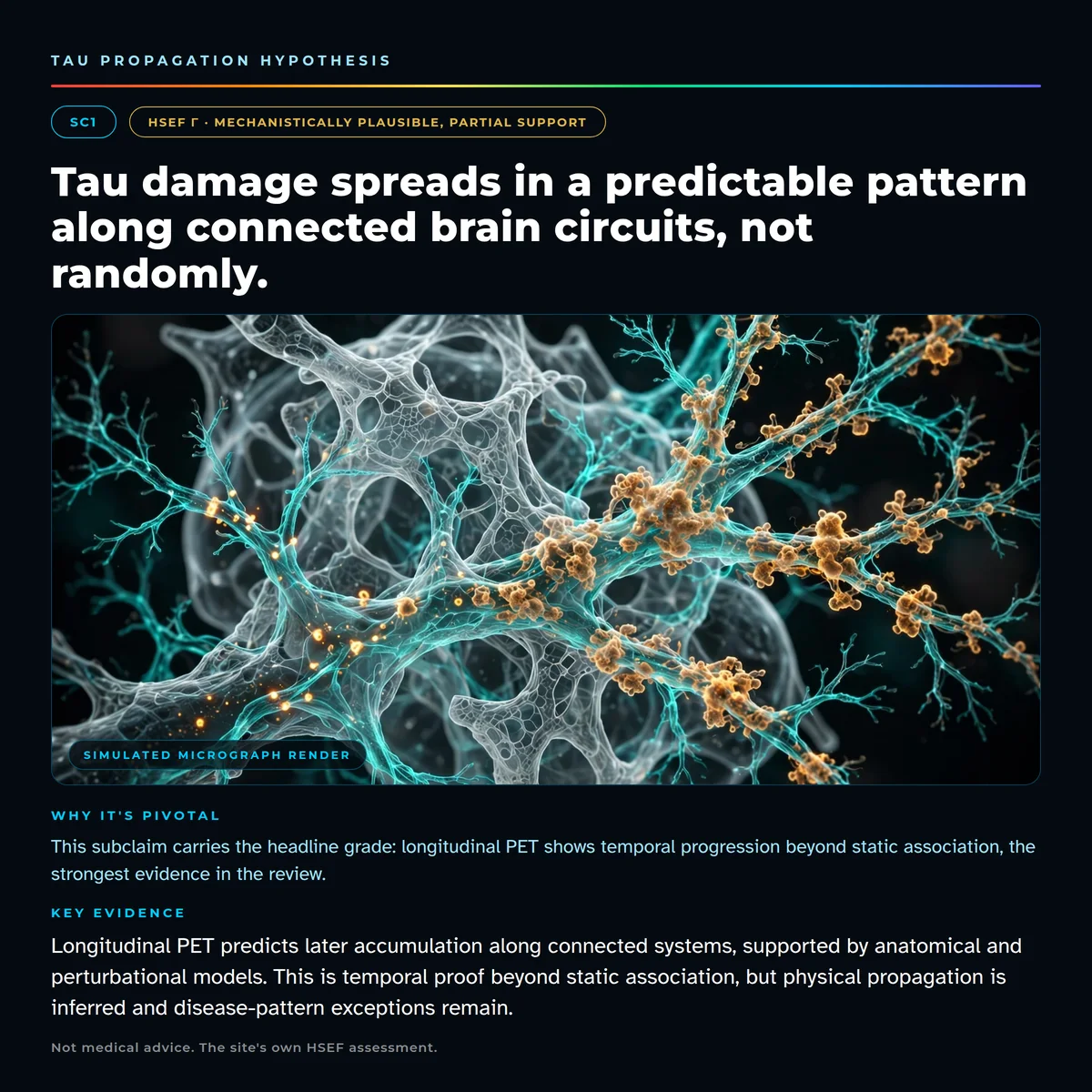
Plausible, not established · HSEF Γ · 3 subclaim cards

Tau Propagation Hypothesis

Relative explanatory fit: Alternative ranked ahead

Tau can spread, but nerve-cell vulnerability better explains some patterns of damage.

Reader-first lay guide Expert critique with citations
Plausible, not established · HSEF Γ · 2 subclaim cards

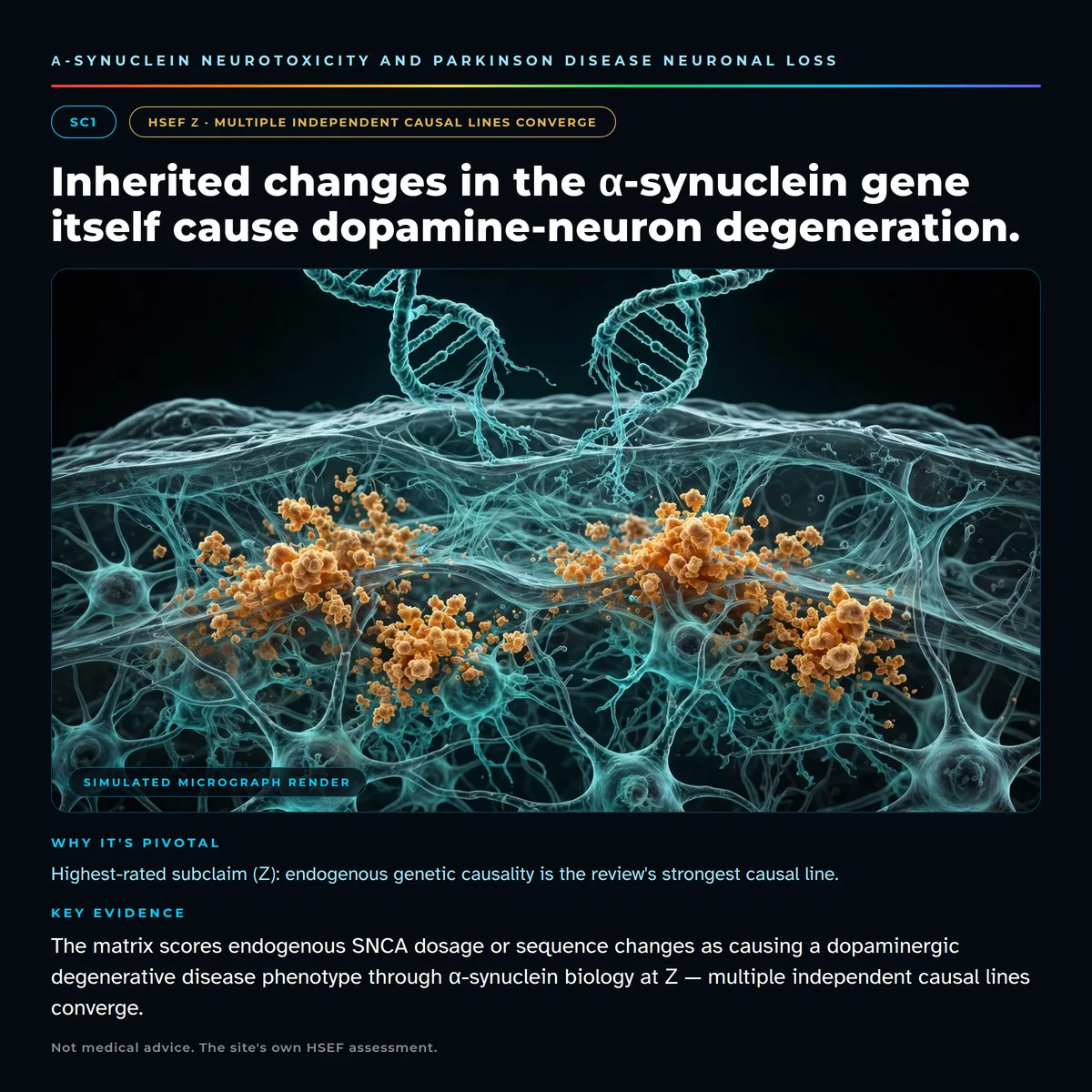
α-Synuclein Toxicity Hypothesis

Relative explanatory fit: Alternative ranked ahead

Damaged alpha-synuclein can matter, but Parkinson's appears to involve several routes to nerve-cell injury.

Reader-first lay guide Expert critique with citations

Plausible, not established · HSEF Γ · 3 subclaim cards

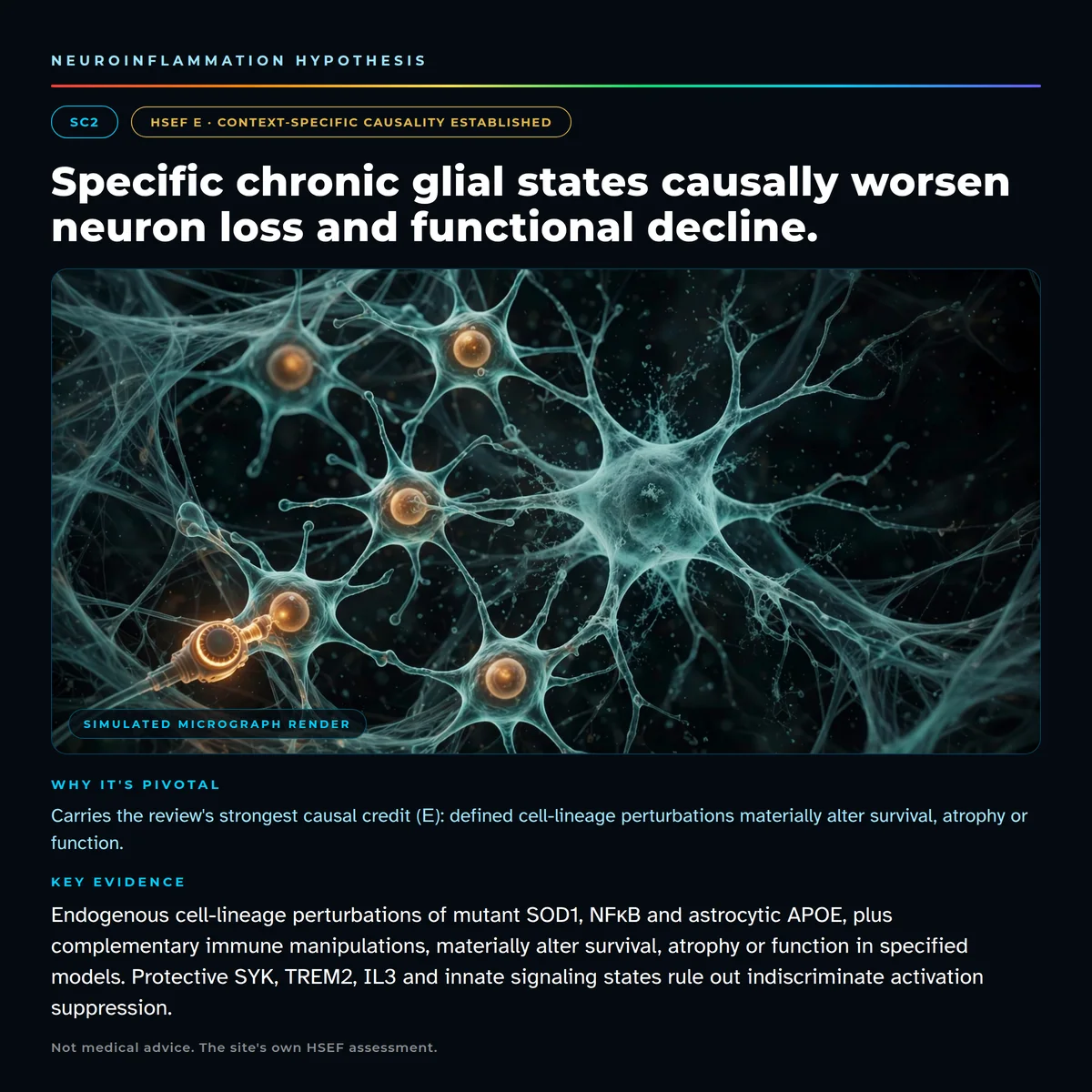
Neuroinflammation Hypothesis

Relative explanatory fit: Alternative ranked ahead

Brain inflammation can worsen injury, but is not established as the universal first cause.

Reader-first lay guide Expert critique with citations
Plausible, not established · HSEF Γ · 2 subclaim cards

Infectious Hypothesis of Alzheimer's

Relative explanatory fit: Alternative ranked ahead

Infection is not established as a required starting point for Alzheimer's disease.

Reader-first lay guide Expert critique with citations

Association only · HSEF Β

Antimicrobial Amyloid Hypothesis

Relative explanatory fit: Alternative ranked ahead

Amyloid can interact with microbes in the lab. That does not establish infection as the reason Alzheimer's deposits form.

Reader-first lay guide Expert critique with citations

Plausible, not established · HSEF Γ

Vascular Hypothesis of Dementia

Relative explanatory fit: Alternative ranked ahead

Blood-vessel damage harms memory without establishing that it starts Alzheimer's protein changes.

Reader-first lay guide Expert critique with citations
Plausible, not established · HSEF Γ · 3 subclaim cards

Metabolic / 'Type 3 Diabetes' Hypothesis

Relative explanatory fit: Alternative ranked ahead

Insulin-related problems may worsen disease, but are not established as its primary starting cause.

Reader-first lay guide Expert critique with citations

Plausible, not established · HSEF Γ

Mitochondrial Dysfunction Hypothesis

Relative explanatory fit: Alternative ranked ahead

Cell energy failure can contribute, but interacting genes, proteins and inflammation fit better.

Reader-first lay guide Expert critique with citations

Plausible, not established · HSEF Γ · 2 subclaim cards

Gut-origin Parkinson's (Braak Hypothesis)

Relative explanatory fit: Alternative ranked ahead

A gut-first route may fit some people, but a mixture of gut-first and brain-first routes fits better.

Reader-first lay guide Expert critique with citations

Plausible, not established · HSEF Γ

Excitotoxicity Hypothesis of ALS

Relative explanatory fit: Alternative ranked ahead

Excess glutamate can add stress, but disruption of RNA handling fits more of the reviewed evidence.

Reader-first lay guide Expert critique with citations

Plausible, not established · HSEF Γ

RNA-binding Protein Aggregation in ALS/FTD

Relative explanatory fit: Alternative ranked ahead

Loss of normal RNA-handling functions can matter even when visible clumps do not explain the damage.

Reader-first lay guide Expert critique with citations
Plausible, not established · HSEF Γ

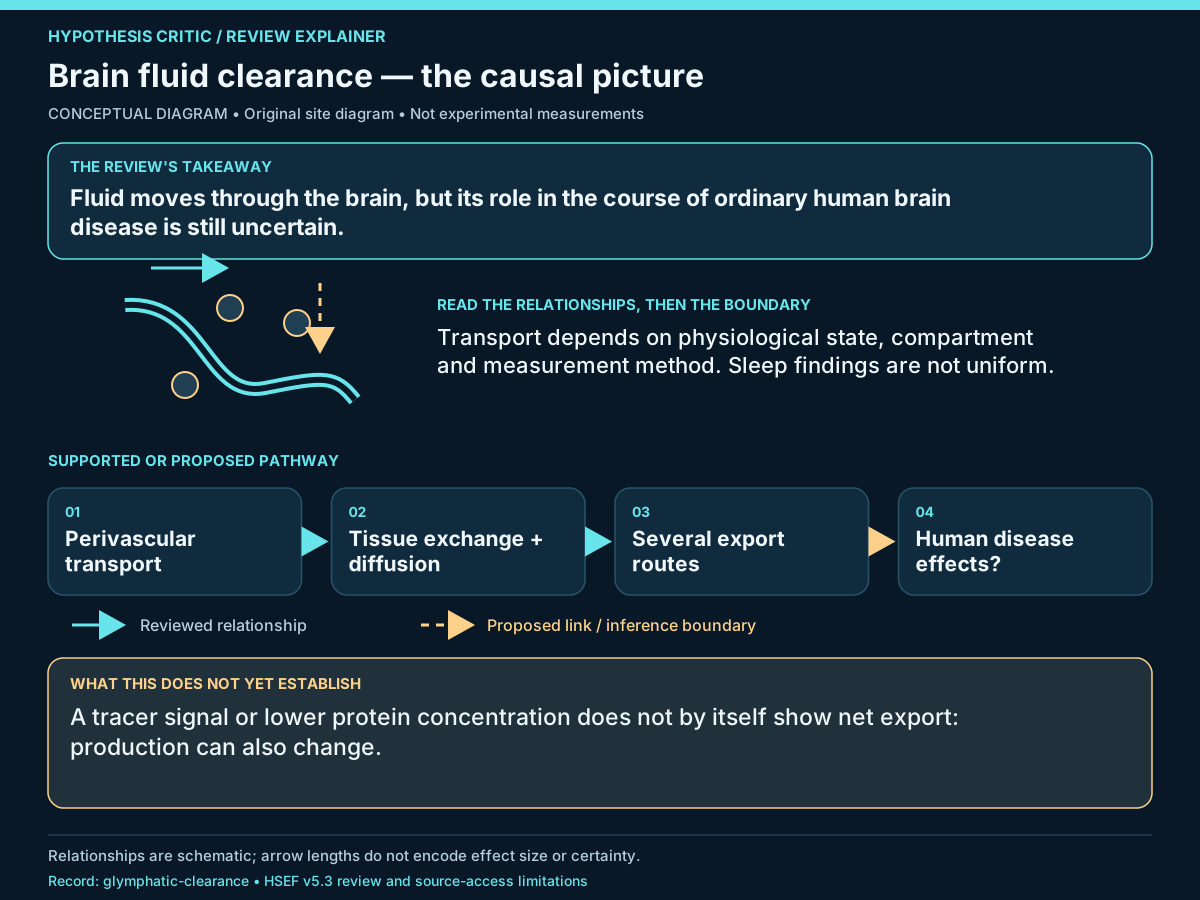
Glymphatic Clearance Hypothesis

Relative explanatory fit: Alternative ranked ahead

Fluid moves through the brain, but its role in the course of ordinary human brain disease is still uncertain.

Reader-first lay guide Expert critique with citations
Plausible, not established · HSEF Γ · 3 subclaim cards

Prion-like Spread of Misfolded Proteins

Relative explanatory fit: Alternative ranked ahead

Damaged proteins can spread in experiments. That does not establish spread as the main driver of natural disease.

Reader-first lay guide Expert critique with citations

Association only · HSEF Β

CCSVI and Liberation Therapy for Multiple Sclerosis

Relative explanatory fit: Alternative ranked ahead

Trials with a sham procedure have not established the claimed clinical benefit; a later brain-scan finding remains a limited research lead.

Reader-first lay guide Expert critique with citations

Plausible, not established · HSEF Γ · 3 subclaim cards

Psilocybin Plasticity Hypothesis of Depression

Relative explanatory fit: Alternative ranked ahead

Clinical improvement and its proposed brain-plasticity mechanism are separate questions.

Reader-first lay guide Expert critique with citations

Plausible, not established · HSEF Γ · 3 subclaim cards

Serotonin Hypothesis of Depression

Relative explanatory fit: Alternative ranked ahead

Antidepressants can help without proving depression is caused by a serotonin shortage. An inflammation-related explanation ranks higher in this review.

Reader-first lay guide Expert critique with citations

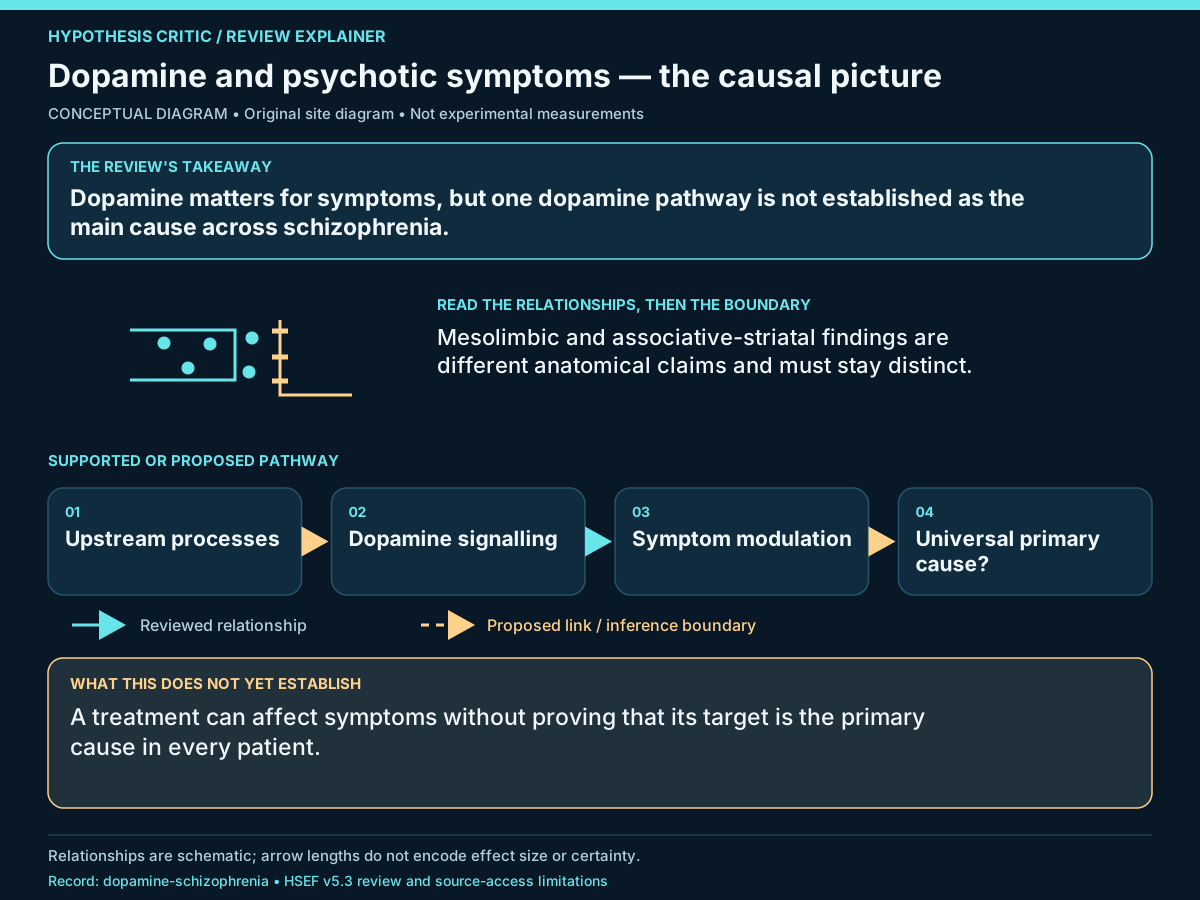
Plausible, not established · HSEF Γ

Dopamine Hypothesis of Schizophrenia

Relative explanatory fit: Alternative ranked ahead

Dopamine matters for symptoms, but one dopamine pathway is not established as the main cause across schizophrenia.

Reader-first lay guide Expert critique with citations

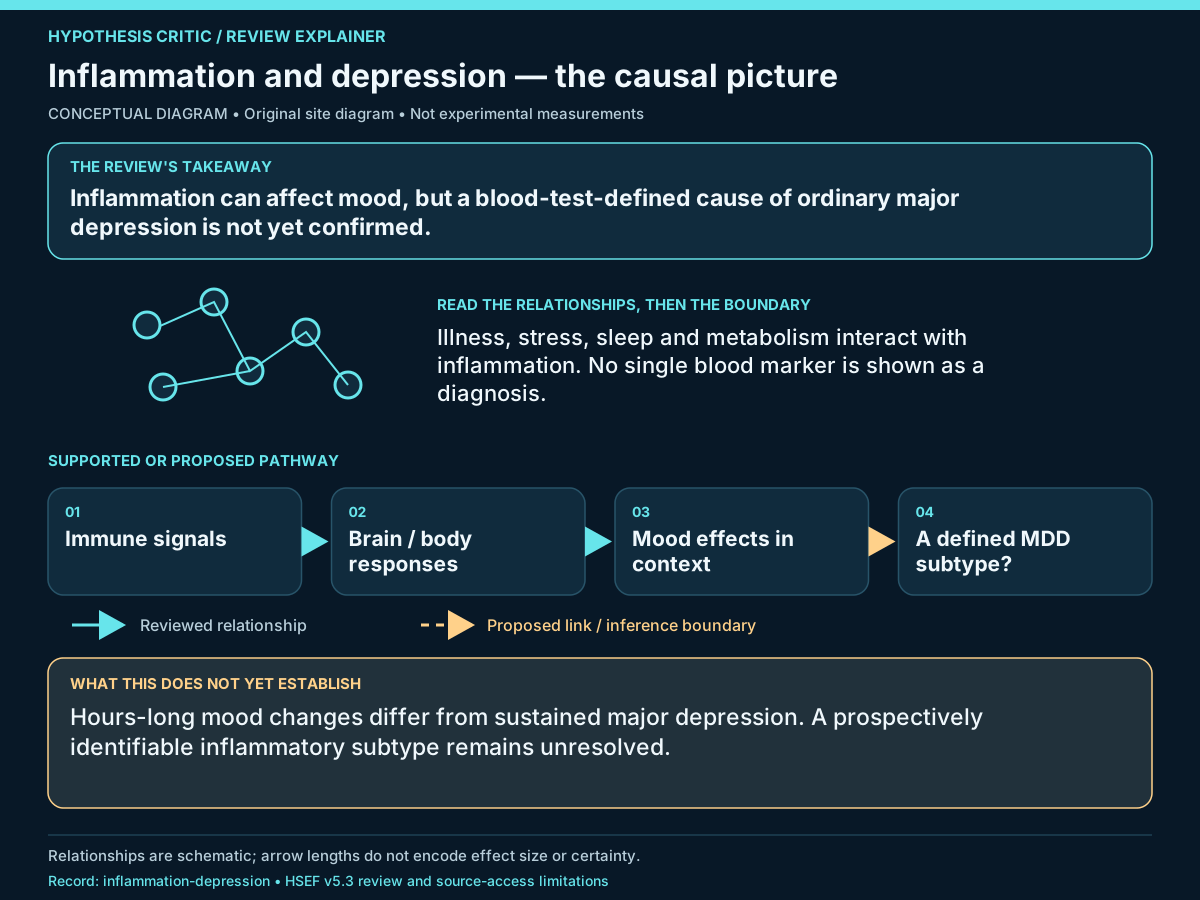
Plausible, not established · HSEF Γ

Inflammatory Depression Hypothesis

Relative explanatory fit: Alternative ranked ahead

Inflammation can affect mood, but a blood-test-defined cause of ordinary major depression is not yet confirmed.

Reader-first lay guide Expert critique with citations
Plausible, not established · HSEF Γ · 3 subclaim cards

Dual-Phase Psilocybin Therapy Hypothesis

Relative explanatory fit: Alternative ranked ahead

Lasting benefit is not established as requiring the proposed two-step mechanism.

Reader-first lay guide Expert critique with citations
First causal test · HSEF Δ

Magnesium Forms, Sleep and Stress

Relative explanatory fit: Leading among models compared

Magnesium has small, inconsistent sleep benefits in controlled studies; glycinate/threonate superiority and a proven human neural mediator are not established.

Reader-first lay guide Expert critique with citations
Plausible, not established · HSEF Γ

Mouth Taping and Obstructive Sleep Apnea

Relative explanatory fit: Alternative ranked ahead

Small selected mouth-taping pilots report lower apnea indices; controlled evidence for tape alone remains insufficient, and closing a compensatory oral airway can worsen airflow.

Reader-first lay guide Expert critique with citations
Plausible, not established · HSEF Γ

Psychedelic Microdosing and Mental Health

Relative explanatory fit: Alternative ranked ahead

Low-dose LSD has real measurable effects, but sustained depression/anxiety relief from repeated microdosing remains unconfirmed beyond expectancy and concurrent care.

Reader-first lay guide Expert critique with citations

Causal in a specific setting · HSEF Ε · 3 subclaim cards

Somatic Mutation Theory of Cancer

Relative explanatory fit: Alternative ranked ahead

Mutations can cause cancer in defined settings, but including tissue conditions explains more of the evidence.

Reader-first lay guide Expert critique with citations
Plausible, not established · HSEF Γ · 2 subclaim cards

Cancer Stem Cell Hypothesis

Relative explanatory fit: Alternative ranked ahead

Cancer stem-cell roles can matter, but a universal fixed hierarchy fits less well than changing cell roles.

Reader-first lay guide Expert critique with citations

Plausible, not established · HSEF Γ

Tumour Microenvironment-driven Progression

Relative explanatory fit: Alternative ranked ahead

A tumour's surroundings matter, but can restrain or promote cancer depending on the setting.

Reader-first lay guide Expert critique with citations

Plausible, not established · HSEF Γ · 2 subclaim cards

Warburg Effect as Cancer Driver

Relative explanatory fit: Alternative ranked ahead

Altered sugar use can support cancer, but is not established as the general first cause.

Reader-first lay guide Expert critique with citations
Strong causal evidence · HSEF Η

Oncogene Addiction Hypothesis

Relative explanatory fit: Leading among models compared

Some defined cancers remain strongly dependent on a dominant driver, despite other genetic changes.

Reader-first lay guide Expert critique with citations

Plausible, not established · HSEF Γ

Chromatin Dysregulation as Primary Driver

Relative explanatory fit: Alternative ranked ahead

DNA packaging can help cancer begin or persist, but it works alongside genetic and tissue changes.

Reader-first lay guide Expert critique with citations

Plausible, not established · HSEF Γ

Genome Instability: Root Cause vs Consequence

Relative explanatory fit: Alternative ranked ahead

DNA errors can help cancers evolve, but their effects vary and can also restrict tumour growth.

Reader-first lay guide Expert critique with citations
Plausible, not established · HSEF Γ

Cancer as Atavism

Relative explanatory fit: Alternative ranked ahead

Cancer cells can reuse ancient genes. That does not establish one ancient programme as the explanation for cancer.

Reader-first lay guide Expert critique with citations

Plausible, not established · HSEF Γ

Epigenetic Field Cancerization

Relative explanatory fit: Alternative ranked ahead

Altered gene-control marks can affect risk, but predicting cancer does not prove that the marks start it alone.

Reader-first lay guide Expert critique with citations

Strong, scope-limited evidence · HSEF Ζ · 2 subclaim cards

Immune Surveillance Hypothesis

Relative explanatory fit: Alternative ranked ahead

Immune control has strong support, but can hold cancer in check without removing every cancer cell.

Reader-first lay guide Expert critique with citations
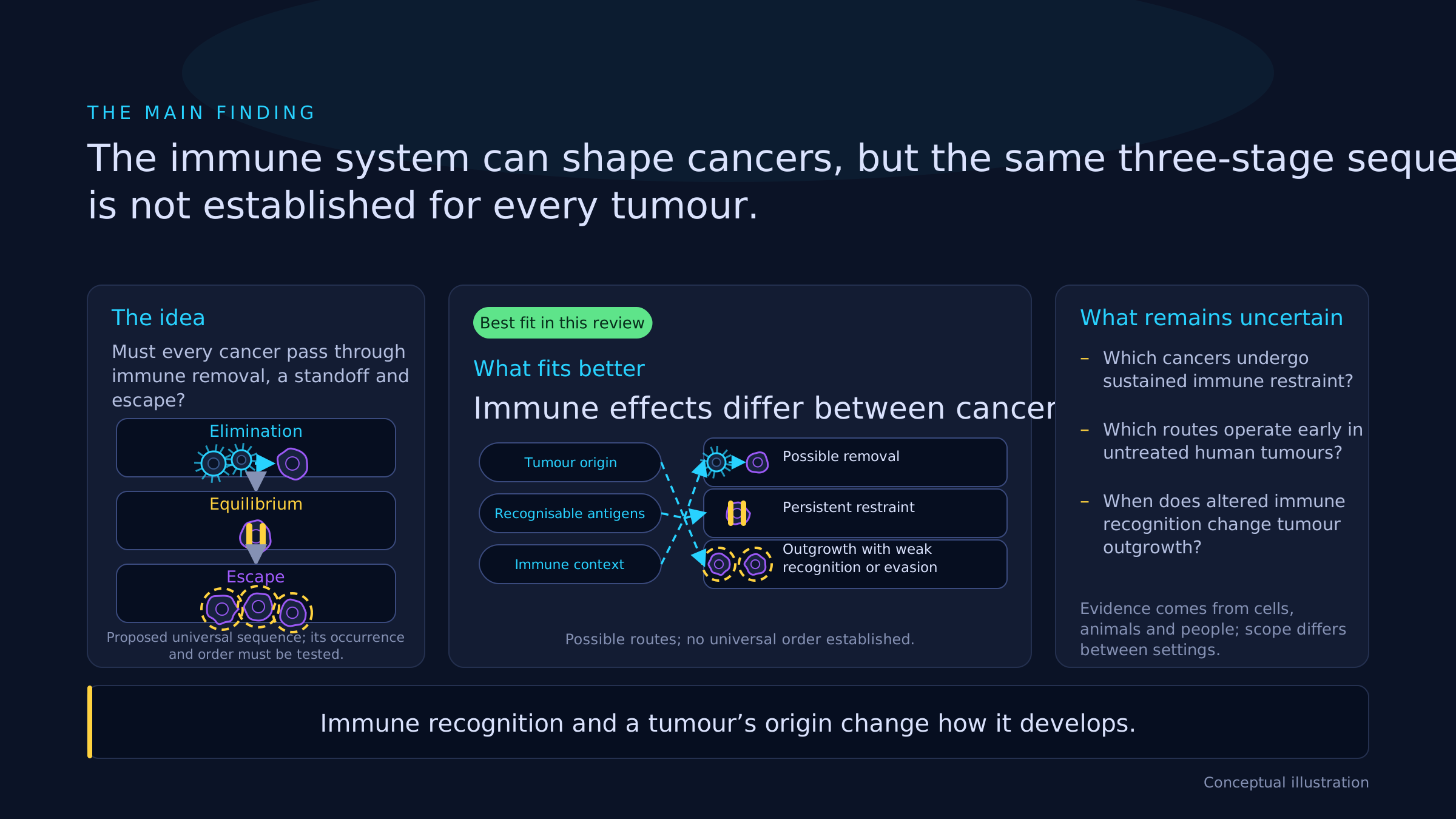
Association only · HSEF Β

Cancer Immunoediting (Elimination–Equilibrium–Escape)

Relative explanatory fit: Alternative ranked ahead

The immune system can shape cancers, but the same three-stage sequence is not established for every tumour.

Reader-first lay guide Expert critique with citations

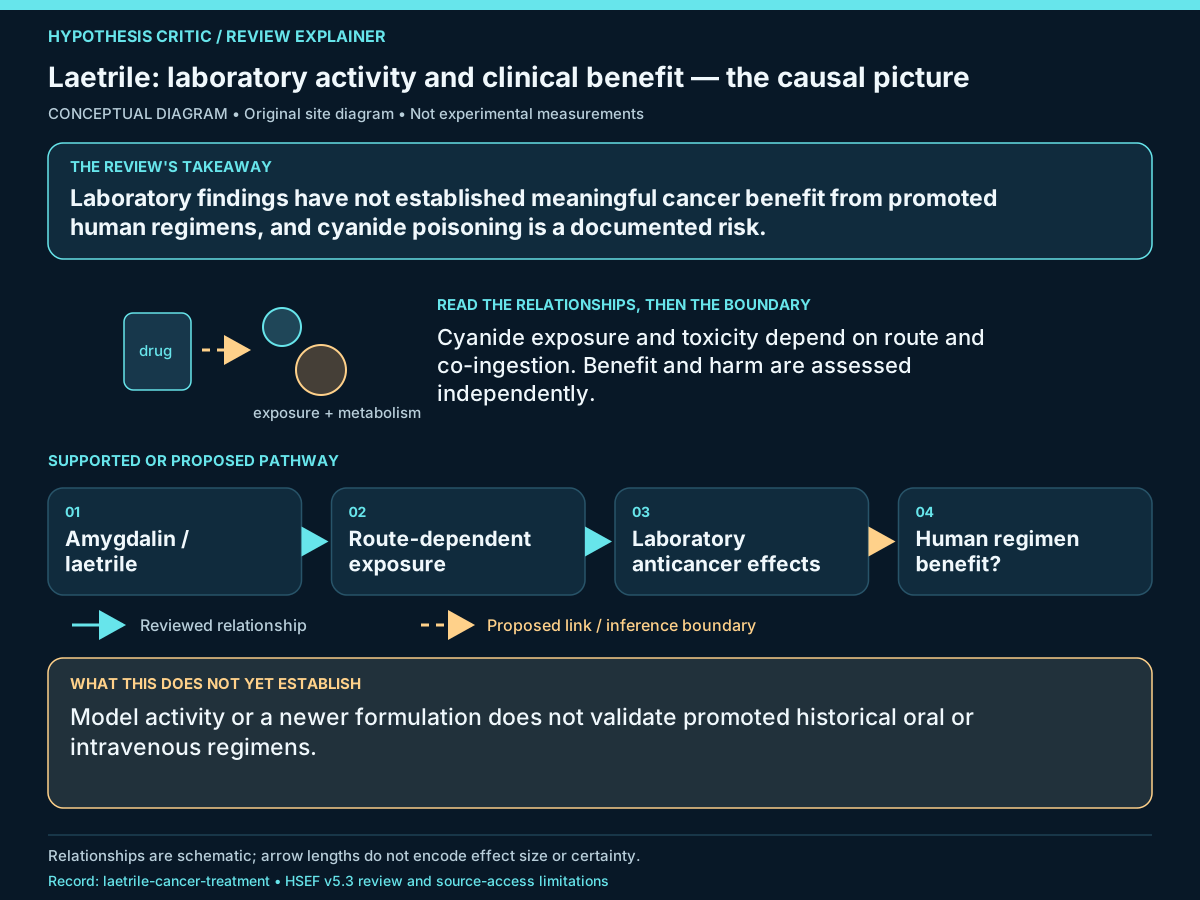
Not established · HSEF Α

Laetrile / Amygdalin as Cancer Treatment

Relative explanatory fit: Alternative ranked ahead

Laboratory findings have not established meaningful cancer benefit from promoted human regimens, and cyanide poisoning is a documented risk.

Reader-first lay guide Expert critique with citations
Plausible, not established · HSEF Γ

Adiposity and Early-Onset Colorectal Cancer

Relative explanatory fit: Alternative ranked ahead

Excess adiposity is a credible contributor to early-onset colorectal cancer, but its precise causal effect before50 and its share of the incidence rise remain less securely identified than the broader colorectal-cancer link.

Reader-first lay guide Expert critique with citations

Plausible, not established · HSEF Γ

Multi-Cancer Blood Screening and Mortality

Relative explanatory fit: Alternative ranked ahead

Galleri detects real cancers, but a cancer-mortality benefit remains unestablished; the2026 primary stage endpoint was null and its favorable secondary stageIV result requires clinical follow-up.

Reader-first lay guide Expert critique with citations
Plausible, not established · HSEF Γ

Histone Code Hypothesis

Relative explanatory fit: Alternative ranked ahead

Some marks affect genes in particular settings. A universal combination-based code is not established.

Reader-first lay guide Expert critique with citations

Plausible, not established · HSEF Γ

Liquid–Liquid Phase Separation in Nuclear Bodies

Relative explanatory fit: Alternative ranked ahead

Some nuclear structures behave like droplets, but several physical mechanisms can work together.

Reader-first lay guide Expert critique with citations
Plausible, not established · HSEF Γ

3D Genome Folding as Regulatory Determinant

Relative explanatory fit: Alternative ranked ahead

DNA folding helps some genes turn on, but it is not a master switch for all gene activity.

Reader-first lay guide Expert critique with citations
Plausible, not established · HSEF Γ

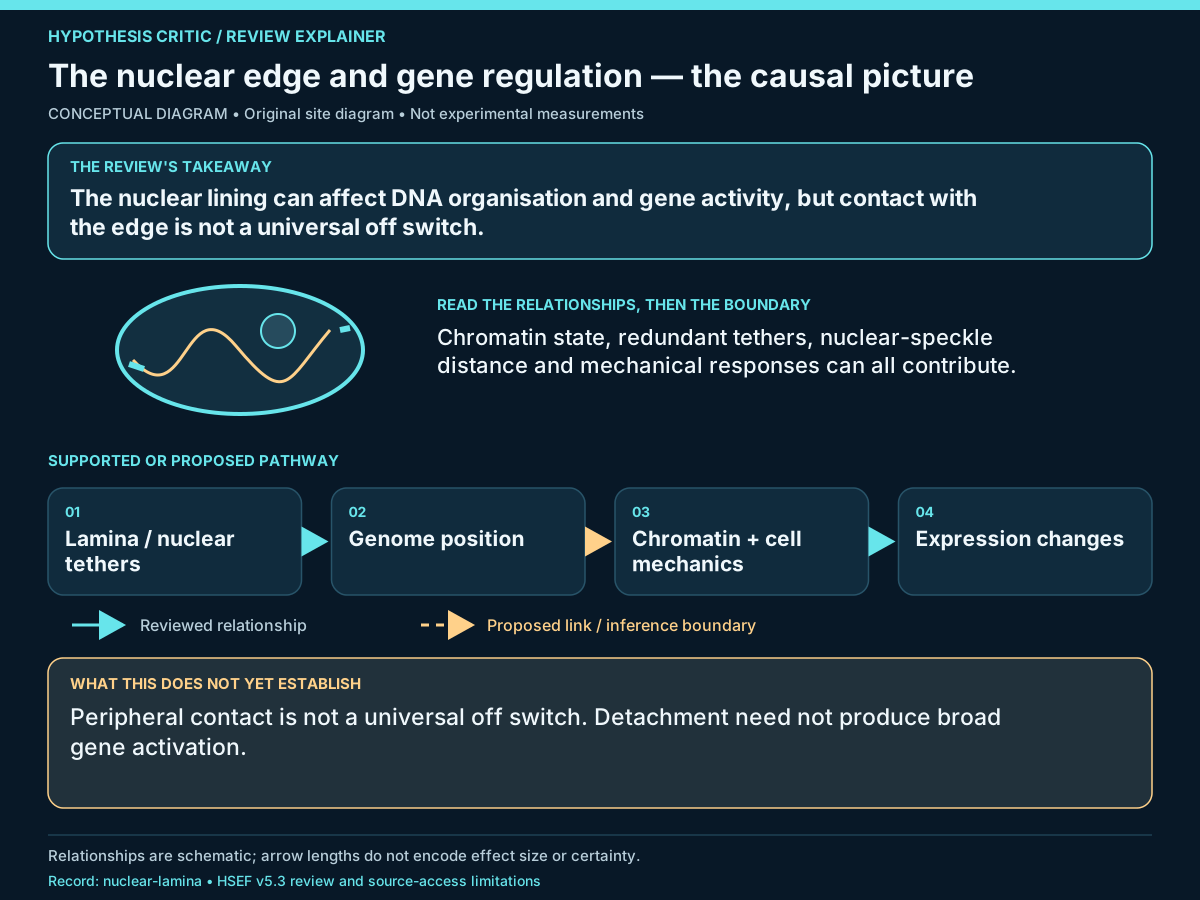
Nuclear Lamina as Global Regulator

Relative explanatory fit: Alternative ranked ahead

The nuclear lining can affect DNA organisation and gene activity, but contact with the edge is not a universal off switch.

Reader-first lay guide Expert critique with citations
Plausible, not established · HSEF Γ

Loss of Heterochromatin Hypothesis of Aging

Relative explanatory fit: Alternative ranked ahead

DNA packaging changes may add to ageing-related harm, but are not established as the main ageing clock.

Reader-first lay guide Expert critique with citations
Plausible, not established · HSEF Γ

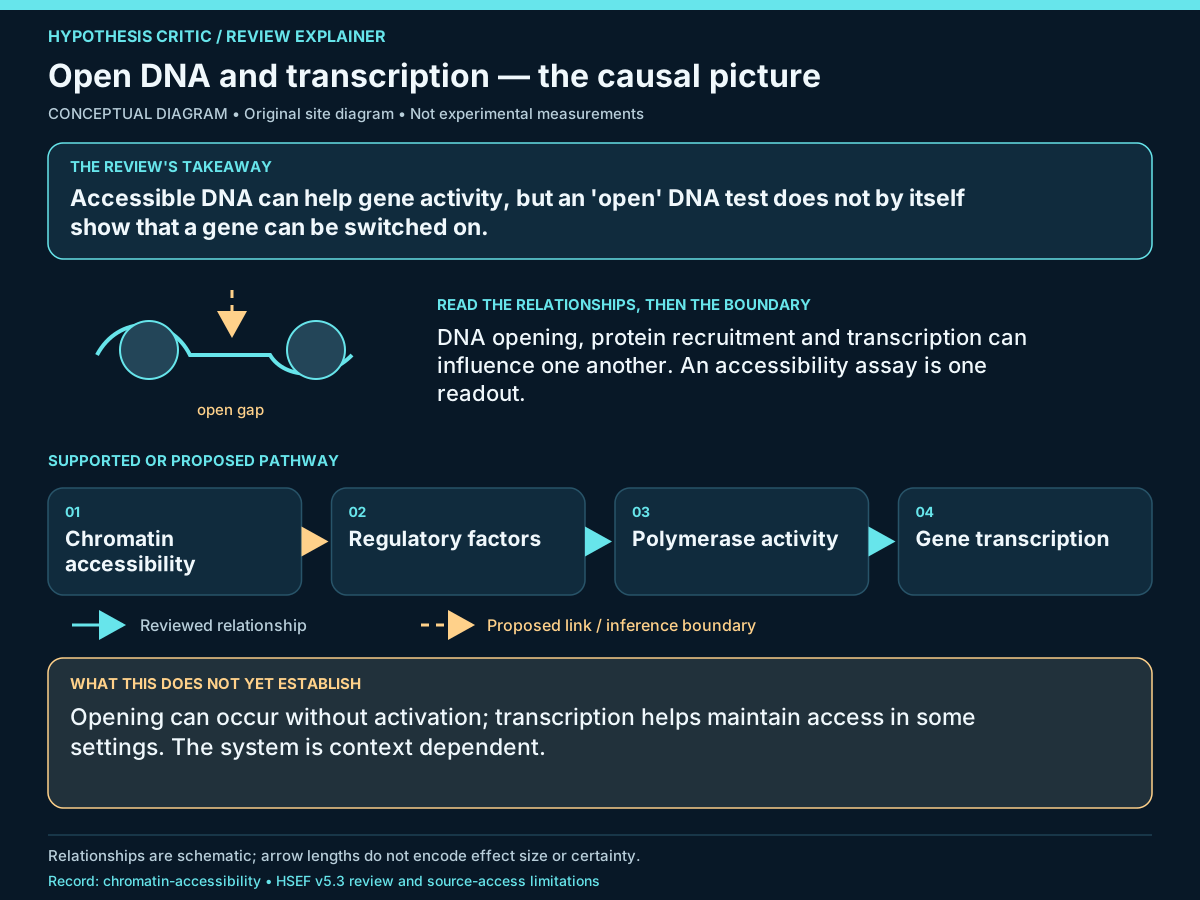
Chromatin Accessibility = Transcriptional Competence

Relative explanatory fit: Alternative ranked ahead

Accessible DNA can help gene activity, but an 'open' DNA test does not by itself show that a gene can be switched on.

Reader-first lay guide Expert critique with citations
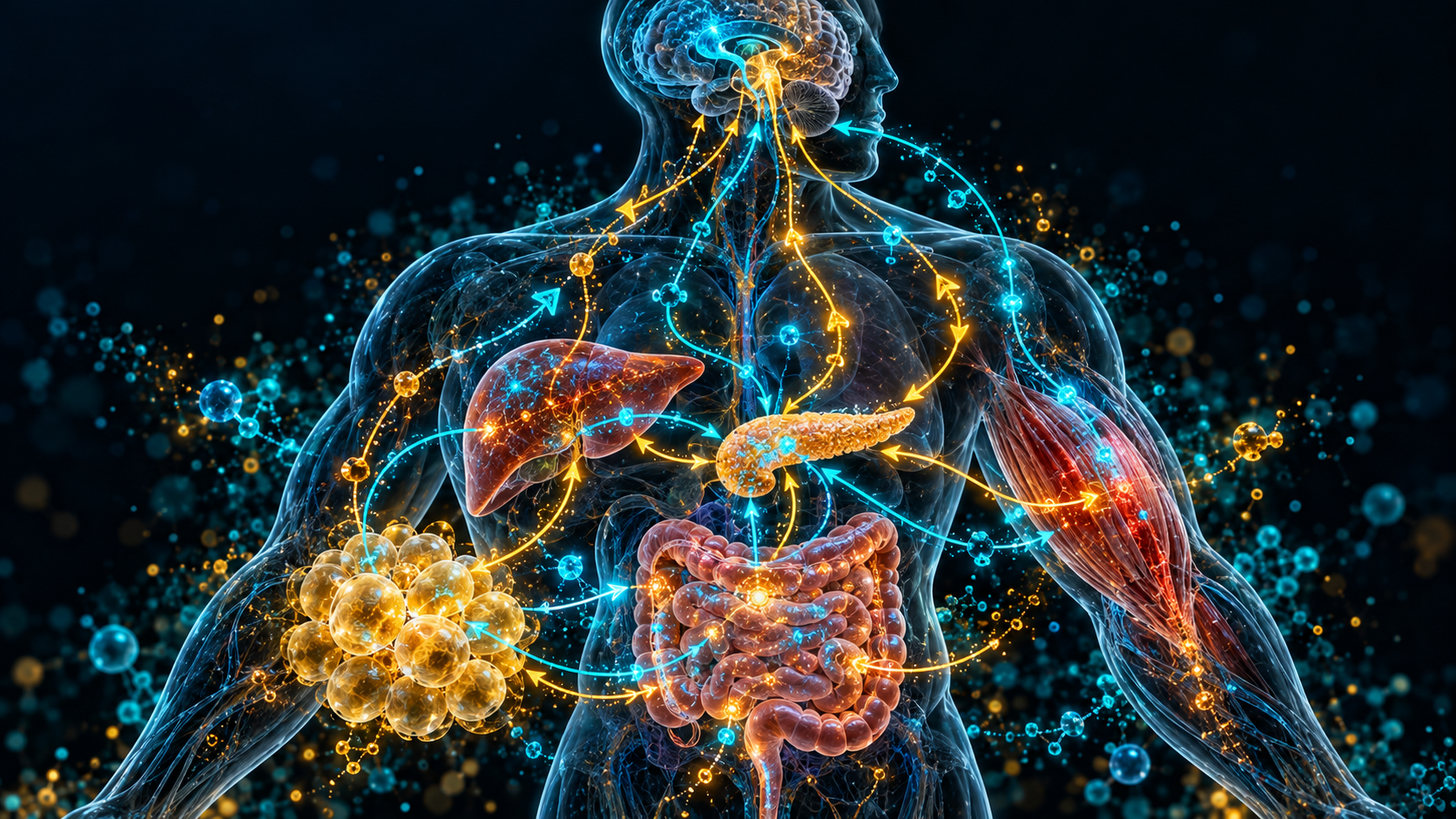
Association only · HSEF Β

Super-enhancer Model of Cell Identity

Relative explanatory fit: Alternative ranked ahead

Large enhancer clusters can be important, but the 'super-enhancer' label does not prove that they all work by one special mechanism.

Reader-first lay guide Expert critique with citations
Association only · HSEF Β

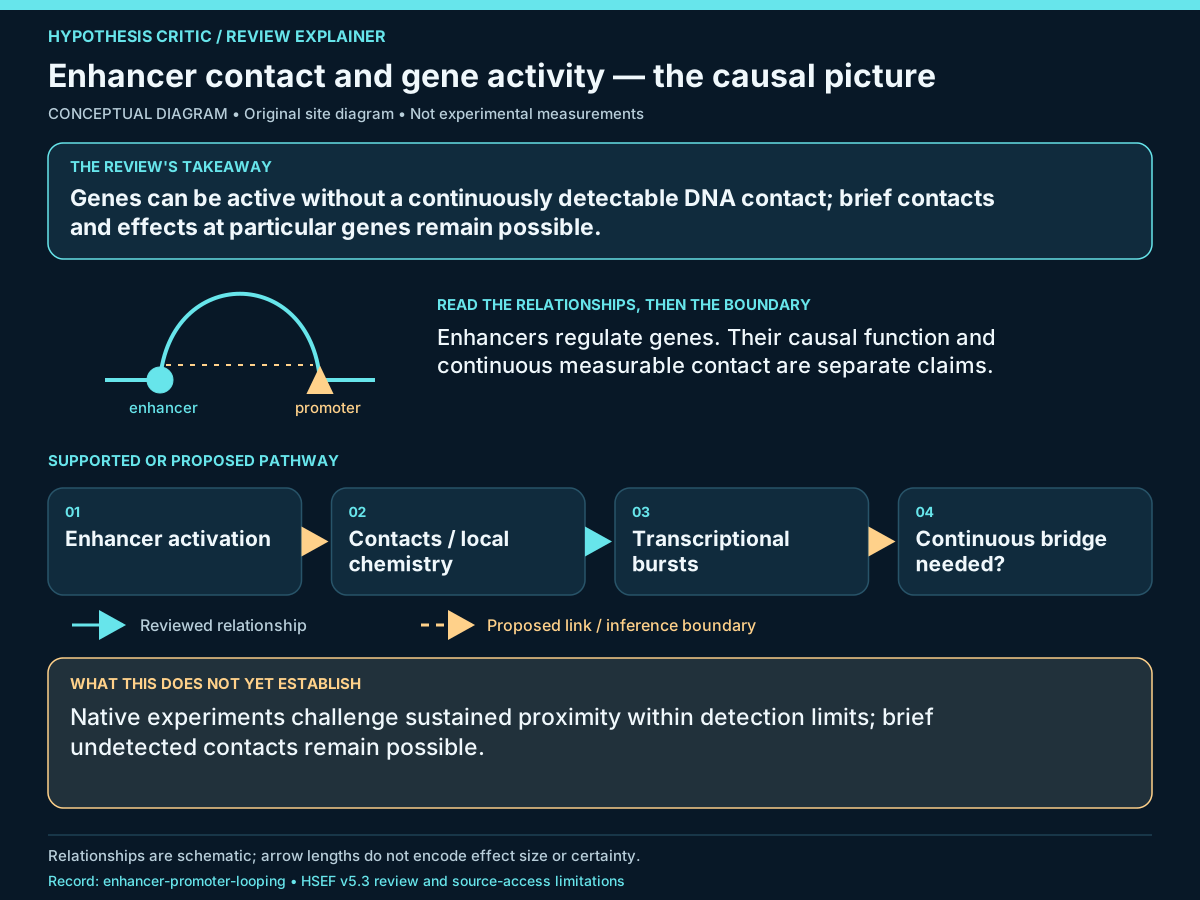
Enhancer–Promoter Looping as Causal

Relative explanatory fit: Alternative ranked ahead

Genes can be active without a continuously detectable DNA contact; brief contacts and effects at particular genes remain possible.

Reader-first lay guide Expert critique with citations
Plausible, not established · HSEF Γ

RNA as Structural Scaffold in Nuclear Organization

Relative explanatory fit: Alternative ranked ahead

Some RNAs help build specific nuclear structures; a supporting RNA mesh across the whole genome is not yet established.

Reader-first lay guide Expert critique with citations
Plausible, not established · HSEF Γ

Xist Smart-Scaffold Hypothesis

Relative explanatory fit: Alternative ranked ahead

Xist helps silence a chromosome, but a continuous direct scaffold is not established as the mechanism.

Reader-first lay guide Expert critique with citations
Plausible, not established · HSEF Γ

Gut Microbiome as Master Regulator of Health

Relative explanatory fit: Alternative ranked ahead

Microbes and diet interact, but microbial composition is not established as a universal disease switch.

Reader-first lay guide Expert critique with citations
Association only · HSEF Β · 3 subclaim cards

Gut–Brain Axis Drives Psychiatric Disease

Relative explanatory fit: Alternative ranked ahead

Gut microbes may influence some responses, but are not established as a primary cause of psychiatric disease.

Reader-first lay guide Expert critique with citations
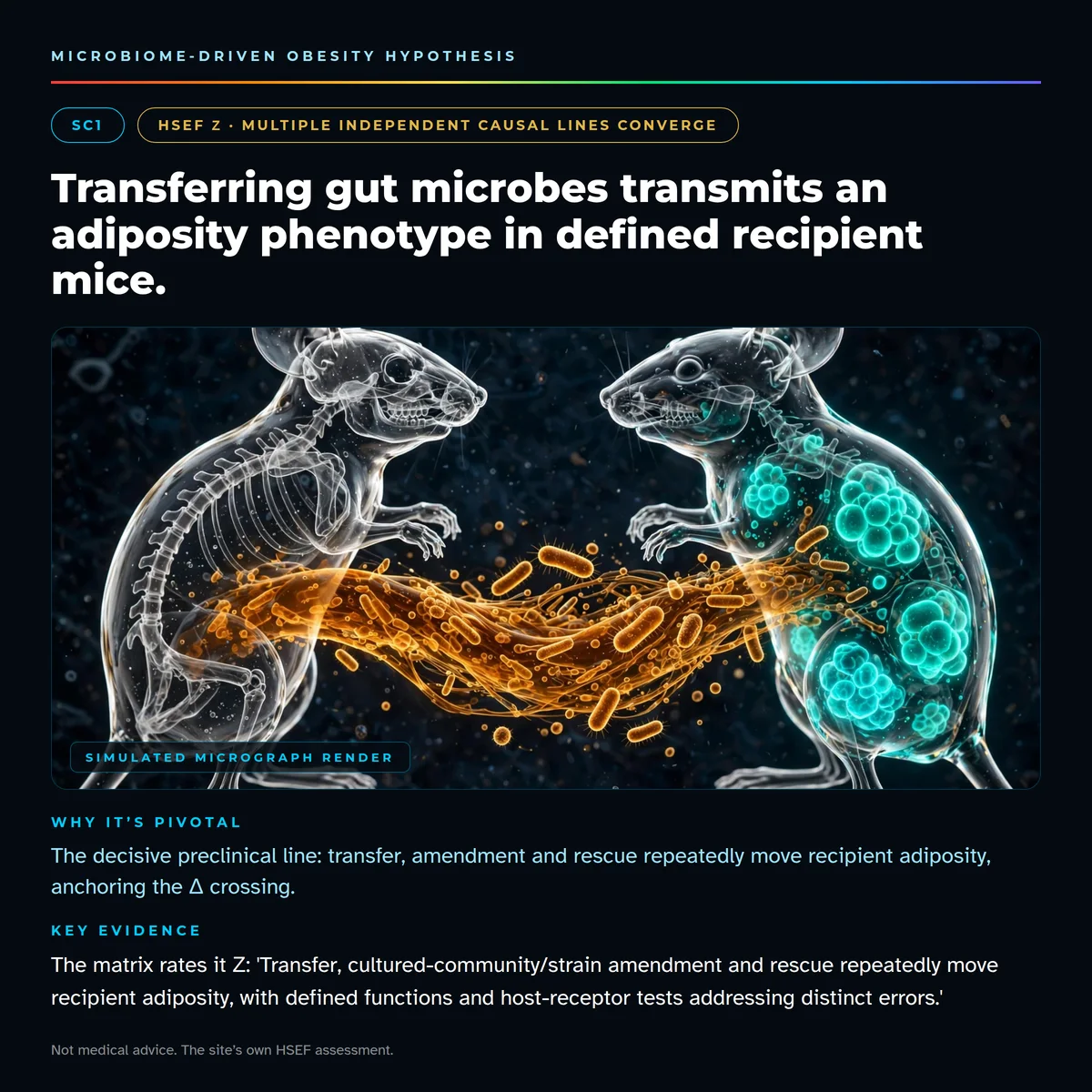
First causal test · HSEF Δ · 3 subclaim cards

Microbiome-driven Obesity Hypothesis

Relative explanatory fit: Alternative ranked ahead

There is limited causal evidence, but a model combining diet, the body and microbes fits better than microbes alone.

Reader-first lay guide Expert critique with citations
Plausible, not established · HSEF Γ · 2 subclaim cards

Leaky Gut Hypothesis

Relative explanatory fit: Alternative ranked ahead

Gut-barrier changes may worsen some conditions, but a universal initiating cause is not established.

Reader-first lay guide Expert critique with citations
Plausible, not established · HSEF Γ · 3 subclaim cards

Oral Microbiome → Systemic Disease

Relative explanatory fit: Alternative ranked ahead

Oral inflammation may affect other systems, but direct microbial causation across many diseases is not established.

Reader-first lay guide Expert critique with citations
Association only · HSEF Β · 2 subclaim cards

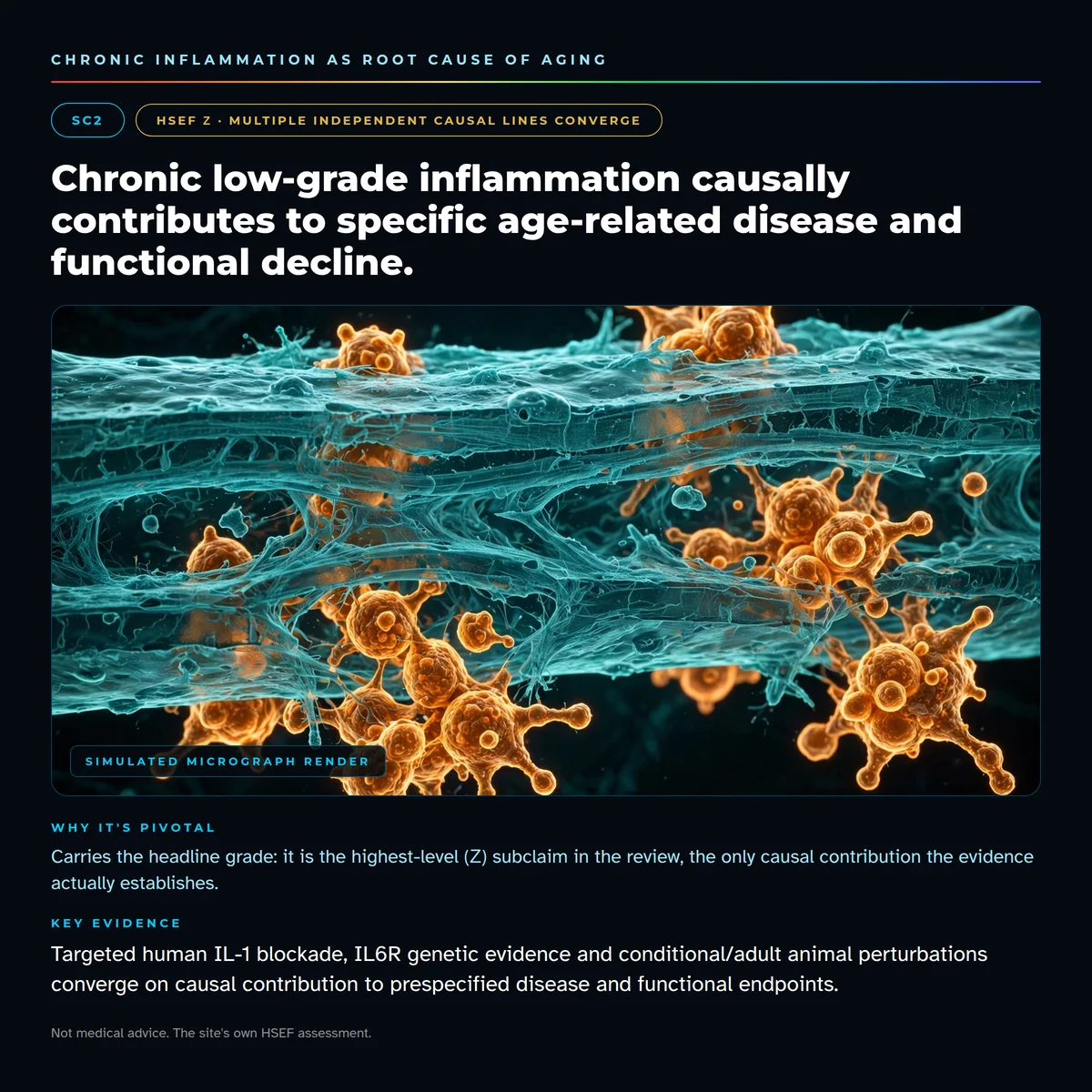
Chronic Inflammation as Root Cause of Aging

Relative explanatory fit: Alternative ranked ahead

Inflammation can add to ageing-related damage, but is not established as an independent master cause.

Reader-first lay guide Expert critique with citations
Association only · HSEF Β

Autoimmunity: Molecular Mimicry vs Tolerance Failure

Relative explanatory fit: Alternative ranked ahead

Infections can contribute, but genes, tissue injury and immune regulation affect who develops disease.

Reader-first lay guide Expert critique with citations
Plausible, not established · HSEF Γ · 2 subclaim cards

Cytokine Storm as Primary Driver

Relative explanatory fit: Alternative ranked ahead

Inflammation can worsen severe COVID-19, but one universal cytokine storm does not explain the disease.

Reader-first lay guide Expert critique with citations
Causal in a specific setting · HSEF Ε

Trained Immunity

Relative explanatory fit: Alternative ranked ahead

Lasting immune responses have causal support in defined settings, but depend on the challenge and cell type.

Reader-first lay guide Expert critique with citations
Plausible, not established · HSEF Γ · 2 subclaim cards

Immune Checkpoint Exhaustion

Relative explanatory fit: Alternative ranked ahead

Immune exhaustion matters, but it is not established as the one main route by which solid tumours escape.

Reader-first lay guide Expert critique with citations
Plausible, not established · HSEF Γ

Viral Persistence in Long COVID

Relative explanatory fit: Alternative ranked ahead

Lingering viral material may contribute, but several lasting post-infection processes fit the varied symptoms better.

Reader-first lay guide Expert critique with citations
Plausible, not established · HSEF Γ

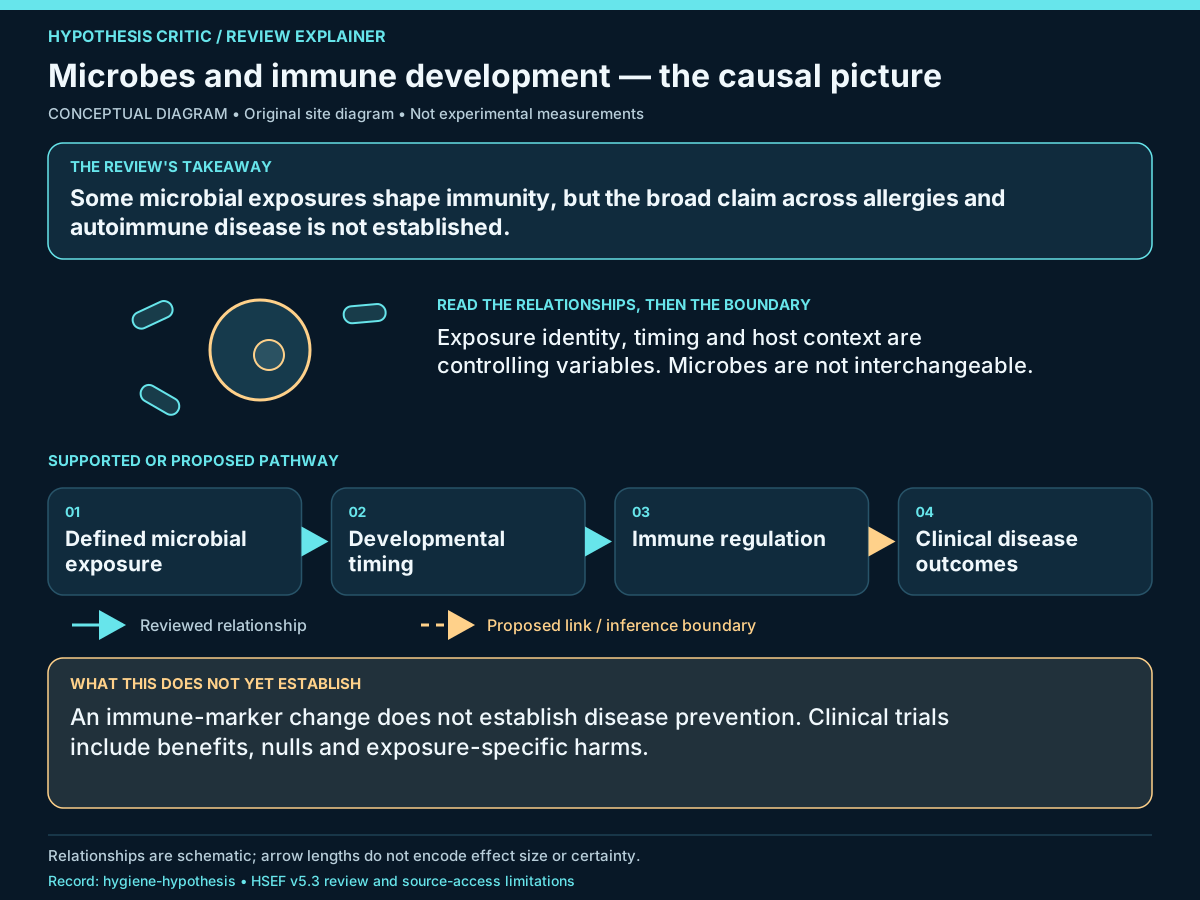
Hygiene Hypothesis

Relative explanatory fit: Alternative ranked ahead

Some microbial exposures shape immunity, but the broad claim across allergies and autoimmune disease is not established.

Reader-first lay guide Expert critique with citations
Not established · HSEF Α

Vaccine–Autism Claims and Vaccine Avoidance

Relative explanatory fit: Alternative ranked ahead

Avoiding childhood vaccination has no demonstrated autism-prevention benefit and leaves children without protection from particular infections.

Reader-first lay guide Expert critique with citations
Association only · HSEF Β · 2 subclaim cards

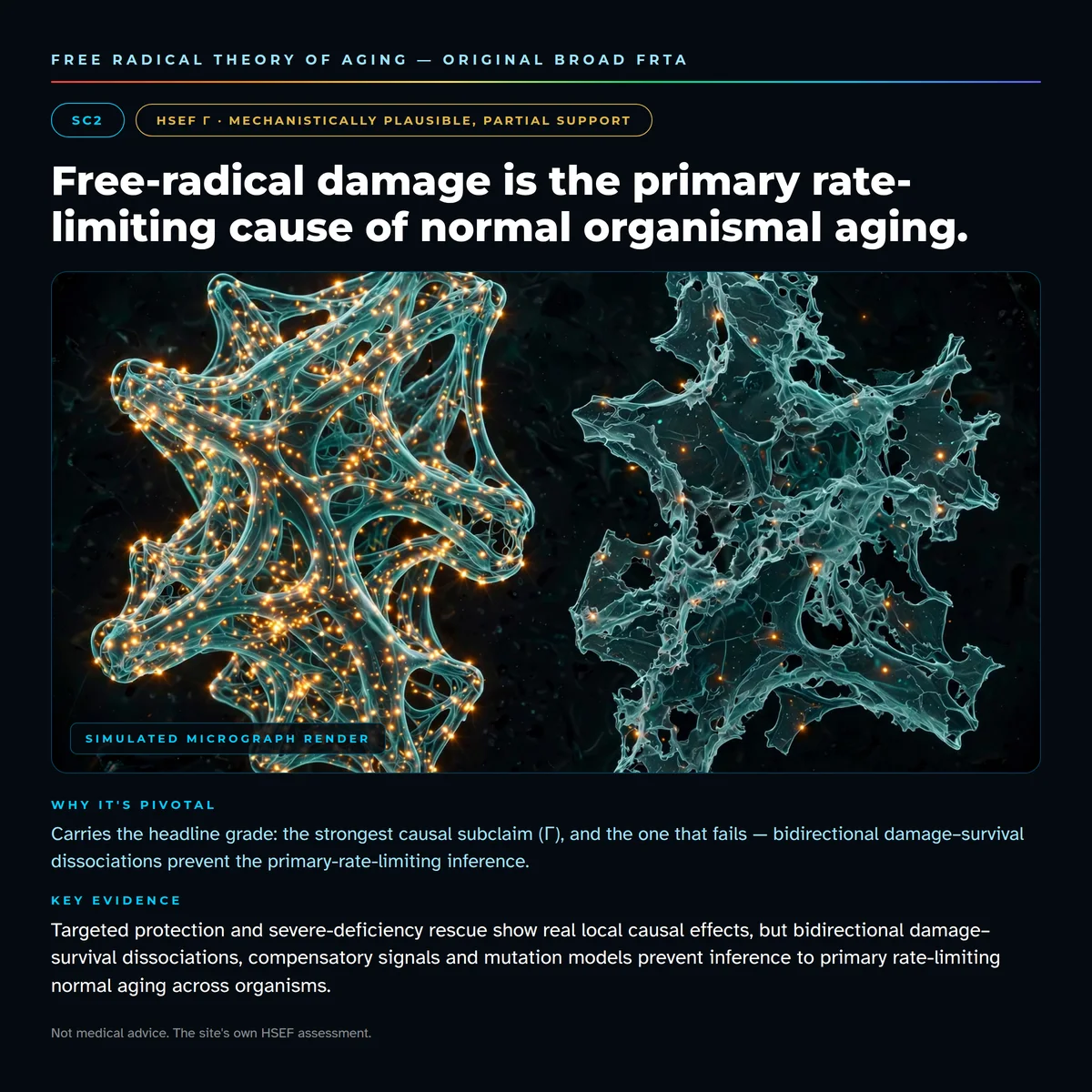
Free Radical Theory of Aging

Relative explanatory fit: Alternative ranked ahead

Free radicals can damage cells, but reducing them is not established as a general way to slow human ageing.

Reader-first lay guide Expert critique with citations
Plausible, not established · HSEF Γ · 2 subclaim cards

mTOR Hyperactivation as Aging Driver

Relative explanatory fit: Alternative ranked ahead

mTOR is influential, but is not established as the single central cause of ageing.

Reader-first lay guide Expert critique with citations
Plausible, not established · HSEF Γ · 2 subclaim cards

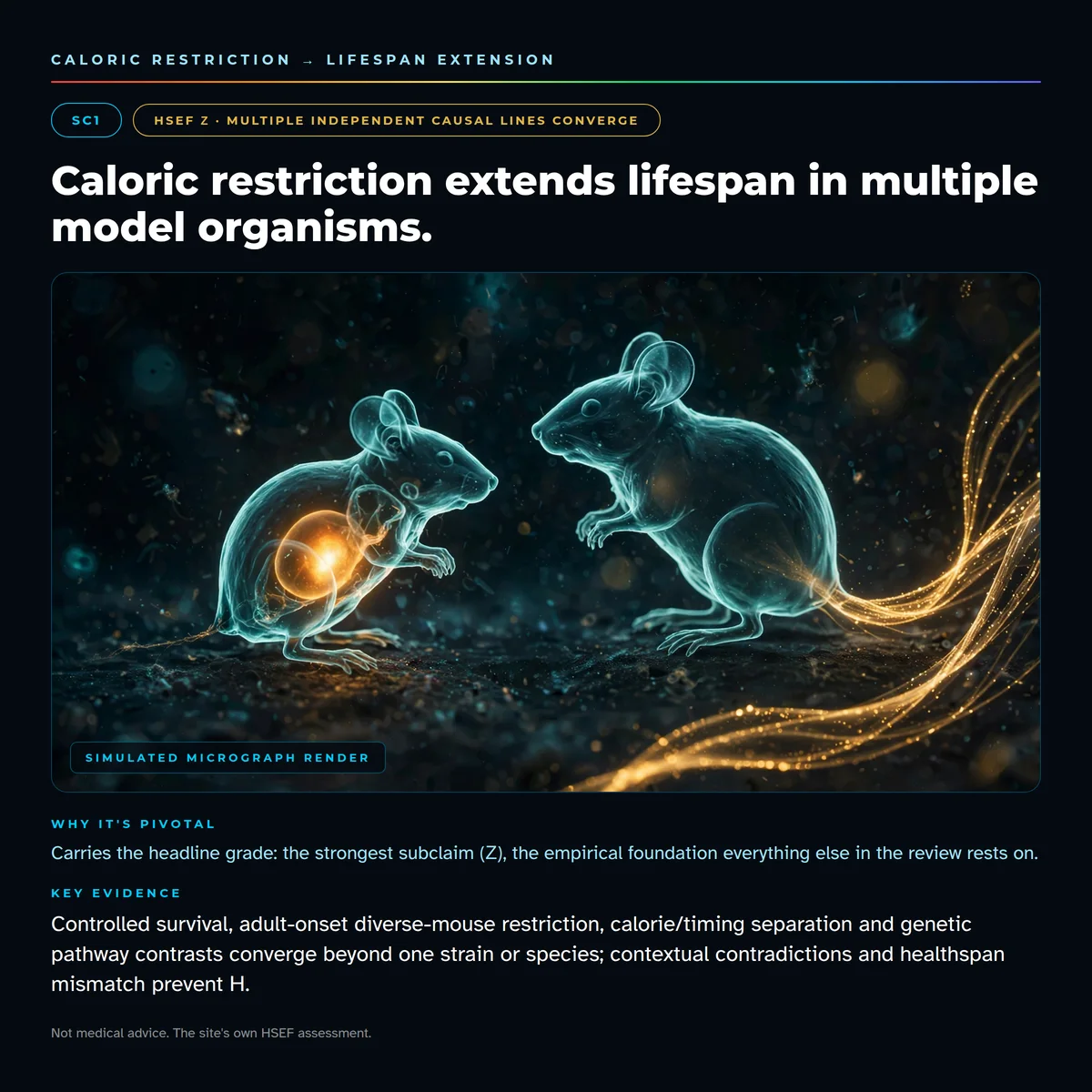
Caloric Restriction → Lifespan Extension

Relative explanatory fit: Alternative ranked ahead

Eating less affects several ageing pathways. A longer human lifespan is not established by this review.

Reader-first lay guide Expert critique with citations
Association only · HSEF Β · 2 subclaim cards

NAD⁺/Sirtuin Aging Hypothesis

Relative explanatory fit: Alternative ranked ahead

NAD-related changes involve several pathways. They do not establish a general human anti-ageing benefit.

Reader-first lay guide Expert critique with citations
Association only · HSEF Β · 2 subclaim cards

Senescent Cells as Aging Driver

Relative explanatory fit: Alternative ranked ahead

Some persistent senescent cells worsen tissue problems, but a broad human anti-ageing claim is not established.

Reader-first lay guide Expert critique with citations
Plausible, not established · HSEF Γ

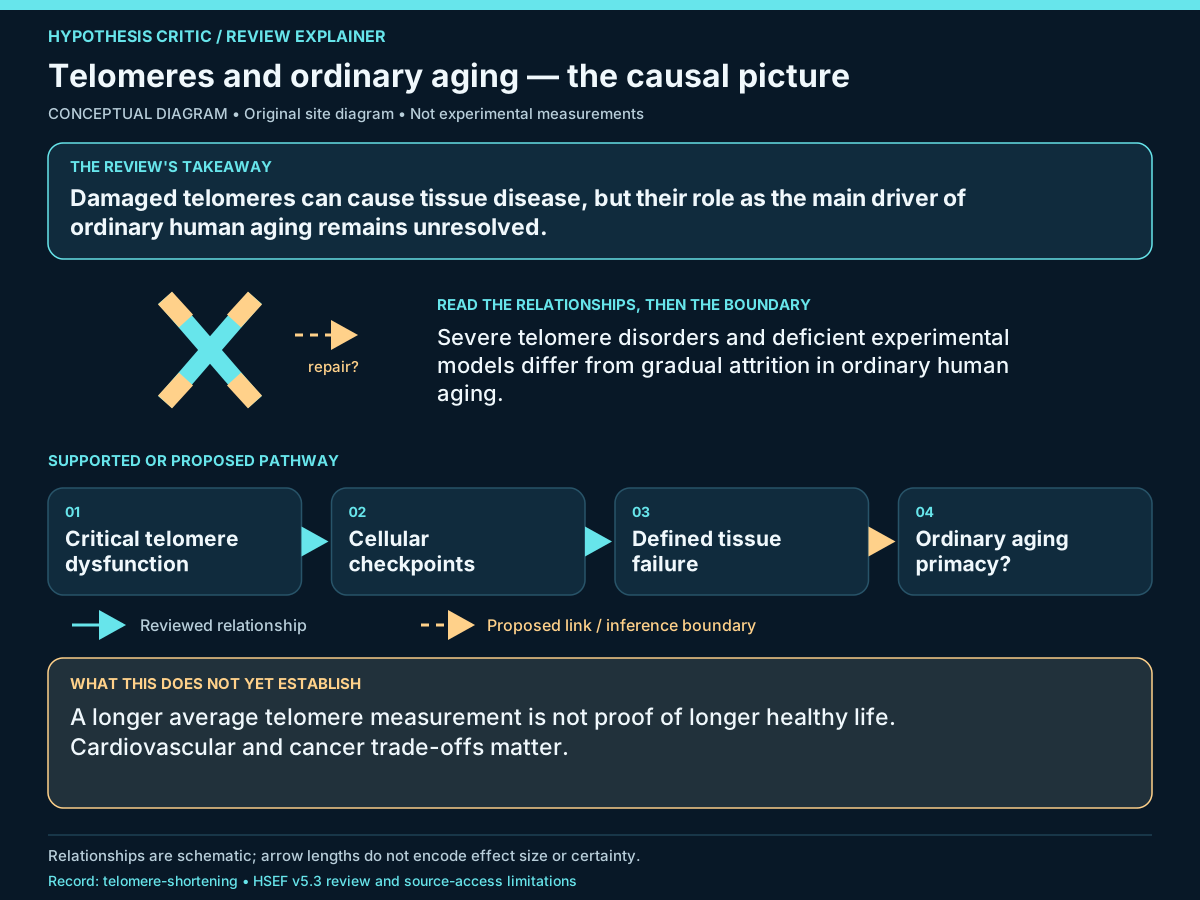
Telomere Shortening Theory of Aging

Relative explanatory fit: Alternative ranked ahead

Damaged telomeres can cause tissue disease, but their role as the main driver of ordinary human aging remains unresolved.

Reader-first lay guide Expert critique with citations
Plausible, not established · HSEF Γ · 2 subclaim cards

Information Theory of Aging

Relative explanatory fit: Alternative ranked ahead

Changing gene-control patterns may improve some measures, but reversing normal ageing through information restoration remains unproven.

Reader-first lay guide Expert critique with citations
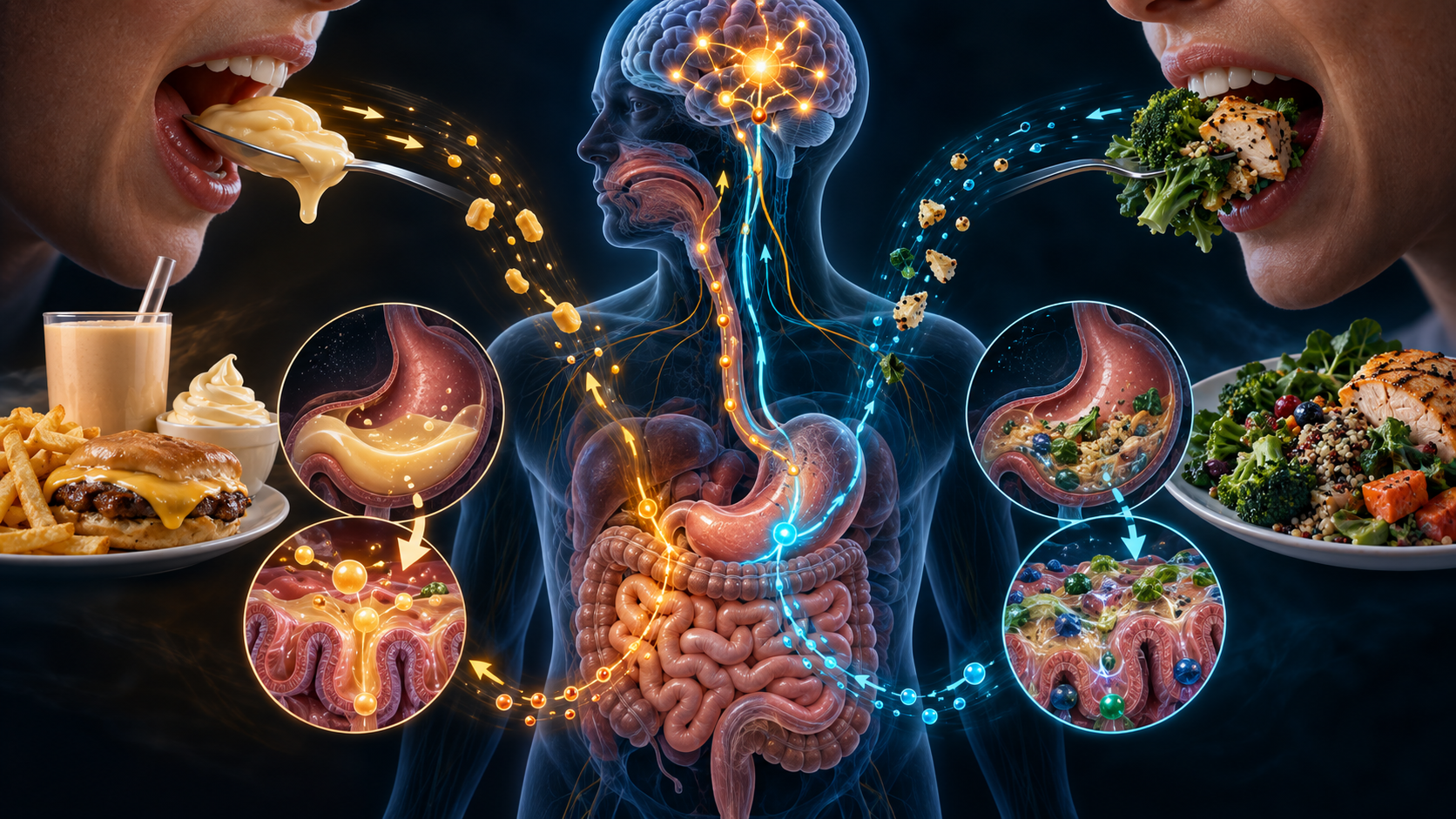
Plausible, not established · HSEF Γ

Metformin as Geroprotector

Relative explanatory fit: Alternative ranked ahead

Benefits in particular conditions do not establish a general anti-ageing effect in people without diabetes.

Reader-first lay guide Expert critique with citations
Causal in a specific setting · HSEF Ε

Creatine and Cognitive Performance

Relative explanatory fit: Alternative ranked ahead

Creatine can preserve selected cognitive performance under experimental energetic stress; evidence for routine enhancement in rested healthy adults is inconsistent, and the brain mediator remains unisolated.

Reader-first lay guide Expert critique with citations
Strong, scope-limited evidence · HSEF Ζ

Menopause Hormones: Symptoms, Prevention and Testosterone

Relative explanatory fit: Leading among models compared

Systemic menopausal hormone therapy has replicated causal benefit for bothersome vasomotor symptoms. Cardiovascular or dementia prevention, and testosterone benefits outside diagnosed HSDD, require separate appraisal.

Reader-first lay guide Expert critique with citations
Causal in a specific setting · HSEF Ε

Protein Intake and Muscle Function in Older Adults

Relative explanatory fit: Alternative ranked ahead

Higher protein intake can improve selected muscle outcomes in some nutritionally vulnerable older adults; adequate-intake cohorts often gain little, and lean-mass changes do not establish stronger or more functional muscle.

Reader-first lay guide Expert critique with citations
Plausible, not established · HSEF Γ

Injectable Peptide Stacks and Human Recovery

Relative explanatory fit: Alternative ranked ahead

CJC-1295 and ipamorelin can stimulate GH, but the marketed combination has no verified human physical-recovery benefit in this bounded review.

Reader-first lay guide Expert critique with citations
First causal test · HSEF Δ

Shingles Vaccination and Dementia Prevention

Relative explanatory fit: Leading among models compared

Shingles vaccination has promising local causal evidence for preventing or delaying dementia diagnoses; product-wide efficacy, causal magnitude and the mediator remain unsettled.

Reader-first lay guide Expert critique with citations
Plausible, not established · HSEF Γ

Partial Reprogramming and Human Aging

Relative explanatory fit: Alternative ranked ahead

Partial reprogramming has genuine preclinical functional benefits and an early human ocular trial; controlled human healthspan benefit and broad long-term safety remain unestablished.

Reader-first lay guide Expert critique with citations
First causal test · HSEF Δ

NAD Boosters and Human Function

Relative explanatory fit: Alternative ranked ahead

NMN raises blood NAD; older-adult gait signals are tentative and inconsistent, with no established broader physical or longevity benefit.

Reader-first lay guide Expert critique with citations
Plausible, not established · HSEF Γ

Rapamycin and Human Healthspan

Relative explanatory fit: Alternative ranked ahead

Rapamycin has strong animal longevity evidence, but intermittent dosing has not yet established improved physical function in otherwise healthy older adults.

Reader-first lay guide Expert critique with citations
Strong, scope-limited evidence · HSEF Ζ · 3 subclaim cards

LDL as Causal Driver of Atherosclerosis

Relative explanatory fit: Alternative ranked ahead

LDL exposure has strong causal support. A wider model including other artery-retained particles explains more.

Reader-first lay guide Expert critique with citations

Plausible, not established · HSEF Γ · 2 subclaim cards

Carbohydrate–Insulin Model of Obesity

Relative explanatory fit: Alternative ranked ahead

Carbohydrates change insulin, but that does not establish insulin as the main cause of common obesity.

Reader-first lay guide Expert critique with citations
Plausible, not established · HSEF Γ · 3 subclaim cards

Ultra-processed Food Hypothesis

Relative explanatory fit: Alternative ranked ahead

Some ultra-processed diets increase intake, but texture, energy density and appeal explain more than the processing label alone.

Reader-first lay guide Expert critique with citations
Plausible, not established · HSEF Γ

Vitamin D Deficiency and Non-skeletal Disease

Relative explanatory fit: Alternative ranked ahead

Low vitamin D can mark poor health without causing every associated disease.

Reader-first lay guide Expert critique with citations
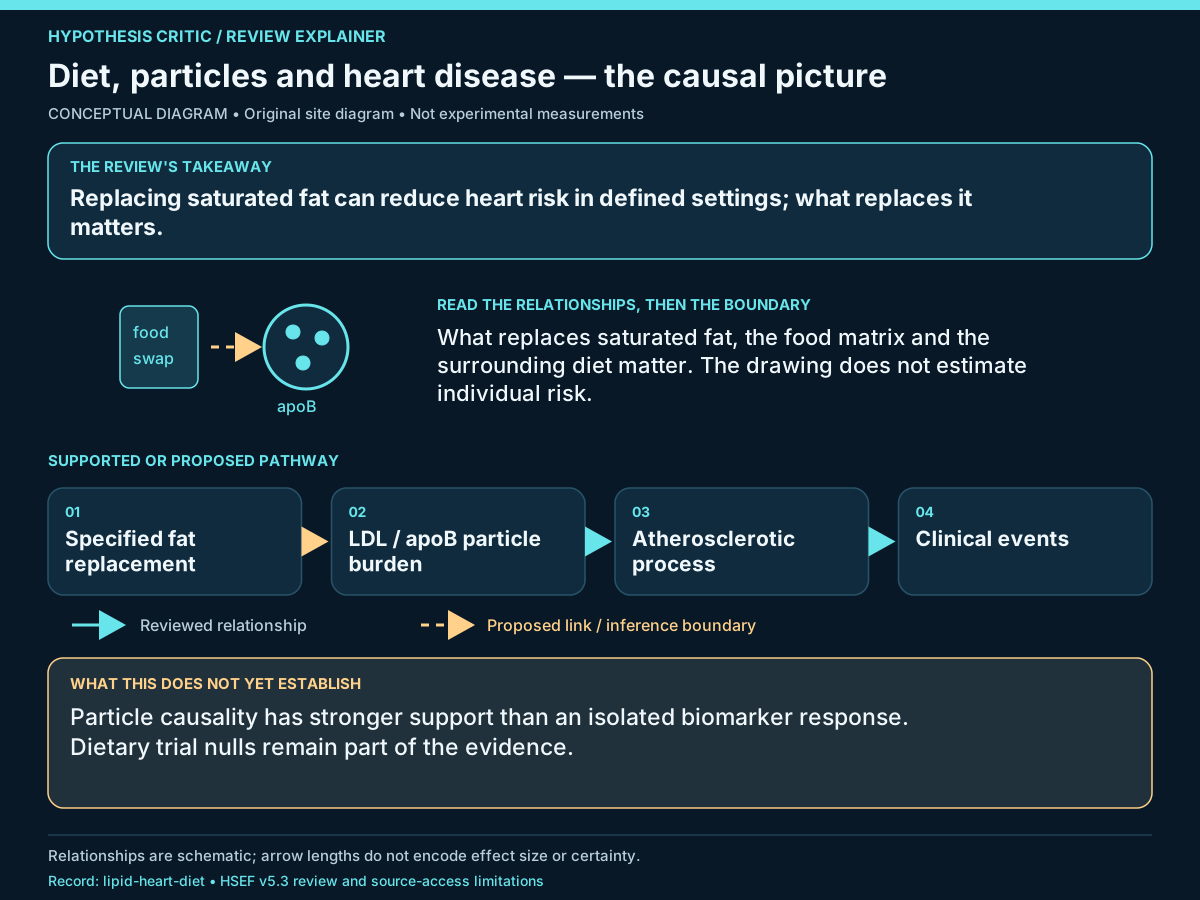
Causal in a specific setting · HSEF Ε

Diet–Heart (Saturated Fat) Hypothesis

Relative explanatory fit: Alternative ranked ahead

Replacing saturated fat can reduce heart risk in defined settings; what replaces it matters.

Reader-first lay guide Expert critique with citations
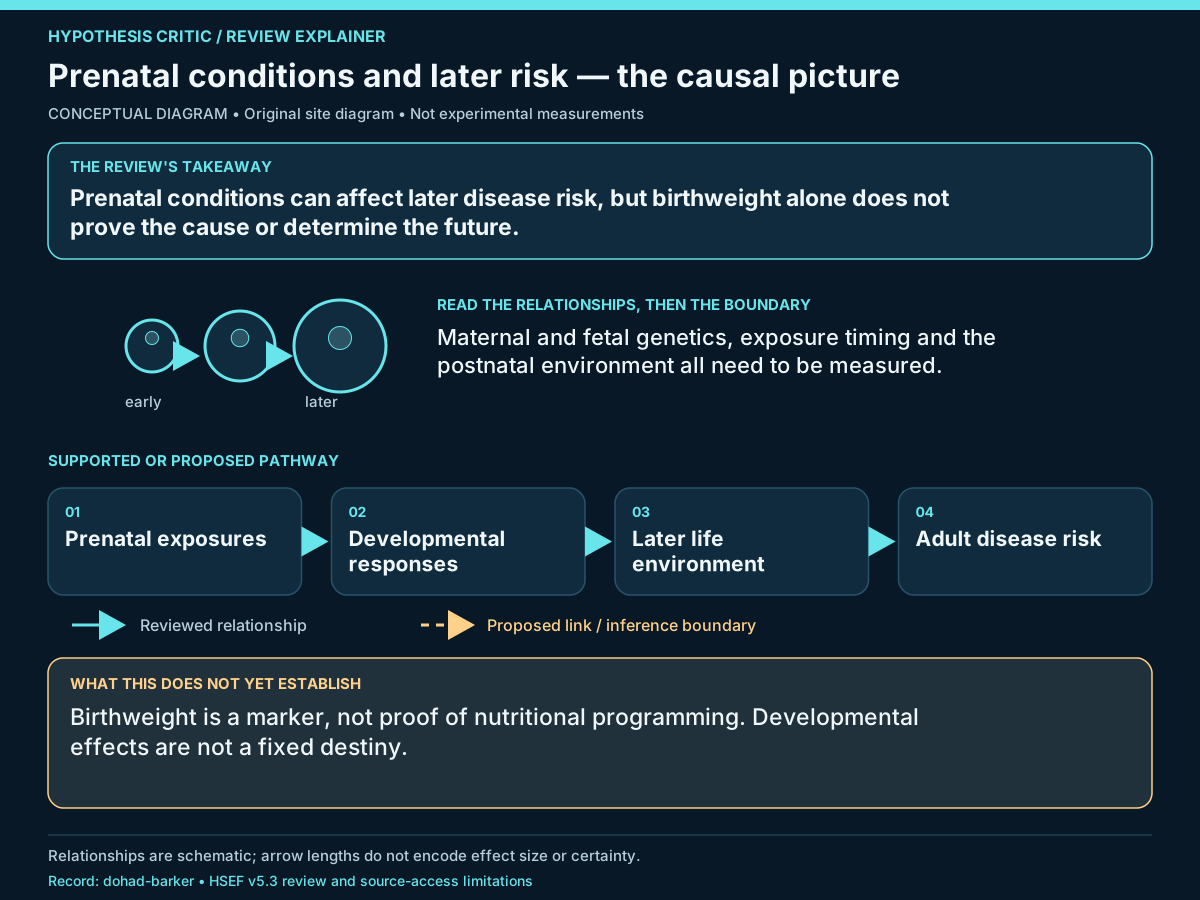
Causal in a specific setting · HSEF Ε

Developmental Origins of Disease (Barker Hypothesis)

Relative explanatory fit: Alternative ranked ahead

Prenatal conditions can affect later disease risk, but birthweight alone does not prove the cause or determine the future.

Reader-first lay guide Expert critique with citations
Causal in a specific setting · HSEF Ε

Retatrutide: Clinical Weight Loss and Supply Claims

Relative explanatory fit: Leading among models compared

Retatrutide causes substantial weight loss in supervised trials; superiority to modern obesity drugs and equivalence of online research vials remain unestablished in this review.

Reader-first lay guide Expert critique with citations
Plausible, not established · HSEF Γ

Zone 2 Training and Cardiorespiratory Fitness

Relative explanatory fit: Alternative ranked ahead

Aerobic training improves fitness in many settings; evidence for an exclusive below-first-threshold prescription remains limited by exposure definitions and mixed results.

Reader-first lay guide Expert critique with citations
Plausible, not established · HSEF Γ

Semaglutide Microdosing and Clinical Outcomes

Relative explanatory fit: Alternative ranked ahead

Semaglutide works at tested clinical doses; sustained weight-loss efficacy of weekly maintenance strictly below 0.5 mg remains unestablished in this review.

Reader-first lay guide Expert critique with citations
Plausible, not established · HSEF Γ

Microplastics and Cardiovascular Disease

Relative explanatory fit: Leading among models compared

Particles are detected in cardiovascular samples and associate with events; their causal contribution at real-world human exposure and the clinical benefit of detox remain unresolved.

Reader-first lay guide Expert critique with citations
Plausible, not established · HSEF Γ

Replacing Saturated Fat with Linoleic-Acid-Rich Oils

Relative explanatory fit: Alternative ranked ahead

LA-rich oil replacement reliably changes lipid markers; exact coronary-event benefit needs more careful source and intervention separation, while blanket inflammatory harm and carnivore superiority remain unproved.

Reader-first lay guide Expert critique with citations
Plausible, not established · HSEF Γ

Pasteurized Akkermansia and Metabolic Health

Relative explanatory fit: Alternative ranked ahead

Pasteurized MucT reduced weight regain in a 2026 trial; broader clinical glycemic benefits and interchangeability with other products remain unestablished.

Reader-first lay guide Expert critique with citations
Plausible, not established · HSEF Γ

Sauna and Cardiovascular Prevention

Relative explanatory fit: Alternative ranked ahead

Sauna changes cardiovascular physiology and may improve selected clinical function, but the evidence does not yet establish that habitual sauna itself prevents hard cardiovascular events across adults.

Reader-first lay guide Expert critique with citations
First causal test · HSEF Δ

Lifestyle Weight Loss and MASH Reversal

Relative explanatory fit: Alternative ranked ahead

Lifestyle treatment can improve MASH histology; fibrosis reversal, liver-death prevention and weight loss as the sole mediator require stronger direct evidence.

Reader-first lay guide Expert critique with citations
First causal test · HSEF Δ

Berberine and Glycemic Control

Relative explanatory fit: Leading among models compared

Defined berberine can improve short-term T2D glycemic control; modern GLP-1 equivalence, broad weight-loss claims and exact glutathione/NMN stack benefits require separate evidence.

Reader-first lay guide Expert critique with citations
Plausible, not established · HSEF Γ · 2 subclaim cards

BPC-157 and Tissue Repair

Relative explanatory fit: Alternative ranked ahead

Promising animal findings do not establish that BPC-157 safely heals tendons, ligaments or the gut in people.

Reader-first lay guide Expert critique with citations
Plausible, not established · HSEF Γ · 2 subclaim cards

Epitalon, Telomerase and Healthspan

Relative explanatory fit: Alternative ranked ahead

Cell experiments do not establish that Epitalon extends healthy human life.

Reader-first lay guide Expert critique with citations
Plausible, not established · HSEF Γ

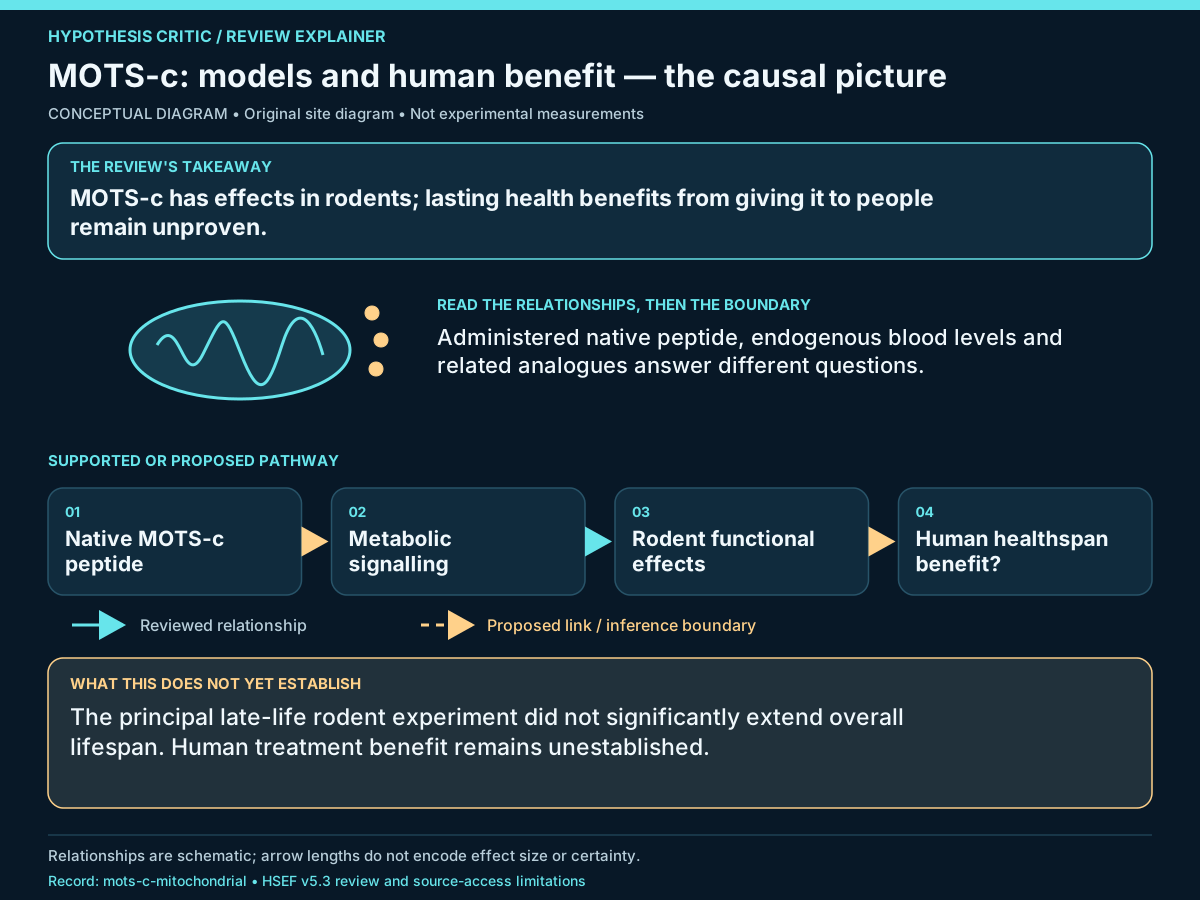
MOTS-c as a Metabolic Healthspan Peptide

Relative explanatory fit: Alternative ranked ahead

MOTS-c has effects in rodents; lasting health benefits from giving it to people remain unproven.

Reader-first lay guide Expert critique with citations
Very well established · HSEF Θ · 3 subclaim cards

HPV as a Necessary Cause of Cervical Carcinoma

Relative explanatory fit: Leading among models compared

Persistent cancer-causing HPV is required for the common HPV-related cervical cancer pathway, but infection alone is not enough.

Reader-first lay guide Expert critique with citations
Very well established · HSEF Θ · 3 subclaim cards

Smoking as a Cause of Lung Carcinoma

Relative explanatory fit: Leading among models compared

Smoking is a well-established major cause of lung cancer. Stopping reduces risk, though smoking does not cause every lung cancer.

Reader-first lay guide Expert critique with citations
Very well established · HSEF Θ · 3 subclaim cards

H. pylori as a Cause of Peptic Ulcer Disease

Relative explanatory fit: Leading among models compared

H. pylori is a well-established major cause of peptic ulcers, though ulcers can have other causes.

Reader-first lay guide Expert critique with citations
Very well established · HSEF Θ · 2 subclaim cards

Phenylalanine Toxicity in PKU

Relative explanatory fit: Leading among models compared

Early control of phenylalanine in PKU prevents the severe brain-development harm of untreated disease.

Reader-first lay guide Expert critique with citations