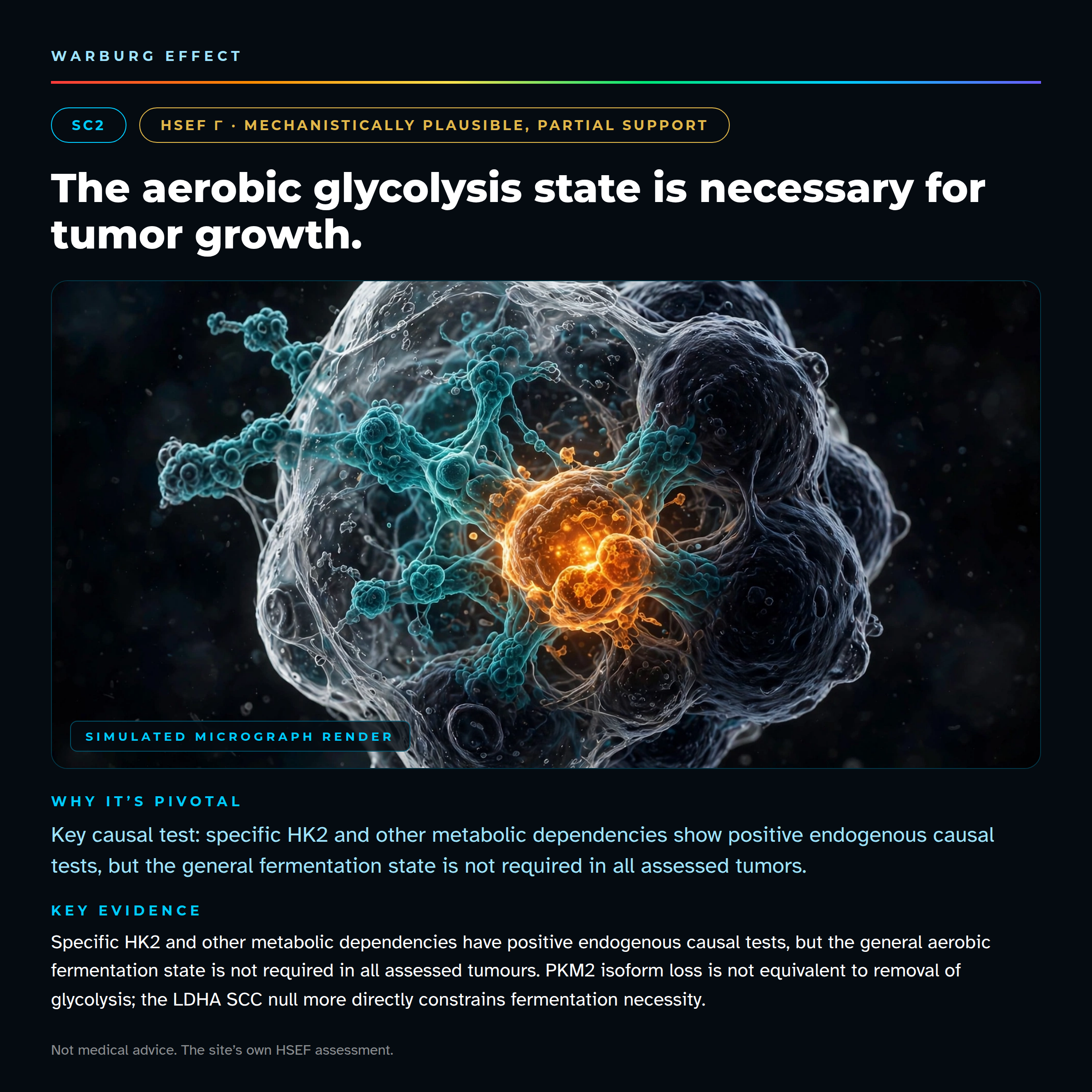
The question
Does a switch in how cells use sugar primarily cause cancer?
This is the specific idea being tested.

Does a switch in how cells use sugar primarily cause cancer?
What you need to knowAltered sugar use can support cancer, but is not established as the general first cause.Relative explanatory fit: Alternative ranked ahead
Why the alternative fits better: Genetic drivers change metabolism, which supports tumour behaviour. Some tumours persist when a proposed metabolic feature is reduced.
Claim assessed: Aerobic glycolysis is a primary causal driver of malignant transformation and sustained tumour growth rather than a metabolic consequence of upstream oncogenic signalling.
Finding: Primary-subclaim SC3 returns Γ. Cell-level feedback and strong context-specific metabolic contributions make the hypothesis more than association, but no examined evidence set establishes general upstream metabolic primacy across tumour classes. SC2 remains Γ for the registered broad state-necessity claim; named endogenous dependencies reach Ε as a competing model. Weakest-link sensitivity is Β due to descriptive SC1; primary and scope-matched sensitivities are Γ. The real Warburg observation is not labelled refuted.
Evidence scope: 68 primary reports; cutoff 2026-10-05; bounded critical review, not exhaustive systematic review.
The grade applies to the stated claim. Model rankings and individual subclaim grades remain separate from the overall causal-evidence grade.
Full scientific assessment and references · Scorecard (JSON) · Review source (Markdown)
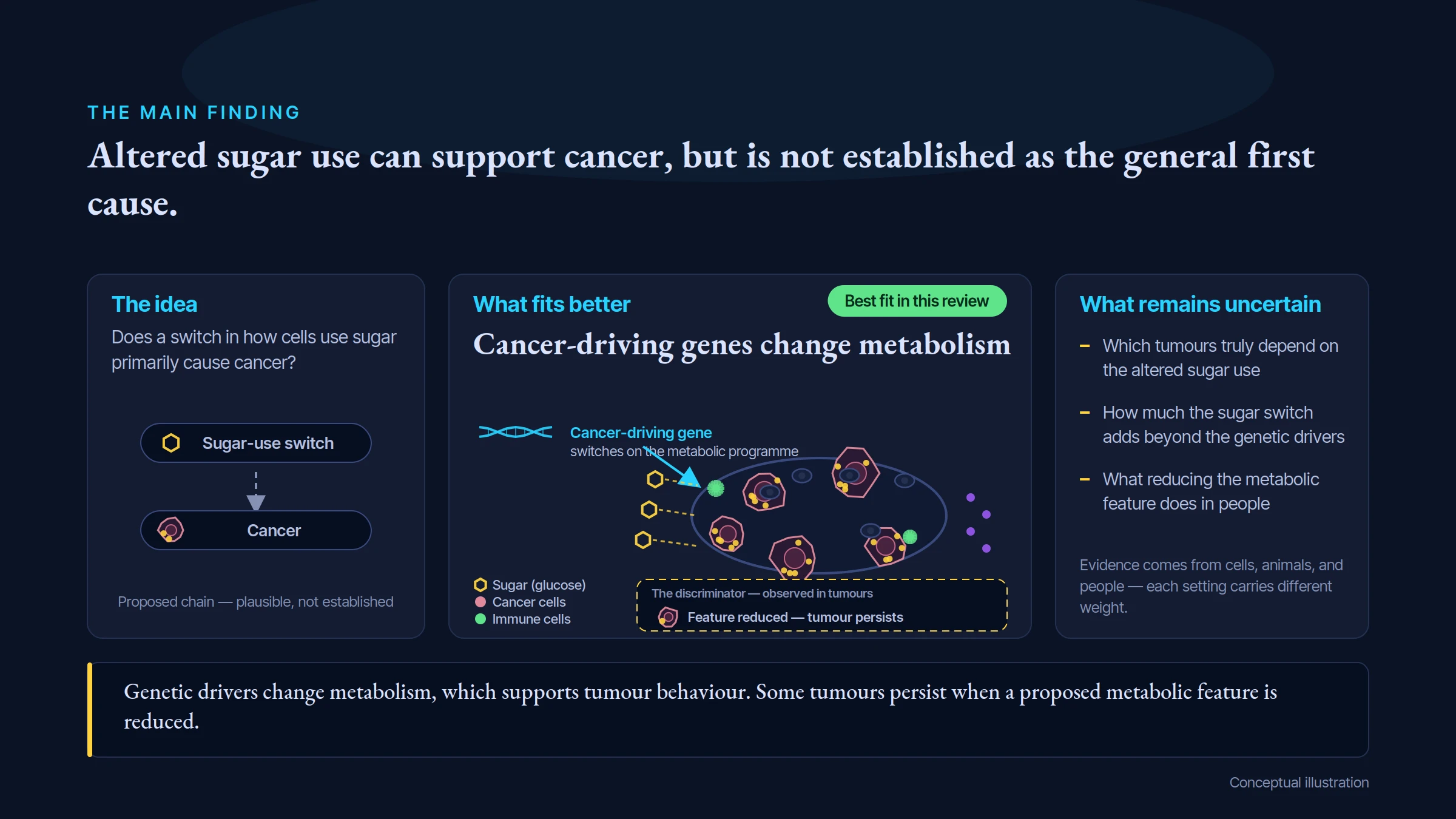
THE MAIN FINDING
Altered sugar use can support cancer, but is not established as the general first cause.
The idea
Does a switch in how cells use sugar primarily cause cancer?
Switch in how cells use sugar
Cancer
Proposed chain — plausible, not established
What fits better
Cancer-driving genes change metabolism
Best fit in this review
Cancer-driving gene
Switches on the metabolic programme
Sugar (glucose)
Cancer cells
Immune cells
The discriminator — observed in tumours
Feature reduced — tumour persists
What remains uncertain
Which tumours truly depend on the altered sugar use
How much the sugar switch adds beyond the genetic drivers
What reducing the metabolic feature does in people
Evidence comes from cells, animals, and people — each setting carries different weight.
Genetic drivers change metabolism, which supports tumour behaviour. Some tumours persist when a proposed metabolic feature is reduced.
Conceptual illustration
This is the specific idea being tested.
Genetic drivers change metabolism, which supports tumour behaviour. Some tumours persist when a proposed metabolic feature is reduced.
A higher rank means a better fit to the evidence in this comparison. It does not prove every part of the leading explanation.
The reviewed hypothesis ranks 5 among 5 models compared; 1 alternative model(s) hold first rank for this stated claim.
Claim under review: rank 5 among 5 compared models.
Leading explanation: Oncogene-driven reprogramming with feedback.
Position in this comparison: Last recorded rank.
The causal grade asks how well the stated causal claim is established. This comparison asks which of the assessed explanations fits the reviewed findings better. A leading explanation can remain unproven. Models can overlap or include the tested mechanism; an alternative ahead does not make that mechanism irrelevant. These ordinal ranks apply within this review; they do not measure the size of a difference or rank scientific strength across topics.
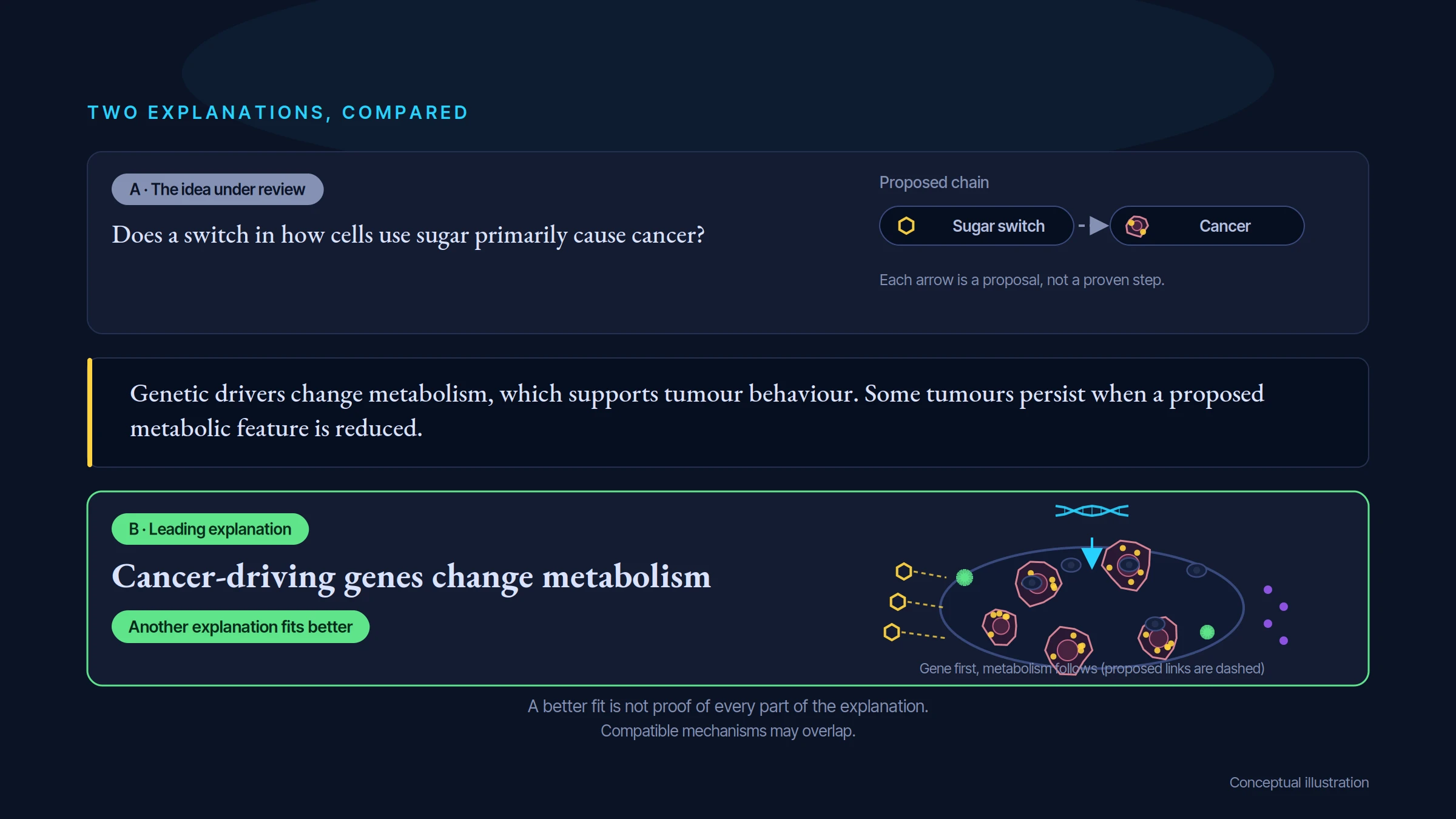
TWO EXPLANATIONS, COMPARED
A · The idea under review
Does a switch in how cells use sugar primarily cause cancer?
Proposed chain
Switch in how cells use sugar
Cancer
Each arrow is a proposal, not a proven step.
Genetic drivers change metabolism, which supports tumour behaviour. Some tumours persist when a proposed metabolic feature is reduced.
B · Leading explanation
Cancer-driving genes change metabolism
Another explanation fits better
Gene first, metabolism follows (proposed links are dashed)
A better fit is not proof of every part of the explanation.
Compatible mechanisms may overlap.
Conceptual illustration
Plausible, not established for the stated claim.
Genetic drivers change metabolism, which supports tumour behaviour. Some tumours persist when a proposed metabolic feature is reduced.
These explanations can overlap. Ranking their fit to the evidence is separate from deciding how firmly a cause has been established.
Rank 1: Oncogene-driven reprogramming with feedback — Oncogenic lesions induce metabolic programs that subsequently support tumour behaviour.
Rank 2: Context-specific respiration and biosynthetic outputs — Mitochondrial redox and aspartate/asparagine output can constrain proliferation and persistence.
Rank 3: Metabolic symbiosis and flexible fuel use — Tumour compartments use lactate and other fuels according to oxygen, stage and nutrient access.
Rank 4: Proliferation-related redox constraint — NAD regeneration and shuttle capacity can cause lactate fermentation without a unique cancer-initiating role.
Rank 5: Glycolysis as primary upstream driver — Aerobic fermentation starts and generally maintains malignant state before oncogenic signalling.
Evidence rating: Γ · Moderate confidence. How the evidence was assessed.
Genetic drivers change metabolism, which supports tumour behaviour. Some tumours persist when a proposed metabolic feature is reduced.
This is an assessment of a causal explanation, not proof that a particular supplement, diet, test, or treatment improves health. A treatment claim needs studies that test the intervention in people and measure meaningful benefits and harms. These findings can help frame research and informed clinical questions, but they do not identify what is right for one person.
Look for the proposed factor and the outcome, in the people or systems covered by the claim.
Cancer-driving genes change metabolism. Genetic drivers change metabolism, which supports tumour behaviour. Some tumours persist when a proposed metabolic feature is reduced.
Change the metabolic feature and genetic driver separately, measuring tumour survival and growth.
These illustrations show the key questions tested in the review. They are conceptual drawings, not microscope images or experimental results.
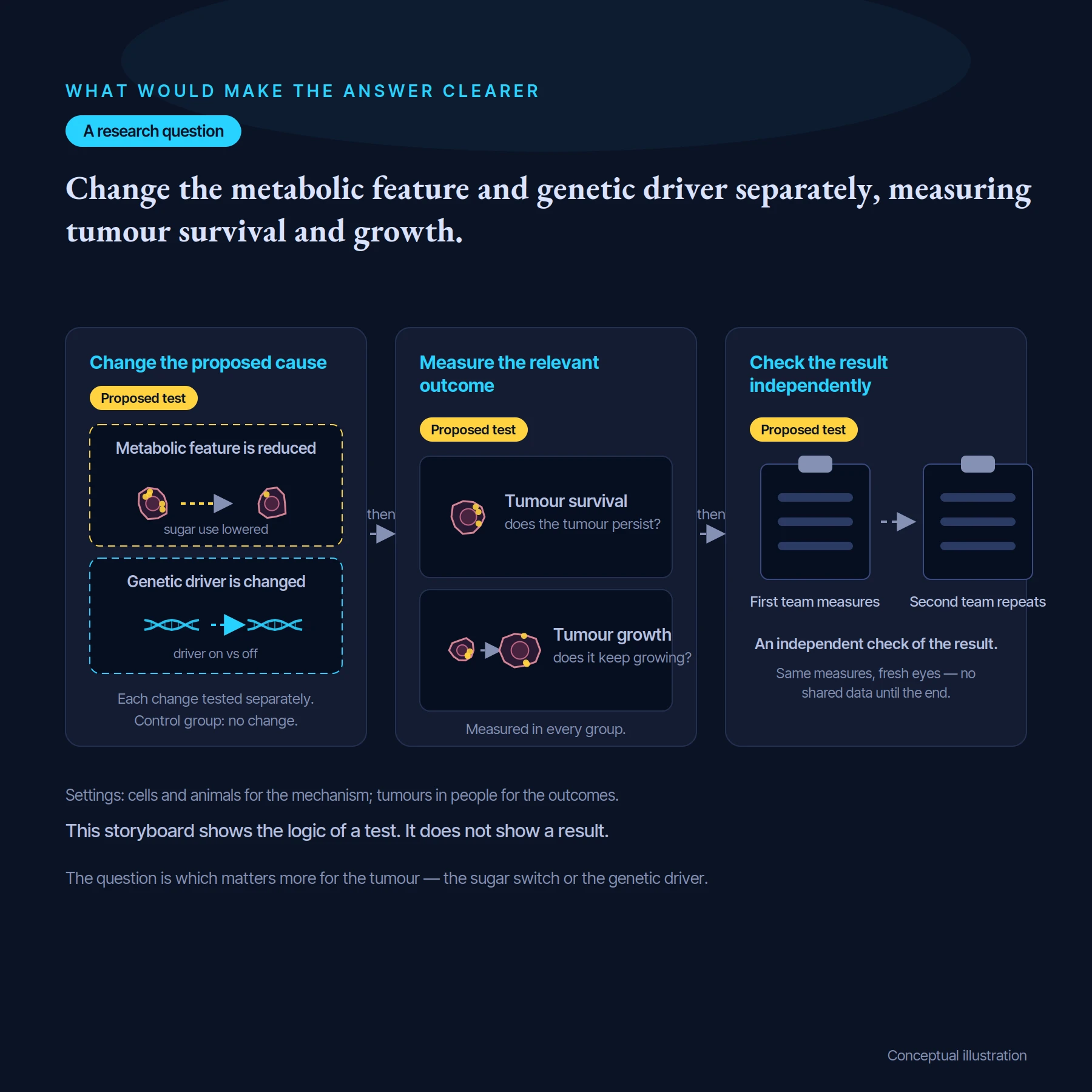
WHAT WOULD MAKE THE ANSWER CLEARER
A research question
Change the metabolic feature and genetic driver separately, measuring tumour survival and growth.
then
then
Change the proposed cause
Proposed test
Metabolic feature is reduced
sugar-use feature lowered
Genetic driver is changed
genetic driver changed separately
Each change tested separately.
Control group: no change.
Measure the relevant outcome
Tumour survival
Does the tumour persist?
Tumour growth
Does it keep growing?
Measured in every group.
Check the result independently
First team measures
Second team repeats
An independent check of the result.
Same measures, fresh eyes — no shared data until the end.
Settings: cells and animals for the mechanism; tumours in people for the outcomes.
This storyboard shows the logic of a test. It does not show a result.
The question is which matters more for the tumour — the sugar switch or the genetic driver.
Conceptual illustration
Change the metabolic feature and genetic driver separately, measuring tumour survival and growth.
Check that the intended change really happened.
Allow for other factors and compare with suitable controls.
Look for independent confirmation and the limits of the effect.
These are questions for research, not a claim that the proposed studies have already succeeded.
Proposed tests: 1 test design(s) are registered in the scorecard.
In plain terms, researchers would change the proposed cause, check that it changed as intended, then measure a meaningful outcome while controlling plausible alternatives. The result should be able to support or count against the claim—not only show that a pathway exists.
Study design: In prespecified autochthonous KRAS, APC and mammary tumour models, independently manipulate cytosolic NADH recycling and lactate fermentation at physiological exposure while preserving glucose uptake, PPP/hexosamine carbon routing and enzyme scaffolding. Apply perturbations before initiation and separately after tumour establishment, with orthogonal flux rescue, matched oncogene signalling and lineage-resolved metastasis/relapse follow-up.
What would be measured: Incident tumours, clonal growth, maintenance regression and metastatic/relapse burden alongside absolute fermentation, TCA flux, redox, ATP demand and biosynthetic routing
Important controls: Catalytic versus scaffold rescue, wild-type and nonmalignant controls, matched oxygen/perfusion and nutrient supply, orthogonal redox instruments, blinded pathology and prespecified tissues/genotypes
Result that would support the claim: Physiological fermentation elevation initiates malignant state before oncogenic changes, and selective reversal suppresses the same state despite preserved nonfermentation outputs across the registered lineages
Result that would count against it: Validated fermentation reduction preserves initiation or maintenance, or effects disappear after biosynthetic/redox rescue while the nominated fermentation state remains altered
Follow the studies, detailed comparisons and evidence ratings behind this guide.
Open the scientific review →