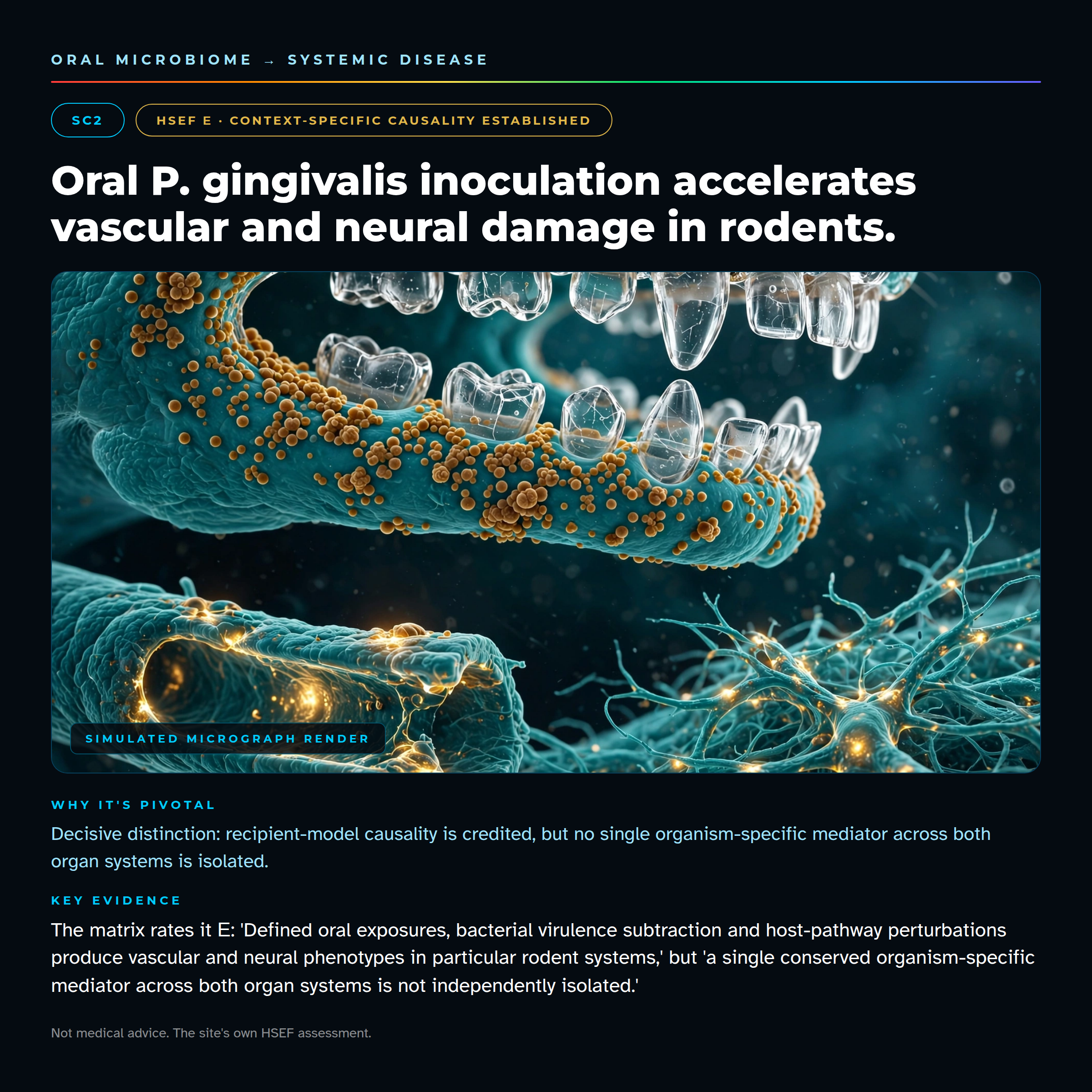
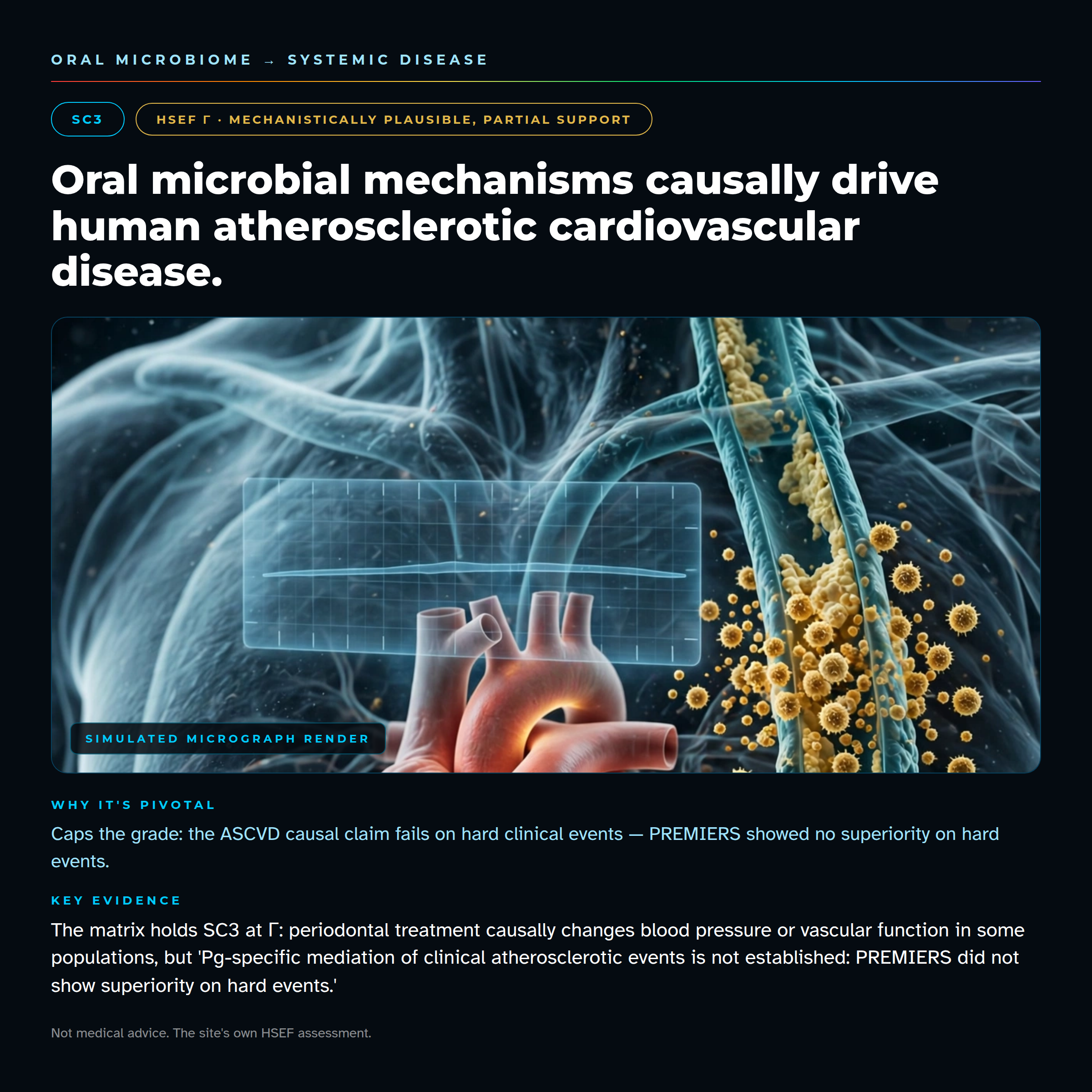
The question
Do oral microbes directly cause diseases elsewhere in the body?
This is the specific idea being tested.
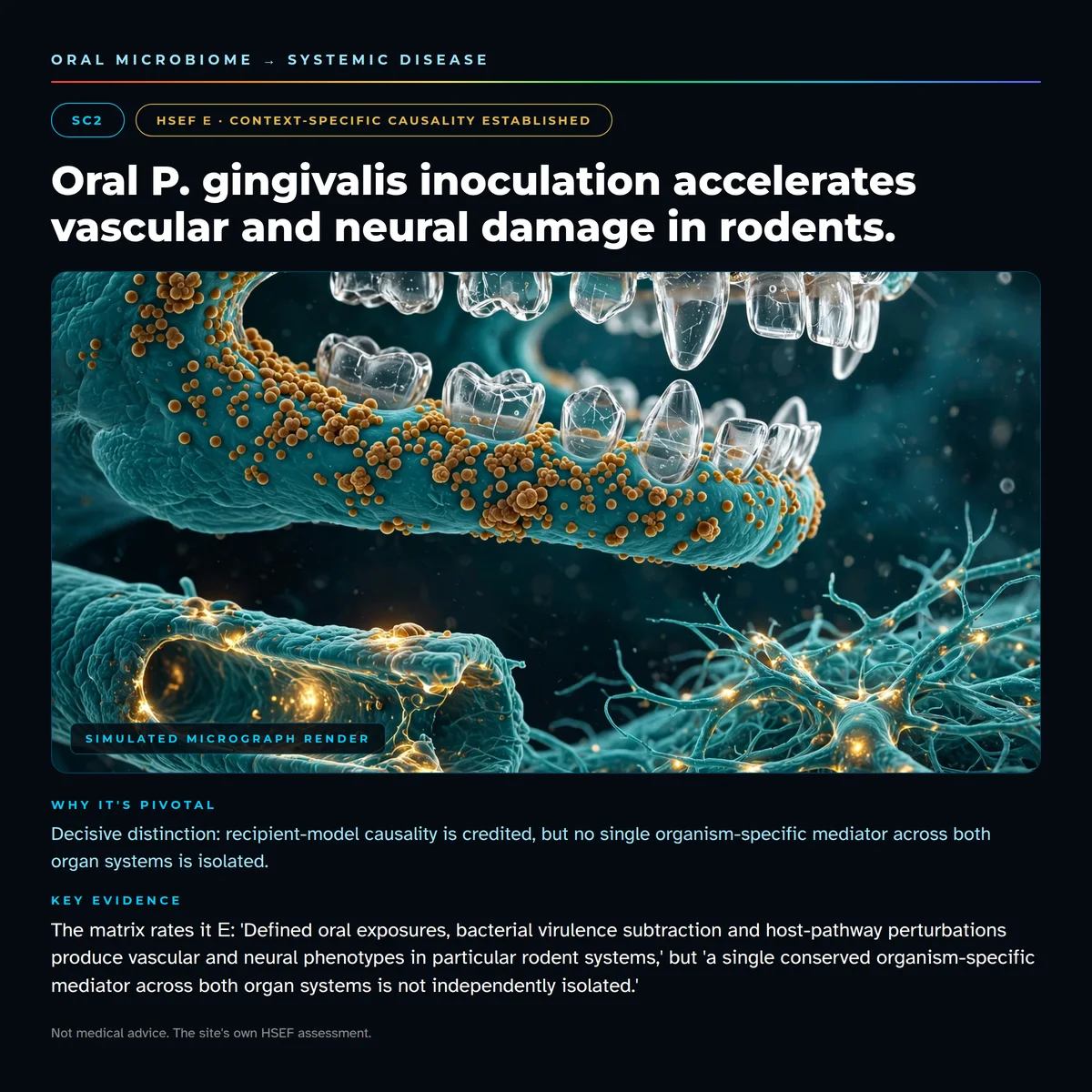
Do oral microbes directly cause diseases elsewhere in the body?
What you need to knowOral inflammation may affect other systems, but direct microbial causation across many diseases is not established.Relative explanatory fit: Alternative ranked ahead
Why the alternative fits better: Mouth inflammation affects blood-vessel function and interacts with other illness without proving one direct infection route.
Claim assessed: Oral microbial pathogens, principally Porphyromonas gingivalis, causally drive systemic cardiovascular and neurodegenerative disease in humans.
Finding: Γ, Moderate confidence, for the preregistered human vascular-and-neurodegenerative bundle. Scope-matched aggregation takes the highest subclaim whose scope matches the central claim; only the co-central human subclaims SC3 and SC4 match that scope, and both are Γ. Primary-subclaim sensitivity is Γ; weakest-link sensitivity is Β because the presence/co-occurrence subclaim is observational. Model causality and systemic physiological effects are credited at Ε in their stated scopes rather than allowed to replace human disease causality. The convergence was assessed as a set; the missing link is specific human clinical mediation, not an automatic requirement for an impossible experiment.
Evidence scope: 69 primary reports; literature cutoff 2026-10-06; source examination UTC date 2026-10-06; bounded critical review, not exhaustive systematic review.
The grade applies to the stated claim. Model rankings and individual subclaim grades remain separate from the overall causal-evidence grade.
Full scientific assessment and references · Scorecard (JSON) · Review source (Markdown)
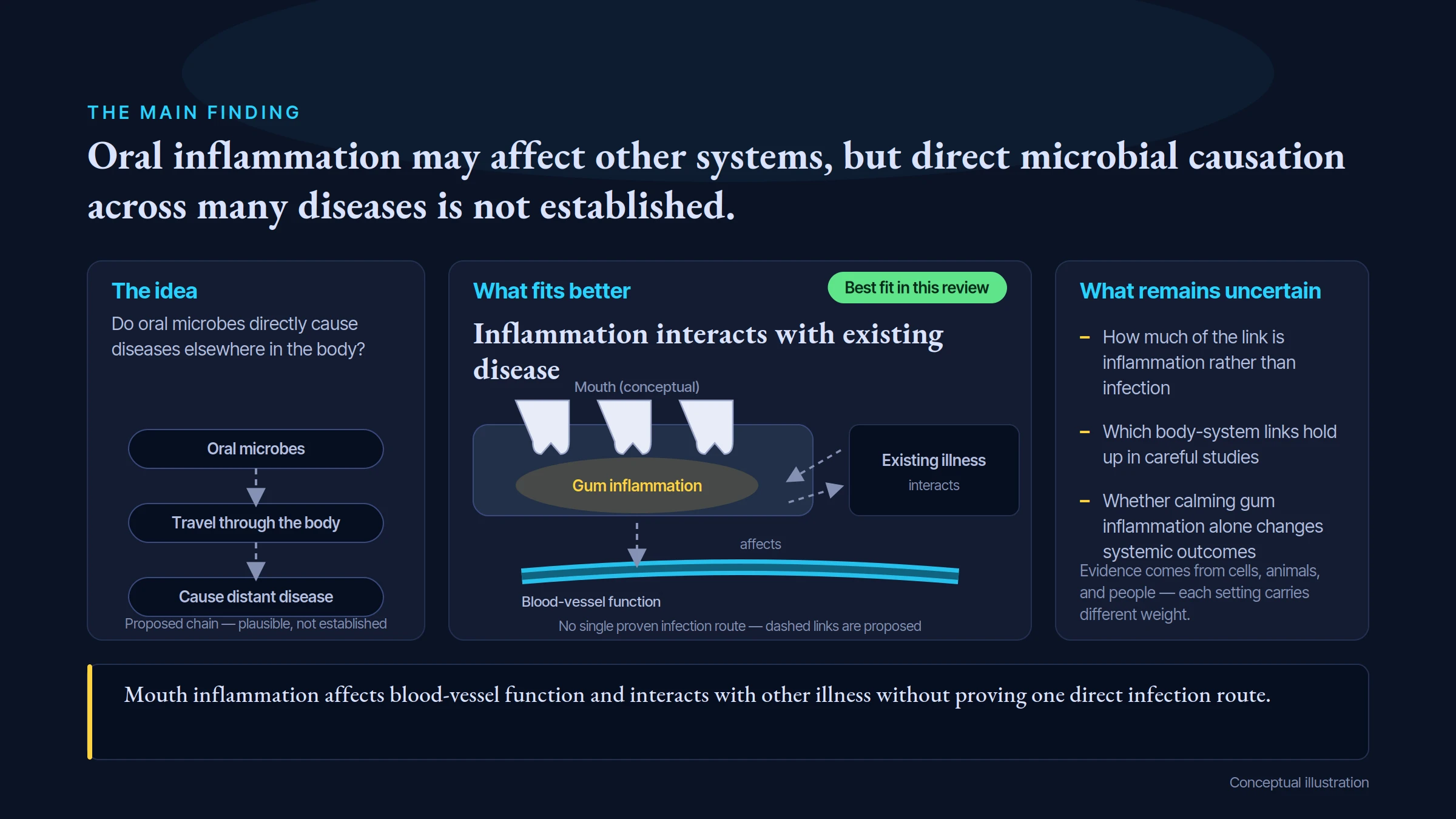
THE MAIN FINDING
Oral inflammation may affect other systems, but direct microbial causation across many diseases is not established.
The idea
Do oral microbes directly cause diseases elsewhere in the body?
Oral microbes
Travel through the body
Cause distant disease
Proposed chain — plausible, not established
What fits better
Inflammation interacts with existing disease
Best fit in this review
Gum inflammation
Mouth (conceptual)
Blood-vessel function
affects
Existing illness
interacts
No single proven infection route — dashed links are proposed
What remains uncertain
How much of the link is inflammation rather than infection
Which body-system links hold up in careful studies
Whether calming gum inflammation alone changes systemic outcomes
Evidence comes from cells, animals, and people — each setting carries different weight.
Mouth inflammation affects blood-vessel function and interacts with other illness without proving one direct infection route.
Conceptual illustration
This is the specific idea being tested.
Mouth inflammation affects blood-vessel function and interacts with other illness without proving one direct infection route.
A higher rank means a better fit to the evidence in this comparison. It does not prove every part of the leading explanation.
The reviewed hypothesis ranks 3 among 5 models compared; 1 alternative model(s) hold first rank for this stated claim.
Claim under review: rank 3 among 5 compared models.
Leading explanation: Systemic inflammatory burden.
Position in this comparison: Between leading and last ranks.
The causal grade asks how well the stated causal claim is established. This comparison asks which of the assessed explanations fits the reviewed findings better. A leading explanation can remain unproven. Models can overlap or include the tested mechanism; an alternative ahead does not make that mechanism irrelevant. These ordinal ranks apply within this review; they do not measure the size of a difference or rank scientific strength across topics.
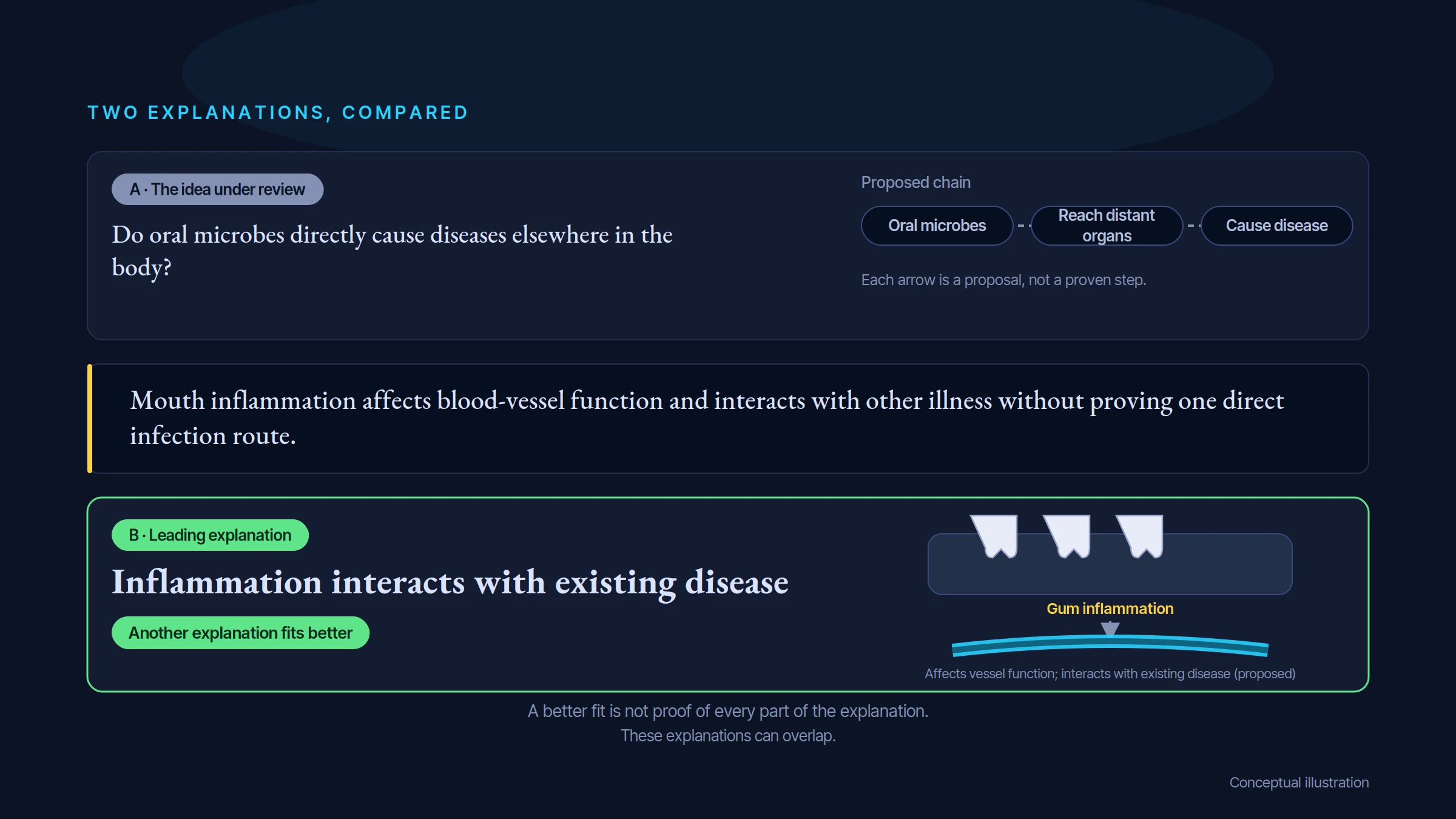
TWO EXPLANATIONS, COMPARED
A · The idea under review
Do oral microbes directly cause diseases elsewhere in the body?
Proposed chain
Oral microbes
Reach distant organs
Cause disease
Each arrow is a proposal, not a proven step.
Mouth inflammation affects blood-vessel function and interacts with other illness without proving one direct infection route.
B · Leading explanation
Inflammation interacts with existing disease
Another explanation fits better
Gum inflammation
Affects vessel function; interacts with existing disease (proposed)
A better fit is not proof of every part of the explanation.
These explanations can overlap.
Conceptual illustration
Plausible, not established for the stated claim.
Mouth inflammation affects blood-vessel function and interacts with other illness without proving one direct infection route.
These explanations can overlap. Ranking their fit to the evidence is separate from deciding how firmly a cause has been established.
Rank 1: Systemic inflammatory burden — Oral inflammatory burden can affect vascular physiology and interact with existing systemic disease.
Rank 2: Common-cause susceptibility — Smoking, deprivation, metabolic disease, host genetics and health-care access contribute to both dental and systemic outcomes.
Rank 3: Direct oral microbial pathogenesis — Oral pathogens directly drive human vascular and Alzheimer disease.
Rank 4: Antimicrobial amyloid response — Amyloid can participate in an innate response to microbial exposure.
Rank 5: Secondary colonization after barrier failure — Age or neurodegeneration can permit microbial components or DNA to enter damaged tissues.
Evidence rating: Γ · Moderate confidence. How the evidence was assessed.
Mouth inflammation affects blood-vessel function and interacts with other illness without proving one direct infection route.
This is an assessment of a causal explanation, not proof that a particular supplement, diet, test, or treatment improves health. A treatment claim needs studies that test the intervention in people and measure meaningful benefits and harms. These findings can help frame research and informed clinical questions, but they do not identify what is right for one person.
Look for the proposed factor and the outcome, in the people or systems covered by the claim.
Inflammation interacts with existing disease. Mouth inflammation affects blood-vessel function and interacts with other illness without proving one direct infection route.
Separate reduced oral inflammation from microbial removal, measuring the specific systemic outcome.
These illustrations show the key questions tested in the review. They are conceptual drawings, not microscope images or experimental results.
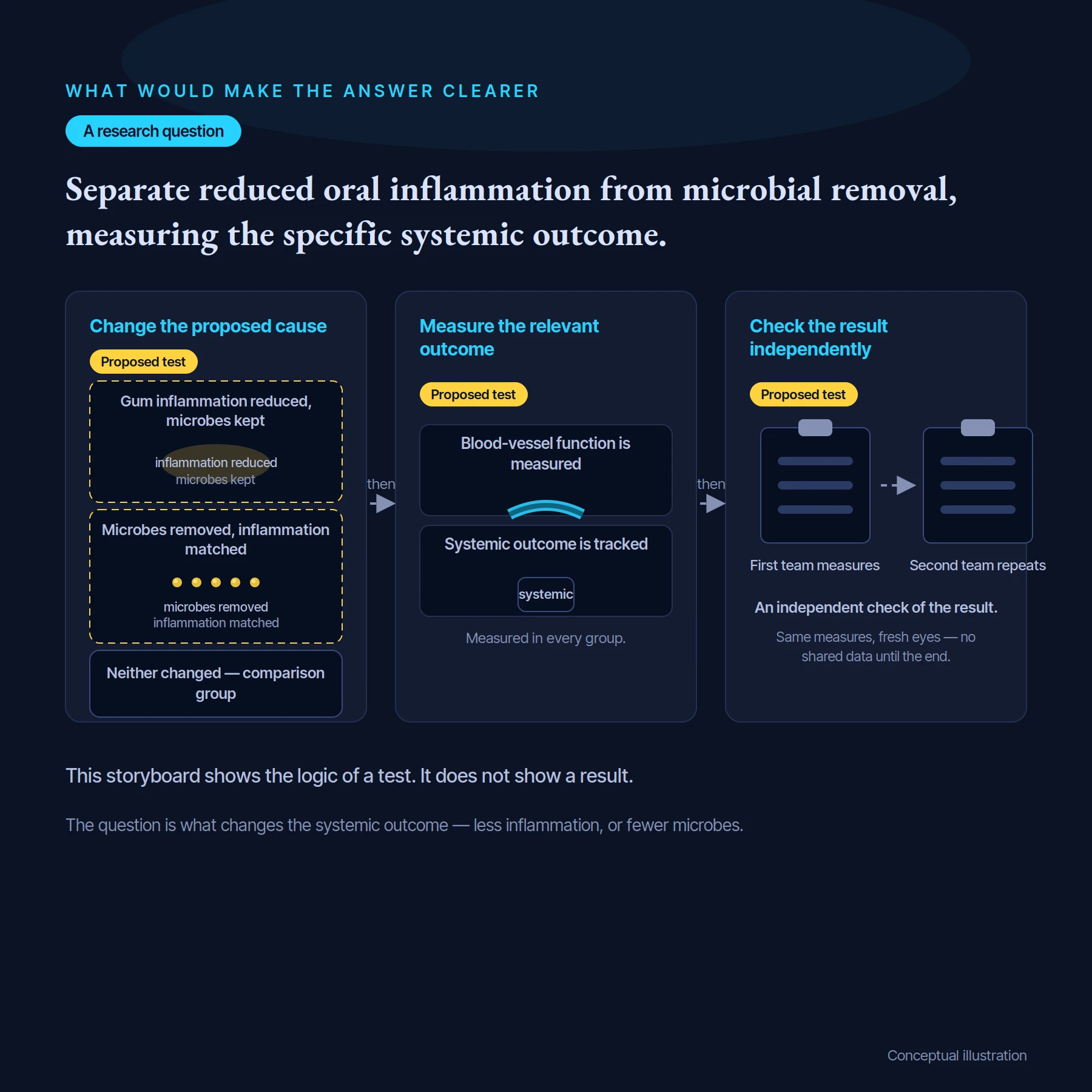
WHAT WOULD MAKE THE ANSWER CLEARER
A research question
Separate reduced oral inflammation from microbial removal, measuring the specific systemic outcome.
then
then
Change the proposed cause
Proposed test
Gum inflammation reduced, microbes kept
inflammation reduced
microbes kept
Microbes removed, inflammation matched
microbes removed
inflammation matched
Neither changed — comparison group
Measure the relevant outcome
Proposed test
Blood-vessel function is measured
Systemic outcome is tracked
systemic
Measured in every group.
Check the result independently
Proposed test
First team measures
Second team repeats
An independent check of the result.
Same measures, fresh eyes — no shared data until the end.
This storyboard shows the logic of a test. It does not show a result.
The question is what changes the systemic outcome — less inflammation, or fewer microbes.
Conceptual illustration
Separate reduced oral inflammation from microbial removal, measuring the specific systemic outcome.
Check that the intended change really happened.
Allow for other factors and compare with suitable controls.
Look for independent confirmation and the limits of the effect.
These are questions for research, not a claim that the proposed studies have already succeeded.
Proposed tests: 1 test design(s) are registered in the scorecard.
In plain terms, researchers would change the proposed cause, check that it changed as intended, then measure a meaningful outcome while controlling plausible alternatives. The result should be able to support or count against the claim—not only show that a pathway exists.
Study design: Run a prospectively pathogen-defined clinical programme with selective Pg suppression versus matched periodontal inflammatory care, documented oral and systemic/CNS engagement, prespecified interactions and independently adjudicated clinical vascular or AD outcomes in separate disease cohorts.
What would be measured: Clinical event or cognitive/functional trajectory with organism load, viability-sensitive measures and mediator timing
Important controls: Matched dental inflammation improvement, placebo/active comparator, non-Pg pathogen comparison, blinded outcomes, contamination/spike-in controls and multiplicity plan
Result that would support the claim: Selective sustained engagement changes the registered clinical trajectory beyond matched inflammation control and replicates in the prespecified pathogen-defined population
Result that would count against it: Adequate engagement with sufficiently precise clinical nulls, or equal benefit from nonspecific inflammation control without pathogen mediation
Follow the studies, detailed comparisons and evidence ratings behind this guide.
Open the scientific review →