The question
Can infection overcome immune tolerance and start autoimmune disease?
This is the specific idea being tested.

Can infection overcome immune tolerance and start autoimmune disease?
What you need to knowInfections can contribute, but genes, tissue injury and immune regulation affect who develops disease.Relative explanatory fit: Alternative ranked ahead
Why the alternative fits better: The same exposure does not produce disease in everyone. A combined threshold better explains different responses.
Claim assessed: Autoimmunity is initiated by infection-triggered molecular mimicry and bystander activation that overcome baseline genetic deficiencies in immune tolerance.
Finding: The preregistered weakest-link rule returns Β because the descriptive antecedence subclaim SC1 is associational. This is an aggregation limitation, not a finding that all infection causality is merely correlational: defined Campylobacter/ganglioside GBS convergence reaches Ζ, intrinsic tolerance necessity Η, and broader context-dependent initiation Ε. Primary-subclaim and scope-matched sensitivities return Ε. Human MS mimic-specific initiation remains Γ. Do not publish the overall letter without this subclaim explanation or interpret it as refuting EBV risk causality.
Evidence scope: 70 primary reports; literature cutoff 2026-10-07; source examination UTC date 2026-10-07; bounded critical review, not exhaustive systematic review.
The grade applies to the stated claim. Model rankings and individual subclaim grades remain separate from the overall causal-evidence grade.
Full scientific assessment and references · Scorecard (JSON) · Review source (Markdown)
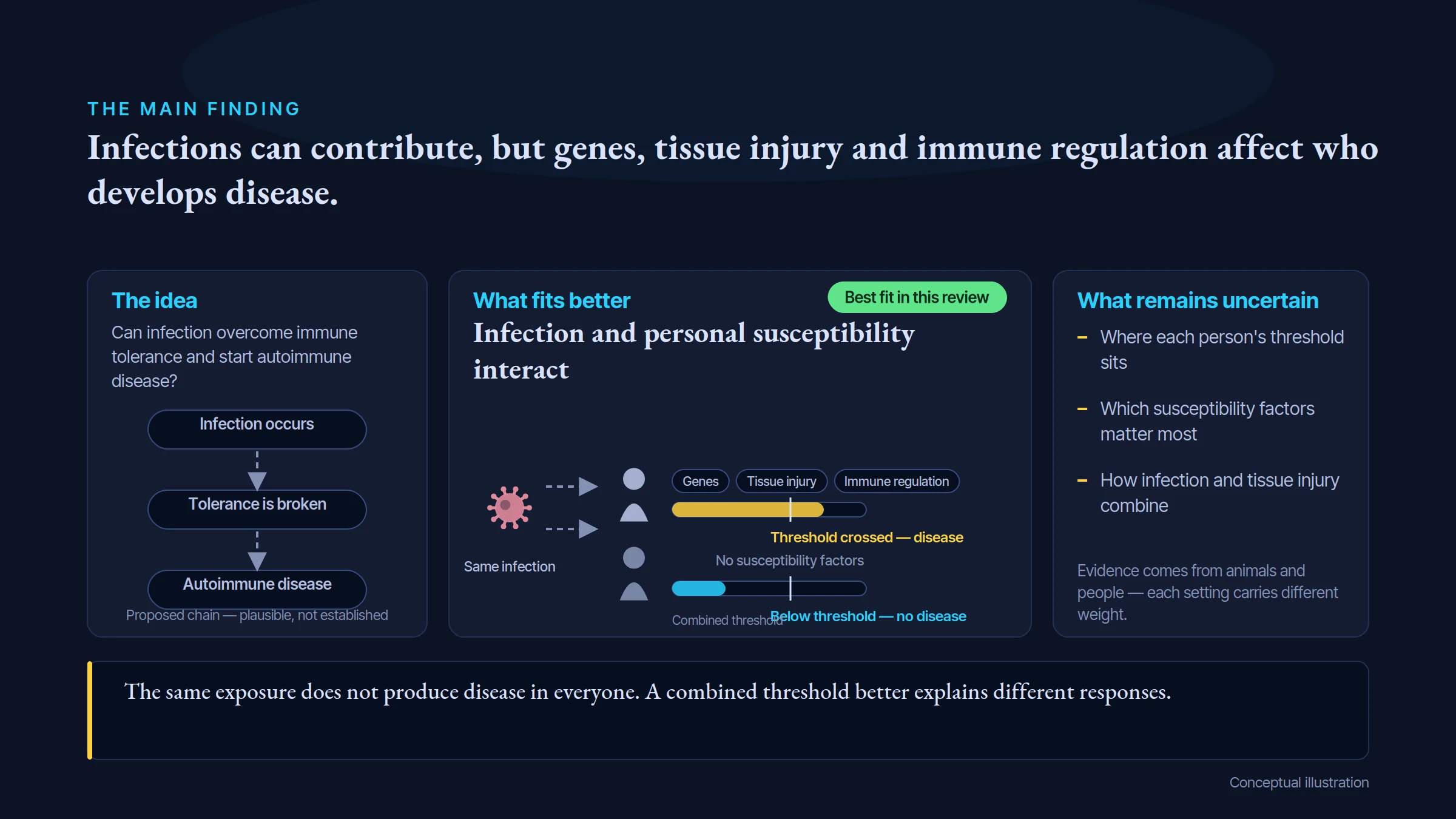
THE MAIN FINDING
Infections can contribute, but genes, tissue injury and immune regulation affect who develops disease.
The idea
What fits better
What remains uncertain
Can infection overcome immune tolerance and start autoimmune disease?
Infection occurs
Tolerance is broken
Autoimmune disease
Proposed chain — plausible, not established
Infection and personal susceptibility interact
Best fit in this review
Same infection
Genes
Tissue injury
Immune regulation
Threshold crossed — disease
No susceptibility factors
Below threshold — no disease
Combined threshold
Where each person's threshold sits
Which susceptibility factors matter most
How infection and tissue injury combine
Evidence comes from animals and people — each setting carries different weight.
The same exposure does not produce disease in everyone. A combined threshold better explains different responses.
Conceptual illustration
This is the specific idea being tested.
The same exposure does not produce disease in everyone. A combined threshold better explains different responses.
A higher rank means a better fit to the evidence in this comparison. It does not prove every part of the leading explanation.
The reviewed hypothesis ranks 3 among 5 models compared; 1 alternative model(s) hold first rank for this stated claim.
Claim under review: rank 3 among 5 compared models.
Leading explanation: Gene-environment threshold.
Position in this comparison: Between leading and last ranks.
The causal grade asks how well the stated causal claim is established. This comparison asks which of the assessed explanations fits the reviewed findings better. A leading explanation can remain unproven. Models can overlap or include the tested mechanism; an alternative ahead does not make that mechanism irrelevant. These ordinal ranks apply within this review; they do not measure the size of a difference or rank scientific strength across topics.
TWO EXPLANATIONS, COMPARED
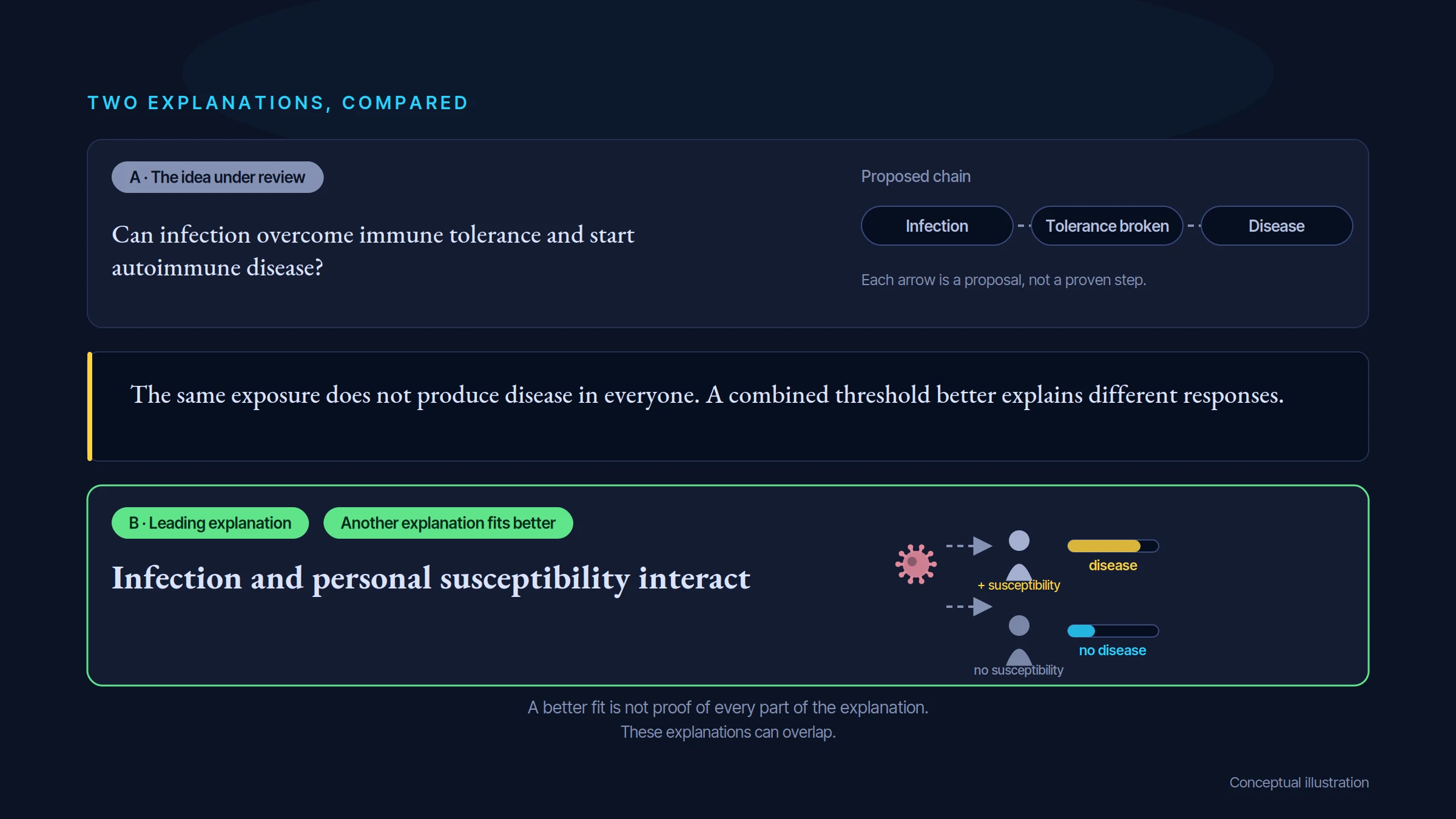
A · The idea under review
Can infection overcome immune tolerance and start autoimmune disease?
Proposed chain
Infection
Tolerance broken
Disease
Each arrow is a proposal, not a proven step.
The same exposure does not produce disease in everyone. A combined threshold better explains different responses.
B · Leading explanation
Infection and personal susceptibility interact
Another explanation fits better
+ susceptibility
disease
no susceptibility
no disease
A better fit is not proof of every part of the explanation.
These explanations can overlap.
Conceptual illustration
Association only for the stated claim.
The same exposure does not produce disease in everyone. A combined threshold better explains different responses.
These explanations can overlap. Ranking their fit to the evidence is separate from deciding how firmly a cause has been established.
Rank 1: Gene-environment threshold — Host regulatory state, tissue injury and defined microbial exposure jointly set disease-specific thresholds.
Rank 2: Intrinsic tolerance failure — Central and peripheral regulatory pathways prevent pathogenic self-reactivity.
Rank 3: Infection-triggered tolerance breakdown — Specific pathogens initiate selected autoimmune injury through mimicry or licensing.
Rank 4: Bystander inflammatory licensing — Infection or tissue injury supplies antigen presentation and inflammatory help to pre-existing autoreactivity.
Rank 5: Microbial-deprivation tolerance calibration — Some microbial exposures reduce rather than cause autoimmune injury.
Evidence rating: Β · Moderate confidence. How the evidence was assessed.
The same exposure does not produce disease in everyone. A combined threshold better explains different responses.
A result about how a disease works is a separate question from whether a treatment improves health.
Look for the proposed factor and the outcome, in the people or systems covered by the claim.
Infection and personal susceptibility interact. The same exposure does not produce disease in everyone. A combined threshold better explains different responses.
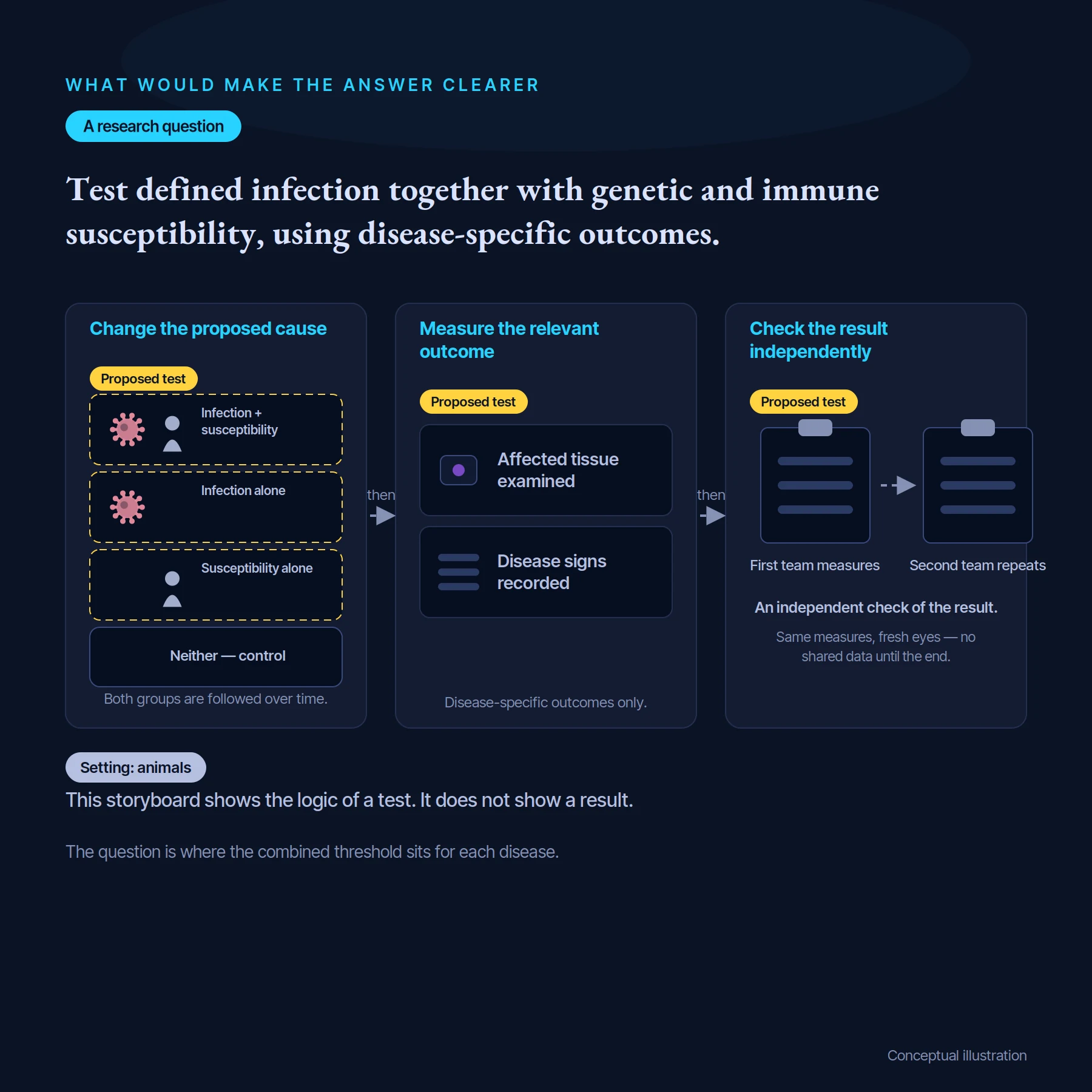
Test defined infection together with genetic and immune susceptibility, using disease-specific outcomes.
WHAT WOULD MAKE THE ANSWER CLEARER
A research question
Test defined infection together with genetic and immune susceptibility, using disease-specific outcomes.
then
then
Change the proposed cause
Proposed test
Measure the relevant outcome
Proposed test
Check the result independently
Proposed test
Infection + susceptibility
Infection alone
Susceptibility alone
Neither — control
Affected tissue examined
Disease signs recorded
Disease-specific outcomes only.
First team measures
Second team repeats
An independent check of the result.
Same measures, fresh eyes — no shared data until the end.
Both groups are followed over time.
Setting: animals
This storyboard shows the logic of a test. It does not show a result.
The question is where the combined threshold sits for each disease.
Conceptual illustration
Test defined infection together with genetic and immune susceptibility, using disease-specific outcomes.
Check that the intended change really happened.
Allow for other factors and compare with suitable controls.
Look for independent confirmation and the limits of the effect.
These are questions for research, not a claim that the proposed studies have already succeeded.
Proposed tests: 1 test design(s) are registered in the scorecard.
In plain terms, researchers would change the proposed cause, check that it changed as intended, then measure a meaningful outcome while controlling plausible alternatives. The result should be able to support or count against the claim—not only show that a pathway exists.
Study design: In baseline infection-negative, genotype- and tolerance-function-characterized cohorts, prevent a specific pathogen before seroconversion or selectively block a prespecified cross-reactive epitope while preserving antiviral immunity. Follow incident disease and matched antigen-specific clones, with independently replicated infection exposure and disease ascertainment; in parallel use physiological pathogen mimic-loss and restored-mimic rescue with functional pathology.
What would be measured: Incident adjudicated autoimmune disease, onset time, organ function, pathogen acquisition/clearance, antigen-specific autoreactivity and baseline-to-onset tolerance function
Important controls: Genotype, age, prior infection, vaccination, baseline autoantibodies/tolerance, tissue injury, clinical stage, target engagement and antiviral competence; pathogen variants with matched fitness
Result that would support the claim: Preventing or subtracting the defined infectious mediator reduces incident disease and restored mimic rescues the matched phenotype in the predicted baseline context
Result that would count against it: Verified infection or mimic suppression leaves onset unchanged, or genotype/tissue injury explains disease without the proposed infectious route
Follow the studies, detailed comparisons and evidence ratings behind this guide.
Open the scientific review →