The question
Does inflammation cause a form of major depression that a blood test can identify before treatment?
This is the specific idea being tested.

Does inflammation cause a form of major depression that a blood test can identify before treatment?
What you need to knowInflammation can affect mood, but a blood-test-defined cause of ordinary major depression is not yet confirmed.Relative explanatory fit: Alternative ranked ahead
Why the alternative fits better: Prolonged treatment with the immune signal interferon can cause depression in a specific setting. Promising findings in people with higher inflammation markers were exploratory, and brief mood changes are different from sustained major depression.
For health decisions: An elevated inflammation blood test is not yet an established way to identify who should receive an anti-inflammatory treatment for major depression.
Claim assessed: Peripheral inflammatory signalling causes major depressive disorder in the subgroup with elevated baseline inflammatory markers.
Finding: Overall Γ follows registered SC3. Baseline prediction is Β, and sustained immune-treatment-related syndromes earn a restricted Ε at SC2. Neither narrow immune exposure nor exploratory high-CRP response establishes prospectively identifiable inflammatory MDD causation. Genuine positive clinical pilot findings are retained alongside larger or prospectively stratified nulls. The next clinical subtype boundary remains open rather than being declared refuted.
Evidence scope: 56 primary reports; literature cutoff 2026-10-09; source examination UTC date 2026-10-12; bounded critical review, not exhaustive systematic review.
The grade applies to the stated claim. Model rankings and individual subclaim grades remain separate from the overall causal-evidence grade.
Full scientific assessment and references · Scorecard (JSON) · Review source (Markdown)
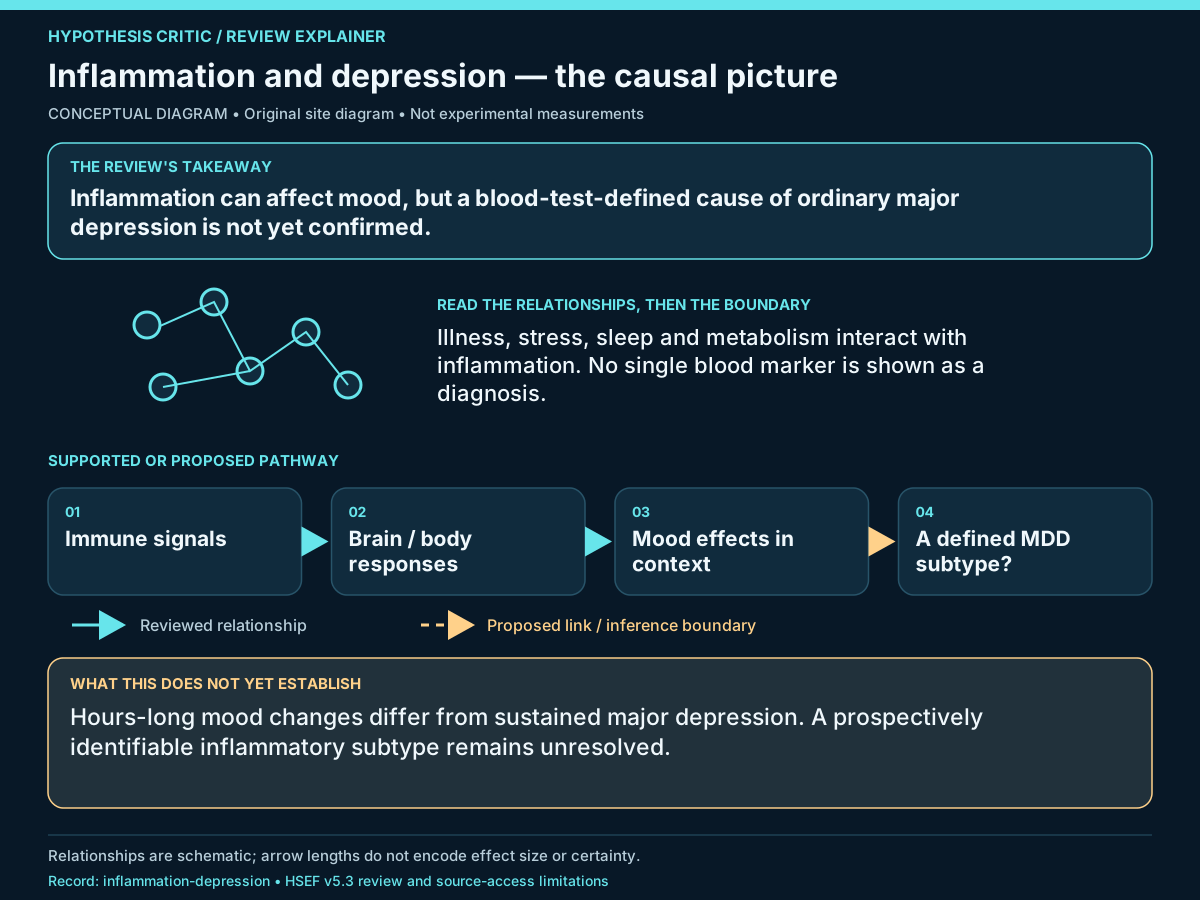
HYPOTHESIS CRITIC  /  REVIEW EXPLAINER
Inflammation and depression — the causal picture
CONCEPTUAL DIAGRAM  •  Original site diagram  •  Not experimental measurements
THE REVIEW'S TAKEAWAY
Inflammation can affect mood, but a blood-test-defined cause of ordinary major depression is not yet confirmed.
READ THE RELATIONSHIPS, THEN THE BOUNDARY
Illness, stress, sleep and metabolism interact with inflammation. No single blood marker is shown as a diagnosis.
SUPPORTED OR PROPOSED PATHWAY
01
Immune signals
02
Brain / body responses
03
Mood effects in context
04
A defined MDD subtype?
Reviewed relationship
Proposed link / inference boundary
WHAT THIS DOES NOT YET ESTABLISH
Hours-long mood changes differ from sustained major depression. A prospectively identifiable inflammatory subtype remains unresolved.
Relationships are schematic; arrow lengths do not encode effect size or certainty.
Record: inflammation-depression  •  HSEF v5.3 review and source-access limitations
This is the specific idea being tested.
Prolonged treatment with the immune signal interferon can cause depression in a specific setting. Promising findings in people with higher inflammation markers were exploratory, and brief mood changes are different from sustained major depression.
A higher rank means a better fit to the evidence in this comparison. It does not prove every part of the leading explanation.
The reviewed hypothesis ranks 4 among 4 models compared; 1 alternative model(s) hold first rank for this stated claim.
Claim under review: rank 4 among 4 compared models.
Leading explanation: Context-specific immune effects.
Position in this comparison: Last recorded rank.
The causal grade asks how well the stated causal claim is established. This comparison asks which of the assessed explanations fits the reviewed findings better. A leading explanation can remain unproven. Models can overlap or include the tested mechanism; an alternative ahead does not make that mechanism irrelevant. These ordinal ranks apply within this review; they do not measure the size of a difference or rank scientific strength across topics.
HYPOTHESIS CRITIC  /  REVIEW EXPLAINER
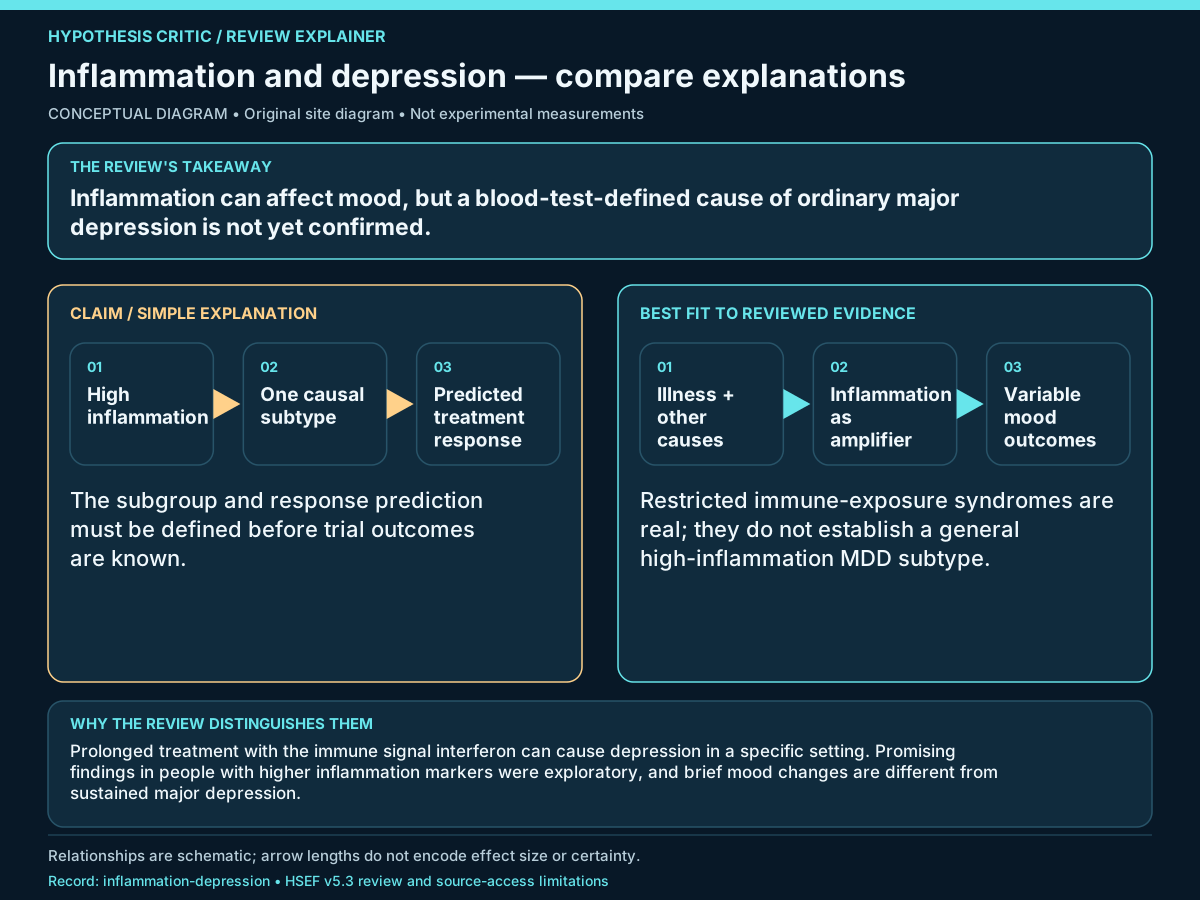
Inflammation and depression — compare explanations
CONCEPTUAL DIAGRAM  •  Original site diagram  •  Not experimental measurements
THE REVIEW'S TAKEAWAY
Inflammation can affect mood, but a blood-test-defined cause of ordinary major depression is not yet confirmed.
CLAIM / SIMPLE EXPLANATION
01
High inflammation
02
One causal subtype
03
Predicted treatment response
The subgroup and response prediction must be defined before trial outcomes are known.
BEST FIT TO REVIEWED EVIDENCE
01
Illness + other causes
02
Inflammation as amplifier
03
Variable mood outcomes
Restricted immune-exposure syndromes are real; they do not establish a general high-inflammation MDD subtype.
WHY THE REVIEW DISTINGUISHES THEM
Prolonged treatment with the immune signal interferon can cause depression in a specific setting. Promising findings in people with higher inflammation markers were exploratory, and brief mood changes are different from sustained major depression.
Relationships are schematic; arrow lengths do not encode effect size or certainty.
Record: inflammation-depression  •  HSEF v5.3 review and source-access limitations
Plausible, not established for the stated claim.
Prolonged treatment with the immune signal interferon can cause depression in a specific setting. Promising findings in people with higher inflammation markers were exploratory, and brief mood changes are different from sustained major depression.
These explanations can overlap. Ranking their fit to the evidence is separate from deciding how firmly a cause has been established.
Rank 1: Context-specific immune effects — Defined immune treatments/stimuli alter mood and sometimes sustained depressive trajectories.
Rank 2: Shared metabolic/stress causes — Inflammatory markers and depression share obesity, sleep, smoking, trauma and physical-illness pathways.
Rank 3: Depression-induced inflammation — Depression, treatment and associated behaviour can raise some markers.
Rank 4: Inflammatory MDD subtype — Peripheral inflammation drives sustained MDD in a baseline-high subgroup.
Evidence rating: Γ · Moderate confidence. How the evidence was assessed.
Prolonged treatment with the immune signal interferon can cause depression in a specific setting. Promising findings in people with higher inflammation markers were exploratory, and brief mood changes are different from sustained major depression.
Inflammation may contribute to depression in some circumstances, but a high blood marker alone does not confirm a distinct inflammatory cause. Promising subgroup results need confirmation in trials that define the group before treatment begins. This review therefore does not provide a validated blood-test rule for choosing anti-inflammatory treatment or replacing an existing depression treatment plan.
Look for the proposed factor and the outcome, in the people or systems covered by the claim.
Inflammation can worsen illness alongside stress, sleep, metabolism and other contributing factors. Prolonged treatment with the immune signal interferon can cause depression in a specific setting. Promising findings in people with higher inflammation markers were exploratory, and brief mood changes are different from sustained major depression.
Define the high-inflammation group before a trial begins and test whether a targeted treatment produces a lasting benefit that is specifically greater in that group.
HYPOTHESIS CRITIC  /  REVIEW EXPLAINER
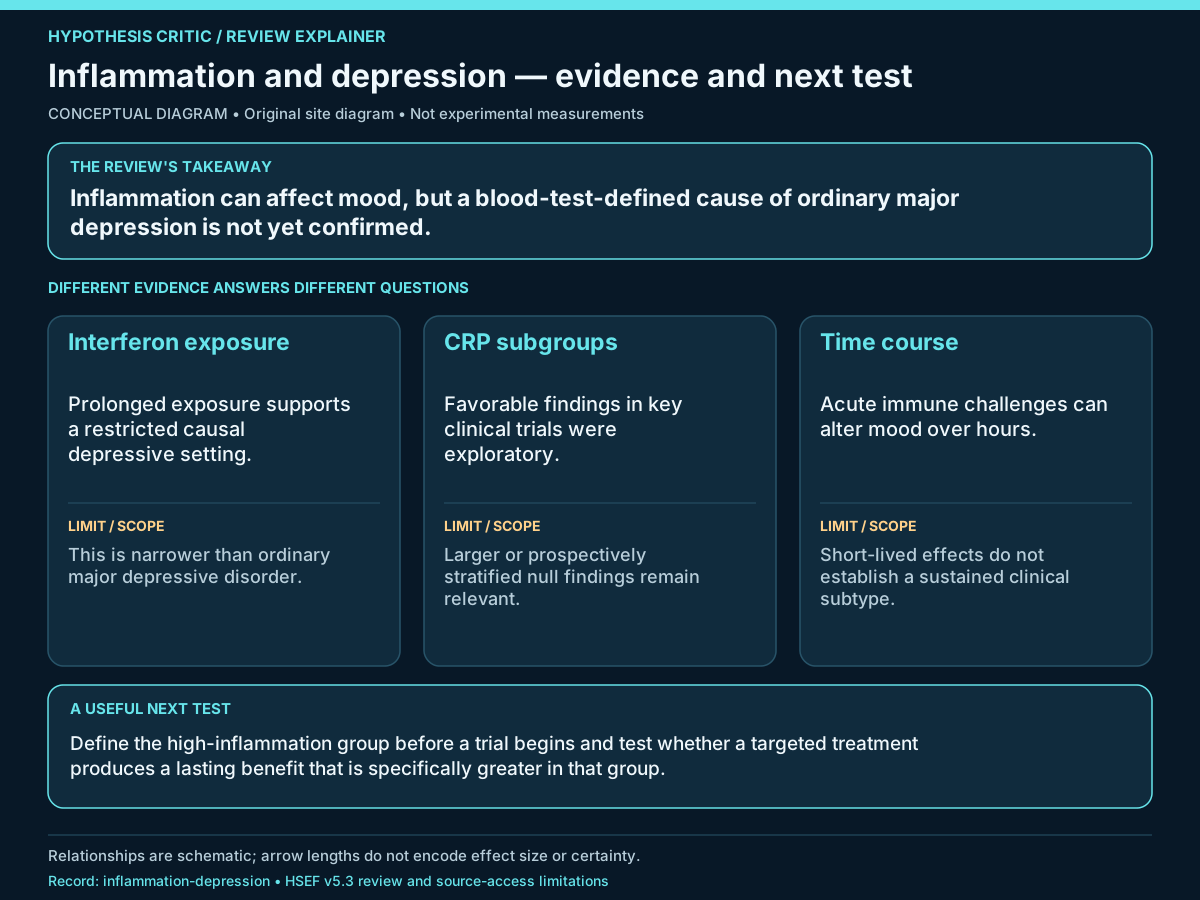
Inflammation and depression — evidence and next test
CONCEPTUAL DIAGRAM  •  Original site diagram  •  Not experimental measurements
THE REVIEW'S TAKEAWAY
Inflammation can affect mood, but a blood-test-defined cause of ordinary major depression is not yet confirmed.
DIFFERENT EVIDENCE ANSWERS DIFFERENT QUESTIONS
Interferon exposure
Prolonged exposure supports a restricted causal depressive setting.
LIMIT / SCOPE
This is narrower than ordinary major depressive disorder.
CRP subgroups
Favorable findings in key clinical trials were exploratory.
LIMIT / SCOPE
Larger or prospectively stratified null findings remain relevant.
Time course
Acute immune challenges can alter mood over hours.
LIMIT / SCOPE
Short-lived effects do not establish a sustained clinical subtype.
A USEFUL NEXT TEST
Define the high-inflammation group before a trial begins and test whether a targeted treatment produces a lasting benefit that is specifically greater in that group.
Relationships are schematic; arrow lengths do not encode effect size or certainty.
Record: inflammation-depression  •  HSEF v5.3 review and source-access limitations
Define the high-inflammation group before a trial begins and test whether a targeted treatment produces a lasting benefit that is specifically greater in that group.
Check that the intended change really happened.
Allow for other factors and compare with suitable controls.
Look for independent confirmation and the limits of the effect.
These are questions for research, not a claim that the proposed studies have already succeeded.
Proposed tests: 1 test design(s) are registered in the scorecard.
In plain terms, researchers would change the proposed cause, check that it changed as intended, then measure a meaningful outcome while controlling plausible alternatives. The result should be able to support or count against the claim—not only show that a pathway exists.
Study design: Prospectively registered marker-stratified MDD trial with a fixed assay/cut-off, powered treatment-by-marker interaction, selective immune-pathway engagement, matched clinical attention and blinded sustained clinical/function outcomes; compare a mechanistically distinct intervention and replicate independently. INSTA-MD addresses part of this design, but drug pleiotropy and target engagement still require examination.
What would be measured: Prespecified sustained MDD remission/course and separately measured function, with verified immune target engagement
Important controls: Baseline eligibility before outcome, multiplicity plan, expectancy/rater masking, metabolic illness/sleep/medication controls and independent replication
Result that would support the claim: Positive primary sustained clinical interaction in the prospectively fixed marker group, with target alignment and replicated mechanism discrimination
Result that would count against it: Precisely absent or opposite clinical benefit despite adequate selective engagement and powered prespecified interaction, without endpoint or responder redefinition
Follow the studies, detailed comparisons and evidence ratings behind this guide.
Open the scientific review →