The question
Are liquid-like protein droplets required to control gene activity?
This is the specific idea being tested.
Are liquid-like protein droplets required to control gene activity?
What you need to knowProtein assemblies help control genes without proving a liquid state is required.Relative explanatory fit: Alternative ranked ahead
Why the alternative fits better: Many weak contacts can stabilise gene-control reactions without a bulk liquid droplet.
Claim assessed: Endogenous transcriptional machinery forms liquid-liquid phase-separated condensates whose liquid state is required for transcription and is its primary organizing principle.
Finding: Weakest-link aggregation yields Γ. SC1 has clear physical capacity and native assemblies but incomplete phase diagnosis; SC2 has strong selected assembly/rescue evidence without cleanly isolating liquid state from affinity and composition; SC3 lacks representative native phase-specific primacy. Stronger levels for multivalency models are not transferred to the stricter LLPS conjunction.
Evidence scope: 64 primary reports; literature cutoff 2026-10-08; source examination UTC date 2026-10-09; bounded critical review, not exhaustive systematic review.
The grade applies to the stated claim. Model rankings and individual subclaim grades remain separate from the overall causal-evidence grade.
Full scientific assessment and references · Scorecard (JSON) · Review source (Markdown)
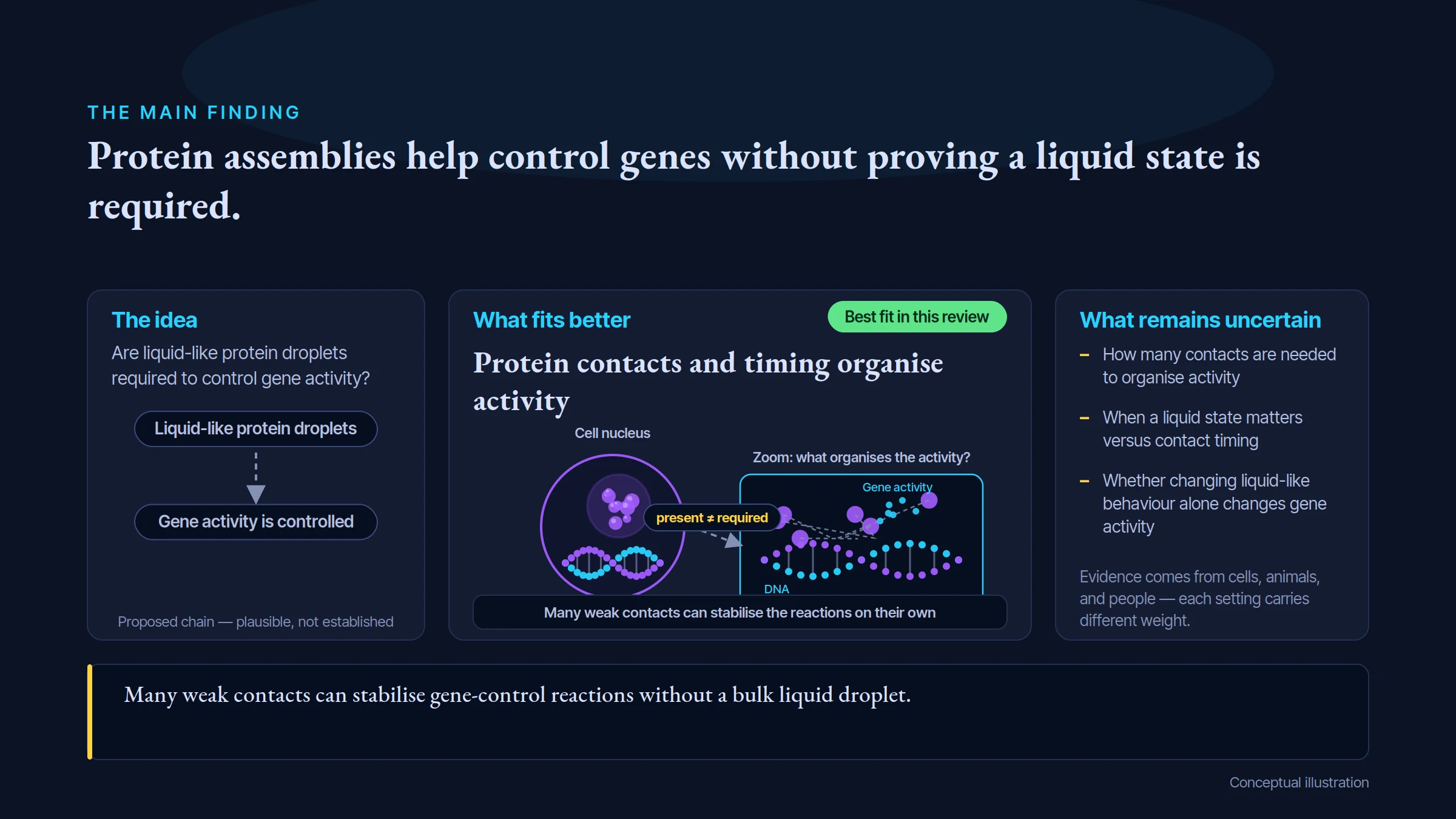
THE MAIN FINDING
Protein assemblies help control genes without proving a liquid state is required.
The idea
Are liquid-like protein droplets required to control gene activity?
Liquid-like protein droplets
Gene activity is controlled
Proposed chain — plausible, not established
What fits better
Best fit in this review
Protein contacts and timing organise activity
Cell nucleus
Droplets are seen in the nucleus
Zoom: what organises the activity?
DNA
Gene activity
Present does not mean required
Many weak contacts can stabilise the reactions on their own
What remains uncertain
How many contacts are needed to organise activity
When a liquid state matters versus contact timing
Whether changing liquid-like behaviour alone changes gene activity
Evidence comes from cells, animals, and people — each setting carries different weight.
Many weak contacts can stabilise gene-control reactions without a bulk liquid droplet.
Conceptual illustration
This is the specific idea being tested.
Many weak contacts can stabilise gene-control reactions without a bulk liquid droplet.
A higher rank means a better fit to the evidence in this comparison. It does not prove every part of the leading explanation.
The reviewed hypothesis ranks 5 among 5 models compared; 1 alternative model(s) hold first rank for this stated claim.
Claim under review: rank 5 among 5 compared models.
Leading explanation: Multivalent residence-time kinetic proofreading.
Position in this comparison: Last recorded rank.
The causal grade asks how well the stated causal claim is established. This comparison asks which of the assessed explanations fits the reviewed findings better. A leading explanation can remain unproven. Models can overlap or include the tested mechanism; an alternative ahead does not make that mechanism irrelevant. These ordinal ranks apply within this review; they do not measure the size of a difference or rank scientific strength across topics.
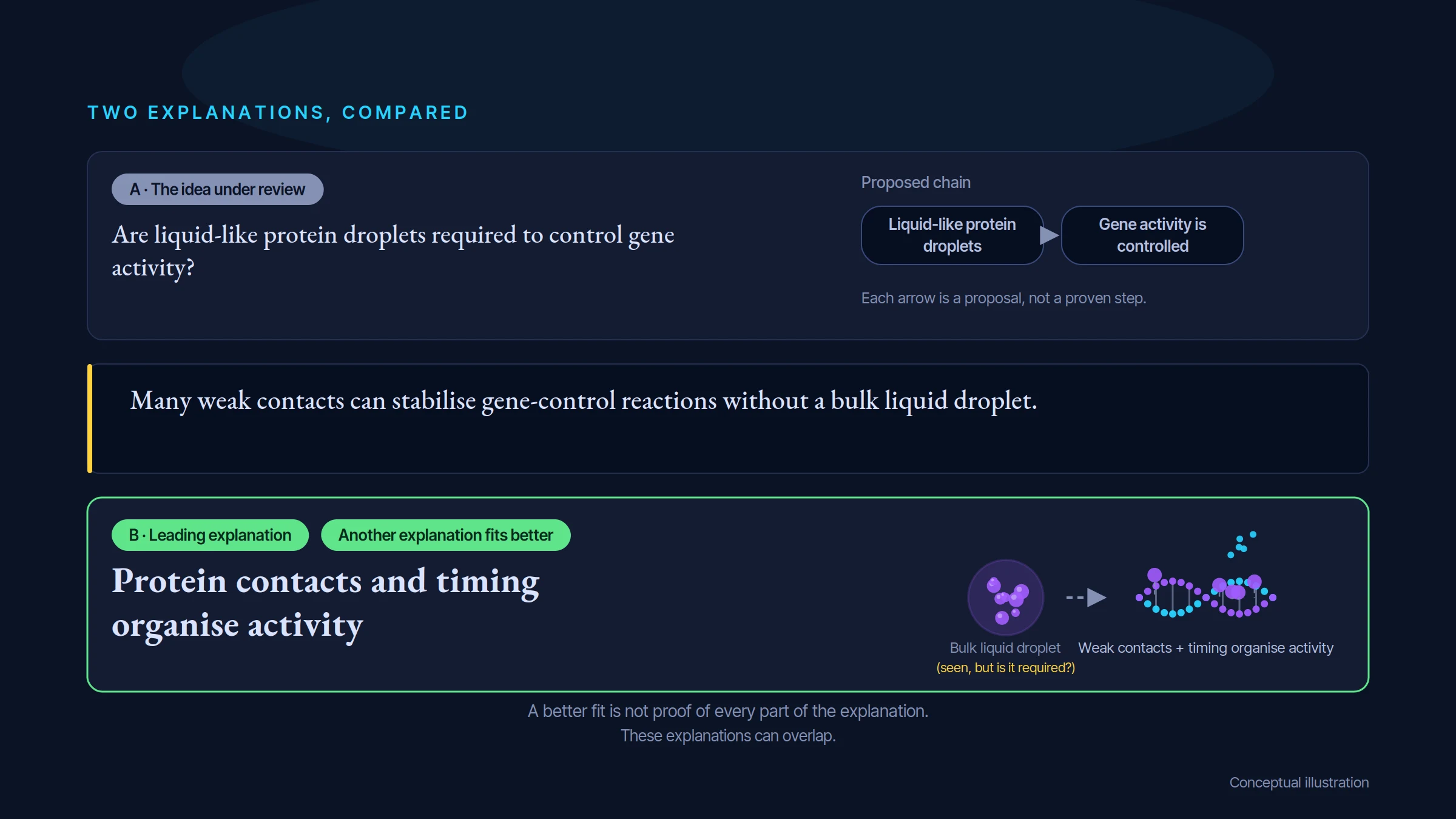
TWO EXPLANATIONS, COMPARED
A · The idea under review
Are liquid-like protein droplets required to control gene activity?
Proposed chain
Liquid-like protein droplets
Gene activity is controlled
Each arrow is a proposal, not a proven step.
Many weak contacts can stabilise gene-control reactions without a bulk liquid droplet.
B · Leading explanation
Another explanation fits better
Protein contacts and timing organise activity
Bulk liquid droplet
Seen, but is it required?
Weak contacts and timing organise activity
A better fit is not proof of every part of the explanation.
These explanations can overlap.
Conceptual illustration
Plausible, not established for the stated claim.
Many weak contacts can stabilise gene-control reactions without a bulk liquid droplet.
These explanations can overlap. Ranking their fit to the evidence is separate from deciding how firmly a cause has been established.
Rank 1: Multivalent residence-time kinetic proofreading — Weak cooperative interactions stabilize recruitment and reaction timing without requiring a bulk liquid phase.
Rank 2: DNA-mediated dynamic hubs — DNA binding and cofactor networks nucleate finite dynamic assemblies.
Rank 3: Phase separation coupled to percolation — Composition-dependent networks can cooperate with, or oppose, phase separation and transcription.
Rank 4: Chromatin bridging-induced clustering — Binding of multiple chromatin segments creates concentration and contact enrichment without bulk LLPS.
Rank 5: Classical liquid-liquid transcriptional condensates — Distinct liquid phases broadly organize and are required for active transcription.
Evidence rating: Γ · Moderate confidence. How the evidence was assessed.
Many weak contacts can stabilise gene-control reactions without a bulk liquid droplet.
Weakest-link aggregation yields Γ. SC1 has clear physical capacity and native assemblies but incomplete phase diagnosis; SC2 has strong selected assembly/rescue evidence without cleanly isolating liquid state from affinity and composition; SC3 lacks representative native phase-specific primacy. Stronger levels for multivalency models are not transferred to the stricter LLPS conjunction.
Look for the proposed factor and the outcome, in the people or systems covered by the claim.
Protein contacts and timing organise activity. Many weak contacts can stabilise gene-control reactions without a bulk liquid droplet.
Change liquid-like behaviour while keeping protein contacts and gene binding matched, then measure gene activity.
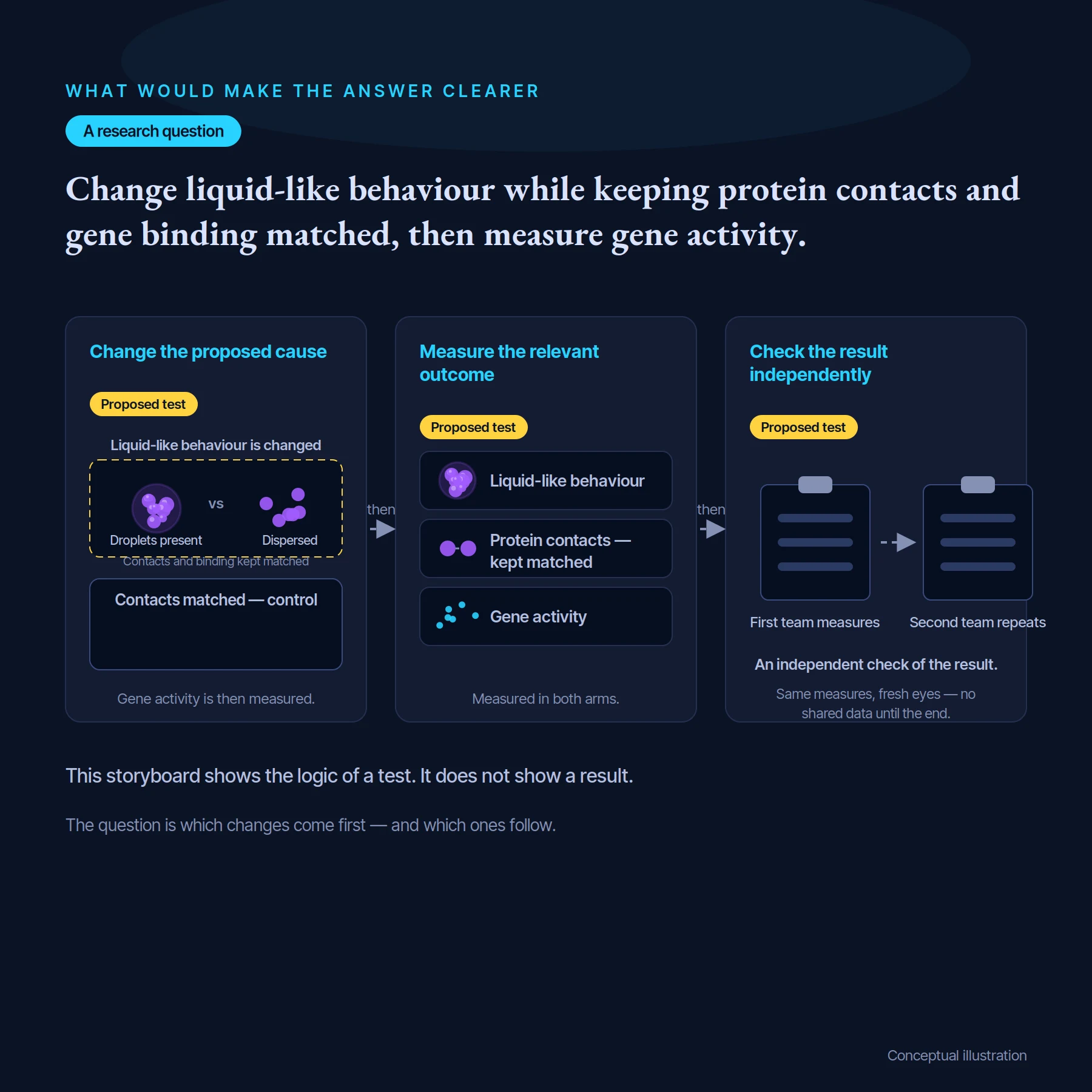
WHAT WOULD MAKE THE ANSWER CLEARER
A research question
Change liquid-like behaviour while keeping protein contacts and gene binding matched, then measure gene activity.
then
then
Change the proposed cause
Proposed test
Liquid-like behaviour is changed
Droplets present
Droplets dispersed
Contacts and binding kept matched
Contacts matched — control
Gene activity is then measured.
Measure the relevant outcome
Proposed test
Liquid-like behaviour
Protein contacts — kept matched
Gene activity
Measured in both arms.
Check the result independently
Proposed test
First team measures
Second team repeats
An independent check of the result.
Same measures, fresh eyes — no shared data until the end.
This storyboard shows the logic of a test. It does not show a result.
The question is which changes come first — and which ones follow.
Conceptual illustration
Change liquid-like behaviour while keeping protein contacts and gene binding matched, then measure gene activity.
Check that the intended change really happened.
Allow for other factors and compare with suitable controls.
Look for independent confirmation and the limits of the effect.
These are questions for research, not a claim that the proposed studies have already succeeded.
Proposed tests: 1 test design(s) are registered in the scorecard.
In plain terms, researchers would change the proposed cause, check that it changed as intended, then measure a meaningful outcome while controlling plausible alternatives. The result should be able to support or count against the claim—not only show that a pathway exists.
Study design: Reversible native material-state tuning with independently matched binding and cofactor recruitment
What would be measured: Quantitative endogenous state diagnostics, molecule abundance/occupancy, nascent burst rates, elongation and viability in the same prespecified loci/cells.
Important controls: Biochemical-only versus state-only mutants with orthogonal matched rescue; tag-free confirmation and alcohol-free perturbation.
Result that would support the claim: State-only loss suppresses nascent output despite unchanged chemistry/occupancy and state restoration rescues across independent lineages.
Result that would count against it: Output follows binding or cofactor chemistry while state changes are neutral or inhibitory, or rescue works without liquid-phase restoration.
Follow the studies, detailed comparisons and evidence ratings behind this guide.
Open the scientific review →