The question
Can conditions before birth change a person's risk of chronic disease as an adult?
This is the specific idea being tested.
Can conditions before birth change a person's risk of chronic disease as an adult?
What you need to knowPrenatal conditions can affect later disease risk, but birthweight alone does not prove the cause or determine the future.Relative explanatory fit: Alternative ranked ahead
Why the alternative fits better: Controlled animal studies and human natural experiments support effects of some prenatal exposures. Genetic comparisons, studies with no effect and improvements after birth show why this is not one fixed programme that applies to everyone.
For health decisions: Prenatal care and nutrition matter, but birthweight is not a forecast of a person's health or evidence that a parent caused a later illness.
Claim assessed: Nutritional and hormonal exposures during fetal development causally programme adult chronic disease risk.
Finding: The registered primary SC3 yields Ε: defined prenatal exposures have human causal support, while internal and external negatives map limits to generalization. SC1 retains Β and controlled developmental SC2 retains Ε. This judgment uses an explicit closest-rubric adaptation because the literal aging-specific requirement is inapplicable to the developmental claim. The absence of a human deprivation RCT does not itself cap valid natural experiments; independence and specificity, rather than an observational label alone, block Ζ at the broad exposure class.
Evidence scope: 66 primary reports; literature cutoff 2026-10-09; source examination UTC date 2026-10-12; bounded critical review, not exhaustive systematic review.
The grade applies to the stated claim. Model rankings and individual subclaim grades remain separate from the overall causal-evidence grade.
Full scientific assessment and references · Scorecard (JSON) · Review source (Markdown)
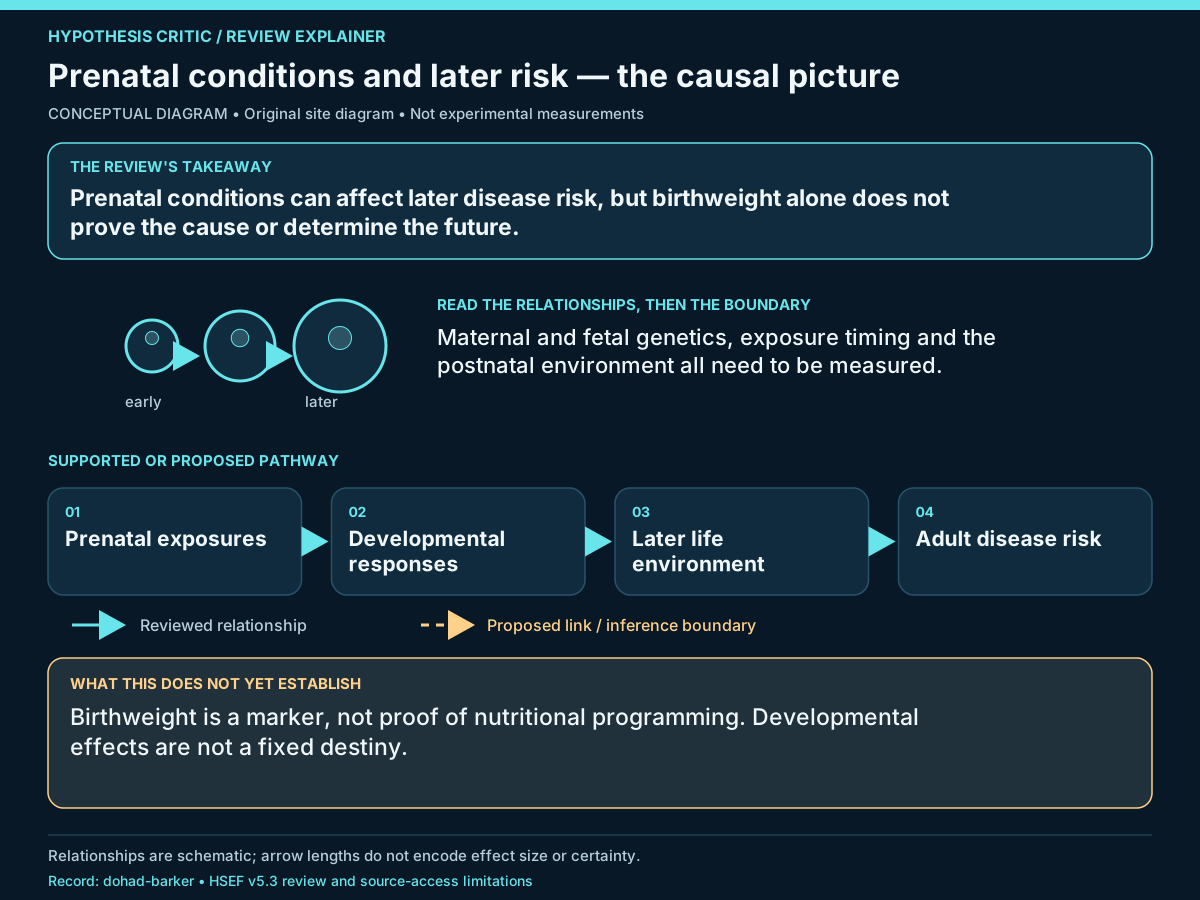
HYPOTHESIS CRITIC  /  REVIEW EXPLAINER
Prenatal conditions and later risk — the causal picture
CONCEPTUAL DIAGRAM  •  Original site diagram  •  Not experimental measurements
THE REVIEW'S TAKEAWAY
Prenatal conditions can affect later disease risk, but birthweight alone does not prove the cause or determine the future.
early
later
READ THE RELATIONSHIPS, THEN THE BOUNDARY
Maternal and fetal genetics, exposure timing and the postnatal environment all need to be measured.
SUPPORTED OR PROPOSED PATHWAY
01
Prenatal exposures
02
Developmental responses
03
Later life environment
04
Adult disease risk
Reviewed relationship
Proposed link / inference boundary
WHAT THIS DOES NOT YET ESTABLISH
Birthweight is a marker, not proof of nutritional programming. Developmental effects are not a fixed destiny.
Relationships are schematic; arrow lengths do not encode effect size or certainty.
Record: dohad-barker  •  HSEF v5.3 review and source-access limitations
This is the specific idea being tested.
Controlled animal studies and human natural experiments support effects of some prenatal exposures. Genetic comparisons, studies with no effect and improvements after birth show why this is not one fixed programme that applies to everyone.
A higher rank means a better fit to the evidence in this comparison. It does not prove every part of the leading explanation.
The reviewed hypothesis ranks 2 among 4 models compared; 1 alternative model(s) hold first rank for this stated claim.
Claim under review: rank 2 among 4 compared models.
Leading explanation: Exposure-specific programming with postnatal modification.
Position in this comparison: Next after leading rank.
The causal grade asks how well the stated causal claim is established. This comparison asks which of the assessed explanations fits the reviewed findings better. A leading explanation can remain unproven. Models can overlap or include the tested mechanism; an alternative ahead does not make that mechanism irrelevant. These ordinal ranks apply within this review; they do not measure the size of a difference or rank scientific strength across topics.
HYPOTHESIS CRITIC  /  REVIEW EXPLAINER
Prenatal conditions and later risk — compare explanations
CONCEPTUAL DIAGRAM  •  Original site diagram  •  Not experimental measurements
THE REVIEW'S TAKEAWAY
Prenatal conditions can affect later disease risk, but birthweight alone does not prove the cause or determine the future.
CLAIM / SIMPLE EXPLANATION
01
Prenatal nutrition / hormones
02
Persistent developmental effects
03
Adult chronic disease risk
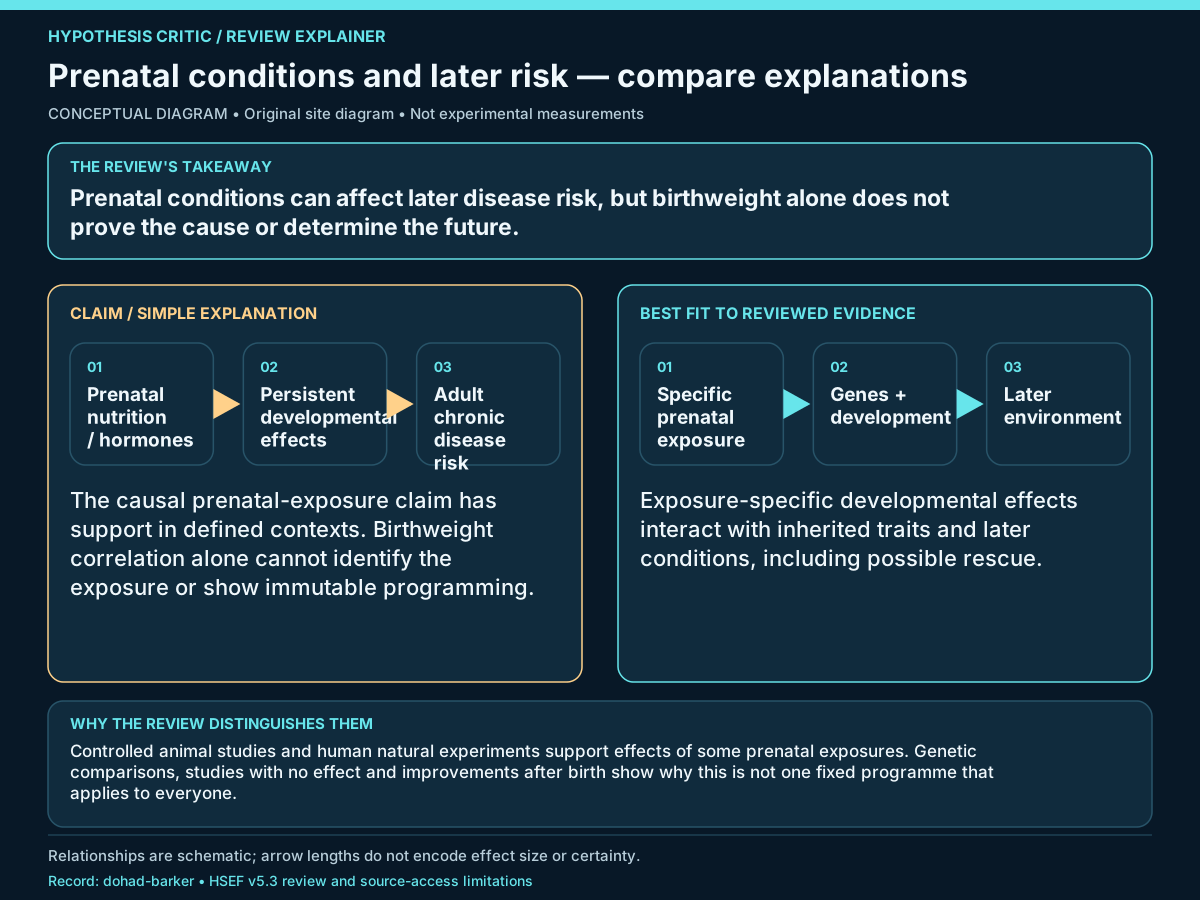
The causal prenatal-exposure claim has support in defined contexts. Birthweight correlation alone cannot identify the exposure or show immutable programming.
BEST FIT TO REVIEWED EVIDENCE
01
Specific prenatal exposure
02
Genes + development
03
Later environment
Exposure-specific developmental effects interact with inherited traits and later conditions, including possible rescue.
WHY THE REVIEW DISTINGUISHES THEM
Controlled animal studies and human natural experiments support effects of some prenatal exposures. Genetic comparisons, studies with no effect and improvements after birth show why this is not one fixed programme that applies to everyone.
Relationships are schematic; arrow lengths do not encode effect size or certainty.
Record: dohad-barker  •  HSEF v5.3 review and source-access limitations
Causal in a specific setting for the stated claim.
Controlled animal studies and human natural experiments support effects of some prenatal exposures. Genetic comparisons, studies with no effect and improvements after birth show why this is not one fixed programme that applies to everyone.
These explanations can overlap. Ranking their fit to the evidence is separate from deciding how firmly a cause has been established.
Rank 1: Exposure-specific programming with postnatal modification — Different prenatal insults establish modifiable susceptibility rather than one universal immutable programme.
Rank 2: Fetal nutritional and hormonal programming — Prenatal nutrition and endocrine state causally alter durable adult physiological and disease risk.
Rank 3: Shared maternal and fetal genetic determinants — Inherited cardiometabolic alleles and maternal physiology generate part of the birth-size/adult-risk association.
Rank 4: Postnatal growth and lifelong environment — Nursing, catch-up growth and adult adiposity account for or modify apparent prenatal risk.
Evidence rating: Ε · Moderate confidence. How the evidence was assessed.
Controlled animal studies and human natural experiments support effects of some prenatal exposures. Genetic comparisons, studies with no effect and improvements after birth show why this is not one fixed programme that applies to everyone.
Pregnancy care includes nutrition, assessment and prevention tailored to the mother and baby. The review supports effects of some prenatal conditions, not a guarantee that any one exposure will cause later disease. Birthweight reflects several influences and cannot identify a nutritional cause by itself. Inherited traits and life after birth also matter, so later health is not fixed at birth.
Further reading: WHO: pregnancy care.
Look for the proposed factor and the outcome, in the people or systems covered by the claim.
Particular prenatal exposures interact with inherited traits and life after birth. Controlled animal studies and human natural experiments support effects of some prenatal exposures. Genetic comparisons, studies with no effect and improvements after birth show why this is not one fixed programme that applies to everyone.
Study a well-defined prenatal exposure while accounting for family and genetic factors, and follow adult health outcomes rather than relying on birthweight alone.
HYPOTHESIS CRITIC  /  REVIEW EXPLAINER
Prenatal conditions and later risk — evidence and next test
CONCEPTUAL DIAGRAM  •  Original site diagram  •  Not experimental measurements
THE REVIEW'S TAKEAWAY
Prenatal conditions can affect later disease risk, but birthweight alone does not prove the cause or determine the future.
DIFFERENT EVIDENCE ANSWERS DIFFERENT QUESTIONS
Animal interventions
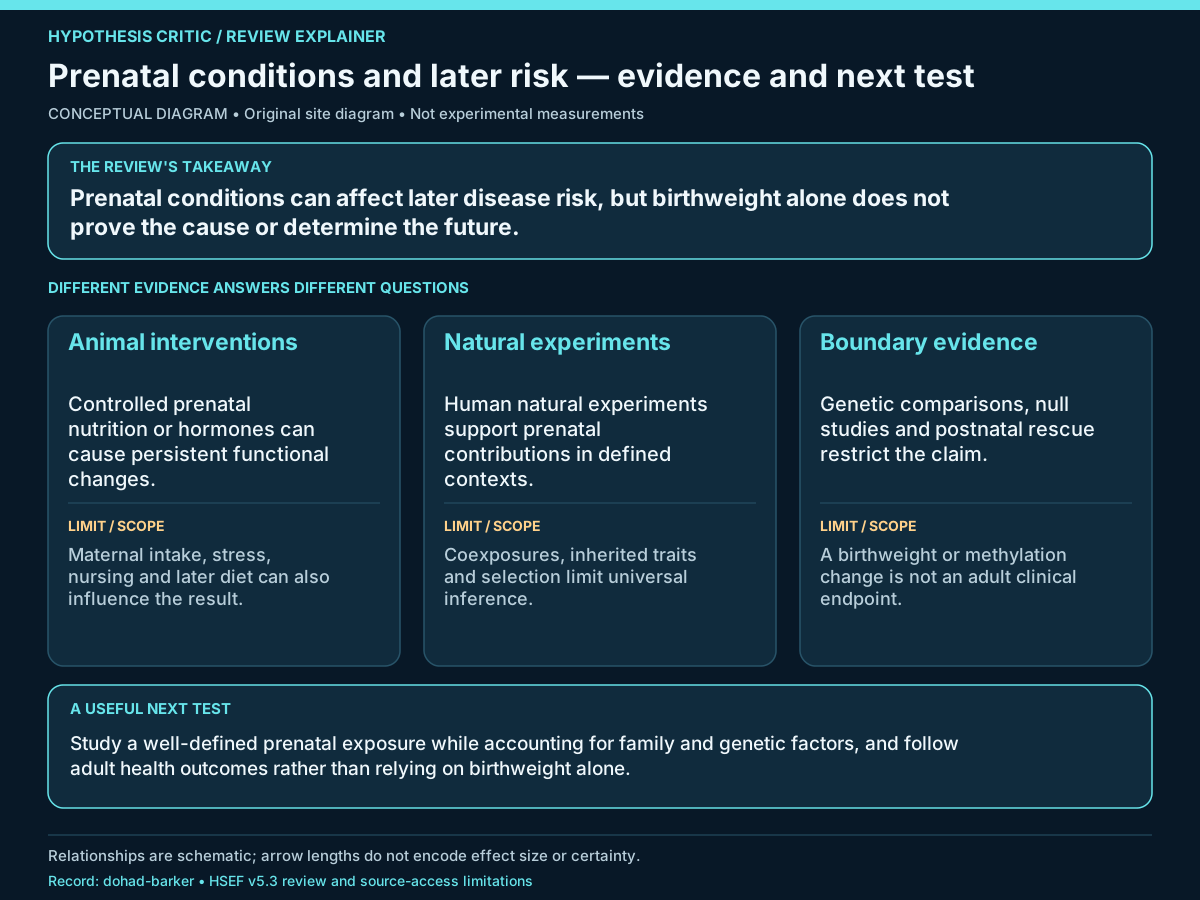
Controlled prenatal nutrition or hormones can cause persistent functional changes.
LIMIT / SCOPE
Maternal intake, stress, nursing and later diet can also influence the result.
Natural experiments
Human natural experiments support prenatal contributions in defined contexts.
LIMIT / SCOPE
Coexposures, inherited traits and selection limit universal inference.
Boundary evidence
Genetic comparisons, null studies and postnatal rescue restrict the claim.
LIMIT / SCOPE
A birthweight or methylation change is not an adult clinical endpoint.
A USEFUL NEXT TEST
Study a well-defined prenatal exposure while accounting for family and genetic factors, and follow adult health outcomes rather than relying on birthweight alone.
Relationships are schematic; arrow lengths do not encode effect size or certainty.
Record: dohad-barker  •  HSEF v5.3 review and source-access limitations
Study a well-defined prenatal exposure while accounting for family and genetic factors, and follow adult health outcomes rather than relying on birthweight alone.
Check that the intended change really happened.
Allow for other factors and compare with suitable controls.
Look for independent confirmation and the limits of the effect.
These are questions for research, not a claim that the proposed studies have already succeeded.
Proposed tests: 1 test design(s) are registered in the scorecard.
In plain terms, researchers would change the proposed cause, check that it changed as intended, then measure a meaningful outcome while controlling plausible alternatives. The result should be able to support or count against the claim—not only show that a pathway exists.
Study design: Follow a prospectively defined prenatal exposure intervention or credible policy natural experiment into adult incident disease, with fetal/maternal genotype and sibling/paternal controls, prespecified sex/window contrasts, quantified postnatal nutrition and selection. Pair it with cross-species prenatal mediator loss and selective rescue while matching maternal intake, stress and lactation. Retain all enrolled exposure groups and telemetry/function outcomes rather than selecting responders or counting epigenetic marks as clinical proof.
What would be measured: Adult incident diabetes/CAD and validated adult metabolic or vascular function; independently quantified exposure and mediator engagement
Important controls: Fetal versus maternal genotype, birth order/parental age, war or socioeconomic coexposures, conception/live-birth/follow-up selection, litter/husbandry, pair feeding, nursing and later diet, sex/window and multiple testing
Result that would support the claim: Concordant prespecified exposure effects survive genetic/family/selection control and selective mediator loss/rescue reproduces adult functional effect
Result that would count against it: Direct exposure manipulation changes birthweight or methylation but not adult disease; inherited genotype or later environment explains the apparent clinical relation
Follow the studies, detailed comparisons and evidence ratings behind this guide.
Open the scientific review →