The question
Does widening veins for proposed CCSVI improve disability or disease activity in multiple sclerosis?
This is the specific idea being tested.

Does widening veins for proposed CCSVI improve disability or disease activity in multiple sclerosis?
What you need to knowTrials with a sham procedure have not established the claimed clinical benefit; a later brain-scan finding remains a limited research lead.Relative explanatory fit: Alternative ranked ahead
Why the alternative fits better: Blinded trials found that the vein procedure did not produce the claimed clinical improvements beyond the comparison procedure. Incomplete blood-flow correction and limited trial size leave some questions open. A positive later scan analysis came from the same trial and does not establish better disability outcomes or independent confirmation.
For health decisions: A change on a brain scan is not proof of improved daily function; the vein procedure has not demonstrated the claimed MS disability benefit.
Claim assessed: Correcting chronic cerebrospinal venous insufficiency with venoplasty improves multiple-sclerosis disability and disease activity.
Finding: Preregistered primary-SC3 aggregation returns Β: meaningful flow/MRI evidence is retained, but clinical benefit is not demonstrated and sham improvement supplies a more parsimonious explanation for uncontrolled subjective response. A single Step11 downgrade from the Γ mechanistic/proxy starting point is explicit. Weakest-link aggregation would return Α because SC1 universal reproducibility/specificity fails; procedural injury Ε is separate and cannot determine a benefit score.
Evidence scope: 69 primary reports; literature cutoff 2026-10-12; source examination UTC date 2026-10-12; bounded critical review, not exhaustive systematic review.
The grade applies to the stated claim. Model rankings and individual subclaim grades remain separate from the overall causal-evidence grade.
Full scientific assessment and references · Scorecard (JSON) · Review source (Markdown)
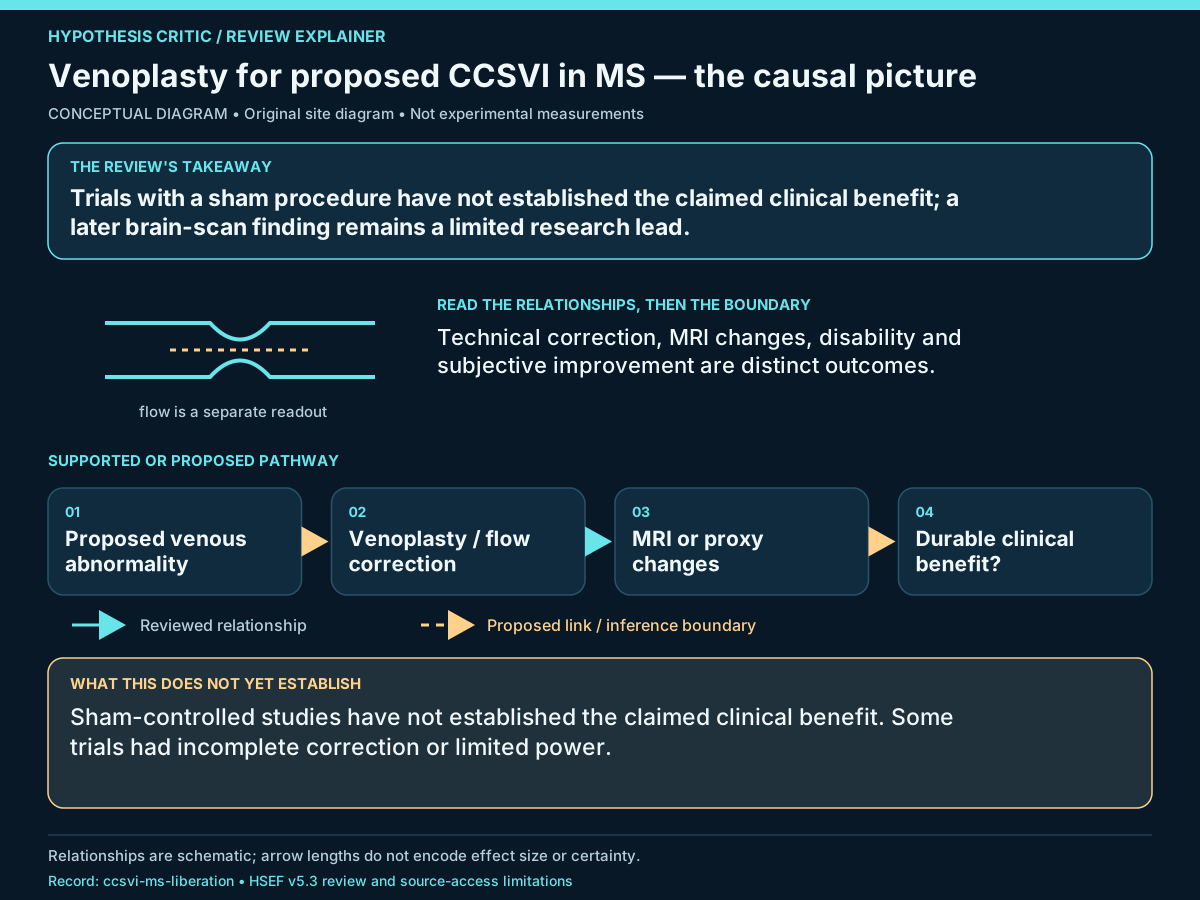
HYPOTHESIS CRITIC  /  REVIEW EXPLAINER
Venoplasty for proposed CCSVI in MS — the causal picture
CONCEPTUAL DIAGRAM  •  Original site diagram  •  Not experimental measurements
THE REVIEW'S TAKEAWAY
Trials with a sham procedure have not established the claimed clinical benefit; a later brain-scan finding remains a limited research lead.
flow is a separate readout
READ THE RELATIONSHIPS, THEN THE BOUNDARY
Technical correction, MRI changes, disability and subjective improvement are distinct outcomes.
SUPPORTED OR PROPOSED PATHWAY
01
Proposed venous abnormality
02
Venoplasty / flow correction
03
MRI or proxy changes
04
Durable clinical benefit?
Reviewed relationship
Proposed link / inference boundary
WHAT THIS DOES NOT YET ESTABLISH
Sham-controlled studies have not established the claimed clinical benefit. Some trials had incomplete correction or limited power.
Relationships are schematic; arrow lengths do not encode effect size or certainty.
Record: ccsvi-ms-liberation  •  HSEF v5.3 review and source-access limitations
This is the specific idea being tested.
Blinded trials found that the vein procedure did not produce the claimed clinical improvements beyond the comparison procedure. Incomplete blood-flow correction and limited trial size leave some questions open. A positive later scan analysis came from the same trial and does not establish better disability outcomes or independent confirmation.
A higher rank means a better fit to the evidence in this comparison. It does not prove every part of the leading explanation.
The reviewed hypothesis ranks 4 among 4 models compared; 1 alternative model(s) hold first rank for this stated claim.
Claim under review: rank 4 among 4 compared models.
Leading explanation: Expectation, regression and treatment selection.
Position in this comparison: Last recorded rank.
The causal grade asks how well the stated causal claim is established. This comparison asks which of the assessed explanations fits the reviewed findings better. A leading explanation can remain unproven. Models can overlap or include the tested mechanism; an alternative ahead does not make that mechanism irrelevant. These ordinal ranks apply within this review; they do not measure the size of a difference or rank scientific strength across topics.
HYPOTHESIS CRITIC  /  REVIEW EXPLAINER
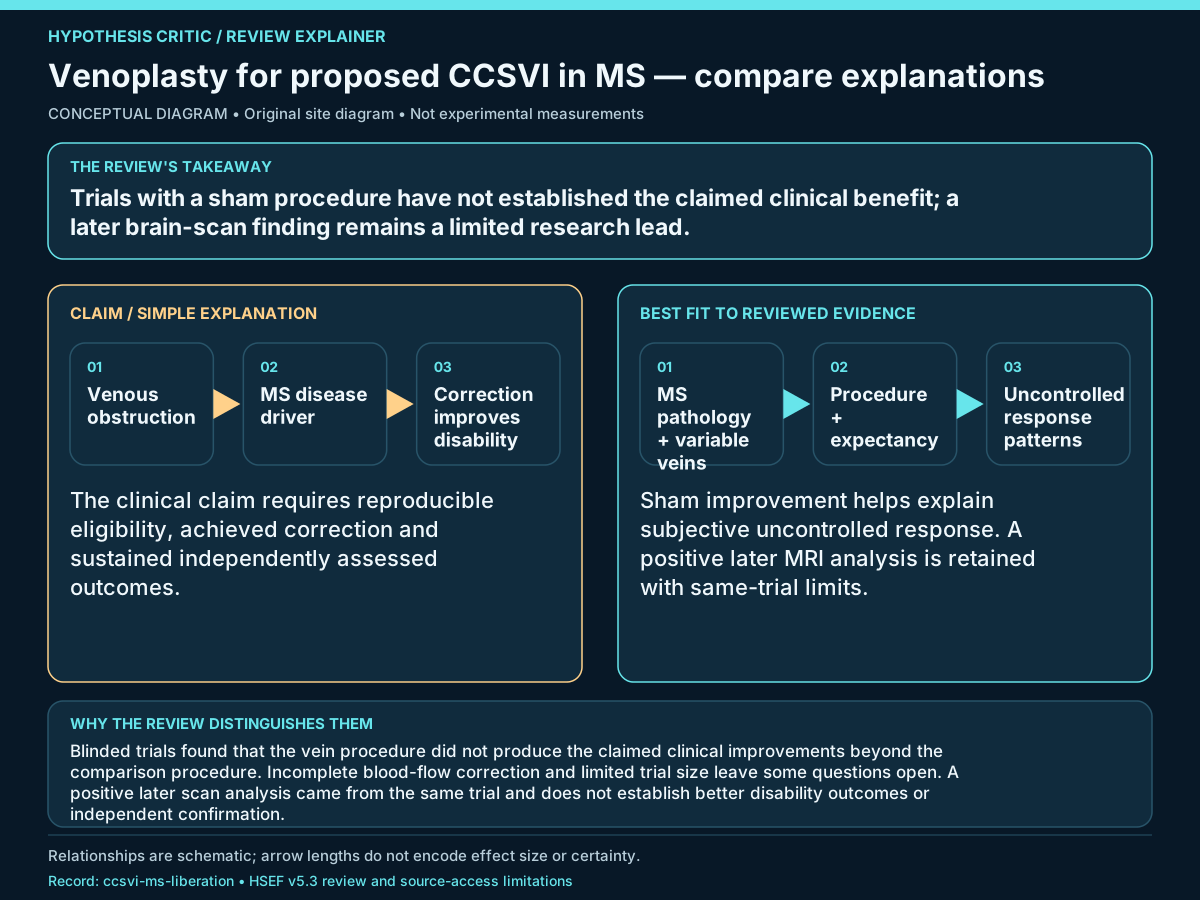
Venoplasty for proposed CCSVI in MS — compare explanations
CONCEPTUAL DIAGRAM  •  Original site diagram  •  Not experimental measurements
THE REVIEW'S TAKEAWAY
Trials with a sham procedure have not established the claimed clinical benefit; a later brain-scan finding remains a limited research lead.
CLAIM / SIMPLE EXPLANATION
01
Venous obstruction
02
MS disease driver
03
Correction improves disability
The clinical claim requires reproducible eligibility, achieved correction and sustained independently assessed outcomes.
BEST FIT TO REVIEWED EVIDENCE
01
MS pathology + variable veins
02
Procedure + expectancy
03
Uncontrolled response patterns
Sham improvement helps explain subjective uncontrolled response. A positive later MRI analysis is retained with same-trial limits.
WHY THE REVIEW DISTINGUISHES THEM
Blinded trials found that the vein procedure did not produce the claimed clinical improvements beyond the comparison procedure. Incomplete blood-flow correction and limited trial size leave some questions open. A positive later scan analysis came from the same trial and does not establish better disability outcomes or independent confirmation.
Relationships are schematic; arrow lengths do not encode effect size or certainty.
Record: ccsvi-ms-liberation  •  HSEF v5.3 review and source-access limitations
Association only for the stated claim.
Blinded trials found that the vein procedure did not produce the claimed clinical improvements beyond the comparison procedure. Incomplete blood-flow correction and limited trial size leave some questions open. A positive later scan analysis came from the same trial and does not establish better disability outcomes or independent confirmation.
These explanations can overlap. Ranking their fit to the evidence is separate from deciding how firmly a cause has been established.
Rank 1: Expectation, regression and treatment selection — Uncontrolled symptom improvement can arise from nonspecific procedural response and selective treatment seeking.
Rank 2: Physiological variation and operator-dependent diagnosis — Normal calibre/flow variation and acquisition or interpretation differences account for many CCSVI classifications.
Rank 3: Inflammatory MS with secondary vascular changes — Inflammatory demyelination can coexist with secondary or age-related vascular changes.
Rank 4: CCSVI is a treatable driver of MS — Venous obstruction drives inflammatory pathology and its correction improves disability and activity.
Evidence rating: Β · Moderate confidence. How the evidence was assessed.
Blinded trials found that the vein procedure did not produce the claimed clinical improvements beyond the comparison procedure. Incomplete blood-flow correction and limited trial size leave some questions open. A positive later scan analysis came from the same trial and does not establish better disability outcomes or independent confirmation.
The reviewed sham-controlled trials do not establish that venoplasty improves MS disability or day-to-day function. A positive later MRI analysis remains a bounded lead rather than proof of that clinical benefit. The procedure can also cause vascular or device complications, and balloon-only protocols differ from stent procedures. These findings do not support treating it as a proven replacement for MS care.
Further reading: Primary study: sham-controlled venoplasty trial.
Look for the proposed factor and the outcome, in the people or systems covered by the claim.
Some reported improvements can reflect expectations and treatment selection, while vein findings vary between people. Blinded trials found that the vein procedure did not produce the claimed clinical improvements beyond the comparison procedure. Incomplete blood-flow correction and limited trial size leave some questions open. A positive later scan analysis came from the same trial and does not establish better disability outcomes or independent confirmation.
Any justified new study would define eligibility in advance, verify sustained blood-flow correction and compare independently assessed clinical outcomes against a credible sham procedure while preserving MS care.
HYPOTHESIS CRITIC  /  REVIEW EXPLAINER
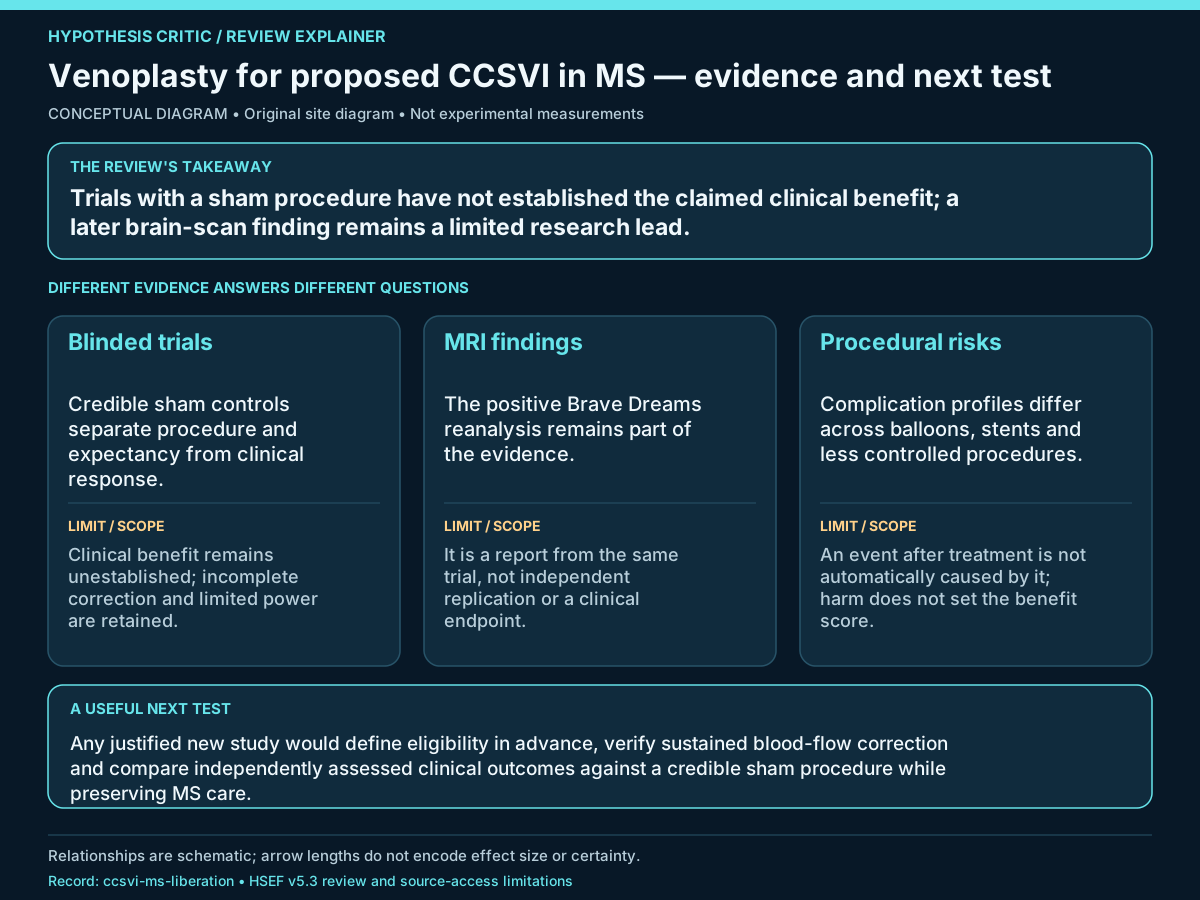
Venoplasty for proposed CCSVI in MS — evidence and next test
CONCEPTUAL DIAGRAM  •  Original site diagram  •  Not experimental measurements
THE REVIEW'S TAKEAWAY
Trials with a sham procedure have not established the claimed clinical benefit; a later brain-scan finding remains a limited research lead.
DIFFERENT EVIDENCE ANSWERS DIFFERENT QUESTIONS
Blinded trials
Credible sham controls separate procedure and expectancy from clinical response.
LIMIT / SCOPE
Clinical benefit remains unestablished; incomplete correction and limited power are retained.
MRI findings
The positive Brave Dreams reanalysis remains part of the evidence.
LIMIT / SCOPE
It is a report from the same trial, not independent replication or a clinical endpoint.
Procedural risks
Complication profiles differ across balloons, stents and less controlled procedures.
LIMIT / SCOPE
An event after treatment is not automatically caused by it; harm does not set the benefit score.
A USEFUL NEXT TEST
Any justified new study would define eligibility in advance, verify sustained blood-flow correction and compare independently assessed clinical outcomes against a credible sham procedure while preserving MS care.
Relationships are schematic; arrow lengths do not encode effect size or certainty.
Record: ccsvi-ms-liberation  •  HSEF v5.3 review and source-access limitations
Any justified new study would define eligibility in advance, verify sustained blood-flow correction and compare independently assessed clinical outcomes against a credible sham procedure while preserving MS care.
Check that the intended change really happened.
Allow for other factors and compare with suitable controls.
Look for independent confirmation and the limits of the effect.
These are questions for research, not a claim that the proposed studies have already succeeded.
Proposed tests: 1 test design(s) are registered in the scorecard.
In plain terms, researchers would change the proposed cause, check that it changed as intended, then measure a meaningful outcome while controlling plausible alternatives. The result should be able to support or count against the claim—not only show that a pathway exists.
Study design: If a scientifically and ethically justified study is contemplated, prospectively fix anatomical/pressure entry criteria and MS stage, verify sustained flow correction, randomize balloon venoplasty versus convincing sham with stable usual therapy and adequate clinical power, and test prespecified functional/relapse outcomes alongside MRI without conditioning on post-treatment responders.
What would be measured: Sustained blinded target flow/pressure, disability function, relapses, MRI lesions and separately attributed vascular/device complications
Important controls: Sham blinding assessment, stable disease-modifying therapy, independent venographic/flow adjudication, intention-to-treat analysis, prespecified anatomy interaction, collateral physiology and procedure-denominator safety follow-up
Result that would support the claim: Meaningful clinical advantage over sham with sustained engagement, prospective anatomical effect modification and independent replication
Result that would count against it: No clinical separation despite reliable target correction, or only exploratory MRI/subjective changes without functional benefit
Follow the studies, detailed comparisons and evidence ratings behind this guide.
Open the scientific review →