The question
Is free-radical damage the main cause of ageing, and can antioxidants slow it?
This is the specific idea being tested.
Is free-radical damage the main cause of ageing, and can antioxidants slow it?
What you need to knowFree radicals can damage cells, but reducing them is not established as a general way to slow human ageing.Relative explanatory fit: Alternative ranked ahead
Why the alternative fits better: Ageing involves several kinds of damage and repair. Free radicals can also carry useful signals.
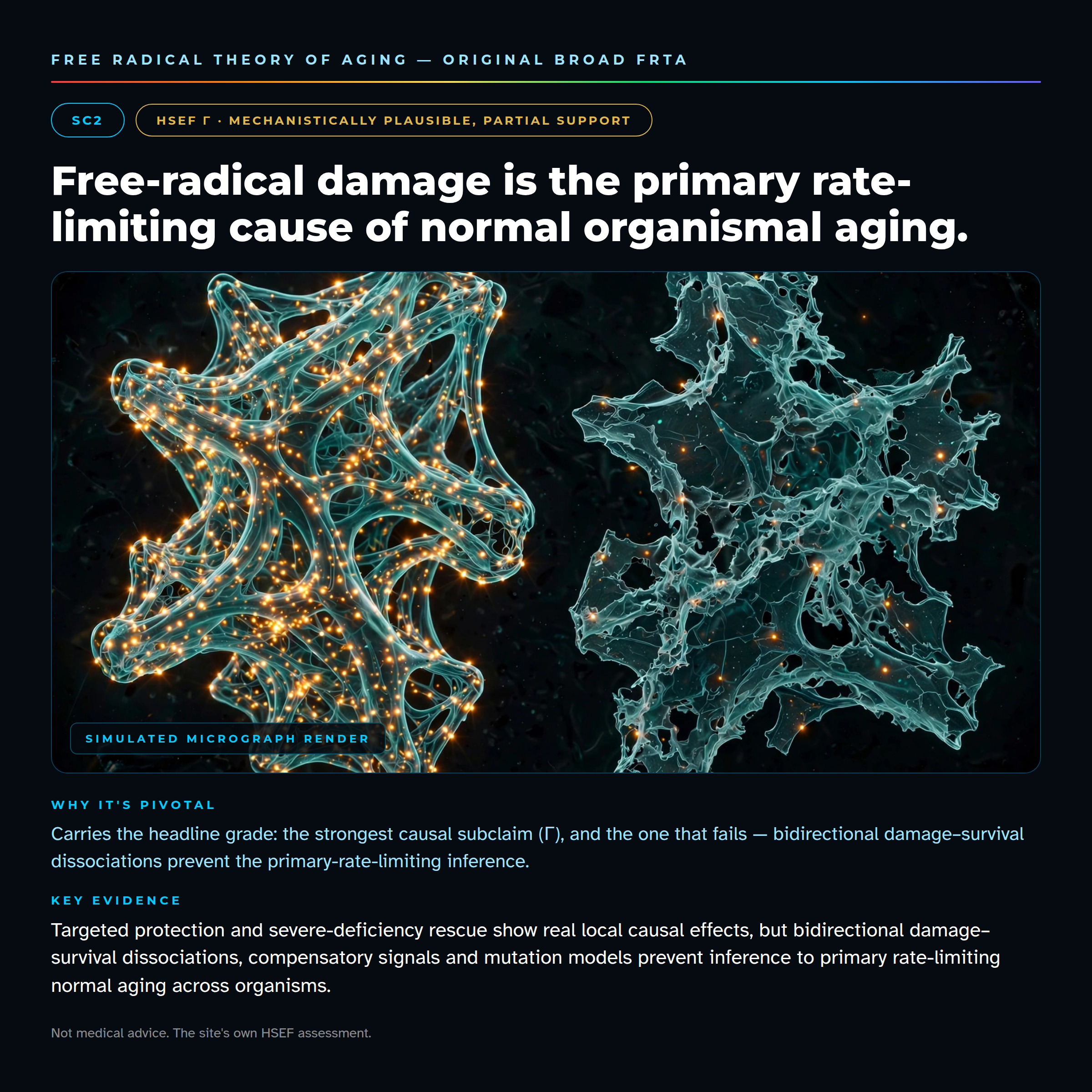
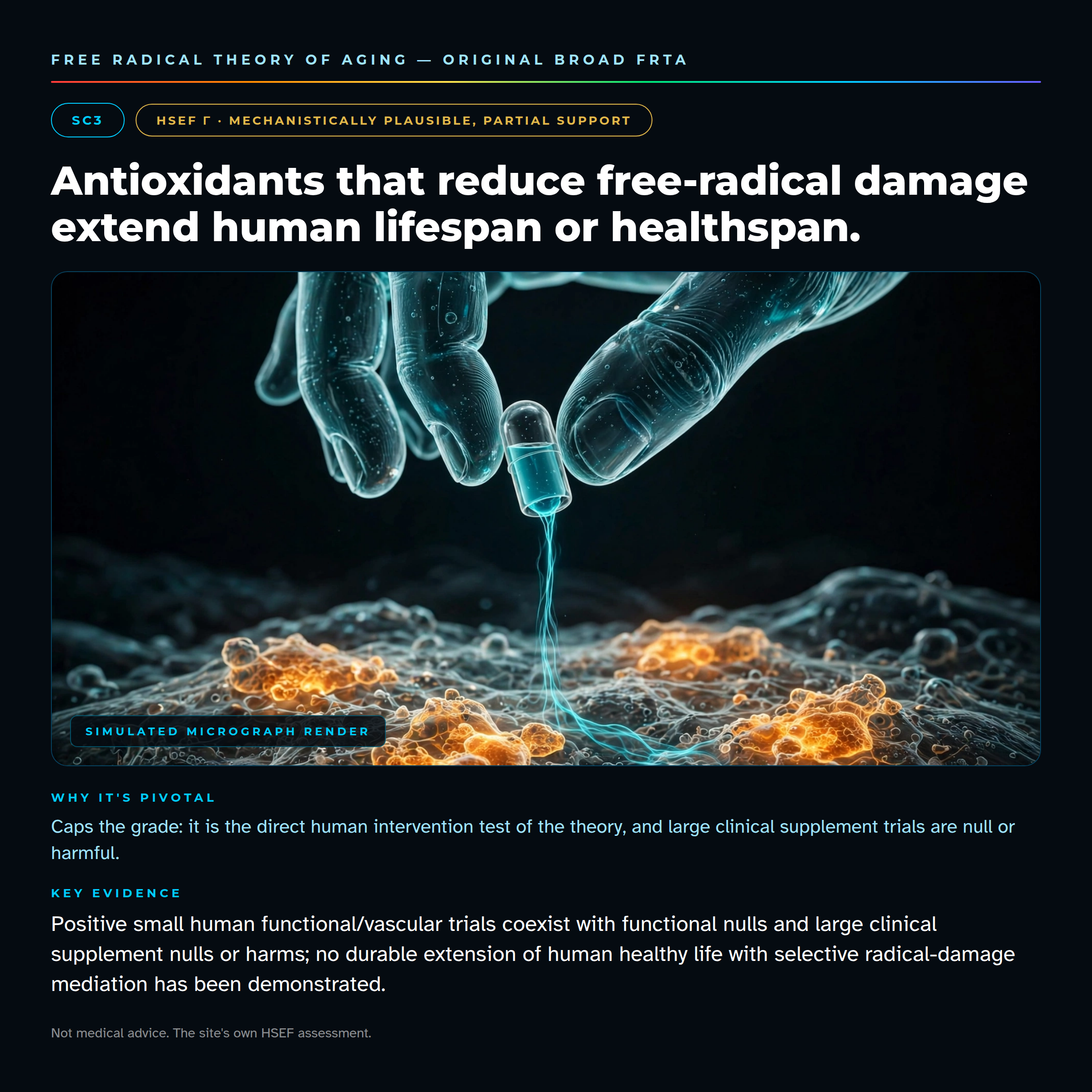
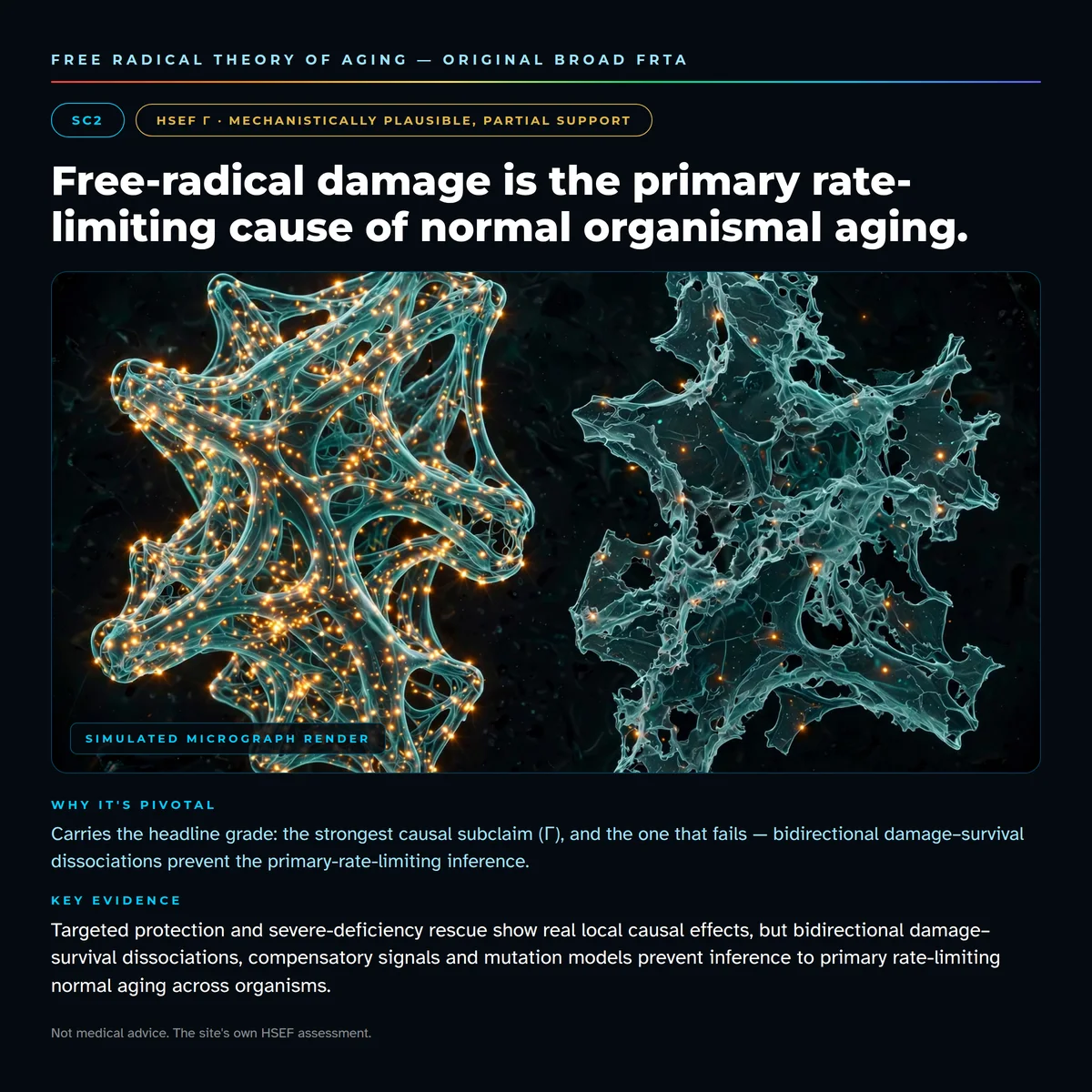
Claim assessed: Accumulated free-radical-mediated macromolecular damage is a primary rate-limiting driver of normal organismal aging, and reducing that damage through antioxidant intervention extends lifespan or healthspan, including in humans.
Finding: The registered weakest-link rule yields Β from SC1 Β, SC2 Γ and SC3 Γ. This bundled score must not be read as denying experimentally demonstrated redox contributions. The primary-driver sensitivity is Γ. Selected lesion protection can reach a contextual causal level, but cannot substitute for organismal primacy or human healthy-life extension.
Evidence scope: 68 primary reports; cutoff 2026-10-05; bounded critical review, not exhaustive systematic review.
The grade applies to the stated claim. Model rankings and individual subclaim grades remain separate from the overall causal-evidence grade.
Full scientific assessment and references · Scorecard (JSON) · Review source (Markdown)
THE MAIN FINDING
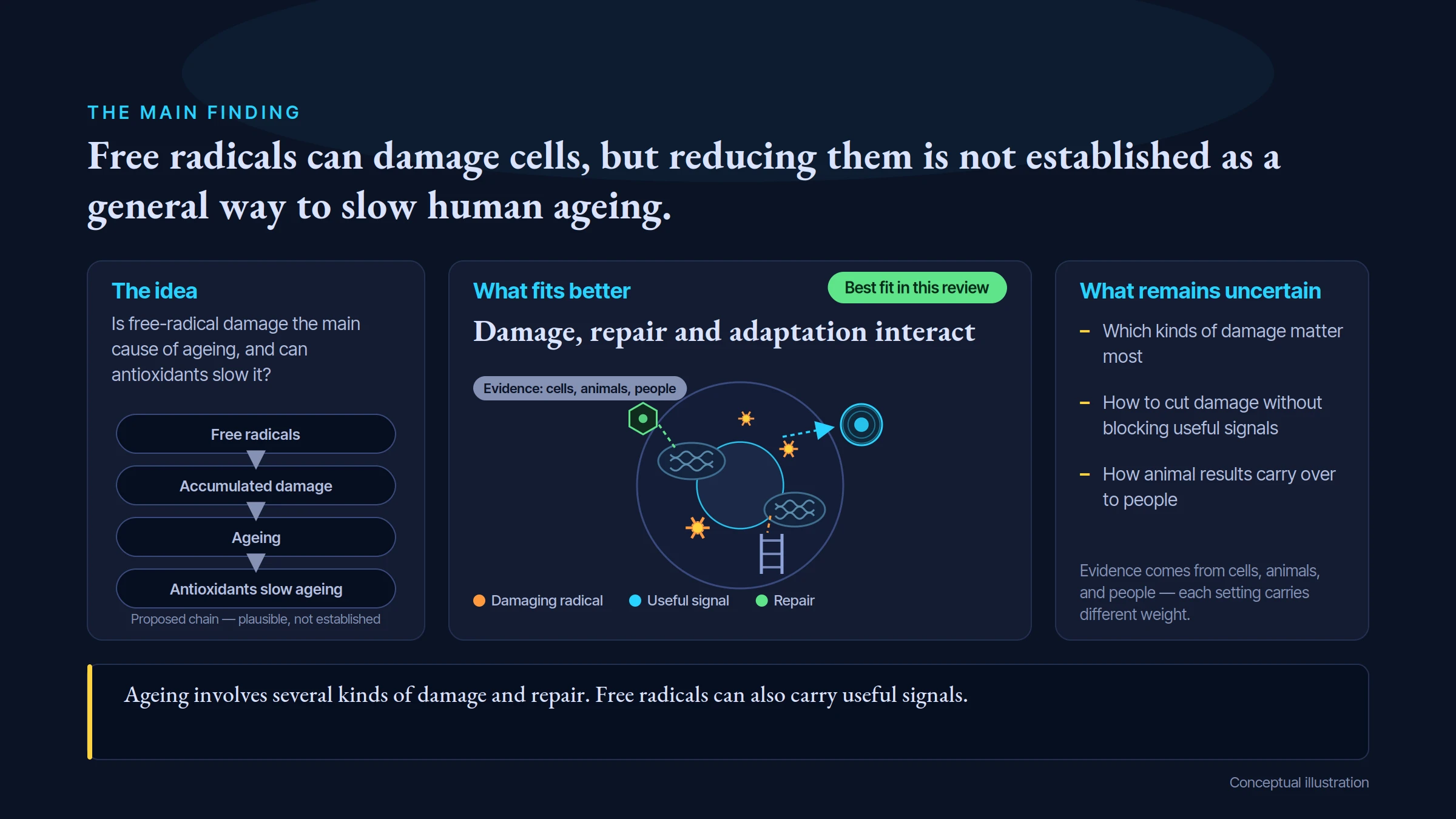
Free radicals can damage cells, but reducing them is not established as a general way to slow human ageing.
The idea
Is free-radical damage the main cause of ageing, and can antioxidants slow it?
Free radicals
Accumulated damage
Ageing
Antioxidants slow ageing
Proposed chain — plausible, not established
What fits better
Damage, repair and adaptation interact
Best fit in this review
Damaging radical
Useful signal
Repair
Evidence: cells, animals, people
What remains uncertain
Which kinds of damage matter most
How to cut damage without blocking useful signals
How animal results carry over to people
Evidence comes from cells, animals, and people — each setting carries different weight.
Ageing involves several kinds of damage and repair. Free radicals can also carry useful signals.
Conceptual illustration
This is the specific idea being tested.
Ageing involves several kinds of damage and repair. Free radicals can also carry useful signals.
A higher rank means a better fit to the evidence in this comparison. It does not prove every part of the leading explanation.
The reviewed hypothesis ranks 5 among 5 models compared; 1 alternative model(s) hold first rank for this stated claim.
Claim under review: rank 5 among 5 compared models.
Leading explanation: Multifactorial damage and compensation.
Position in this comparison: Last recorded rank.
The causal grade asks how well the stated causal claim is established. This comparison asks which of the assessed explanations fits the reviewed findings better. A leading explanation can remain unproven. Models can overlap or include the tested mechanism; an alternative ahead does not make that mechanism irrelevant. These ordinal ranks apply within this review; they do not measure the size of a difference or rank scientific strength across topics.
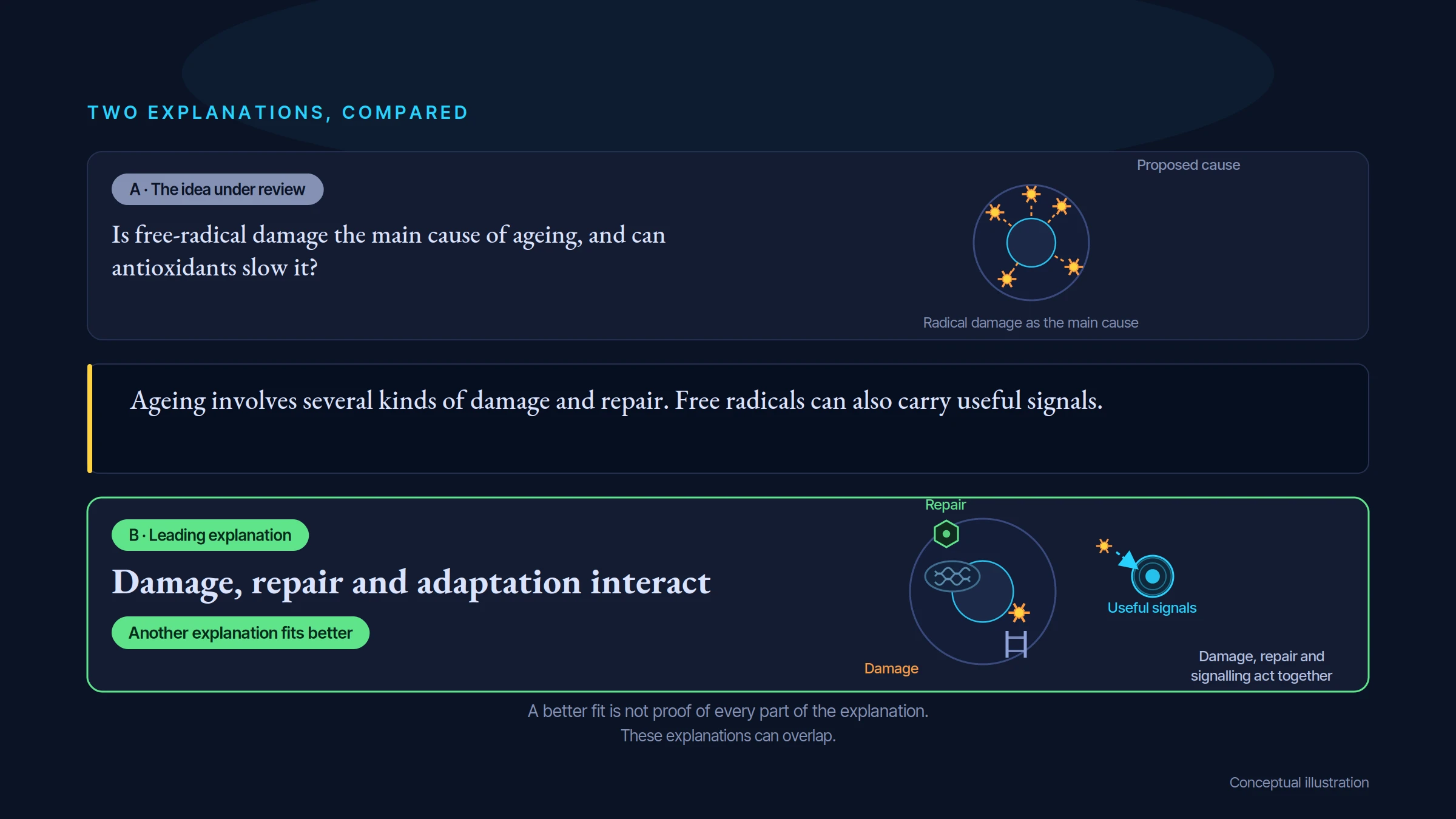
TWO EXPLANATIONS, COMPARED
A · The idea under review
Is free-radical damage the main cause of ageing, and can antioxidants slow it?
Radical damage as the main cause
Proposed cause
Ageing involves several kinds of damage and repair. Free radicals can also carry useful signals.
B · Leading explanation
Damage, repair and adaptation interact
Another explanation fits better
Damage
Repair
Useful signals
Damage, repair and signalling act together
A better fit is not proof of every part of the explanation.
These explanations can overlap.
Conceptual illustration
Association only for the stated claim.
Ageing involves several kinds of damage and repair. Free radicals can also carry useful signals.
These explanations can overlap. Ranking their fit to the evidence is separate from deciding how firmly a cause has been established.
Rank 1: Multifactorial damage and compensation — Aging combines heterogeneous damage, repair, disease and compensatory responses; ROS may be both signals and damaging intermediates.
Rank 2: Adaptive redox signalling / hormesis — Location, dose and timing determine whether ROS trigger adaptive protection.
Rank 3: Mutation and mitochondrial quality — Mutation spectra, apoptosis and mitochondrial maintenance can alter survival without a simple ROS feedback loop.
Rank 4: Nutrient sensing and hyperfunction — Metabolic signalling, intake and growth can mediate longevity independently of measured oxidative damage.
Rank 5: Broad damage-primacy FRTA — Accumulated radical-mediated lesions primarily limit normal aging and their removal extends healthy life.
Evidence rating: Β · Moderate confidence. How the evidence was assessed.
Ageing involves several kinds of damage and repair. Free radicals can also carry useful signals.
This is an assessment of a causal explanation, not proof that a particular supplement, diet, test, or treatment improves health. A treatment claim needs studies that test the intervention in people and measure meaningful benefits and harms. These findings can help frame research and informed clinical questions, but they do not identify what is right for one person.
Look for the proposed factor and the outcome, in the people or systems covered by the claim.
Damage, repair and adaptation interact. Ageing involves several kinds of damage and repair. Free radicals can also carry useful signals.
Reduce specific damage while preserving useful signals, then measure health and lifespan.
These illustrations show the key questions tested in the review. They are conceptual drawings, not microscope images or experimental results.
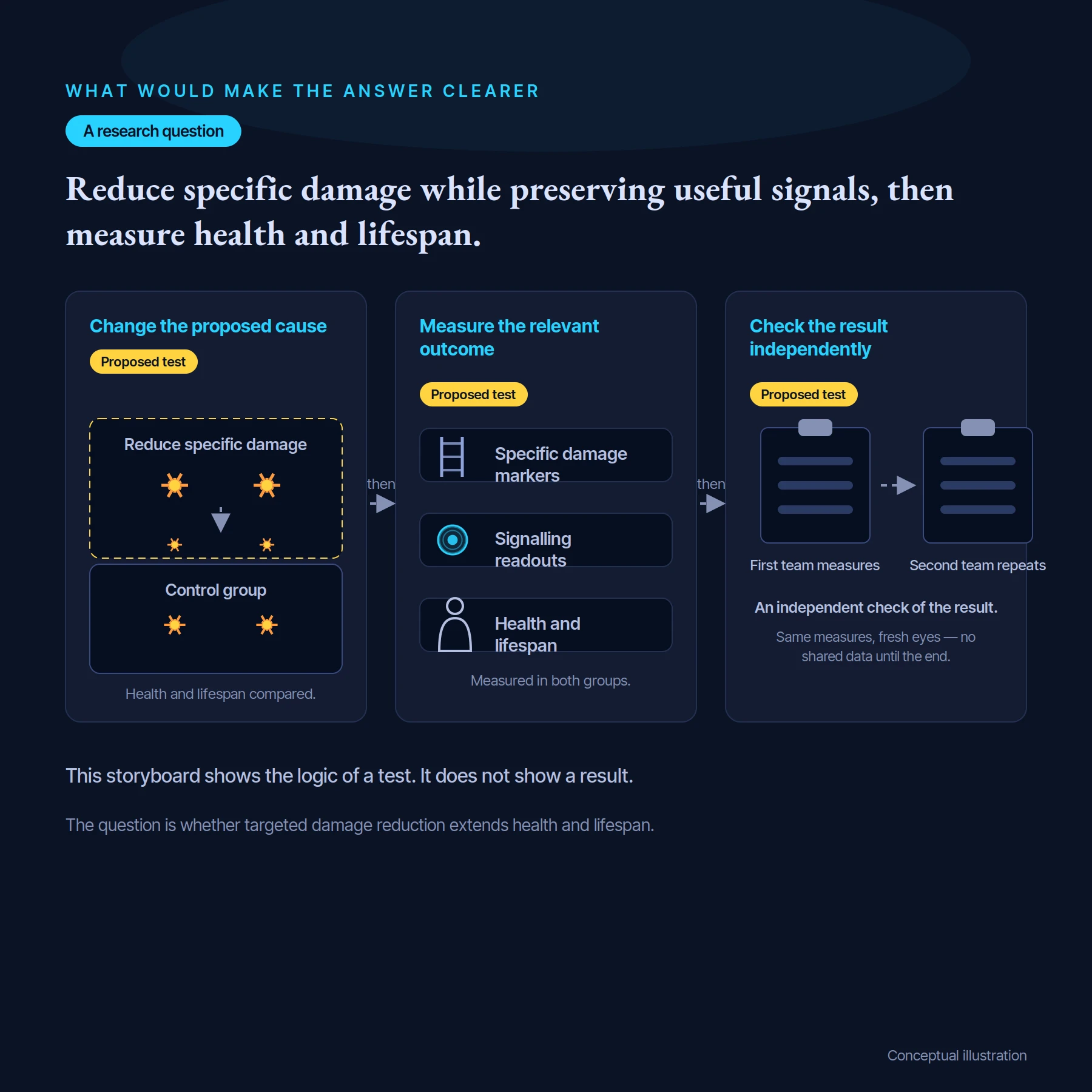
WHAT WOULD MAKE THE ANSWER CLEARER
A research question
Reduce specific damage while preserving useful signals, then measure health and lifespan.
then
then
Change the proposed cause
Proposed test
Reduce specific damage
Signals preserved
Control group
Health and lifespan compared.
Measure the relevant outcome
Proposed test
Specific damage markers
Signalling readouts
Health and lifespan
Measured in both groups.
Check the result independently
Proposed test
First team measures
Second team repeats
An independent check of the result.
Same measures, fresh eyes — no shared data until the end.
This storyboard shows the logic of a test. It does not show a result.
The question is whether targeted damage reduction extends health and lifespan.
Conceptual illustration
Reduce specific damage while preserving useful signals, then measure health and lifespan.
Check that the intended change really happened.
Allow for other factors and compare with suitable controls.
Look for independent confirmation and the limits of the effect.
These are questions for research, not a claim that the proposed studies have already succeeded.
Proposed tests: 1 test design(s) are registered in the scorecard.
In plain terms, researchers would change the proposed cause, check that it changed as intended, then measure a meaningful outcome while controlling plausible alternatives. The result should be able to support or count against the claim—not only show that a pathway exists.
Study design: Preregister an adult-onset, compartment-specific ROS-lesion intervention in genetically diverse male and female mice at independent sites, alongside a signalling-preserving orthogonal lesion-clearance intervention, then translate a target-engaged formulation to an adequately powered older-adult clinical trial.
What would be measured: Lifespan plus longitudinal frailty, mobility, cognition and organ function; in humans durable clinical function and disability-free survival rather than a redox marker alone
Important controls: Pair-feeding, developmental-timing exclusion, pharmacokinetics, compartment-specific lesion quantification, redox-signalling measures, common husbandry and prospective endpoint multiplicity handling
Result that would support the claim: Concordant functional aging trajectories and survival with specific lesion mediation across backgrounds and independent modalities
Result that would count against it: Adequate lesion reduction without trajectory benefit, or benefits explained entirely by food intake, transient signalling or one lethal disease
Follow the studies, detailed comparisons and evidence ratings behind this guide.
Open the scientific review →