The question
Do clumps of RNA-binding proteins cause ALS and frontotemporal degeneration?
This is the specific idea being tested.
Do clumps of RNA-binding proteins cause ALS and frontotemporal degeneration?
What you need to knowLoss of normal RNA-handling functions can matter even when visible clumps do not explain the damage.Relative explanatory fit: Alternative ranked ahead
Why the alternative fits better: Nerve-cell maintenance fails when specific RNA-processing functions are lost. Visible clumps do not capture every route.
Claim assessed: Mislocalization and aggregation of TDP-43 and FUS is the principal causal driver of neurodegeneration across ALS-FTD through nuclear loss of function and cytoplasmic toxic gain of function.
Finding: The preregistered scope-matched gate SC5 is Γ. Nuclear splicing failure has convergent causal and functional rescue evidence (SC2 Ζ), and physiological mutant-FUS toxicity is context-valid (SC3 Ε). Neither establishes selective macroscopic-aggregate toxicity or principal dual-arm causation across sporadic ALS–FTD. No narrow success silently replaces that broad gate.
Evidence scope: 63 primary reports; literature cutoff 2026-10-08; source examination UTC date 2026-10-09; bounded critical review, not exhaustive systematic review.
The grade applies to the stated claim. Model rankings and individual subclaim grades remain separate from the overall causal-evidence grade.
Full scientific assessment and references · Scorecard (JSON) · Review source (Markdown)
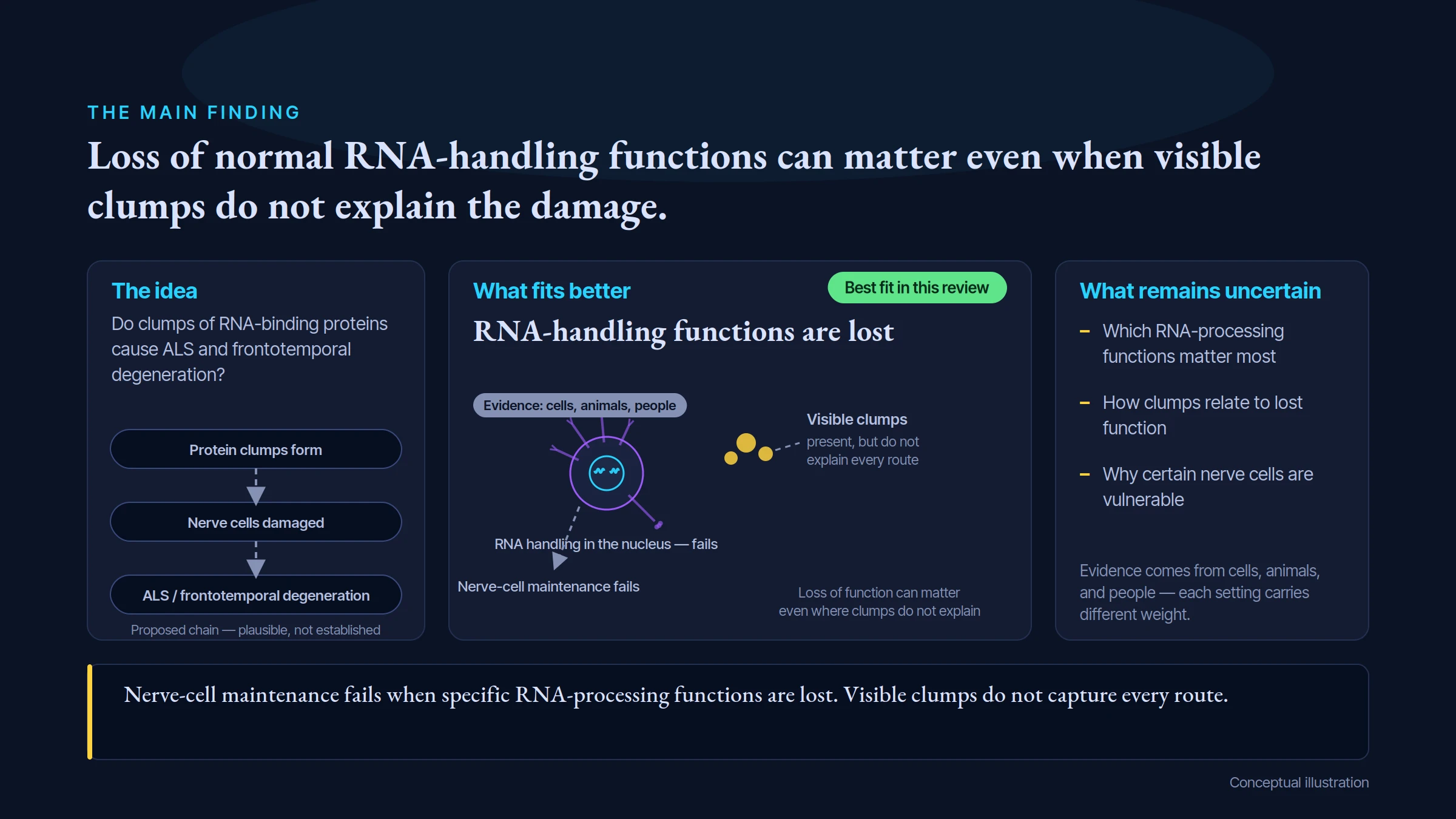
THE MAIN FINDING
Loss of normal RNA-handling functions can matter even when visible clumps do not explain the damage.
The idea
Do clumps of RNA-binding proteins cause ALS and frontotemporal degeneration?
Protein clumps form
Nerve cells damaged
ALS / frontotemporal degeneration
Proposed chain — plausible, not established
What fits better
RNA-handling functions are lost
Best fit in this review
RNA handling in the nucleus — fails
Nerve-cell maintenance fails
Visible clumps
present, but do not explain every route
Loss of function can matter even where clumps do not explain the damage
Evidence: cells, animals, people
What remains uncertain
Which RNA-processing functions matter most
How clumps relate to lost function
Why certain nerve cells are vulnerable
Evidence comes from cells, animals, and people — each setting carries different weight.
Nerve-cell maintenance fails when specific RNA-processing functions are lost. Visible clumps do not capture every route.
Conceptual illustration
This is the specific idea being tested.
Nerve-cell maintenance fails when specific RNA-processing functions are lost. Visible clumps do not capture every route.
A higher rank means a better fit to the evidence in this comparison. It does not prove every part of the leading explanation.
The reviewed hypothesis ranks 4 among 5 models compared; 1 alternative model(s) hold first rank for this stated claim.
Claim under review: rank 4 among 5 compared models.
Leading explanation: Nuclear RNA dysfunction as a causal contributor.
Position in this comparison: Between leading and last ranks.
The causal grade asks how well the stated causal claim is established. This comparison asks which of the assessed explanations fits the reviewed findings better. A leading explanation can remain unproven. Models can overlap or include the tested mechanism; an alternative ahead does not make that mechanism irrelevant. These ordinal ranks apply within this review; they do not measure the size of a difference or rank scientific strength across topics.
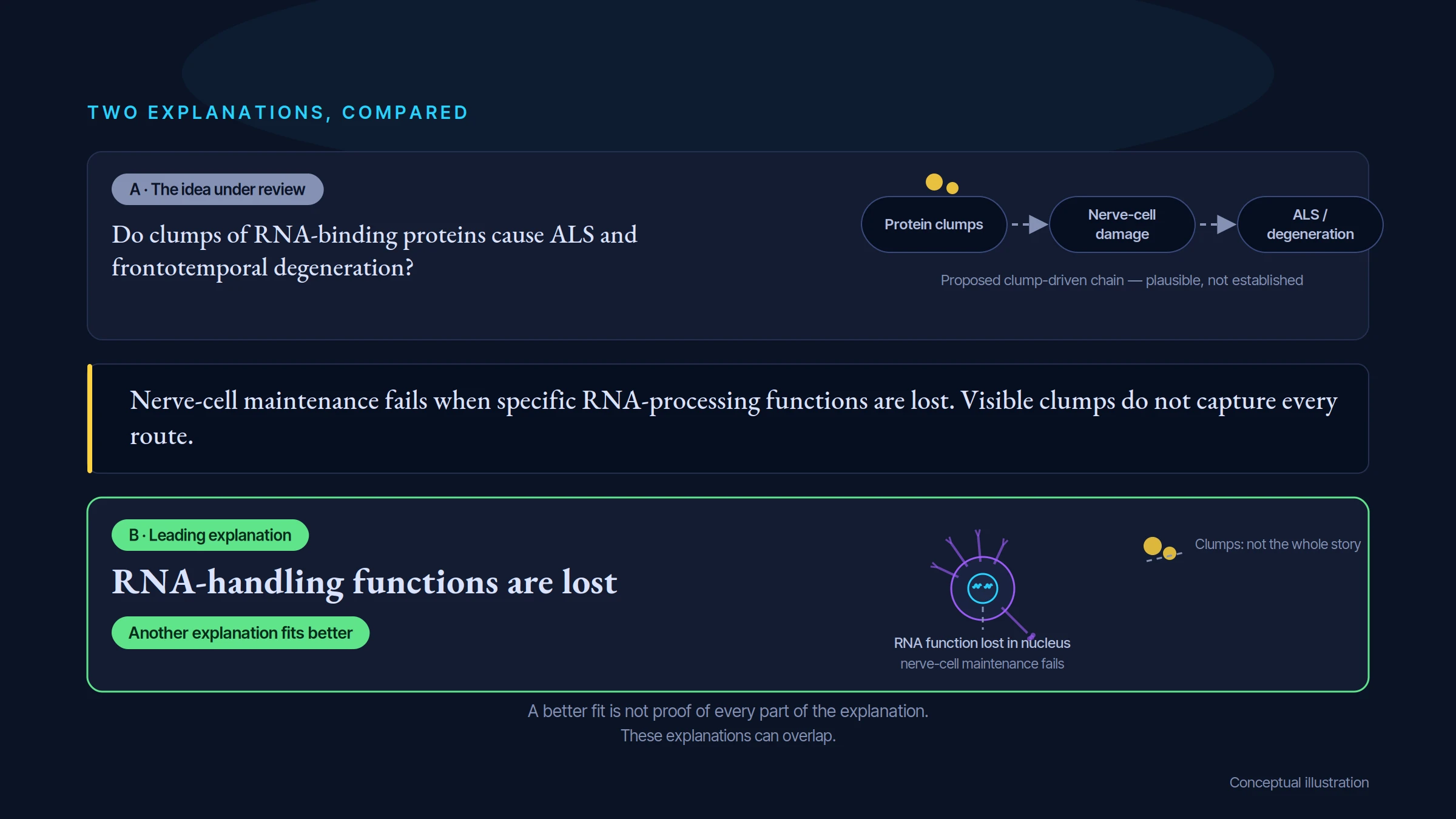
TWO EXPLANATIONS, COMPARED
A · The idea under review
Do clumps of RNA-binding proteins cause ALS and frontotemporal degeneration?
Protein clumps
Nerve-cell damage
ALS / degeneration
Proposed clump-driven chain — plausible, not established
Nerve-cell maintenance fails when specific RNA-processing functions are lost. Visible clumps do not capture every route.
B · Leading explanation
RNA-handling functions are lost
Another explanation fits better
RNA function lost in the nucleus
nerve-cell maintenance fails
Clumps: not the whole story
A better fit is not proof of every part of the explanation.
These explanations can overlap.
Conceptual illustration
Plausible, not established for the stated claim.
Nerve-cell maintenance fails when specific RNA-processing functions are lost. Visible clumps do not capture every route.
These explanations can overlap. Ranking their fit to the evidence is separate from deciding how firmly a cause has been established.
Rank 1: Nuclear RNA dysfunction as a causal contributor — Loss of specific RNA-processing functions damages neuronal maintenance.
Rank 2: Mislocalized soluble mutant-RBP toxicity — Physiological mutant FUS can damage neurons before visible aggregates.
Rank 3: RNA/chaperone homeostatic failure — RNA concentration and import/chaperone systems govern material state and localization.
Rank 4: Principal dual-arm aggregate mechanism — Nuclear loss and cytoplasmic aggregation can reinforce each other.
Rank 5: Aggregates as sequestration or quality control — Large assemblies can sequester more toxic soluble or liquid species.
Evidence rating: Γ · Moderate confidence. How the evidence was assessed.
Nerve-cell maintenance fails when specific RNA-processing functions are lost. Visible clumps do not capture every route.
The preregistered scope-matched gate SC5 is Γ. Nuclear splicing failure has convergent causal and functional rescue evidence (SC2 Ζ), and physiological mutant-FUS toxicity is context-valid (SC3 Ε). Neither establishes selective macroscopic-aggregate toxicity or principal dual-arm causation across sporadic ALS–FTD. No narrow success silently replaces that broad gate.
Look for the proposed factor and the outcome, in the people or systems covered by the claim.
RNA-handling functions are lost. Nerve-cell maintenance fails when specific RNA-processing functions are lost. Visible clumps do not capture every route.
Restore RNA-handling functions separately from removing clumps, then compare nerve-cell survival.
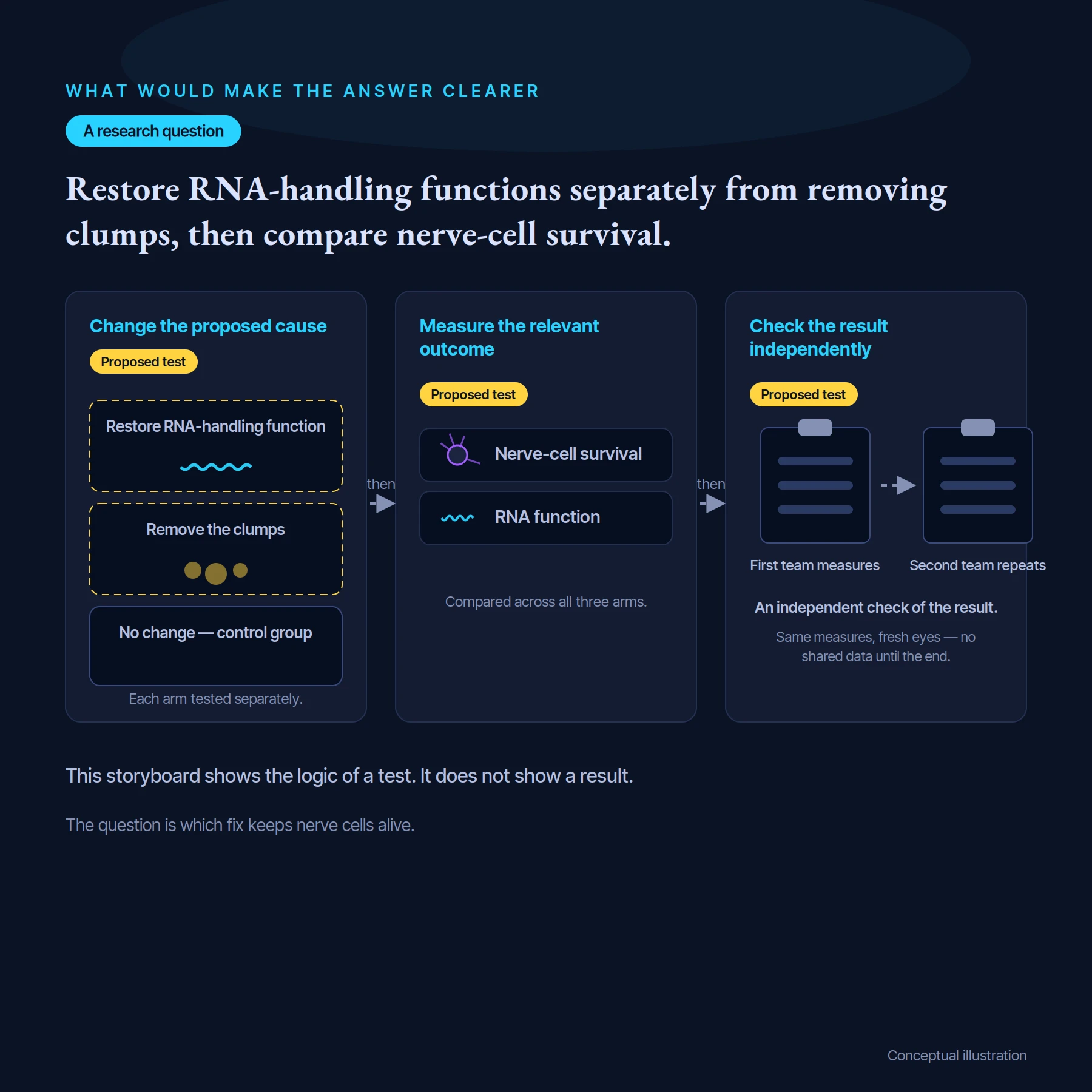
WHAT WOULD MAKE THE ANSWER CLEARER
A research question
Restore RNA-handling functions separately from removing clumps, then compare nerve-cell survival.
then
then
Change the proposed cause
Proposed test
Restore RNA-handling function
Remove the clumps
No change — control group
Each arm tested separately.
Measure the relevant outcome
Proposed test
Nerve-cell survival
RNA function
Compared across all three arms.
Check the result independently
Proposed test
First team measures
Second team repeats
An independent check of the result.
Same measures, fresh eyes — no shared data until the end.
This storyboard shows the logic of a test. It does not show a result.
The question is which fix keeps nerve cells alive.
Conceptual illustration
Restore RNA-handling functions separately from removing clumps, then compare nerve-cell survival.
Check that the intended change really happened.
Allow for other factors and compare with suitable controls.
Look for independent confirmation and the limits of the effect.
These are questions for research, not a claim that the proposed studies have already succeeded.
Proposed tests: 1 test design(s) are registered in the scorecard.
In plain terms, researchers would change the proposed cause, check that it changed as intended, then measure a meaningful outcome while controlling plausible alternatives. The result should be able to support or count against the claim—not only show that a pathway exists.
Study design: In prospectively genotyped sporadic ALS/FTD humanized models, factorially restore nuclear splicing, prevent only large cytoplasmic assembly and alter soluble cytoplasmic abundance while holding total endogenous protein constant. Start after pathology onset and reverse each rescue to test mediation.
What would be measured: Single-neuron RNA processing, soluble/insoluble state, axonal and synaptic function, motor/cognitive trajectory and survival
Important controls: Abundance-matched WT, aggregate-free mutants, RNA-binding controls, independent cell populations, delivery controls and blinded post-onset phenotyping
Result that would support the claim: Both independently specified arms are necessary and joint correction consistently restores disease course across predefined sporadic contexts
Result that would count against it: Degeneration persists after complete aggregate-only removal with restored splicing, or follows nuclear/soluble dysfunction independently of macroscopic state
Follow the studies, detailed comparisons and evidence ratings behind this guide.
Open the scientific review →