The question
Is gut microbial composition a primary, treatable cause of disease throughout the body?
This is the specific idea being tested.
Is gut microbial composition a primary, treatable cause of disease throughout the body?
What you need to knowMicrobes and diet interact, but microbial composition is not established as a universal disease switch.Relative explanatory fit: Alternative ranked ahead
Why the alternative fits better: Diet supplies what microbes use, and microbial functions vary with those inputs. Neither is a universal independent cause.
Claim assessed: The composition of the human gut microbiome is a primary, targetable causal driver of systemic and neurobehavioural disease.
Finding: SC4 is the preregistered human-primacy gate. Transfers, defined strains and microbial products show real bounded contributions, and HE intervention crosses human contribution thresholds, but none establishes composition as the primary upstream target across systemic and neurobehavioural disease. SC1 association is Β, bounded rodent causality SC2 Ζ, human contribution SC3 Ε, broad primacy SC4 Γ. These are different scopes, not a refutation of the microbiome.
Evidence scope: 67 primary reports; literature cutoff 2026-10-08; source examination UTC date 2026-10-09; bounded critical review, not exhaustive systematic review.
The grade applies to the stated claim. Model rankings and individual subclaim grades remain separate from the overall causal-evidence grade.
Full scientific assessment and references · Scorecard (JSON) · Review source (Markdown)
THE MAIN FINDING
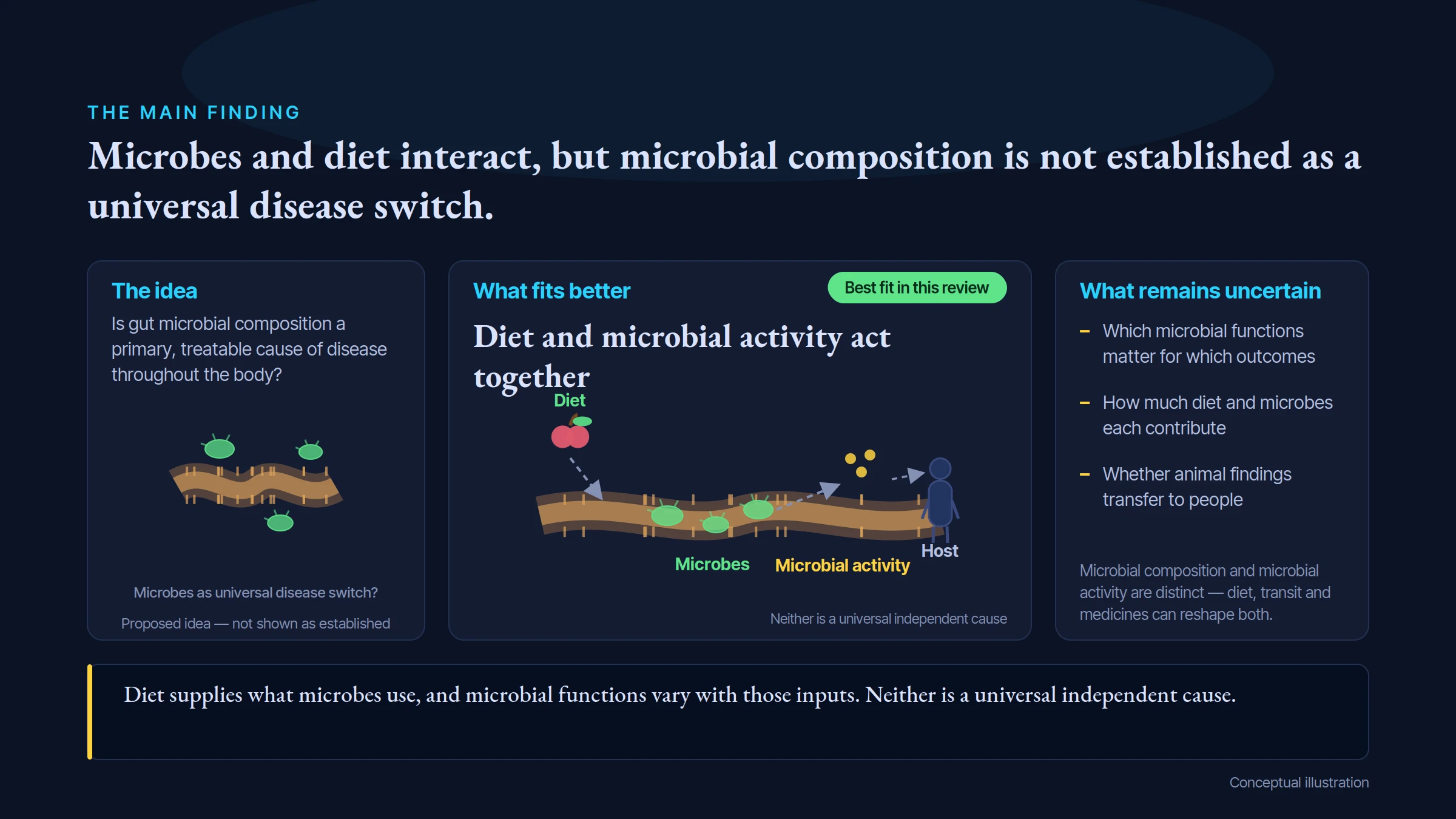
Microbes and diet interact, but microbial composition is not established as a universal disease switch.
The idea
Is gut microbial composition a primary, treatable cause of disease throughout the body?
Microbes as universal disease switch?
Proposed idea — not shown as established
What fits better
Best fit in this review
Diet and microbial activity act together
Diet inputs
Gut microbes
Microbial activity (varies with inputs)
Host
Neither is a universal independent cause
What remains uncertain
Which microbial functions matter for which outcomes
How much diet and microbes each contribute
Whether animal findings transfer to people
Microbial composition and microbial activity are distinct — diet, transit and medicines can reshape both.
Diet supplies what microbes use, and microbial functions vary with those inputs. Neither is a universal independent cause.
Conceptual illustration
This is the specific idea being tested.
Diet supplies what microbes use, and microbial functions vary with those inputs. Neither is a universal independent cause.
A higher rank means a better fit to the evidence in this comparison. It does not prove every part of the leading explanation.
The reviewed hypothesis ranks 5 among 5 models compared; 1 alternative model(s) hold first rank for this stated claim.
Claim under review: rank 5 among 5 compared models.
Leading explanation: Diet/substrate-dependent microbial contribution.
Position in this comparison: Last recorded rank.
The causal grade asks how well the stated causal claim is established. This comparison asks which of the assessed explanations fits the reviewed findings better. A leading explanation can remain unproven. Models can overlap or include the tested mechanism; an alternative ahead does not make that mechanism irrelevant. These ordinal ranks apply within this review; they do not measure the size of a difference or rank scientific strength across topics.
TWO EXPLANATIONS, COMPARED
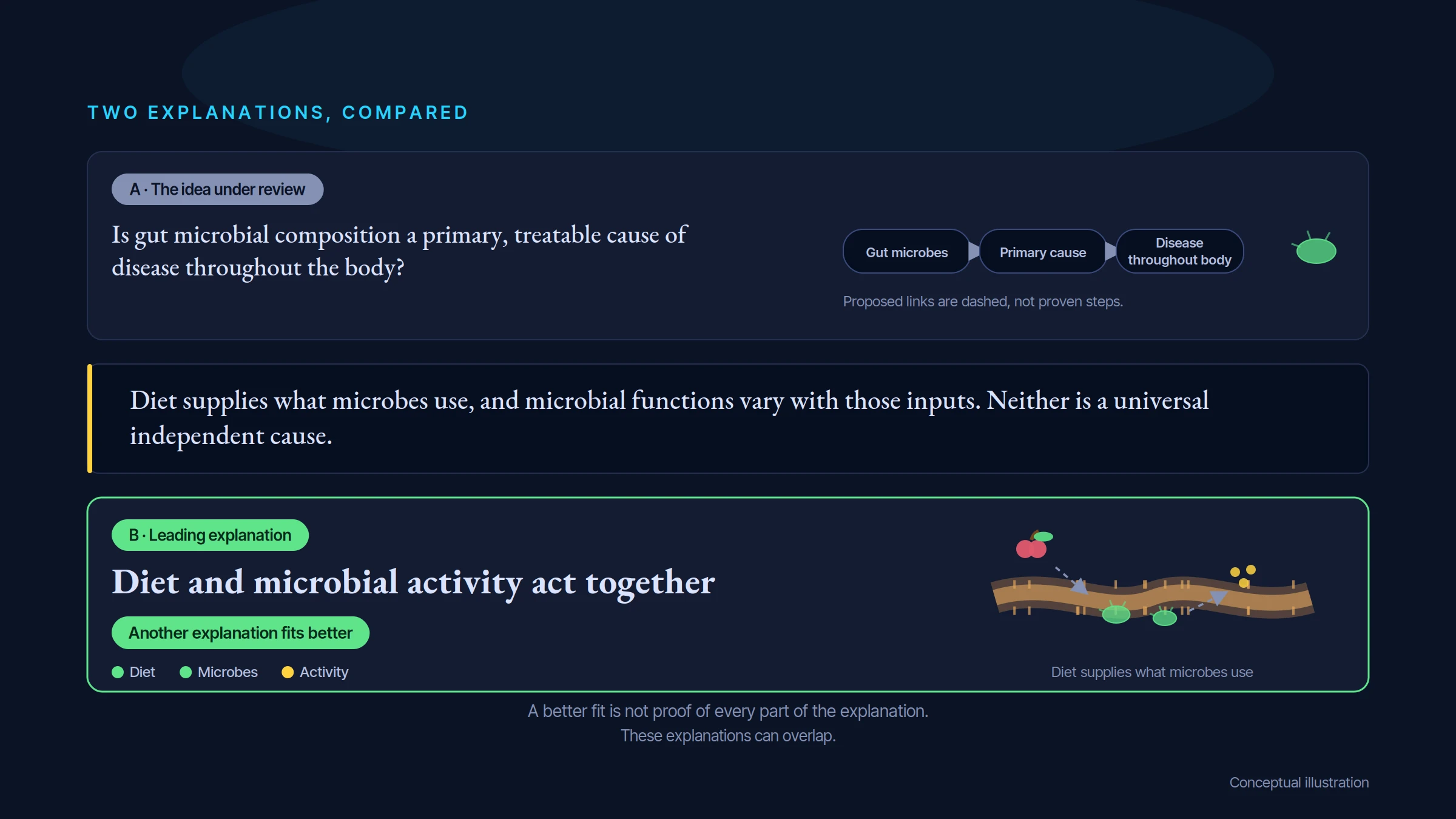
A · The idea under review
Is gut microbial composition a primary, treatable cause of disease throughout the body?
Gut microbes
Primary cause
Disease throughout body
Proposed links are dashed, not proven steps.
Diet supplies what microbes use, and microbial functions vary with those inputs. Neither is a universal independent cause.
B · Leading explanation
Diet and microbial activity act together
Another explanation fits better
Diet
Microbes
Activity
Diet supplies what microbes use
A better fit is not proof of every part of the explanation.
These explanations can overlap.
Conceptual illustration
Plausible, not established for the stated claim.
Diet supplies what microbes use, and microbial functions vary with those inputs. Neither is a universal independent cause.
These explanations can overlap. Ranking their fit to the evidence is separate from deciding how firmly a cause has been established.
Rank 1: Diet/substrate-dependent microbial contribution — Host diet and microbial function interact; neither alone is a universal primary switch.
Rank 2: Disease/transit/medication-dependent microbiome — Disease features, treatment and transit reshape community signatures.
Rank 3: Rodent-context microbial causality — Specific microbial factors can be causal inside predefined genotypes and diets.
Rank 4: Host-genetic and immune-state common causes — Host traits influence both disease and microbial ecology.
Rank 5: Primary gut-microbiome driver — Composition is the broad primary upstream, targetable human disease cause.
Evidence rating: Γ · Moderate confidence. How the evidence was assessed.
Diet supplies what microbes use, and microbial functions vary with those inputs. Neither is a universal independent cause.
SC4 is the preregistered human-primacy gate. Transfers, defined strains and microbial products show real bounded contributions, and HE intervention crosses human contribution thresholds, but none establishes composition as the primary upstream target across systemic and neurobehavioural disease. SC1 association is Β, bounded rodent causality SC2 Ζ, human contribution SC3 Ε, broad primacy SC4 Γ. These are different scopes, not a refutation of the microbiome.
Look for the proposed factor and the outcome, in the people or systems covered by the claim.
Diet and microbial activity act together. Diet supplies what microbes use, and microbial functions vary with those inputs. Neither is a universal independent cause.
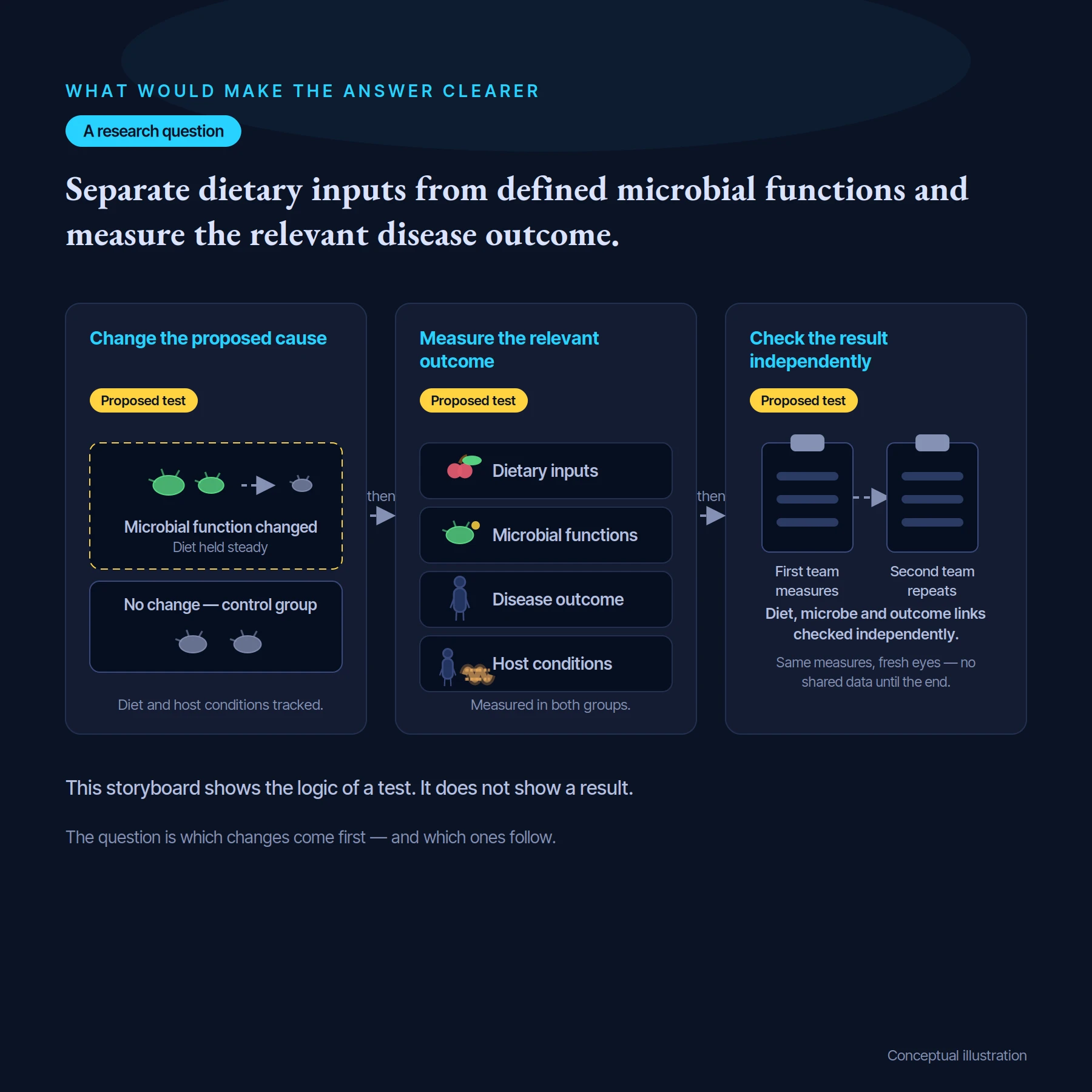
Separate dietary inputs from defined microbial functions and measure the relevant disease outcome.
WHAT WOULD MAKE THE ANSWER CLEARER
A research question
Separate dietary inputs from defined microbial functions and measure the relevant disease outcome.
then
then
Change the proposed cause
Proposed test
Microbial function changed
Diet held steady
No change — control group
Diet and host conditions tracked.
Measure the relevant outcome
Proposed test
Dietary inputs
Microbial functions
Disease outcome
Host conditions
Measured in both groups.
Check the result independently
Proposed test
First team measures
Second team repeats
Diet, microbe and outcome links checked independently.
Same measures, fresh eyes — no shared data until the end.
This storyboard shows the logic of a test. It does not show a result.
The question is which changes come first — and which ones follow.
Conceptual illustration
Separate dietary inputs from defined microbial functions and measure the relevant disease outcome.
Check that the intended change really happened.
Allow for other factors and compare with suitable controls.
Look for independent confirmation and the limits of the effect.
These are questions for research, not a claim that the proposed studies have already succeeded.
Proposed tests: 1 test design(s) are registered in the scorecard.
In plain terms, researchers would change the proposed cause, check that it changed as intended, then measure a meaningful outcome while controlling plausible alternatives. The result should be able to support or count against the claim—not only show that a pathway exists.
Study design: Run preregistered diagnosis-specific factorial trials of a defined strain/enzyme consortium and matched control, crossed with controlled dietary substrate, while measuring bowel transit and fixing baseline drugs. Use baseline factor abundance for enrollment, retain nonresponders, and assess mechanistic mediation and durable clinical endpoints.
What would be measured: HE recurrence or another prespecified diagnosis-specific clinical trajectory, native microbial-factor activity and host-pathway engagement over a registered horizon
Important controls: Inactive factor/strain control, equivalent bowel preparation, substrate matching, stable host drugs, transit measurements, blinded outcomes and dose-matched functional rescue
Result that would support the claim: Selective factor correction improves the registered disease endpoint with specific mediation across substrate/genotype strata and persists beyond transient engraftment
Result that would count against it: Verified factor engagement changes only composition/metabolites, benefit disappears after diet/drug matching, or relevant human functional outcomes remain unchanged
Follow the studies, detailed comparisons and evidence ratings behind this guide.
Open the scientific review →