The question
Must every cancer pass through immune removal, a standoff and escape?
This is the specific idea being tested.
Must every cancer pass through immune removal, a standoff and escape?
What you need to knowThe immune system can shape cancers, but the same three-stage sequence is not established for every tumour.Relative explanatory fit: Alternative ranked ahead
Why the alternative fits better: Immune recognition and a tumour's origin change how it develops.
Claim assessed: The immune system actively sculpts tumors, driving all developing tumors through an obligate sequence of elimination, equilibrium and escape while selecting immune-resistant variants.
Finding: SC6 gates the registered universal scope and remains Β. Human phase histories are chiefly inferred from sampled lesions/genomes without an all-etiology causal inception dataset. This does not cap scoped immune elimination or presentation escape, which reach Ζ through matching genetic and functional contrasts. Low-antigen KPC, innate-only editing and early evasion delimit the universal inference.
Evidence scope: 63 primary reports; literature cutoff 2026-10-08; source examination UTC date 2026-10-09; bounded critical review, not exhaustive systematic review.
The grade applies to the stated claim. Model rankings and individual subclaim grades remain separate from the overall causal-evidence grade.
Full scientific assessment and references · Scorecard (JSON) · Review source (Markdown)
THE MAIN FINDING
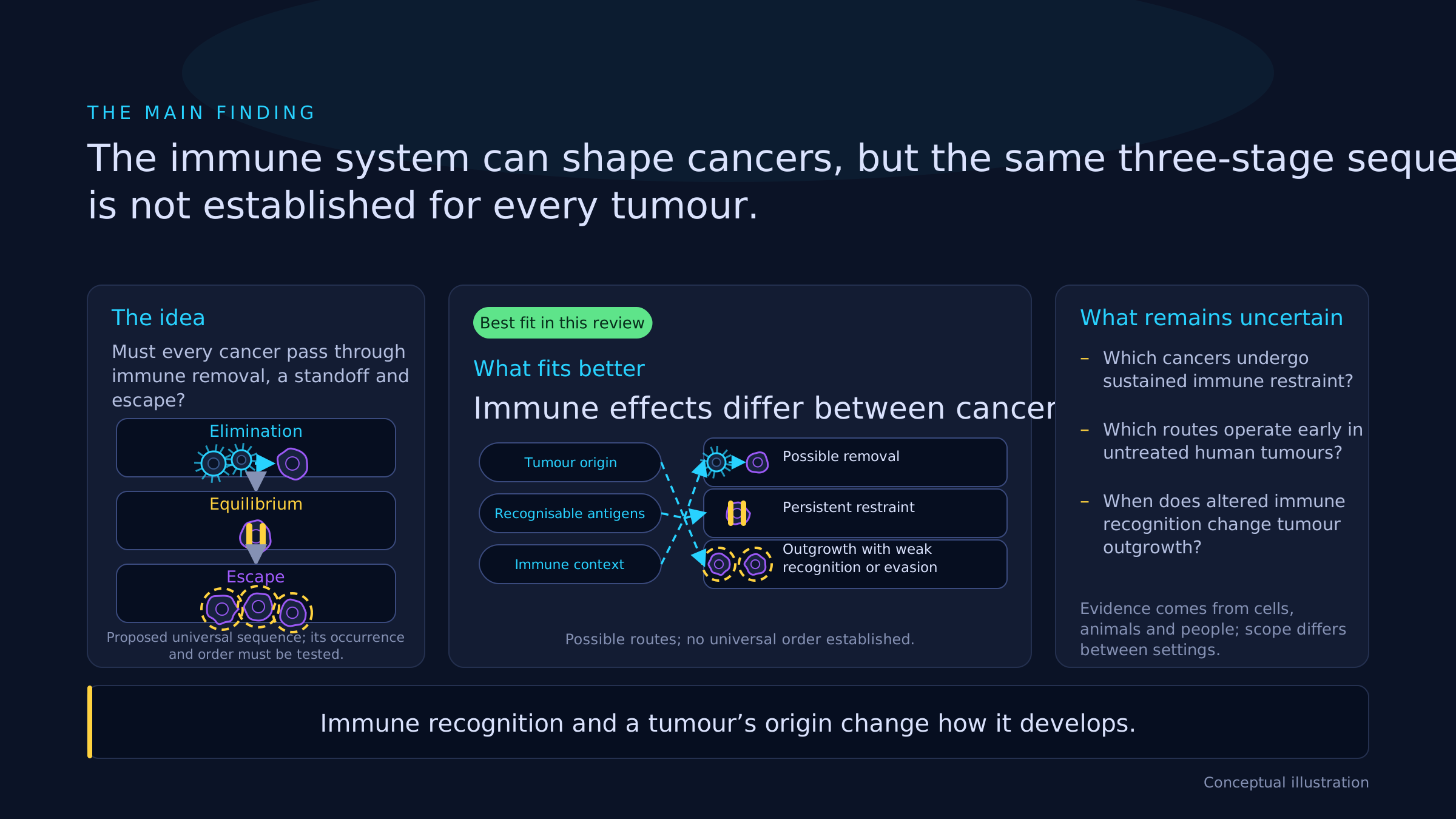
The immune system can shape cancers, but the same three-stage sequence is not established for every tumour.
The idea
Must every cancer pass through immune removal, a standoff and escape?
Elimination
Equilibrium
Escape
Proposed universal sequence; its occurrence and order must be tested.
What fits better
Immune effects differ between cancers
Best fit in this review
Tumour origin
Recognisable antigens
Immune context
Possible removal
Persistent restraint
Outgrowth with weak recognition or evasion
Possible routes; no universal order established.
What remains uncertain
Which cancers undergo sustained immune restraint?
Which routes operate early in untreated human tumours?
When does altered immune recognition change tumour outgrowth?
Evidence comes from cells, animals and people; scope differs between settings.
Immune recognition and a tumour's origin change how it develops.
Conceptual illustration
This is the specific idea being tested.
Immune recognition and a tumour's origin change how it develops.
A higher rank means a better fit to the evidence in this comparison. It does not prove every part of the leading explanation.
The reviewed hypothesis ranks 5 among 5 models compared; 1 alternative model(s) hold first rank for this stated claim.
Claim under review: rank 5 among 5 compared models.
Leading explanation: Etiology-stratified immune editing.
Position in this comparison: Last recorded rank.
The causal grade asks how well the stated causal claim is established. This comparison asks which of the assessed explanations fits the reviewed findings better. A leading explanation can remain unproven. Models can overlap or include the tested mechanism; an alternative ahead does not make that mechanism irrelevant. These ordinal ranks apply within this review; they do not measure the size of a difference or rank scientific strength across topics.
TWO EXPLANATIONS, COMPARED
A · The idea under review
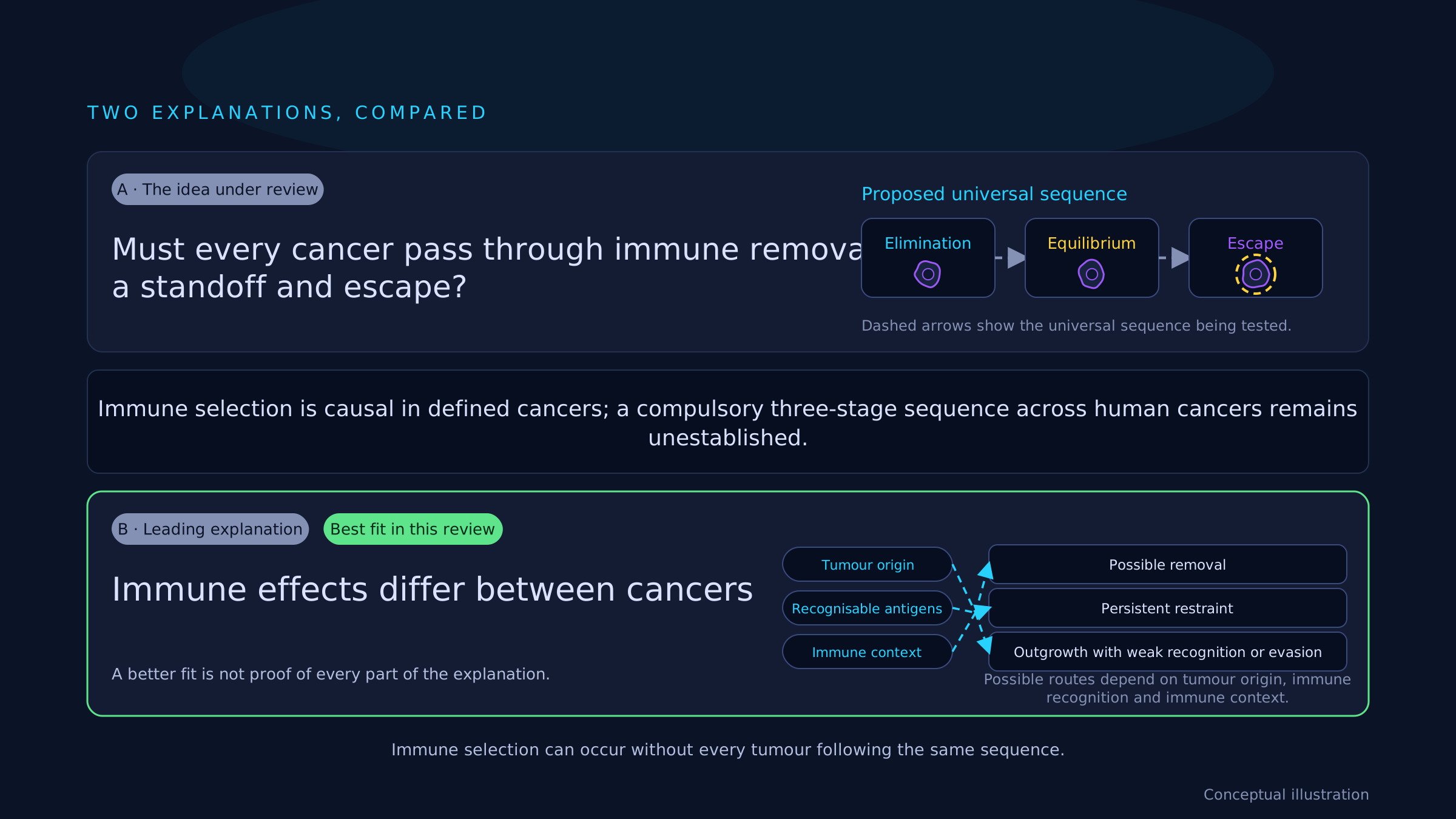
Must every cancer pass through immune removal, a standoff and escape?
Proposed universal sequence
Elimination
Equilibrium
Escape
Dashed arrows show the universal sequence being tested.
Immune selection is causal in defined cancers; a compulsory three-stage sequence across human cancers remains unestablished.
B · Leading explanation
Immune effects differ between cancers
Best fit in this review
Tumour origin
Recognisable antigens
Immune context
Possible removal
Persistent restraint
Outgrowth with weak recognition or evasion
Possible routes depend on tumour origin, immune recognition and immune context.
A better fit is not proof of every part of the explanation.
Immune selection can occur without every tumour following the same sequence.
Conceptual illustration
Association only for the stated claim.
Immune recognition and a tumour's origin change how it develops.
These explanations can overlap. Ranking their fit to the evidence is separate from deciding how firmly a cause has been established.
Rank 1: Etiology-stratified immune editing — Baseline antigenicity, lineage and immunity determine editing routes.
Rank 2: Antigen-presentation attrition — Mutations can persist while HLA/B2M presentation or recognition fails.
Rank 3: Immunological ignorance — Expressed antigens need not recruit effective specific recognition.
Rank 4: Innate/myeloid pre-emption — Lineage and early suppressive niches permit outgrowth before effective adaptive engagement.
Rank 5: Universal obligatory three phases — All developing human tumors require sequential adaptive elimination, equilibrium and escape.
Evidence rating: Β · Moderate confidence. How the evidence was assessed.
Immune recognition and a tumour's origin change how it develops.
SC6 gates the registered universal scope and remains Β. Human phase histories are chiefly inferred from sampled lesions/genomes without an all-etiology causal inception dataset. This does not cap scoped immune elimination or presentation escape, which reach Ζ through matching genetic and functional contrasts. Low-antigen KPC, innate-only editing and early evasion delimit the universal inference.
Look for the proposed factor and the outcome, in the people or systems covered by the claim.
Immune effects differ between cancers. Immune recognition and a tumour's origin change how it develops.
Track developing tumours and immune recognition to test whether the proposed stages occur.
WHAT WOULD MAKE THE ANSWER CLEARER
A research question
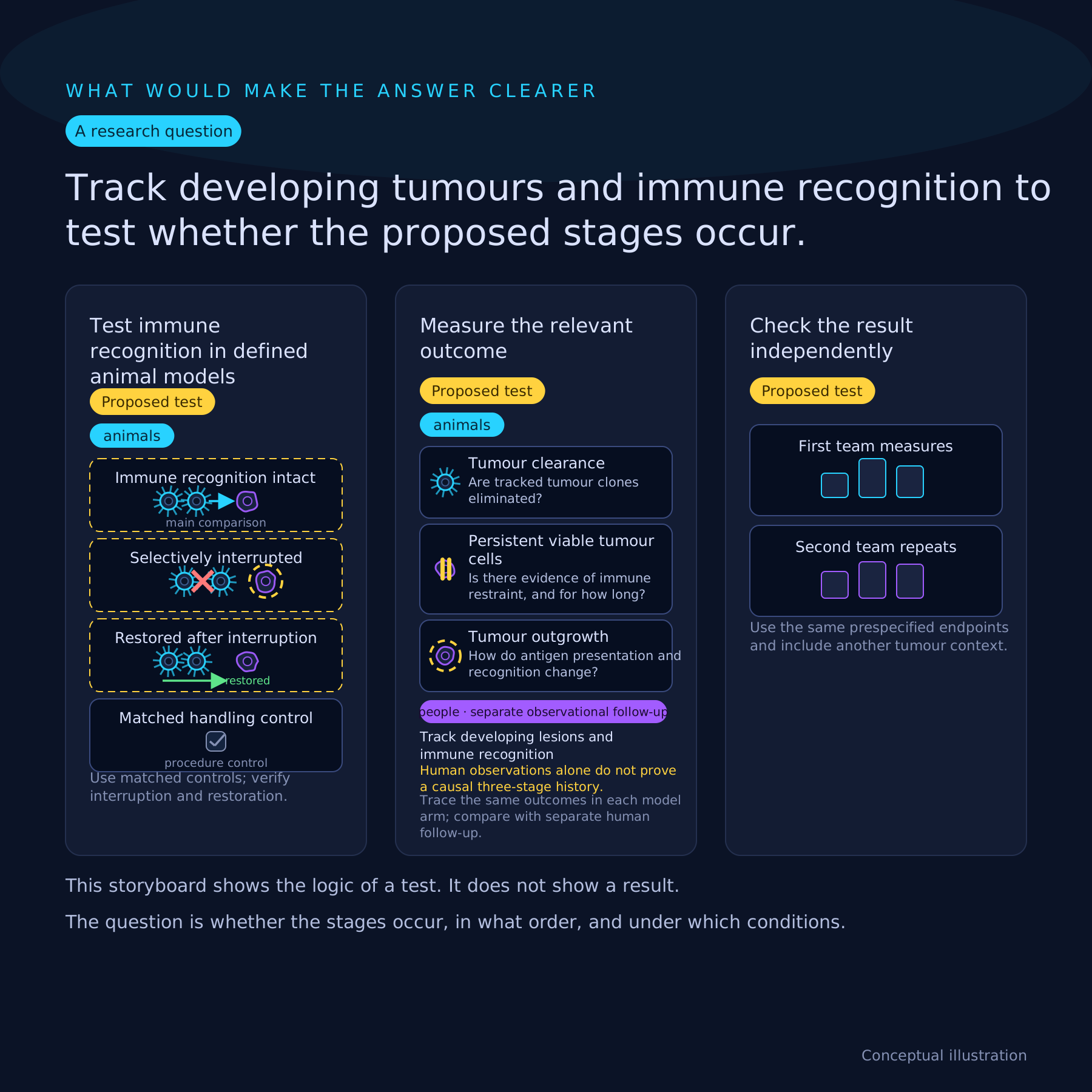
Track developing tumours and immune recognition to test whether the proposed stages occur.
Test immune recognition in defined animal models
Proposed test
animals
Immune recognition intact
Selectively interrupted
Restored after interruption
Matched handling control
Use matched controls; verify interruption and restoration.
Measure the relevant outcome
Proposed test
animals
Tumour clearance
Are tracked tumour clones eliminated?
Persistent viable tumour cells
Is there evidence of immune restraint, and for how long?
Tumour outgrowth
How do antigen presentation and recognition change?
people · separate observational follow-up
Track developing lesions and immune recognition
Human observations alone do not prove a causal three-stage history.
Trace the same outcomes in each model arm; compare with separate human follow-up.
Check the result independently
Proposed test
First team measures
Second team repeats
Use the same prespecified endpoints and include another tumour context.
This storyboard shows the logic of a test. It does not show a result.
The question is whether the stages occur, in what order, and under which conditions.
Conceptual illustration
Track developing tumours and immune recognition to test whether the proposed stages occur.
Check that the intended change really happened.
Allow for other factors and compare with suitable controls.
Look for independent confirmation and the limits of the effect.
These are questions for research, not a claim that the proposed studies have already succeeded.
Proposed tests: 1 test design(s) are registered in the scorecard.
In plain terms, researchers would change the proposed cause, check that it changed as intended, then measure a meaningful outcome while controlling plausible alternatives. The result should be able to support or count against the claim—not only show that a pathway exists.
Study design: Prospectively barcode autochthonous clones across predefined high/low-antigen etiologies; serially trace immune contact, viable occult persistence and outgrowth with delayed antigen-specific interruption and physiological restoration; pair with untreated human surveillance.
What would be measured: Clone survival, occult proliferation balance, antigen/presenter substrate, autologous recognition and tumor outcomes
Important controls: Antigen-negative lineages, tolerant/depleted/intact hosts, restoration, CIN-matched HLA passengers, mutation-signature nulls and blinded phase labels
Result that would support the claim: Every predefined developing clone traverses causally verified sequential phases with matching interruption/restoration effects
Result that would count against it: Tracked clones bypass the required adaptive phase or inherit early escape without preceding causal equilibrium
Follow the studies, detailed comparisons and evidence ratings behind this guide.
Open the scientific review →