The question
Does RNA form a supporting mesh that keeps loosely packed DNA open throughout the nucleus?
This is the specific idea being tested.
Can RNA help build the structures inside a nucleus?
Does RNA form a supporting mesh that keeps loosely packed DNA open throughout the nucleus?
What you need to knowSome RNAs help build specific nuclear structures; a supporting RNA mesh across the whole genome is not yet established.Relative explanatory fit: Alternative ranked ahead
Why the alternative fits better: The RNA NEAT1 has strong evidence for helping build structures called paraspeckles. Other experiments change DNA packing, but removing RNA can also stop gene activity or disturb samples, making a whole-nucleus supporting mesh harder to test.
Why this matters: RNA-built structures called paraspeckles are studied in how cells respond to stress and infection. Results in mouse immune cells connect them to infection responses, but do not establish a supporting RNA mesh across the whole nucleus or a human treatment.
Claim assessed: Nascent and non-coding RNA acts as a pervasive, load-bearing physical scaffold that organizes interphase chromatin and props open euchromatin throughout the nucleus.
Finding: Scope-matched aggregation gives Γ for the global meshwork (SC2/SC3). Specific RNA-dependent compartment nucleation retains Ζ under its local scope; it cannot carry the whole-interphase requirement. Strong positive RNA-protein structure studies prevent a purely associational dismissal, but no examined live global RNA-selective loss/rescue isolates necessary load-bearing material from the act of transcription or protein functions.
Evidence scope: 60 primary reports; literature cutoff 2026-10-09; source examination UTC date 2026-10-12; bounded critical review, not exhaustive systematic review.
The grade applies to the stated claim. Model rankings and individual subclaim grades remain separate from the overall causal-evidence grade.
Full scientific assessment and references · Scorecard (JSON) · Review source (Markdown)
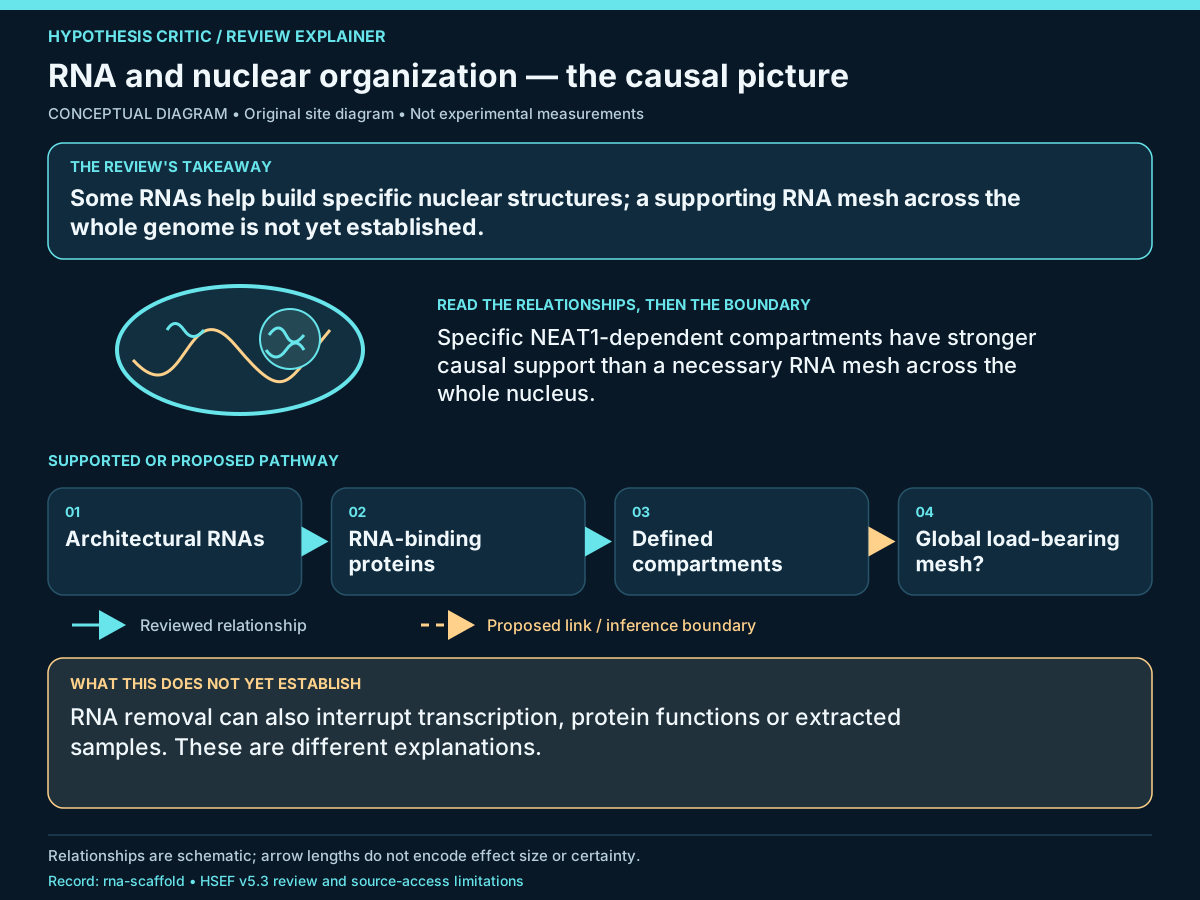
HYPOTHESIS CRITIC  /  REVIEW EXPLAINER
RNA and nuclear organization — the causal picture
CONCEPTUAL DIAGRAM  •  Original site diagram  •  Not experimental measurements
THE REVIEW'S TAKEAWAY
Some RNAs help build specific nuclear structures; a supporting RNA mesh across the whole genome is not yet established.
READ THE RELATIONSHIPS, THEN THE BOUNDARY
Specific NEAT1-dependent compartments have stronger causal support than a necessary RNA mesh across the whole nucleus.
SUPPORTED OR PROPOSED PATHWAY
01
Architectural RNAs
02
RNA-binding proteins
03
Defined compartments
04
Global load-bearing mesh?
Reviewed relationship
Proposed link / inference boundary
WHAT THIS DOES NOT YET ESTABLISH
RNA removal can also interrupt transcription, protein functions or extracted samples. These are different explanations.
Relationships are schematic; arrow lengths do not encode effect size or certainty.
Record: rna-scaffold  •  HSEF v5.3 review and source-access limitations
This is the specific idea being tested.
The RNA NEAT1 has strong evidence for helping build structures called paraspeckles. Other experiments change DNA packing, but removing RNA can also stop gene activity or disturb samples, making a whole-nucleus supporting mesh harder to test.
A higher rank means a better fit to the evidence in this comparison. It does not prove every part of the leading explanation.
The reviewed hypothesis ranks 3 among 5 models compared; 1 alternative model(s) hold first rank for this stated claim.
Claim under review: rank 3 among 5 compared models.
Leading explanation: Specific architectural RNA compartments.
Position in this comparison: Between leading and last ranks.
The causal grade asks how well the stated causal claim is established. This comparison asks which of the assessed explanations fits the reviewed findings better. A leading explanation can remain unproven. Models can overlap or include the tested mechanism; an alternative ahead does not make that mechanism irrelevant. These ordinal ranks apply within this review; they do not measure the size of a difference or rank scientific strength across topics.
HYPOTHESIS CRITIC  /  REVIEW EXPLAINER
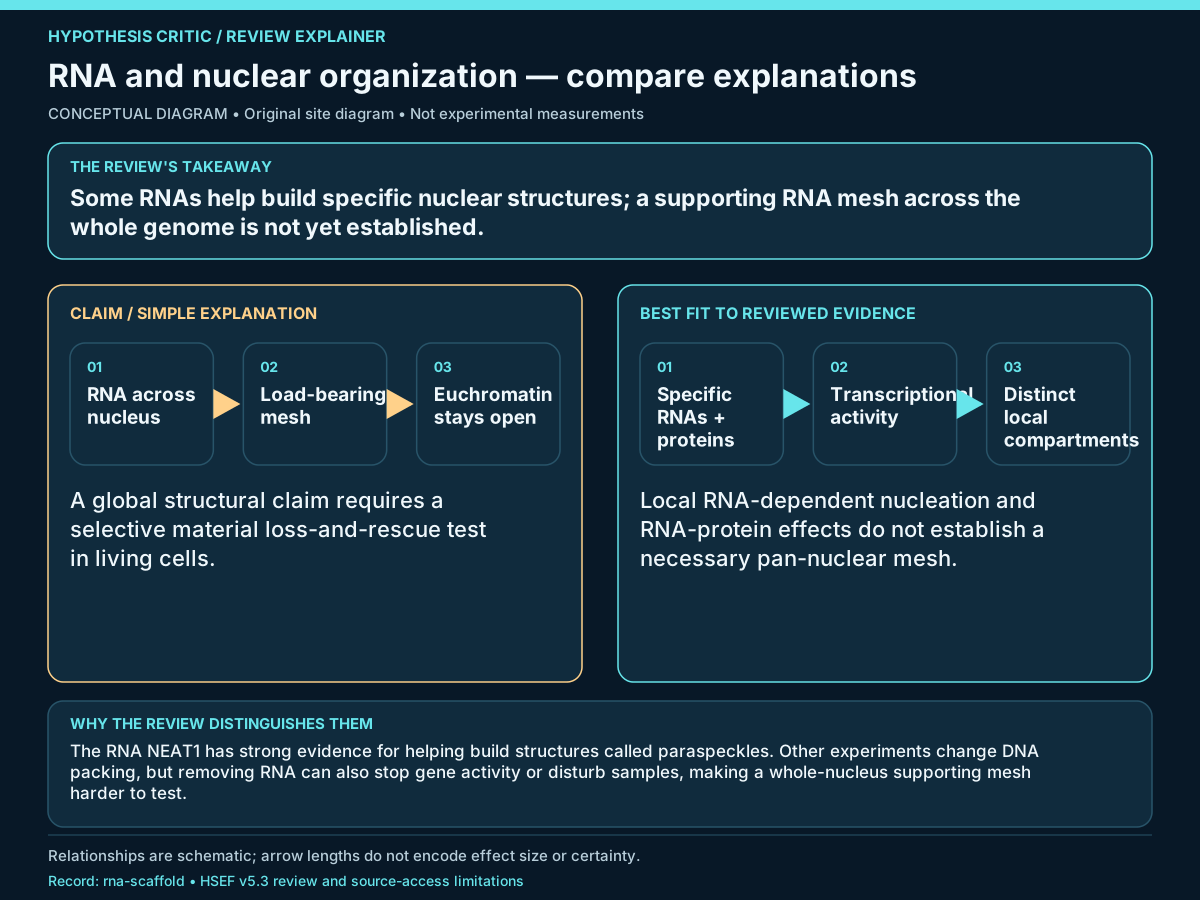
RNA and nuclear organization — compare explanations
CONCEPTUAL DIAGRAM  •  Original site diagram  •  Not experimental measurements
THE REVIEW'S TAKEAWAY
Some RNAs help build specific nuclear structures; a supporting RNA mesh across the whole genome is not yet established.
CLAIM / SIMPLE EXPLANATION
01
RNA across nucleus
02
Load-bearing mesh
03
Euchromatin stays open
A global structural claim requires a selective material loss-and-rescue test in living cells.
BEST FIT TO REVIEWED EVIDENCE
01
Specific RNAs + proteins
02
Transcriptional activity
03
Distinct local compartments
Local RNA-dependent nucleation and RNA-protein effects do not establish a necessary pan-nuclear mesh.
WHY THE REVIEW DISTINGUISHES THEM
The RNA NEAT1 has strong evidence for helping build structures called paraspeckles. Other experiments change DNA packing, but removing RNA can also stop gene activity or disturb samples, making a whole-nucleus supporting mesh harder to test.
Relationships are schematic; arrow lengths do not encode effect size or certainty.
Record: rna-scaffold  •  HSEF v5.3 review and source-access limitations
Plausible, not established for the stated claim.
The RNA NEAT1 has strong evidence for helping build structures called paraspeckles. Other experiments change DNA packing, but removing RNA can also stop gene activity or disturb samples, making a whole-nucleus supporting mesh harder to test.
These explanations can overlap. Ranking their fit to the evidence is separate from deciding how firmly a cause has been established.
Rank 1: Specific architectural RNA compartments — Defined RNA-protein assemblies organize selected compartments and domains without requiring one global matrix.
Rank 2: Transcription and tethered microphase organization — Polymerase attachment, RNA-rich phases and biochemical work organize active chromatin in specified contexts.
Rank 3: Global RNA load-bearing mesh — Nascent/noncoding RNA physically props open bulk euchromatin throughout interphase.
Rank 4: Intrinsic chromatin polymer organization — Chromatin affinity and polymer behavior contribute to baseline compartmentalization without one external RNA tether.
Rank 5: Classical static protein matrix — A stable insoluble fibrillar protein skeleton specifies all nuclear architecture.
Evidence rating: Γ · Moderate confidence. How the evidence was assessed.
The RNA NEAT1 has strong evidence for helping build structures called paraspeckles. Other experiments change DNA packing, but removing RNA can also stop gene activity or disturb samples, making a whole-nucleus supporting mesh harder to test.
RNA-built structures called paraspeckles are studied in how cells respond to stress and infection. Results in mouse immune cells connect them to infection responses, but do not establish a supporting RNA mesh across the whole nucleus or a human treatment.
Further reading: Primary study: paraspeckles and mouse immune responses.
RNA: A molecule made from DNA instructions; some RNAs carry information and others help regulate or organise the cell.
Scaffold: A structure that helps other components assemble or stay organised.
Paraspeckle: A nuclear structure assembled around the RNA NEAT1 and cooperating proteins.
Euchromatin: Generally less tightly packed DNA, often associated with active genes.
Look for the proposed factor and the outcome, in the people or systems covered by the claim.
Specialised RNAs, RNA-binding proteins and the act of reading genes make different contributions to nuclear structure. The RNA NEAT1 has strong evidence for helping build structures called paraspeckles. Other experiments change DNA packing, but removing RNA can also stop gene activity or disturb samples, making a whole-nucleus supporting mesh harder to test.
Selectively break RNA-based structural connections while preserving gene-reading machinery, protein functions and cell health, then restore the connections and measure nuclear structure in living cells.
HYPOTHESIS CRITIC  /  REVIEW EXPLAINER
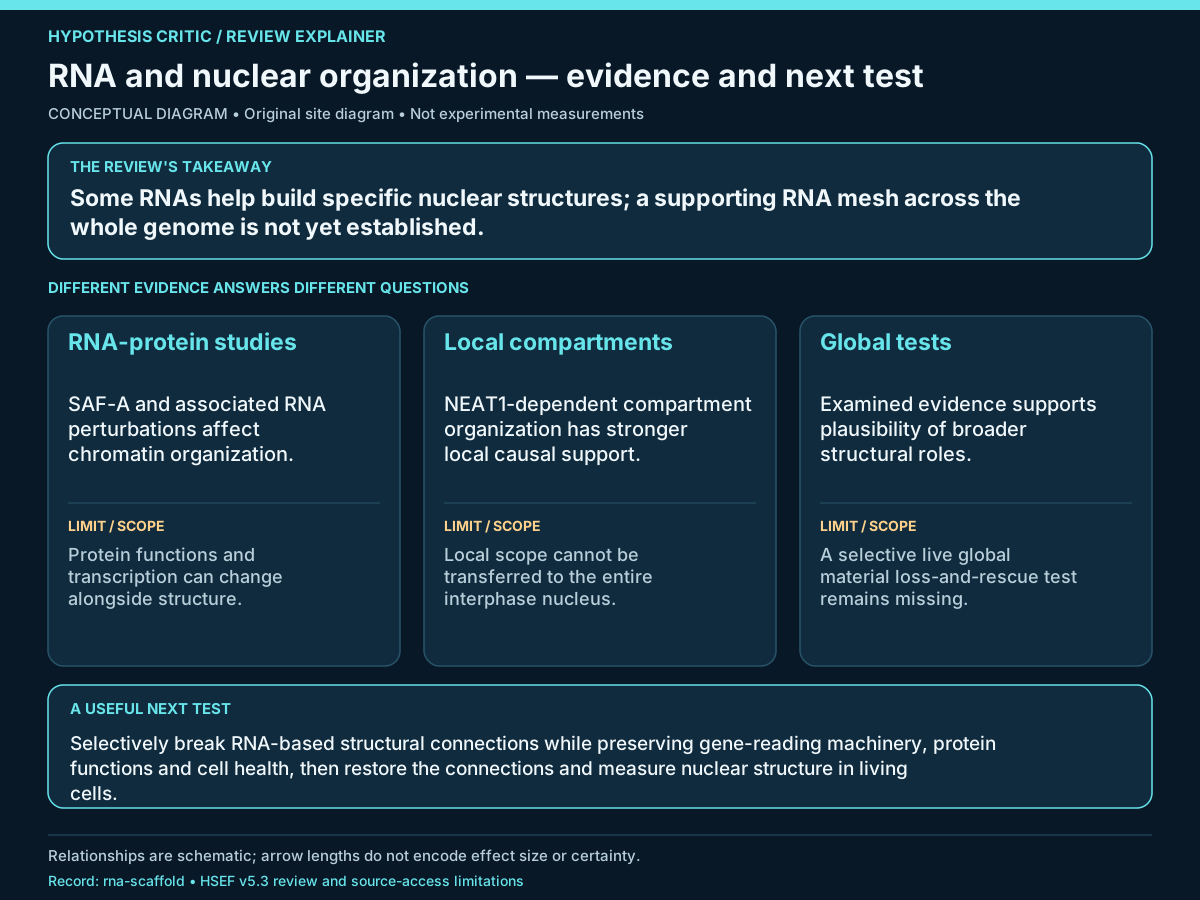
RNA and nuclear organization — evidence and next test
CONCEPTUAL DIAGRAM  •  Original site diagram  •  Not experimental measurements
THE REVIEW'S TAKEAWAY
Some RNAs help build specific nuclear structures; a supporting RNA mesh across the whole genome is not yet established.
DIFFERENT EVIDENCE ANSWERS DIFFERENT QUESTIONS
RNA-protein studies
SAF-A and associated RNA perturbations affect chromatin organization.
LIMIT / SCOPE
Protein functions and transcription can change alongside structure.
Local compartments
NEAT1-dependent compartment organization has stronger local causal support.
LIMIT / SCOPE
Local scope cannot be transferred to the entire interphase nucleus.
Global tests
Examined evidence supports plausibility of broader structural roles.
LIMIT / SCOPE
A selective live global material loss-and-rescue test remains missing.
A USEFUL NEXT TEST
Selectively break RNA-based structural connections while preserving gene-reading machinery, protein functions and cell health, then restore the connections and measure nuclear structure in living cells.
Relationships are schematic; arrow lengths do not encode effect size or certainty.
Record: rna-scaffold  •  HSEF v5.3 review and source-access limitations
Selectively break RNA-based structural connections while preserving gene-reading machinery, protein functions and cell health, then restore the connections and measure nuclear structure in living cells.
Check that the intended change really happened.
Allow for other factors and compare with suitable controls.
Look for independent confirmation and the limits of the effect.
These are questions for research, not a claim that the proposed studies have already succeeded.
Proposed tests: 1 test design(s) are registered in the scorecard.
In plain terms, researchers would change the proposed cause, check that it changed as intended, then measure a meaningful outcome while controlling plausible alternatives. The result should be able to support or count against the claim—not only show that a pathway exists.
Study design: Prespecify several intact interphase cell states and gene-rich/poor compartments; reversibly disrupt nascent RNA material interactions without terminating polymerase or changing RNA-protein abundance, assay chromatin mechanics and compaction with orthogonal live methods, and rescue architecture with endogenous-level structural RNA while transcriptional work remains controlled.
What would be measured: Verified RNA network interaction/load response, chromatin compaction and compartment scale, nascent transcription, energy, stress and cell-cycle state
Important controls: RNA-selective versus polymerase-selective perturbation, RNA-binding separation-of-function rescue, matched protein level/ATP/ionic conditions, native isoform and genomic DNA controls, viability and replication stress
Result that would support the claim: Loss of verified RNA material interactions precedes global structural change and is specifically rescued by the structural RNA at fixed polymerase/protein state across preregistered contexts
Result that would count against it: RNA network loss leaves global mechanics intact, or effects follow polymerase termination, osmotic/protein redistribution or stress and are rescued without RNA material
Follow the studies, detailed comparisons and evidence ratings behind this guide.
Open the scientific review →