The question
Do unregulated GLP-1 products work as well as tested medicines?
This is the specific idea being tested.

Do unregulated GLP-1 products work as well as tested medicines?
What you need to knowResults from regulated GLP-1 medicines cannot be assumed to apply to unregulated products.Relative explanatory fit: Alternative ranked ahead
Why the alternative fits better: A known formulation and reliable delivery are part of what was tested. Unverified products may not give the same exposure.
Claim assessed: Research-chemical-sourced GLP-1 analogues deliver the efficacy demonstrated in registrational trials.
Finding: Overall Α applies to SC3, the preregistered clinical-equivalence proposition. It does not deny the efficacy of regulated GLP-1 medicines or prove that every research-market preparation is inactive. Product identity, exposure and clinical equivalence cannot be supplied by a chemical label or transferred from a registrational trial.
Evidence scope: 51 primary reports; literature cutoff 2026-10-09; source examination UTC date 2026-10-10; bounded critical review, not exhaustive systematic review.
The grade applies to the stated claim. Model rankings and individual subclaim grades remain separate from the overall causal-evidence grade.
Full scientific assessment and references · Scorecard (JSON) · Review source (Markdown)
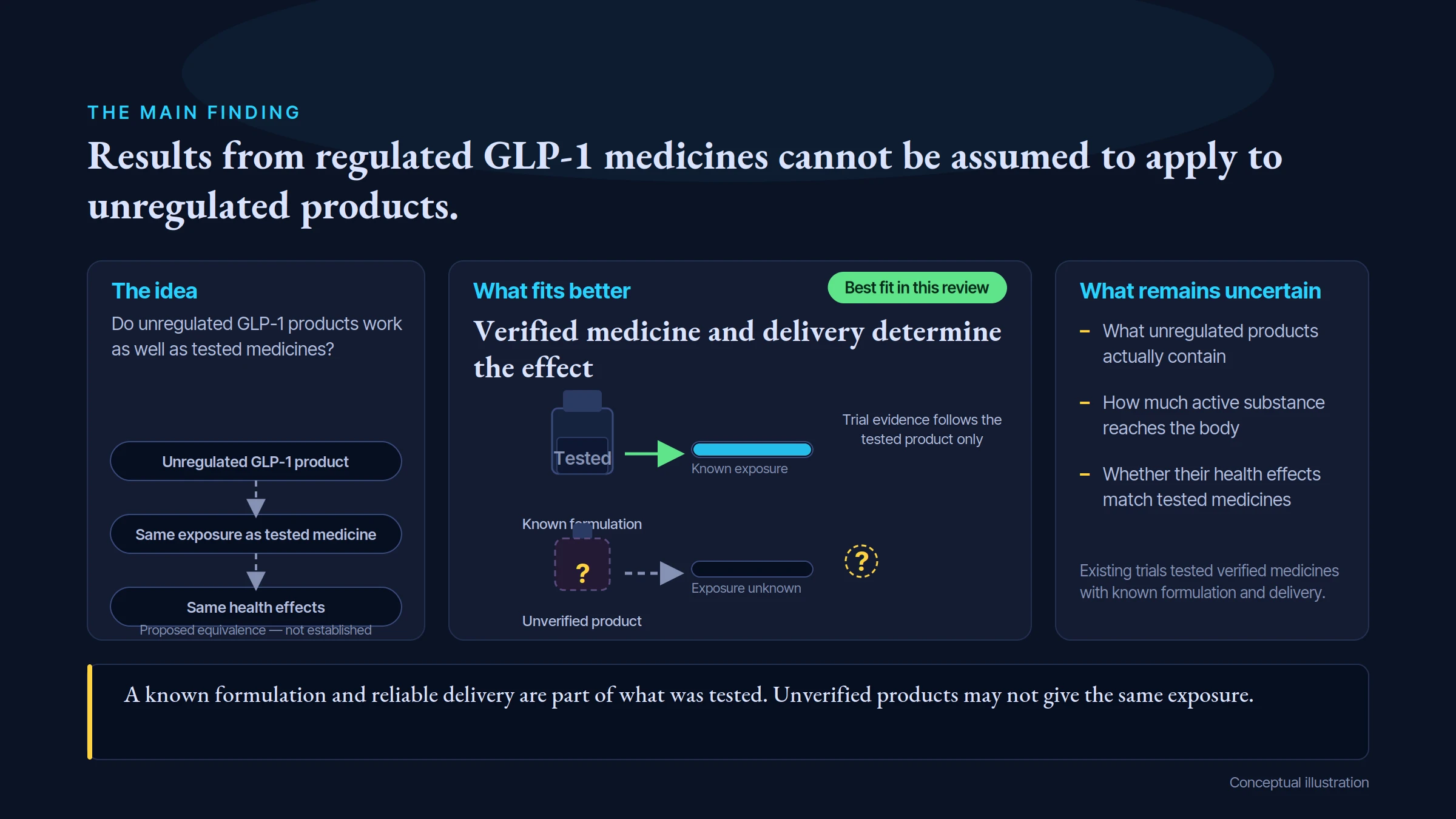
THE MAIN FINDING
Results from regulated GLP-1 medicines cannot be assumed to apply to unregulated products.
The idea
Do unregulated GLP-1 products work as well as tested medicines?
Unregulated GLP-1 product
Same exposure as tested medicine
Same health effects
Proposed equivalence — not established
What fits better
Verified medicine and delivery determine the effect
Best fit in this review
Tested medicine vial (illustrative)
Known formulation
Known exposure
Unverified product
Exposure unknown
Trial evidence follows the tested product only
What remains uncertain
What unregulated products actually contain
How much active substance reaches the body
Whether their health effects match tested medicines
Existing trials tested verified medicines with known formulation and delivery.
A known formulation and reliable delivery are part of what was tested. Unverified products may not give the same exposure.
Conceptual illustration
This is the specific idea being tested.
A known formulation and reliable delivery are part of what was tested. Unverified products may not give the same exposure.
A higher rank means a better fit to the evidence in this comparison. It does not prove every part of the leading explanation.
The reviewed hypothesis ranks 3 among 4 models compared; 1 alternative model(s) hold first rank for this stated claim.
Claim under review: rank 3 among 4 compared models.
Leading explanation: Authentic-product pharmacology with exposure-dependent effects.
Position in this comparison: Between leading and last ranks.
The causal grade asks how well the stated causal claim is established. This comparison asks which of the assessed explanations fits the reviewed findings better. A leading explanation can remain unproven. Models can overlap or include the tested mechanism; an alternative ahead does not make that mechanism irrelevant. These ordinal ranks apply within this review; they do not measure the size of a difference or rank scientific strength across topics.
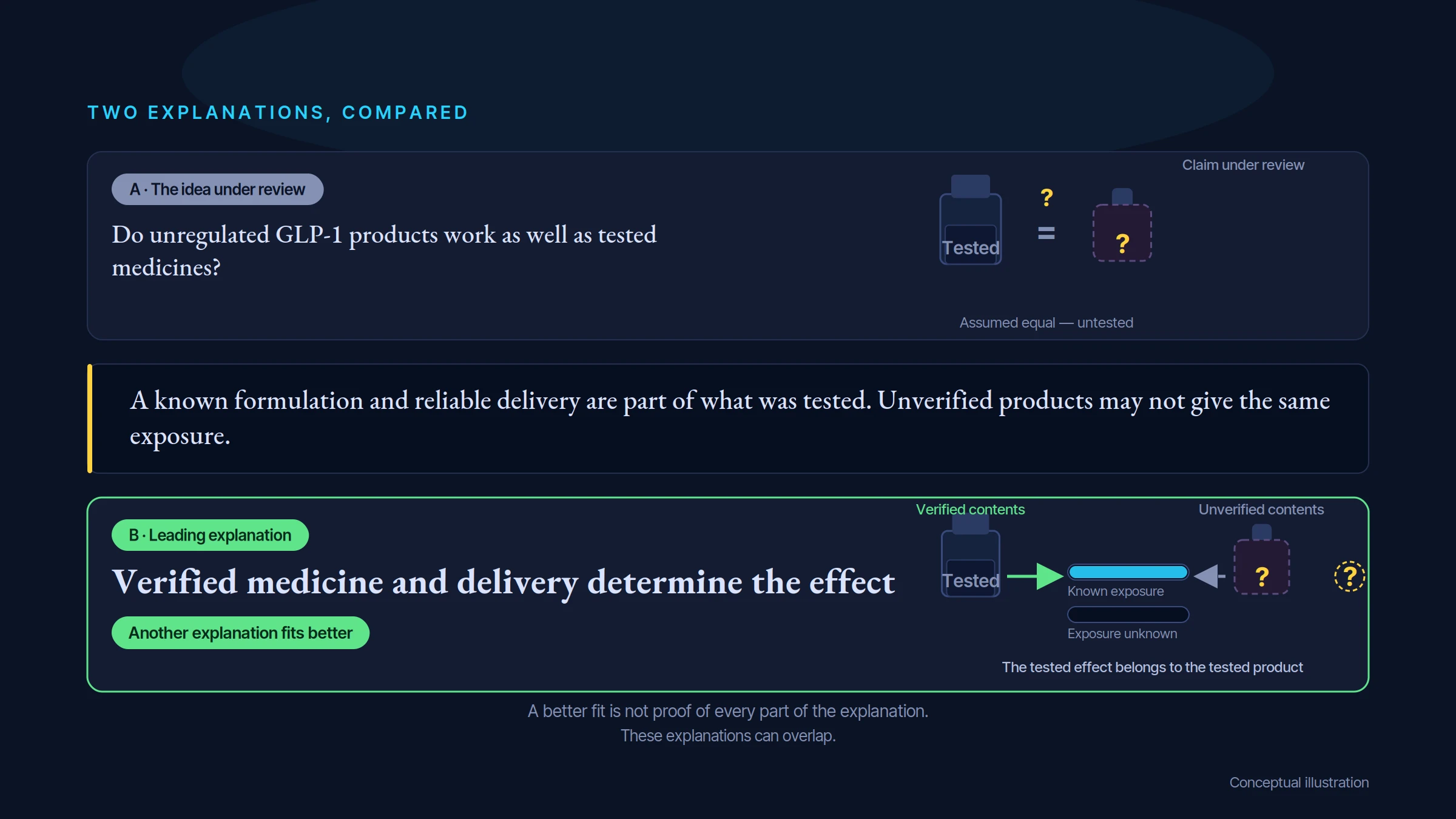
TWO EXPLANATIONS, COMPARED
A · The idea under review
Do unregulated GLP-1 products work as well as tested medicines?
Tested medicine (illustrative)
Assumed equal — untested
Claim under review
A known formulation and reliable delivery are part of what was tested. Unverified products may not give the same exposure.
B · Leading explanation
Verified medicine and delivery determine the effect
Another explanation fits better
Tested medicine (illustrative)
Verified contents
Known exposure
Unverified contents
Exposure unknown
The tested effect belongs to the tested product
A better fit is not proof of every part of the explanation.
These explanations can overlap.
Conceptual illustration
Not established for the stated claim.
A known formulation and reliable delivery are part of what was tested. Unverified products may not give the same exposure.
These explanations can overlap. Ranking their fit to the evidence is separate from deciding how firmly a cause has been established.
Rank 1: Authentic-product pharmacology with exposure-dependent effects — Known formulation and verified delivery determine the tested therapeutic effect.
Rank 2: Variable identity, formulation and administration — Supply and administration variation can change exposure independently of the advertised target.
Rank 3: Research-market clinical equivalence — The advertised peptide label is treated as sufficient to transfer trial efficacy.
Rank 4: Expectation, co-use and selection — Self-reported outcomes may reflect other interventions or selective reporting.
Evidence rating: Α · Moderate confidence. How the evidence was assessed.
A known formulation and reliable delivery are part of what was tested. Unverified products may not give the same exposure.
Overall Α applies to SC3, the preregistered clinical-equivalence proposition. It does not deny the efficacy of regulated GLP-1 medicines or prove that every research-market preparation is inactive. Product identity, exposure and clinical equivalence cannot be supplied by a chemical label or transferred from a registrational trial.
Look for the proposed factor and the outcome, in the people or systems covered by the claim.
Verified medicine and delivery determine the effect. A known formulation and reliable delivery are part of what was tested. Unverified products may not give the same exposure.
Independently test product contents and delivery before controlled comparisons of health effects.
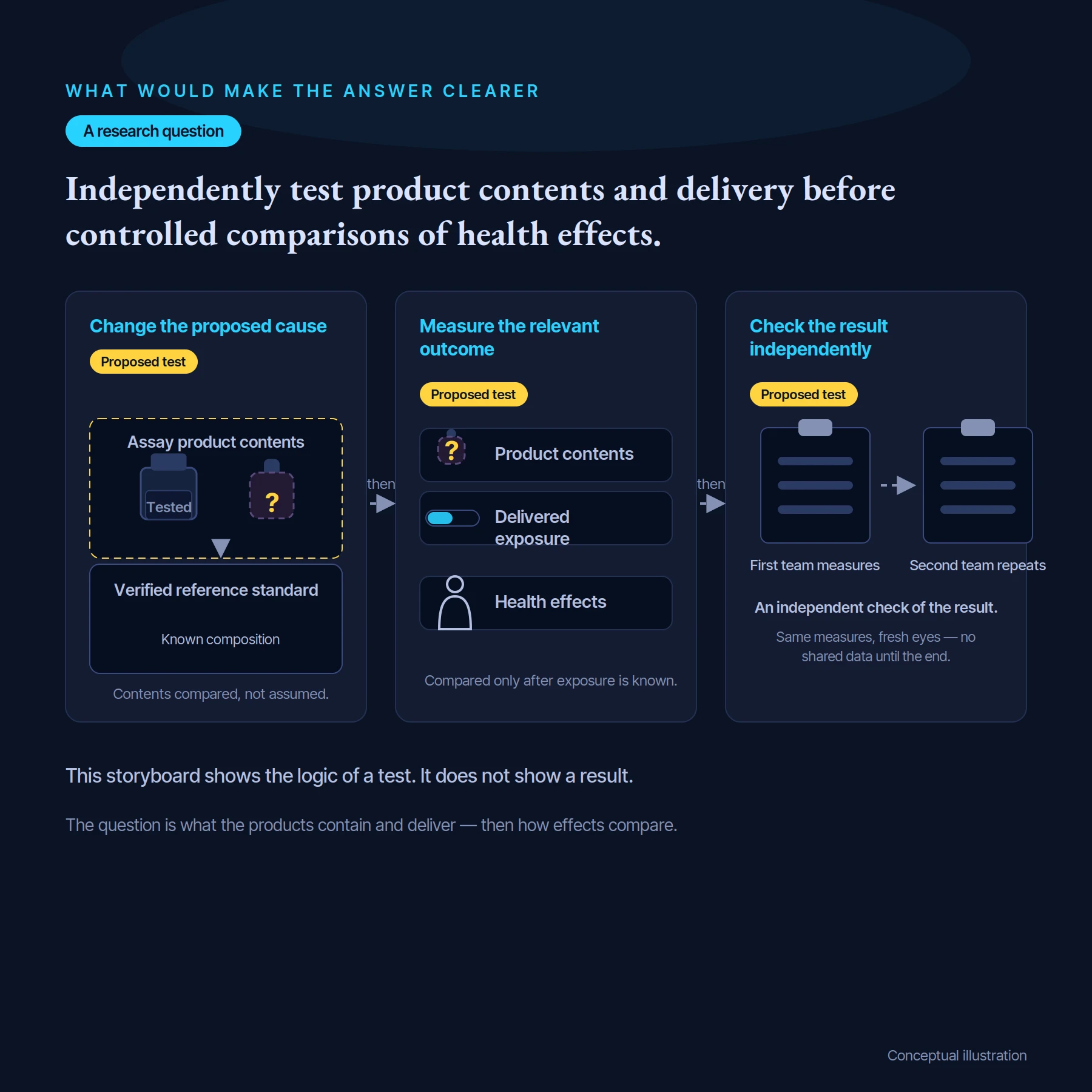
WHAT WOULD MAKE THE ANSWER CLEARER
A research question
Independently test product contents and delivery before controlled comparisons of health effects.
then
then
Change the proposed cause
Proposed test
Assay product contents
Tested medicine (illustrative)
Verified reference standard
Known composition
Contents compared, not assumed.
Measure the relevant outcome
Proposed test
Product contents
Delivered exposure
Health effects
Compared only after exposure is known.
Check the result independently
Proposed test
First team measures
Second team repeats
An independent check of the result.
Same measures, fresh eyes — no shared data until the end.
This storyboard shows the logic of a test. It does not show a result.
The question is what the products contain and deliver — then how effects compare.
Conceptual illustration
Independently test product contents and delivery before controlled comparisons of health effects.
Check that the intended change really happened.
Allow for other factors and compare with suitable controls.
Look for independent confirmation and the limits of the effect.
These are questions for research, not a claim that the proposed studies have already succeeded.
Proposed tests: 1 test design(s) are registered in the scorecard.
In plain terms, researchers would change the proposed cause, check that it changed as intended, then measure a meaningful outcome while controlling plausible alternatives. The result should be able to support or count against the claim—not only show that a pathway exists.
Study design: Compare independently assayed candidate preparations against the authentic trial product under ethically authorized product-quality and clinical-trial oversight, with prespecified exposure and clinical equivalence margins; assay every batch before outcomes.
What would be measured: Verified exposure, prespecified functional/metabolic outcomes and adverse-event ascertainment
Important controls: Authentic matched formulation, batch blinding, measured identity/potency/sterility, and identical follow-up
Result that would support the claim: Quality and exposure equivalence plus clinical results meeting the registered margins
Result that would count against it: Mismatched composition/exposure or failure of clinical equivalence despite verified adequate exposure
Follow the studies, detailed comparisons and evidence ratings behind this guide.
Open the scientific review →