The question
Does restoring NAD and sirtuin activity generally slow ageing?
This is the specific idea being tested.
Does restoring NAD and sirtuin activity generally slow ageing?
What you need to knowNAD-related changes involve several pathways. They do not establish a general human anti-ageing benefit.Relative explanatory fit: Alternative ranked ahead
Why the alternative fits better: NAD treatments change metabolism and repair without proving one NAD-to-sirtuin route controls ageing.
Claim assessed: Age-related NAD+ decline limits sirtuin activity and is a causal driver of organismal aging, so NAD+ precursor repletion restores youthful function and improves human healthspan or lifespan.
Finding: Preregistered weakest-link returns Β because SC1 is scored at association/existence level; SC2 and bounded functional SC3 reach Ε, and general primacy SC4 is Γ. This conservative aggregation is preserved even though it can understate the strength of narrower causal contributions. The named primary subclaim SC3 returns Ε for the measured human functional scope. Scope-matched returns Γ: only SC4 carries the central claim's general organismal-aging scope, while SC3 is restricted to baseline-defined trial populations and is reported separately. Neither sensitivity establishes human lifespan or general aging reversal.
Evidence scope: 60 primary reports; cutoff 2026-10-04; bounded critical review, not exhaustive systematic review.
The grade applies to the stated claim. Model rankings and individual subclaim grades remain separate from the overall causal-evidence grade.
Full scientific assessment and references · Scorecard (JSON) · Review source (Markdown)
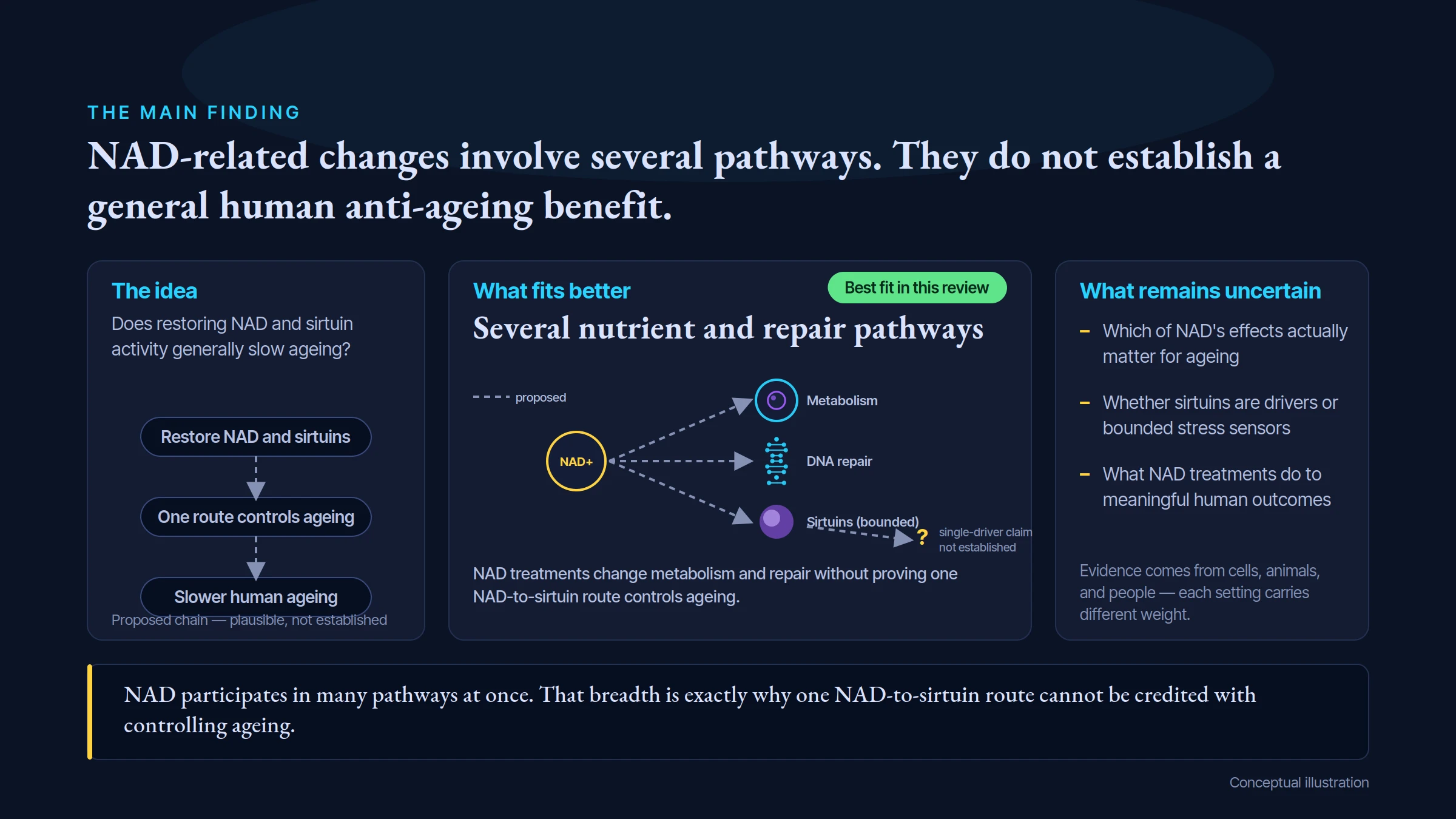
THE MAIN FINDING
NAD-related changes involve several pathways. They do not establish a general human anti-ageing benefit.
The idea
Does restoring NAD and sirtuin activity generally slow ageing?
Restore NAD and sirtuins
One route controls ageing
Slower human ageing
Proposed chain — plausible, not established
What fits better
Several nutrient and repair pathways
Best fit in this review
dashed line: proposed relationship
NAD+ (a cellular cofactor)
Metabolism
DNA repair
Sirtuins (bounded)
NAD touches several routes (proposed links, dashed)
single-driver claim not established
NAD treatments change metabolism and repair without proving one NAD-to-sirtuin route controls ageing.
What remains uncertain
Which of NAD's effects actually matter for ageing
Whether sirtuins are drivers or bounded stress sensors
What NAD treatments do to meaningful human outcomes
Evidence comes from cells, animals, and people — each setting carries different weight.
NAD participates in many pathways at once. That breadth is exactly why one NAD-to-sirtuin route cannot be credited with controlling ageing.
Conceptual illustration
This is the specific idea being tested.
NAD treatments change metabolism and repair without proving one NAD-to-sirtuin route controls ageing.
A higher rank means a better fit to the evidence in this comparison. It does not prove every part of the leading explanation.
The reviewed hypothesis ranks 5 among 5 models compared; 1 alternative model(s) hold first rank for this stated claim.
Claim under review: rank 5 among 5 compared models.
Leading explanation: Nutrient-sensing network primacy.
Position in this comparison: Last recorded rank.
The causal grade asks how well the stated causal claim is established. This comparison asks which of the assessed explanations fits the reviewed findings better. A leading explanation can remain unproven. Models can overlap or include the tested mechanism; an alternative ahead does not make that mechanism irrelevant. These ordinal ranks apply within this review; they do not measure the size of a difference or rank scientific strength across topics.
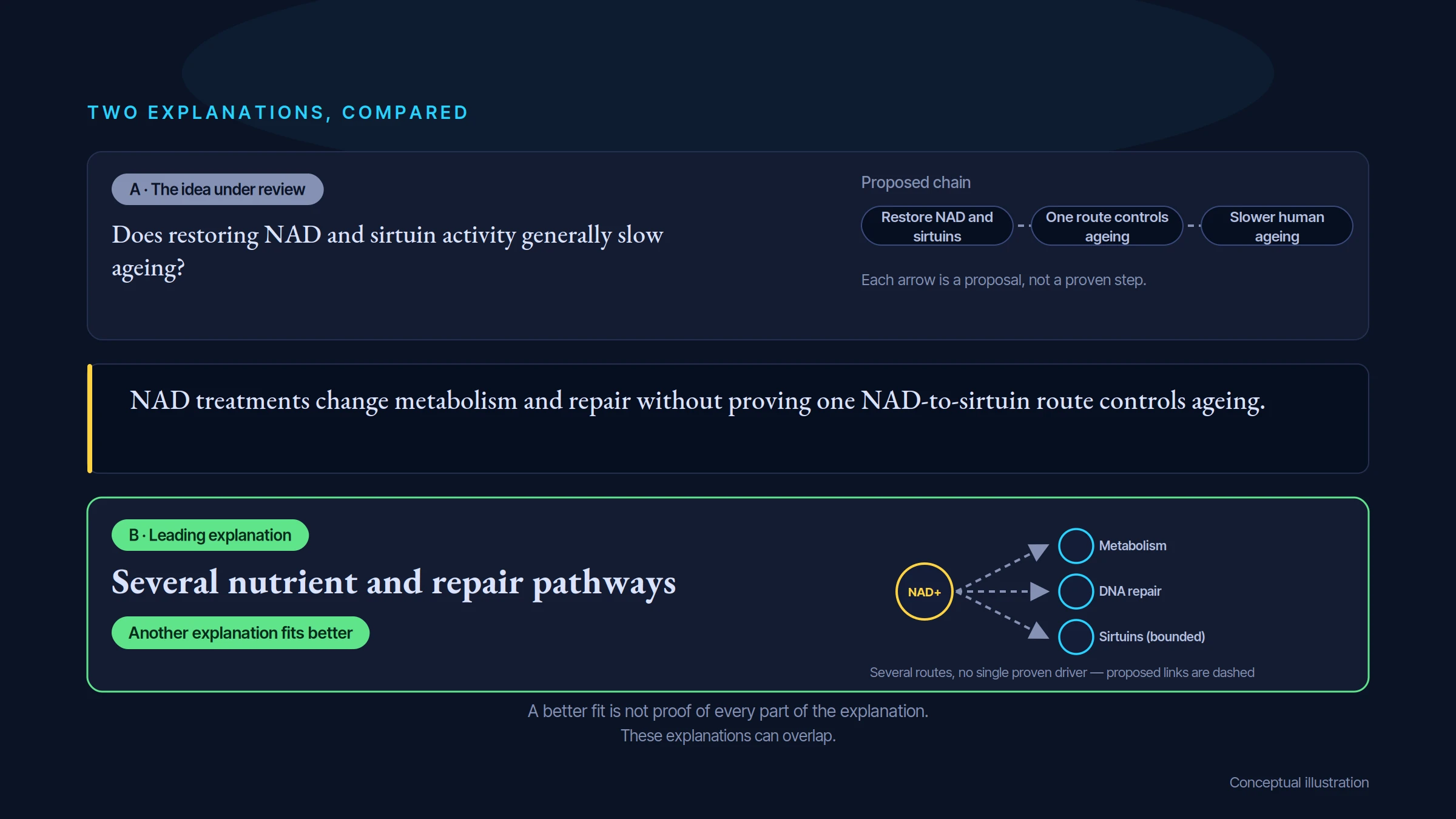
TWO EXPLANATIONS, COMPARED
A · The idea under review
Does restoring NAD and sirtuin activity generally slow ageing?
Proposed chain
Restore NAD and sirtuins
One route controls ageing
Slower human ageing
Each arrow is a proposal, not a proven step.
NAD treatments change metabolism and repair without proving one NAD-to-sirtuin route controls ageing.
B · Leading explanation
Several nutrient and repair pathways
Another explanation fits better
NAD+ (a cellular cofactor)
Metabolism
DNA repair
Sirtuins (bounded)
NAD touches several routes (proposed links, dashed)
Several routes, no single proven driver — proposed links are dashed
A better fit is not proof of every part of the explanation.
These explanations can overlap.
Conceptual illustration
Association only for the stated claim.
NAD treatments change metabolism and repair without proving one NAD-to-sirtuin route controls ageing.
These explanations can overlap. Ranking their fit to the evidence is separate from deciding how firmly a cause has been established.
Rank 1: Nutrient-sensing network primacy — NAD interventions participate in multiple metabolic and repair pathways.
Rank 2: Senescence/CD38 degradation sink — Inflammatory senescence drives a modifiable NAD sink.
Rank 3: Sirtuins as bounded stress sensors — Particular sirtuins protect particular contexts.
Rank 4: Permissive redox-cofactor availability — NAD pools enable several necessary cellular reactions.
Rank 5: NAD decline/sirtuin primacy — Age-associated NAD loss initiates general aging through limited sirtuin activity.
Evidence rating: Β · Moderate confidence. How the evidence was assessed.
NAD treatments change metabolism and repair without proving one NAD-to-sirtuin route controls ageing.
This is an assessment of a causal explanation, not proof that a particular supplement, diet, test, or treatment improves health. A treatment claim needs studies that test the intervention in people and measure meaningful benefits and harms. These findings can help frame research and informed clinical questions, but they do not identify what is right for one person.
Look for the proposed factor and the outcome, in the people or systems covered by the claim.
Several nutrient and repair pathways. NAD treatments change metabolism and repair without proving one NAD-to-sirtuin route controls ageing.
Separate NAD's different effects, measuring meaningful ageing outcomes rather than a marker alone.
These illustrations show the key questions tested in the review. They are conceptual drawings, not microscope images or experimental results.
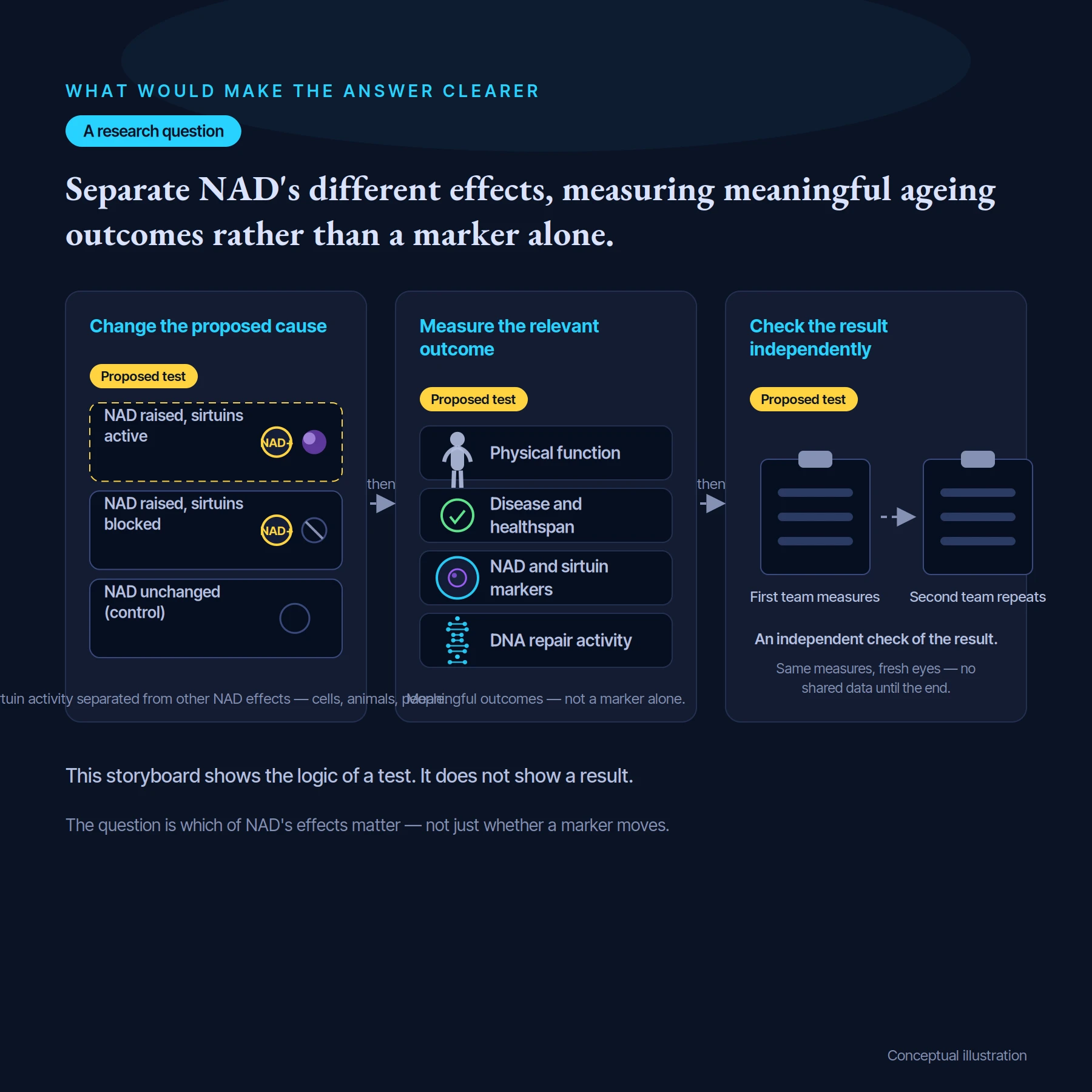
WHAT WOULD MAKE THE ANSWER CLEARER
A research question
Separate NAD's different effects, measuring meaningful ageing outcomes rather than a marker alone.
then
then
Change the proposed cause
Proposed test
NAD raised, sirtuins active
NAD raised, sirtuins blocked
NAD unchanged (control)
Sirtuin activity separated from other NAD effects — cells, animals, people.
Measure the relevant outcome
Proposed test
Physical function
Disease and healthspan
NAD and sirtuin markers
DNA repair activity
Meaningful outcomes — not a marker alone.
Check the result independently
Proposed test
First team measures
Second team repeats
An independent check of the result.
Same measures, fresh eyes — no shared data until the end.
This storyboard shows the logic of a test. It does not show a result.
The question is which of NAD's effects matter — not just whether a marker moves.
Conceptual illustration
Separate NAD's different effects, measuring meaningful ageing outcomes rather than a marker alone.
Check that the intended change really happened.
Allow for other factors and compare with suitable controls.
Look for independent confirmation and the limits of the effect.
These are questions for research, not a claim that the proposed studies have already succeeded.
Proposed tests: 1 test design(s) are registered in the scorecard.
In plain terms, researchers would change the proposed cause, check that it changed as intended, then measure a meaningful outcome while controlling plausible alternatives. The result should be able to support or count against the claim—not only show that a pathway exists.
Study design: In baseline-defined older adults, randomize adequate NR/NMN exposure and test prespecified clinical function/disability over meaningful follow-up. Pair this with an adult-selective mechanistic contrast that blocks the proposed sirtuin mediator while preserving NAD repletion and other NAD-dependent routes, with selective rescue and masked outcome assessment. Human exposure instruments or lifelong natural experiments can complement the mediator experiment.
What would be measured: Clinical function, disability, incident age-related disease and survival, separately from blood/tissue NAD and sirtuin activity
Important controls: Tissue engagement, age/sex/disease context, intake, co-interventions, multiplicity and mediation specificity; no responder-selected inference
Result that would support the claim: Replicated clinical aging benefit lost specifically with sirtuin blockade and restored by mediator rescue
Result that would count against it: Adequate engagement without clinical benefit, or preserved benefit when the nominal sirtuin mediator is removed
Follow the studies, detailed comparisons and evidence ratings behind this guide.
Open the scientific review →