The question
Does giving people MOTS-c improve metabolism and extend the years they live in good health?
This is the specific idea being tested.
Does giving people MOTS-c improve metabolism and extend the years they live in good health?
What you need to knowMOTS-c has effects in rodents; lasting health benefits from giving it to people remain unproven.Relative explanatory fit: Alternative ranked ahead
Why the alternative fits better: Some rodent studies find functional improvements, but the main late-life experiment did not significantly extend overall lifespan. Human studies of exercise and inherited variation do not show that taking MOTS-c is an effective treatment.
For health decisions: Rodent findings do not establish that buying or injecting MOTS-c improves human health or extends healthy life.
Claim assessed: MOTS-c is a mitochondrial-derived peptide that improves human metabolic function and healthspan.
Finding: Overall Γ follows preregistered primary human-administered SC3. Partial native molecular SC1 is Γ and explicitly scoped rodent metabolic/functional pharmacology SC2 is Ε under a declared phenotype adaptation. Controlled model benefit is retained; neither endogenous exercise-marker induction, K14Q population association nor an analogue program supplies native human healthspan causality.
Evidence scope: 64 primary reports; literature cutoff 2026-10-09; source examination UTC date 2026-10-12; bounded critical review, not exhaustive systematic review.
The grade applies to the stated claim. Model rankings and individual subclaim grades remain separate from the overall causal-evidence grade.
Full scientific assessment and references · Scorecard (JSON) · Review source (Markdown)
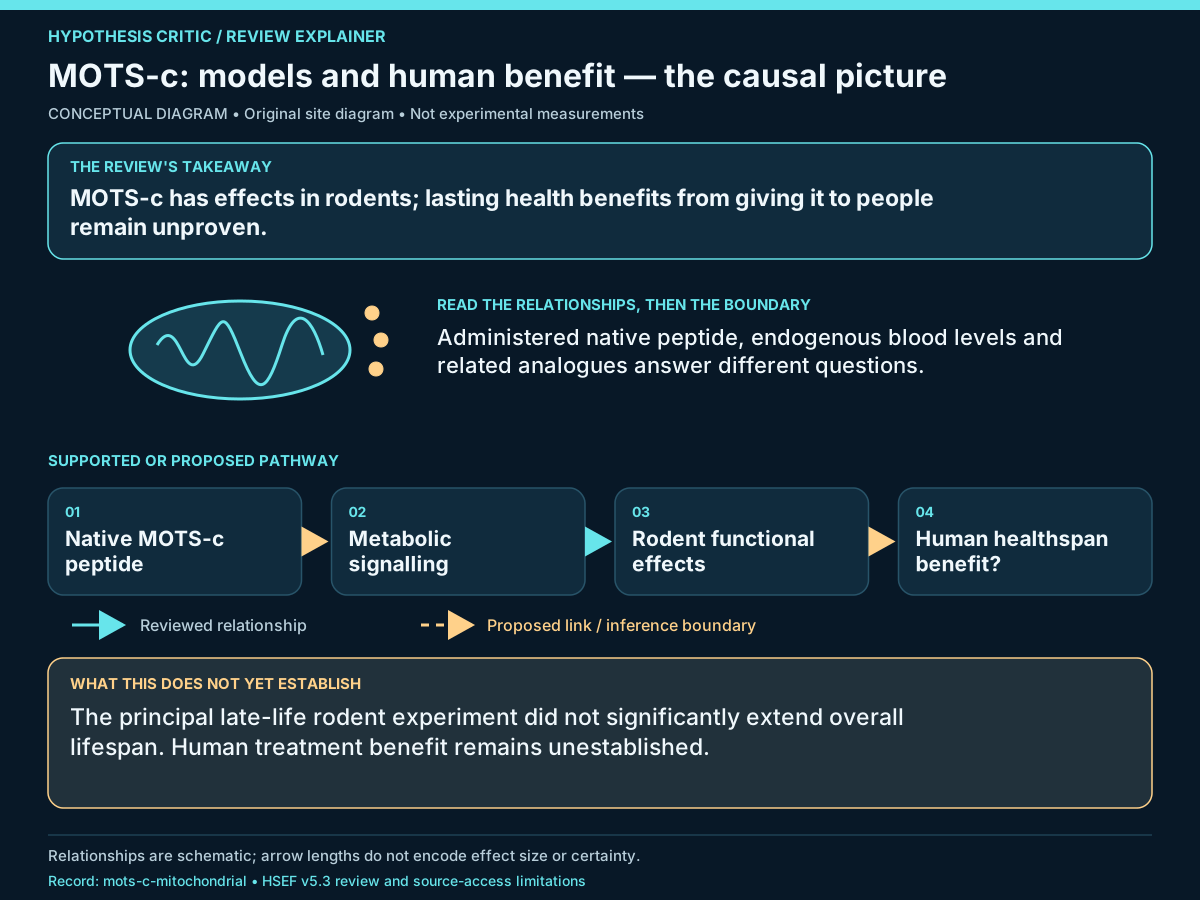
HYPOTHESIS CRITIC  /  REVIEW EXPLAINER
MOTS-c: models and human benefit — the causal picture
CONCEPTUAL DIAGRAM  •  Original site diagram  •  Not experimental measurements
THE REVIEW'S TAKEAWAY
MOTS-c has effects in rodents; lasting health benefits from giving it to people remain unproven.
READ THE RELATIONSHIPS, THEN THE BOUNDARY
Administered native peptide, endogenous blood levels and related analogues answer different questions.
SUPPORTED OR PROPOSED PATHWAY
01
Native MOTS-c peptide
02
Metabolic signalling
03
Rodent functional effects
04
Human healthspan benefit?
Reviewed relationship
Proposed link / inference boundary
WHAT THIS DOES NOT YET ESTABLISH
The principal late-life rodent experiment did not significantly extend overall lifespan. Human treatment benefit remains unestablished.
Relationships are schematic; arrow lengths do not encode effect size or certainty.
Record: mots-c-mitochondrial  •  HSEF v5.3 review and source-access limitations
This is the specific idea being tested.
Some rodent studies find functional improvements, but the main late-life experiment did not significantly extend overall lifespan. Human studies of exercise and inherited variation do not show that taking MOTS-c is an effective treatment.
A higher rank means a better fit to the evidence in this comparison. It does not prove every part of the leading explanation.
The reviewed hypothesis ranks 3 among 4 models compared; 1 alternative model(s) hold first rank for this stated claim.
Claim under review: rank 3 among 4 compared models.
Leading explanation: Context-dependent exogenous peptide pharmacology.
Position in this comparison: Between leading and last ranks.
The causal grade asks how well the stated causal claim is established. This comparison asks which of the assessed explanations fits the reviewed findings better. A leading explanation can remain unproven. Models can overlap or include the tested mechanism; an alternative ahead does not make that mechanism irrelevant. These ordinal ranks apply within this review; they do not measure the size of a difference or rank scientific strength across topics.
HYPOTHESIS CRITIC  /  REVIEW EXPLAINER
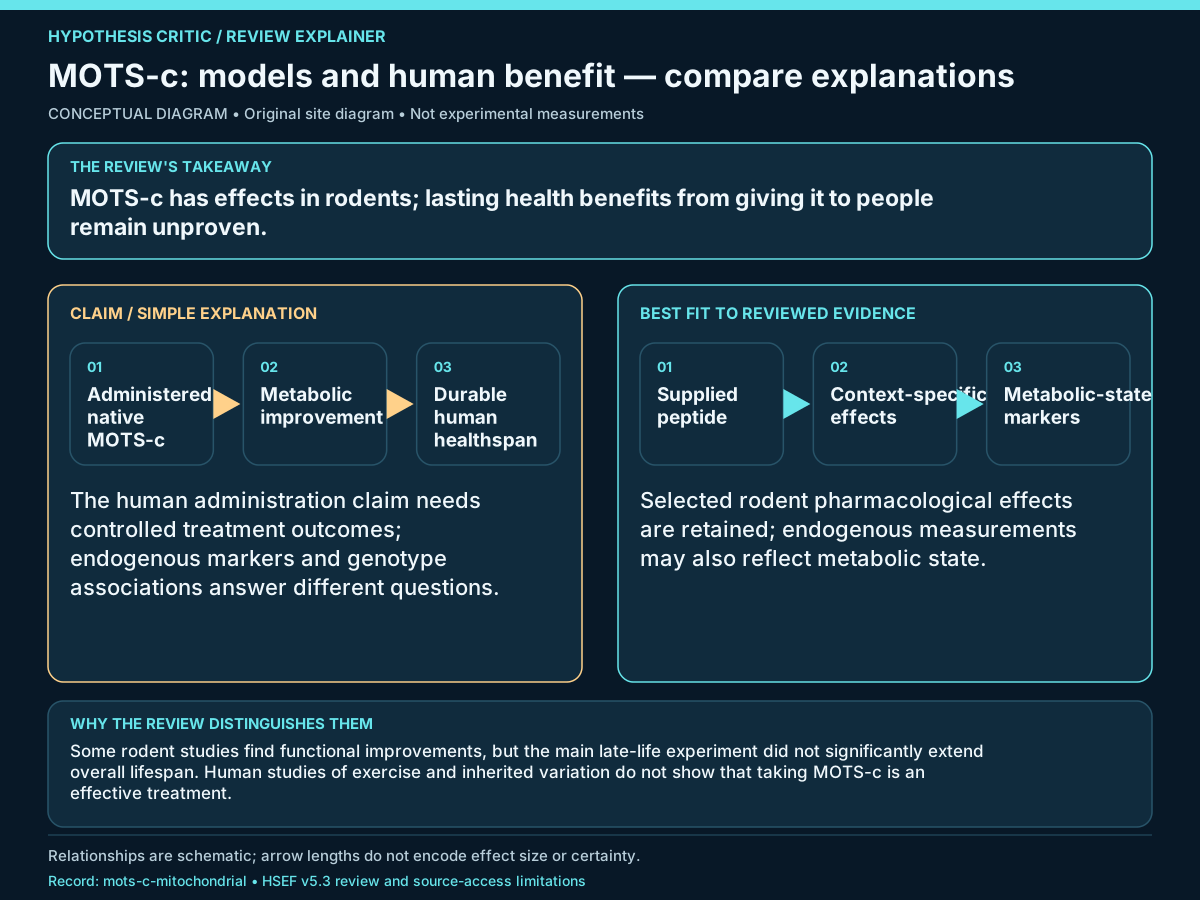
MOTS-c: models and human benefit — compare explanations
CONCEPTUAL DIAGRAM  •  Original site diagram  •  Not experimental measurements
THE REVIEW'S TAKEAWAY
MOTS-c has effects in rodents; lasting health benefits from giving it to people remain unproven.
CLAIM / SIMPLE EXPLANATION
01
Administered native MOTS-c
02
Metabolic improvement
03
Durable human healthspan
The human administration claim needs controlled treatment outcomes; endogenous markers and genotype associations answer different questions.
BEST FIT TO REVIEWED EVIDENCE
01
Supplied peptide
02
Context-specific effects
03
Metabolic-state markers
Selected rodent pharmacological effects are retained; endogenous measurements may also reflect metabolic state.
WHY THE REVIEW DISTINGUISHES THEM
Some rodent studies find functional improvements, but the main late-life experiment did not significantly extend overall lifespan. Human studies of exercise and inherited variation do not show that taking MOTS-c is an effective treatment.
Relationships are schematic; arrow lengths do not encode effect size or certainty.
Record: mots-c-mitochondrial  •  HSEF v5.3 review and source-access limitations
Plausible, not established for the stated claim.
Some rodent studies find functional improvements, but the main late-life experiment did not significantly extend overall lifespan. Human studies of exercise and inherited variation do not show that taking MOTS-c is an effective treatment.
These explanations can overlap. Ranking their fit to the evidence is separate from deciding how firmly a cause has been established.
Rank 1: Context-dependent exogenous peptide pharmacology — Supplied MOTS-c can change defined glucose, muscle and cardiac phenotypes through multiple tissue-dependent pathways.
Rank 2: Adaptive endogenous stress signal — Endogenous peptide measurements change with exercise, lipid load, tissue composition and illness as part of a context-dependent stress response.
Rank 3: Native human MOTS-c healthspan intervention — Administering native MOTS-c improves human metabolism and durable healthspan.
Rank 4: Assay and mitochondrial-genotype confounding — Part of the apparent systemic peptide signal or genotype-risk attribution reflects immunoassay, tissue/renal handling or linked mitochondrial biology.
Evidence rating: Γ · Moderate confidence. How the evidence was assessed.
Some rodent studies find functional improvements, but the main late-life experiment did not significantly extend overall lifespan. Human studies of exercise and inherited variation do not show that taking MOTS-c is an effective treatment.
The reviewed animal findings are a reason to study MOTS-c, not evidence that a person will benefit from taking it. A rise in the body's own peptide after exercise or an association with inherited variation is different from testing an administered treatment. This review does not establish a safe, effective human regimen or a lasting health benefit, and a related analogue cannot supply that missing evidence for native MOTS-c.
Look for the proposed factor and the outcome, in the people or systems covered by the claim.
Giving the peptide can have drug-like effects, while the body's own peptide levels can also reflect its metabolic state. Some rodent studies find functional improvements, but the main late-life experiment did not significantly extend overall lifespan. Human studies of exercise and inherited variation do not show that taking MOTS-c is an effective treatment.
Confirm the identity and exposure of the native peptide, then test it in a registered, controlled human trial that measures lasting metabolic function and health.
HYPOTHESIS CRITIC  /  REVIEW EXPLAINER
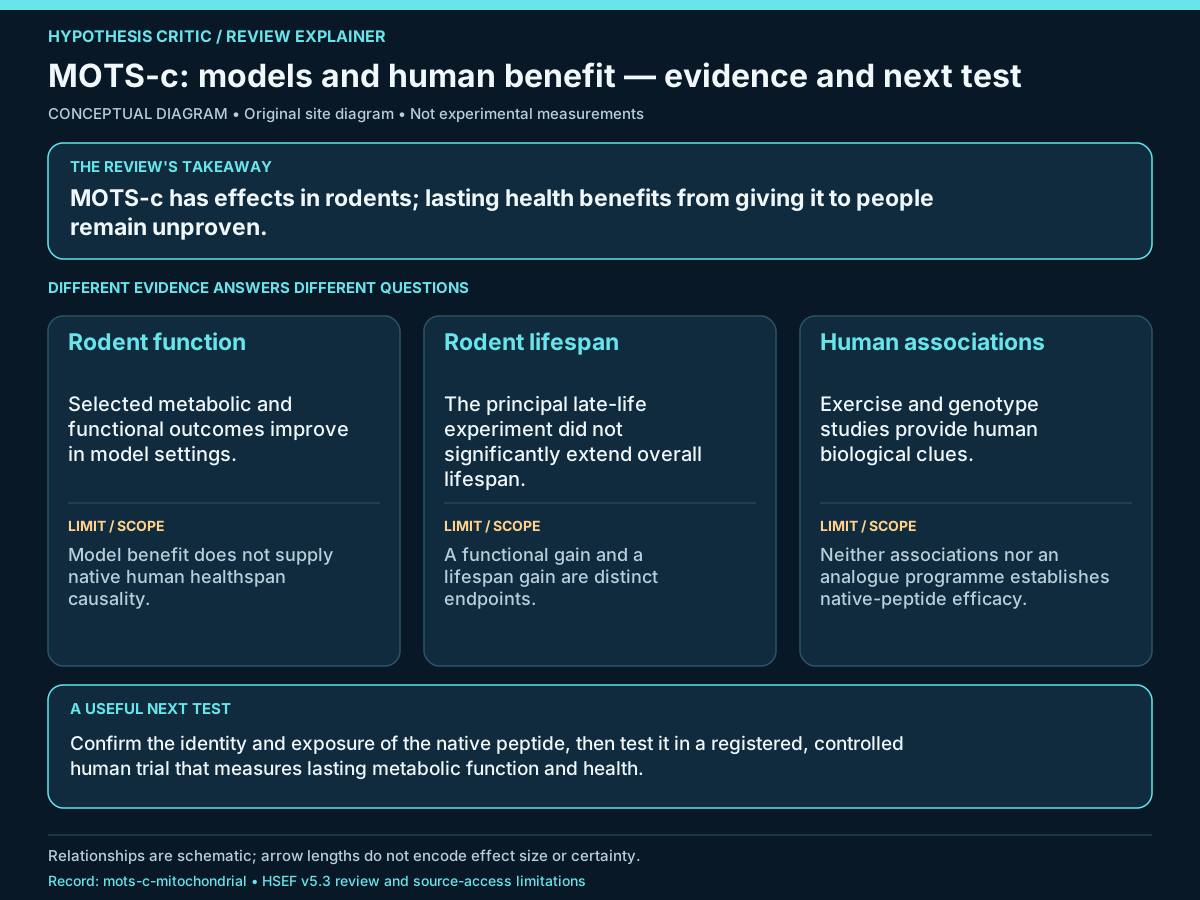
MOTS-c: models and human benefit — evidence and next test
CONCEPTUAL DIAGRAM  •  Original site diagram  •  Not experimental measurements
THE REVIEW'S TAKEAWAY
MOTS-c has effects in rodents; lasting health benefits from giving it to people remain unproven.
DIFFERENT EVIDENCE ANSWERS DIFFERENT QUESTIONS
Rodent function
Selected metabolic and functional outcomes improve in model settings.
LIMIT / SCOPE
Model benefit does not supply native human healthspan causality.
Rodent lifespan
The principal late-life experiment did not significantly extend overall lifespan.
LIMIT / SCOPE
A functional gain and a lifespan gain are distinct endpoints.
Human associations
Exercise and genotype studies provide human biological clues.
LIMIT / SCOPE
Neither associations nor an analogue programme establishes native-peptide efficacy.
A USEFUL NEXT TEST
Confirm the identity and exposure of the native peptide, then test it in a registered, controlled human trial that measures lasting metabolic function and health.
Relationships are schematic; arrow lengths do not encode effect size or certainty.
Record: mots-c-mitochondrial  •  HSEF v5.3 review and source-access limitations
Confirm the identity and exposure of the native peptide, then test it in a registered, controlled human trial that measures lasting metabolic function and health.
Check that the intended change really happened.
Allow for other factors and compare with suitable controls.
Look for independent confirmation and the limits of the effect.
These are questions for research, not a claim that the proposed studies have already succeeded.
Proposed tests: 1 test design(s) are registered in the scorecard.
In plain terms, researchers would change the proposed cause, check that it changed as intended, then measure a meaningful outcome while controlling plausible alternatives. The result should be able to support or count against the claim—not only show that a pathway exists.
Study design: First validate native human peptide identity, quantitative exposure and translation/export separately from synthetic material. Then preregister placebo-controlled native-MOTS-c dosing in a baseline-defined human metabolic/age cohort, with pharmacokinetics, tissue-specific engagement and prespecified glucose/physical-function endpoints plus durable clinical healthspan follow-up. Prospectively stratify sex/age/genotype and independently replicate; separately use a peptide-selective production perturbation preserving 12S-rRNA function to test endogenous necessity with sequence-specific rescue.
What would be measured: Validated native/synthetic peptide exposure, human metabolic functional measurements and durable physical/clinical healthspan rather than only AMPK, ROS or aging clocks
Important controls: Orthogonal LC-MS/MS identity and spike recovery, antibody cross-reactivity, native 12S-rRNA preservation, renal clearance, baseline diet/activity, sex/age/genotype, caloric intake, blinded dosing and predeclared endpoints
Result that would support the claim: Adequate native-peptide exposure produces reproducible clinically meaningful metabolic and durable functional benefit with predicted target engagement and prospectively validated context
Result that would count against it: Exposure/engagement changes only biomarkers, fails prespecified functional outcomes, or harms baseline-defined subgroups; native-selective production loss leaves the proposed physiological dependency intact
Follow the studies, detailed comparisons and evidence ratings behind this guide.
Open the scientific review →