The question
Does high phenylalanine in PKU cause preventable brain-development harm?
This is the specific idea being tested.
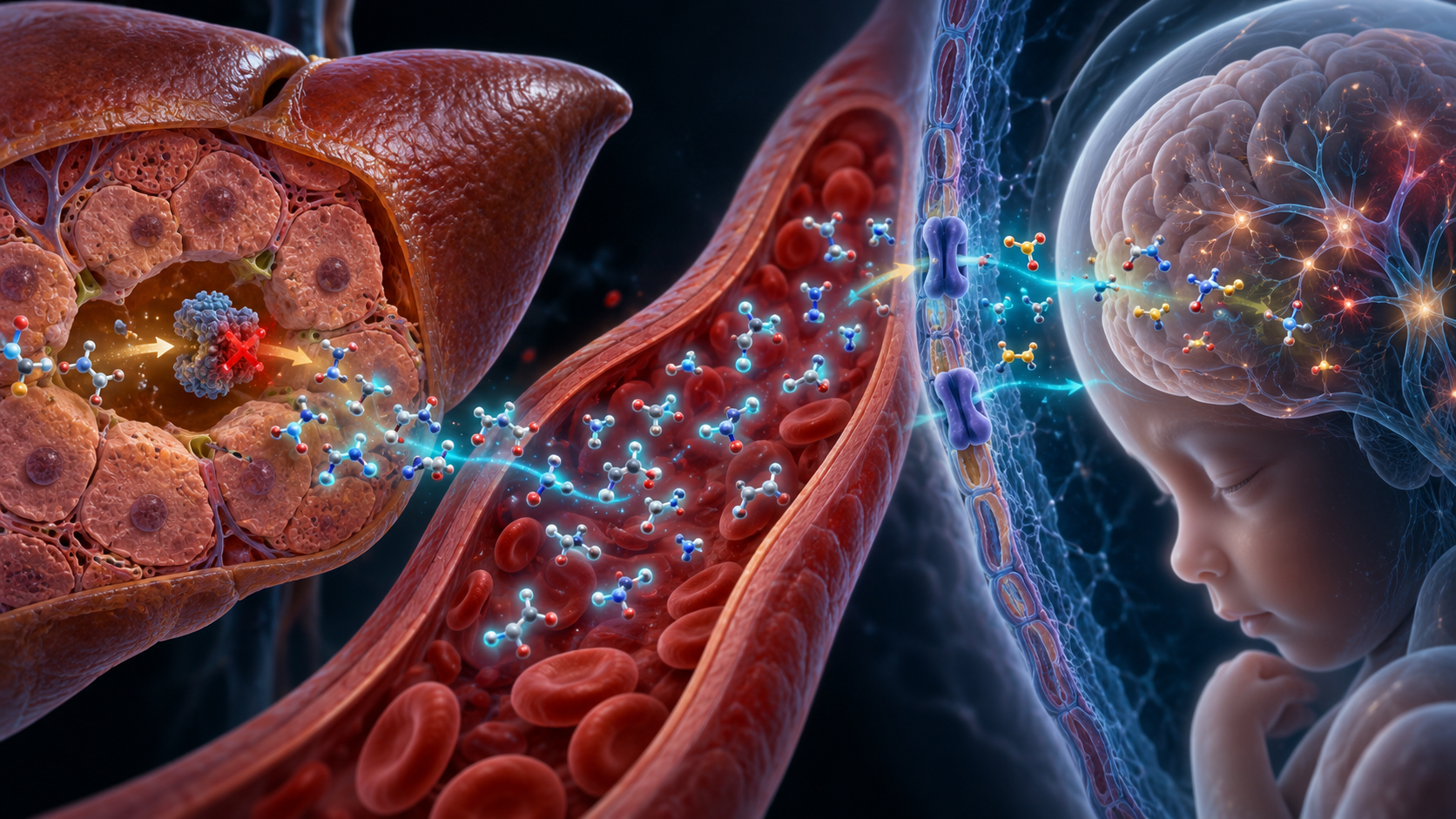
Does high phenylalanine in PKU cause preventable brain-development harm?
What you need to knowEarly control of phenylalanine in PKU prevents the severe brain-development harm of untreated disease.Relative explanatory fit: Leading among models compared
Why the evidence supports this: Inherited enzyme deficiency, sustained phenylalanine elevation and protection from early treatment support the same explanation.
Claim assessed: Sustained marked phenylalanine elevation caused by PAH-deficient phenylketonuria is a major cause of developmental intellectual disability, which can be prevented by early, sustained, nutritionally adequate dietary phenylalanine restriction.
Finding: PAH-related phenylalanine accumulation is an established cause of the intellectual disability of untreated PKU, and early dietary control prevents its severe phenotype; the integrated claim is Θ with High confidence.
Evidence scope: Targeted primary-literature review, including a 2026 update. Primary abstracts and status metadata read for all 15 reports; full Bickel paper and Demirbas article read. Not a systematic review or full-text-complete risk-of-bias audit. Pass-02 re-resolved all 15 prior ledger records and all 17 R2 records in PubMed, read full text of [1], [8], [23] (partial) and [25] (partial), and added 12 records (16–27).
The grade applies to the stated claim. Model rankings and individual subclaim grades remain separate from the overall causal-evidence grade.
Full scientific assessment and references · Scorecard (JSON) · Review source (Markdown)
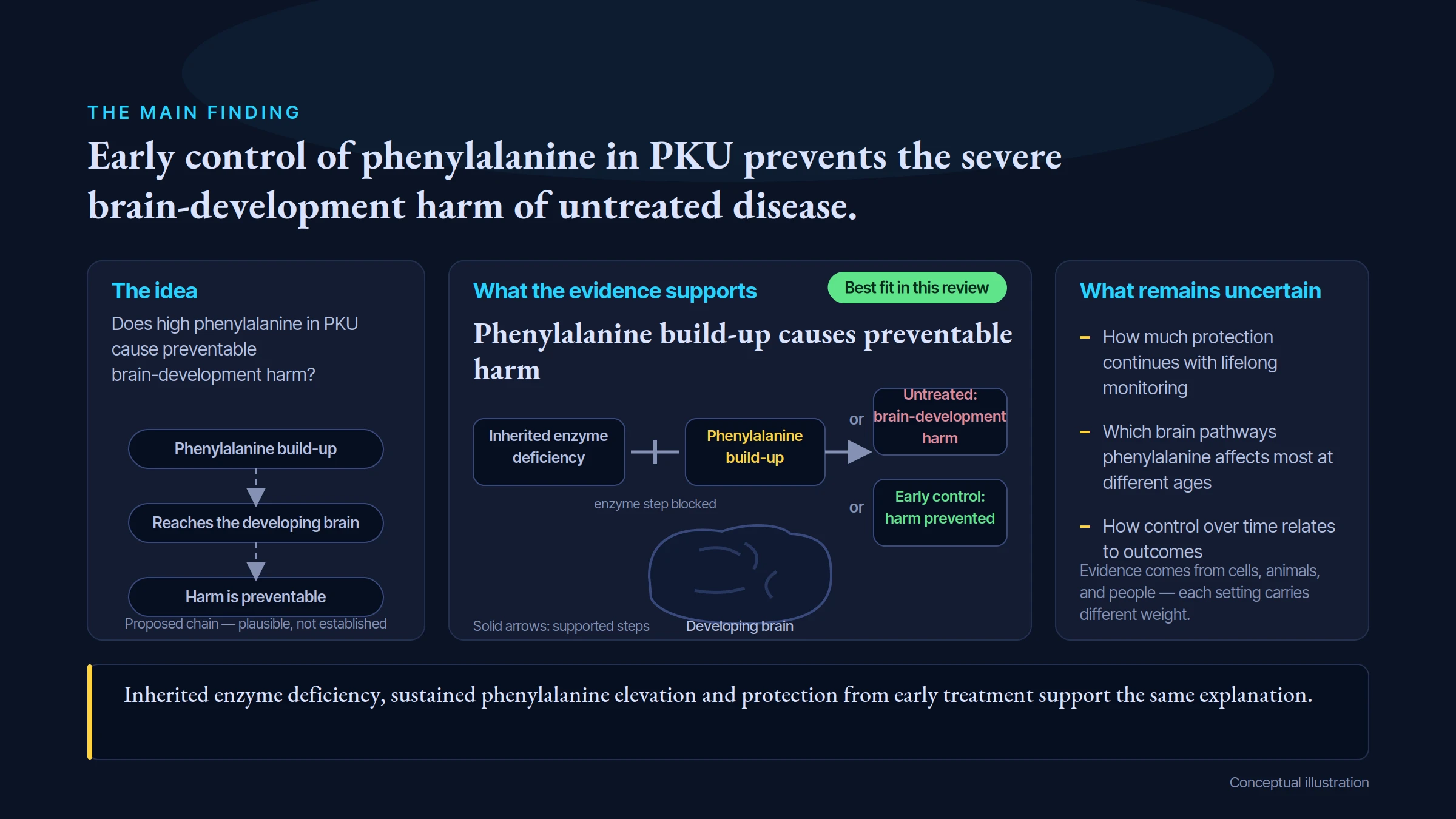
THE MAIN FINDING
Early control of phenylalanine in PKU prevents the severe brain-development harm of untreated disease.
The idea
Does high phenylalanine in PKU cause preventable brain-development harm?
Phenylalanine build-up
Reaches the developing brain
Harm is preventable
Proposed chain — plausible, not established
What the evidence supports
Phenylalanine build-up causes preventable harm
Best fit in this review
Inherited enzyme deficiency
enzyme step blocked
Phenylalanine build-up
Untreated: brain-development harm
Early control: harm prevented
or
Developing brain
Solid arrows: supported steps
What remains uncertain
How much protection continues with lifelong monitoring
Which brain pathways phenylalanine affects most at different ages
How control over time relates to outcomes
Evidence comes from cells, animals, and people — each setting carries different weight.
Inherited enzyme deficiency, sustained phenylalanine elevation and protection from early treatment support the same explanation.
Conceptual illustration
This is the specific idea being tested.
Inherited enzyme deficiency, sustained phenylalanine elevation and protection from early treatment support the same explanation.
This conclusion applies to the people, conditions and outcomes covered by the review.
The reviewed hypothesis ranks first among 4 models compared for this stated claim.
Claim under review: rank 1 among 4 compared models.
Leading explanation: PAH deficiency → phenylalanine accumulation → preventable developmental disability.
Position in this comparison: First rank.
The causal grade asks how well the stated causal claim is established. This comparison asks which of the assessed explanations fits the reviewed findings better. A leading explanation can remain unproven. Models can overlap or include the tested mechanism; an alternative ahead does not make that mechanism irrelevant. These ordinal ranks apply within this review; they do not measure the size of a difference or rank scientific strength across topics.
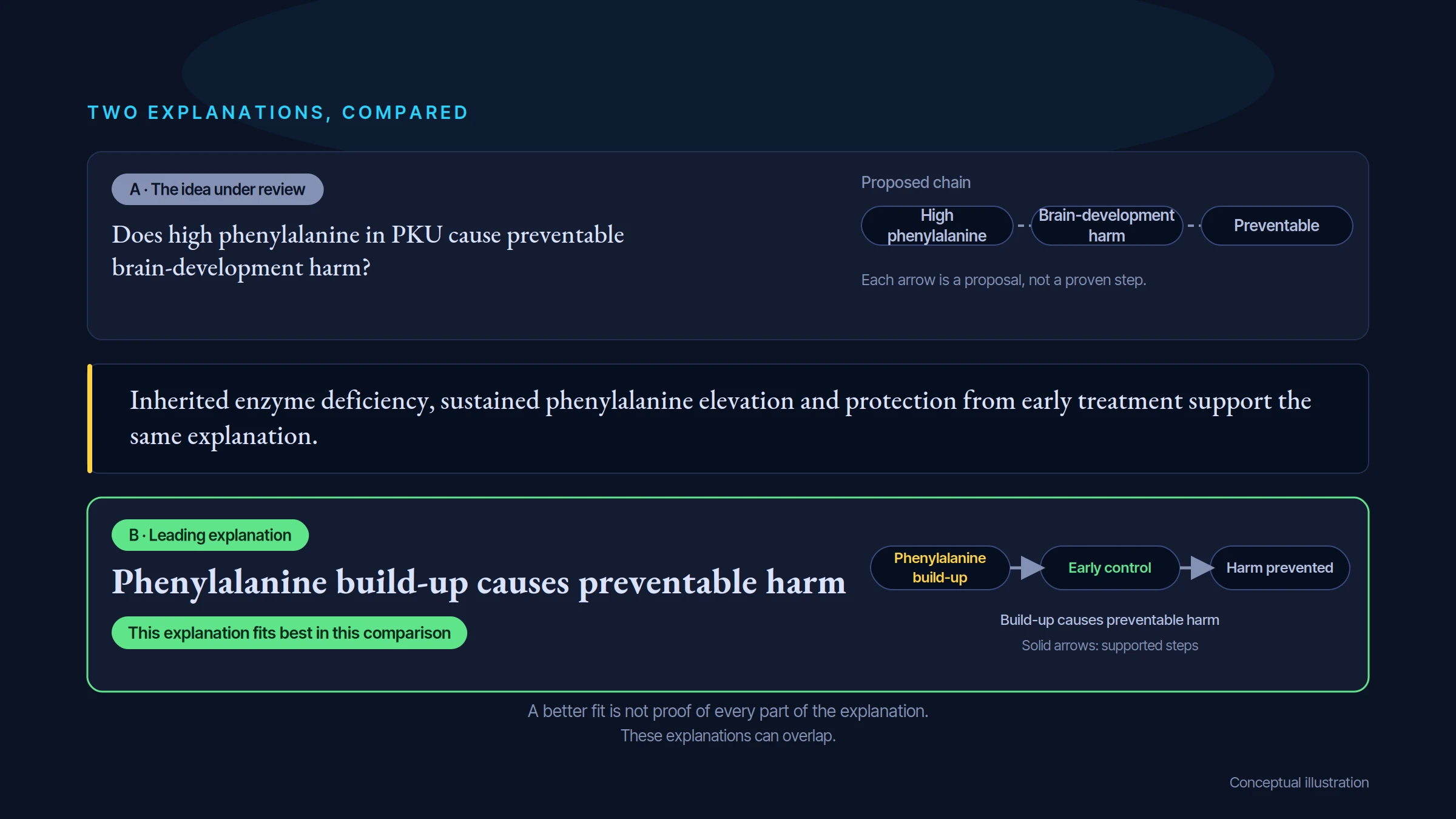
TWO EXPLANATIONS, COMPARED
A · The idea under review
Does high phenylalanine in PKU cause preventable brain-development harm?
Proposed chain
High phenylalanine
Brain-development harm
Preventable
Each arrow is a proposal, not a proven step.
Inherited enzyme deficiency, sustained phenylalanine elevation and protection from early treatment support the same explanation.
B · Leading explanation
Phenylalanine build-up causes preventable harm
This explanation fits best in this comparison
Phenylalanine build-up
Early control
Harm prevented
Build-up causes preventable harm
Solid arrows: supported steps
A better fit is not proof of every part of the explanation.
These explanations can overlap.
Conceptual illustration
Very well established for the stated claim.
Inherited enzyme deficiency, sustained phenylalanine elevation and protection from early treatment support the same explanation.
These explanations can overlap. Ranking their fit to the evidence is separate from deciding how firmly a cause has been established.
Rank 1: PAH deficiency → phenylalanine accumulation → preventable developmental disability — Sustained marked phenylalanine elevation caused by PAH-deficient phenylketonuria is a major cause of developmental intellectual disability, which can be prevented by early, sustained, nutritionally adequate dietary phenylalanine restriction.
Rank 2: Phenylalanine injury modified by development and multiple brain pathways — Phe exposure is causal, with effects modified by timing, brain handling, nutrition and several downstream processes.
Rank 3: Tyrosine shortage alone explains the neurological phenotype — The phenotype is explained principally by low tyrosine rather than toxic Phe exposure.
Rank 4: Nonspecific nutritional benefit explains apparent dietary rescue — Improved nutrition and care account for the apparent treatment effect without requiring a major Phe-specific effect.
Evidence rating: Θ · High confidence. How the evidence was assessed.
Inherited enzyme deficiency, sustained phenylalanine elevation and protection from early treatment support the same explanation.
For health and treatment, this is not a speculative lifestyle claim: timely diagnosis, regular monitoring, and an individually prescribed management plan can prevent serious harm. The review also explains an important limit: early prevention does not automatically mean that late treatment can reverse every established effect, and a low-phenylalanine diet still has to provide enough protein, vitamins, minerals, and energy for growth and health.
Look for the proposed factor and the outcome, in the people or systems covered by the claim.
Phenylalanine build-up causes preventable harm. Inherited enzyme deficiency, sustained phenylalanine elevation and protection from early treatment support the same explanation.
Measure protection with early, nutritionally adequate control and continued specialist monitoring.
These illustrations show the key questions tested in the review. They are conceptual drawings, not microscope images or experimental results.
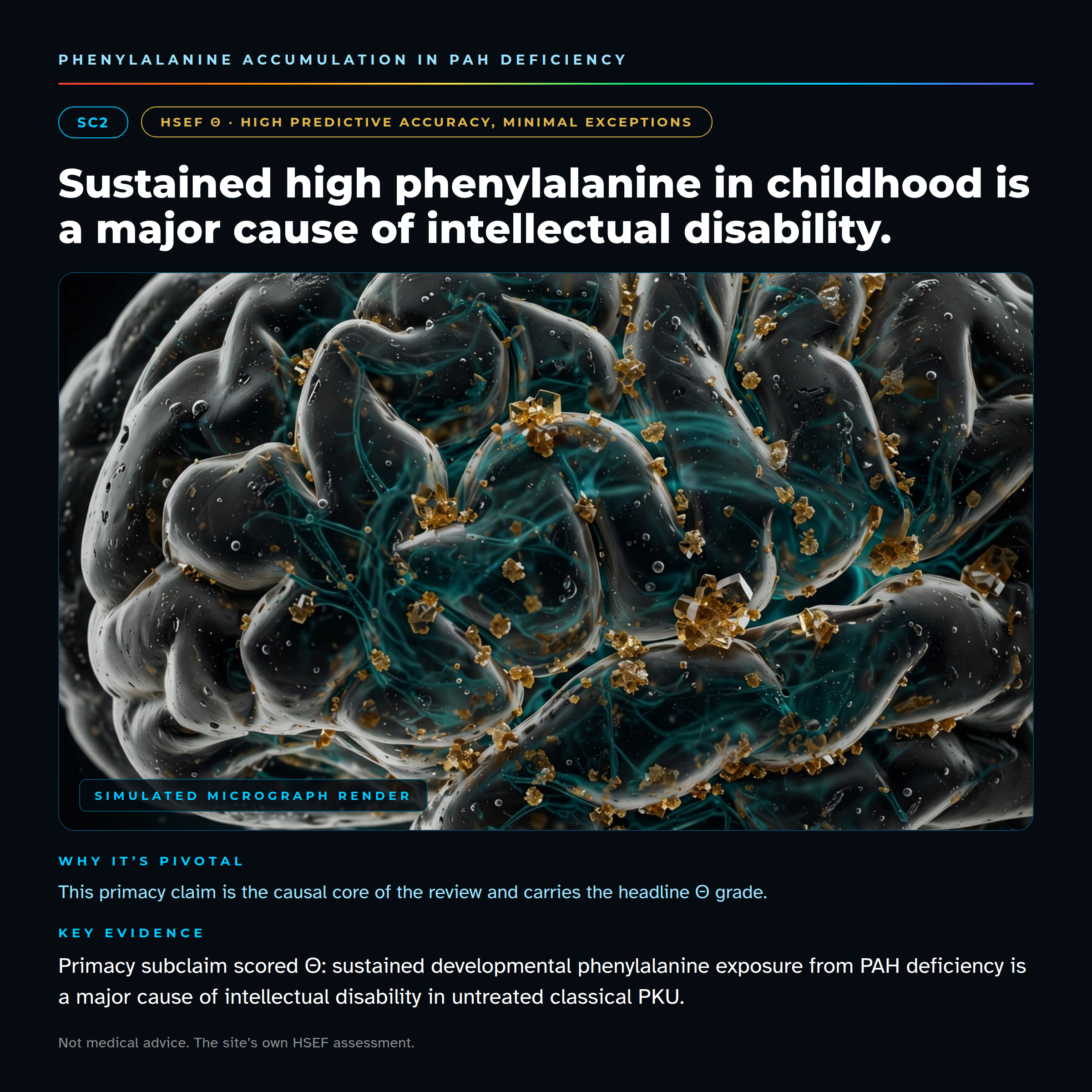
The resulting sustained developmental phenylalanine exposure is a major cause of intellectual disability in untreated PAH-deficient PKU.
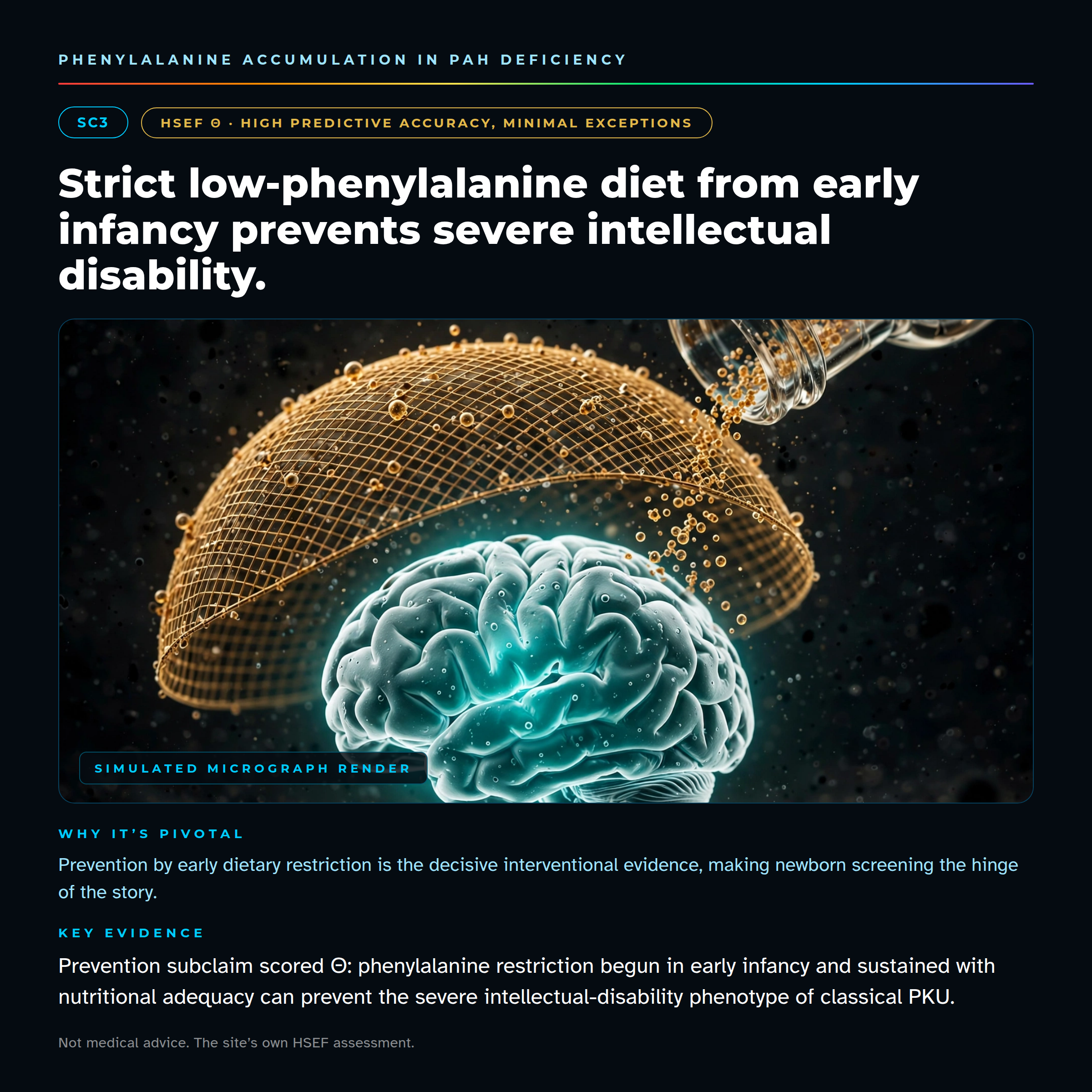
Phenylalanine restriction begun in early infancy and sustained with nutritional adequacy can prevent the severe intellectual-disability phenotype of classical PKU.
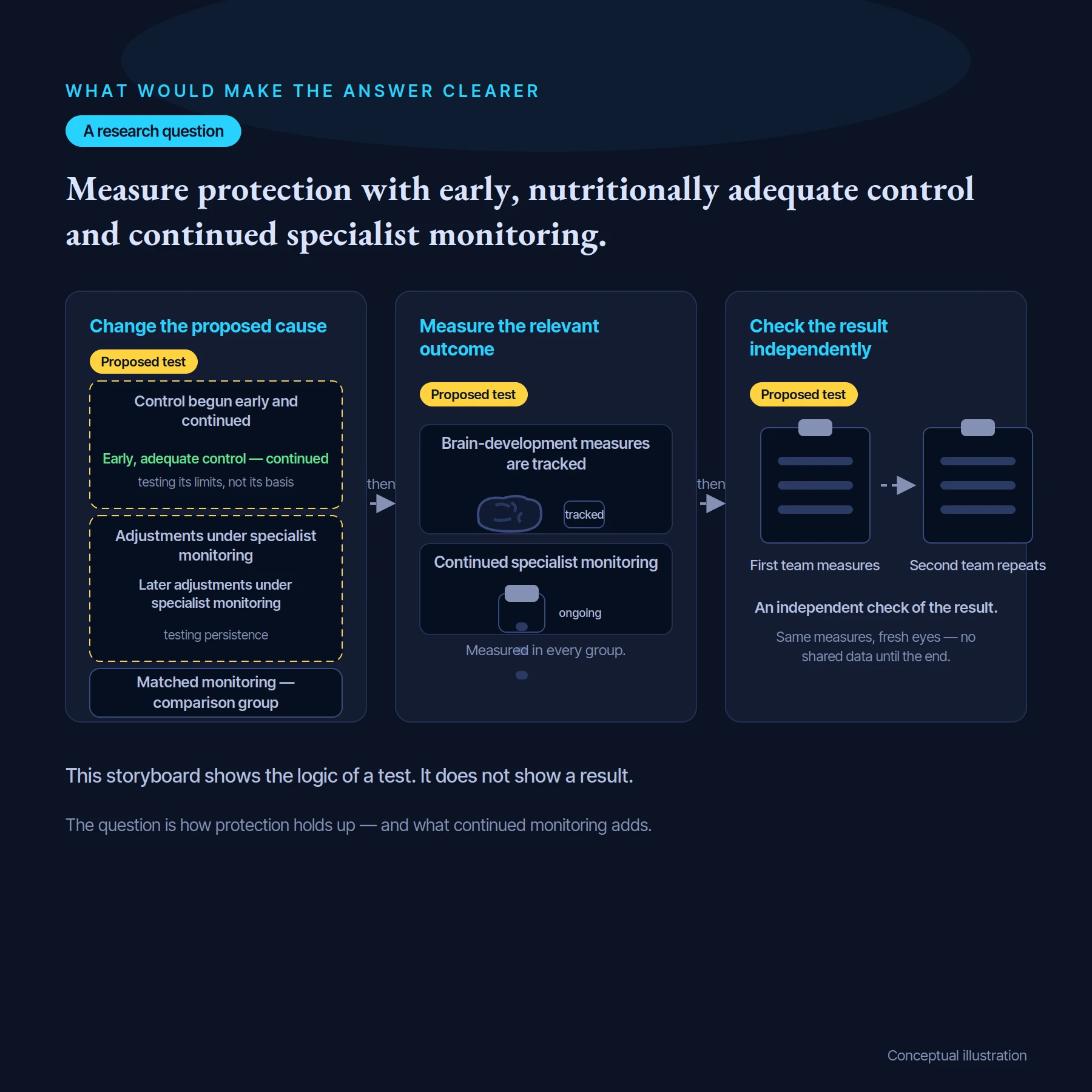
WHAT WOULD MAKE THE ANSWER CLEARER
A research question
Measure protection with early, nutritionally adequate control and continued specialist monitoring.
then
then
Change the proposed cause
Proposed test
Control begun early and continued
Early, adequate control — continued
testing its limits, not its basis
Adjustments under specialist monitoring
Later adjustments under specialist monitoring
testing persistence
Matched monitoring — comparison group
Measure the relevant outcome
Proposed test
Brain-development measures are tracked
tracked
Continued specialist monitoring
ongoing
Measured in every group.
Check the result independently
Proposed test
First team measures
Second team repeats
An independent check of the result.
Same measures, fresh eyes — no shared data until the end.
This storyboard shows the logic of a test. It does not show a result.
The question is how protection holds up — and what continued monitoring adds.
Conceptual illustration
Measure protection with early, nutritionally adequate control and continued specialist monitoring.
Check that the intended change really happened.
Allow for other factors and compare with suitable controls.
Look for independent confirmation and the limits of the effect.
These are questions for research, not a claim that the proposed studies have already succeeded.
Proposed tests: 1 test design(s) are registered in the scorecard.
In plain terms, researchers would change the proposed cause, check that it changed as intended, then measure a meaningful outcome while controlling plausible alternatives. The result should be able to support or count against the claim—not only show that a pathway exists.
Study design: Study independently ascertained archival/prescreening cases with verified PAH deficiency, exposure history, brain Phe where feasible, genomic modifiers and both intellectual and adaptive-function outcomes; use a separate validation sample. Controlled developmental animal studies can separate timing, Phe and nutrition without withholding effective infant care.
What would be measured: A prediction that distinguishes severe intellectual disability from preserved function before seeing validation outcomes, plus phenotype-relevant selective rescue.
Important controls: Do not recruit only by favorable outcome and call the resulting marker prospectively validated; measure baseline exposure and other causes. Do not treat blood or motor normalization as the intellectual endpoint.
Result that would support the claim: Replicated outcome prediction and mechanistically selective prevention in independently defined contexts; this would support Ω-level coverage of the exception.
Result that would count against it: Repeated failure of the prespecified modifier/exposure prediction, or failure of selective early Phe lowering to prevent injury in a controlled relevant setting despite adequate nutrition.
Follow the studies, detailed comparisons and evidence ratings behind this guide.
Open the scientific review →