The question
Is an overwhelming cytokine storm the main cause of severe COVID-19?
This is the specific idea being tested.
Is an overwhelming cytokine storm the main cause of severe COVID-19?
What you need to knowInflammation can worsen severe COVID-19, but one universal cytokine storm does not explain the disease.Relative explanatory fit: Alternative ranked ahead
Why the alternative fits better: Specific inflammatory treatments help in defined conditions. Earlier defence failures and later injury also matter.
Claim assessed: Systemic hypercytokinemia at a magnitude comparable to sepsis, hyperinflammatory ARDS or CAR-T cytokine release syndrome is the primary driver of severe COVID-19 pathology and mortality.
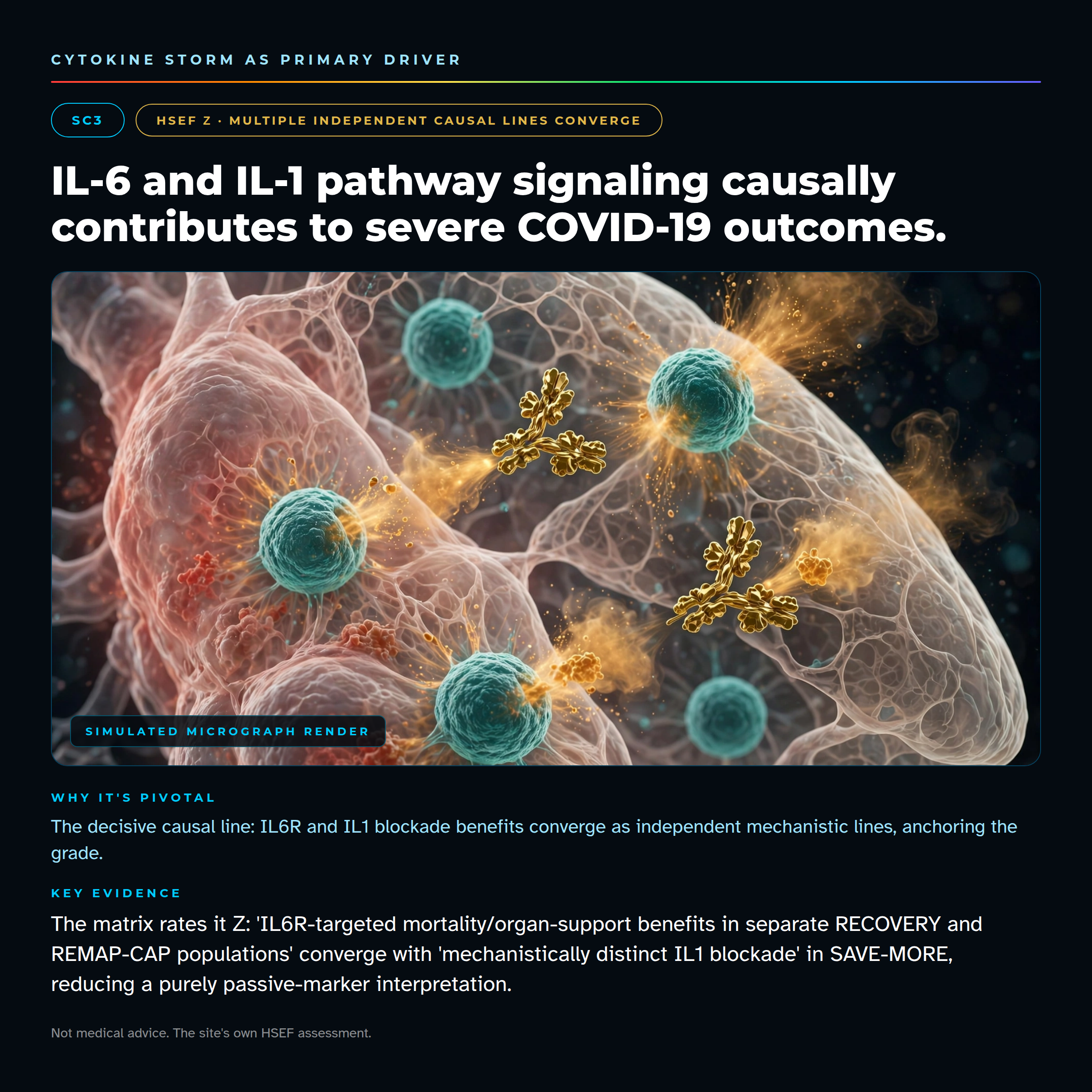
Finding: The preregistered scope-matched gate SC4 yields Γ / Moderate for systemic-storm primacy. SC3 earns Ζ for convergent targeted cytokine contribution in prespecified hospitalized contexts; this is explicitly retained. Weakest-link sensitivity is Β because SC1/SC2 are descriptive observations. Primary-subclaim and scope-matched sensitivities are Γ. Treatable inflammation and a cytokine-first systemic magnitude claim are different propositions.
Evidence scope: 68 primary reports; cutoff 2026-10-05; bounded critical review, not exhaustive systematic review.
The grade applies to the stated claim. Model rankings and individual subclaim grades remain separate from the overall causal-evidence grade.
Full scientific assessment and references · Scorecard (JSON) · Review source (Markdown)
THE MAIN FINDING
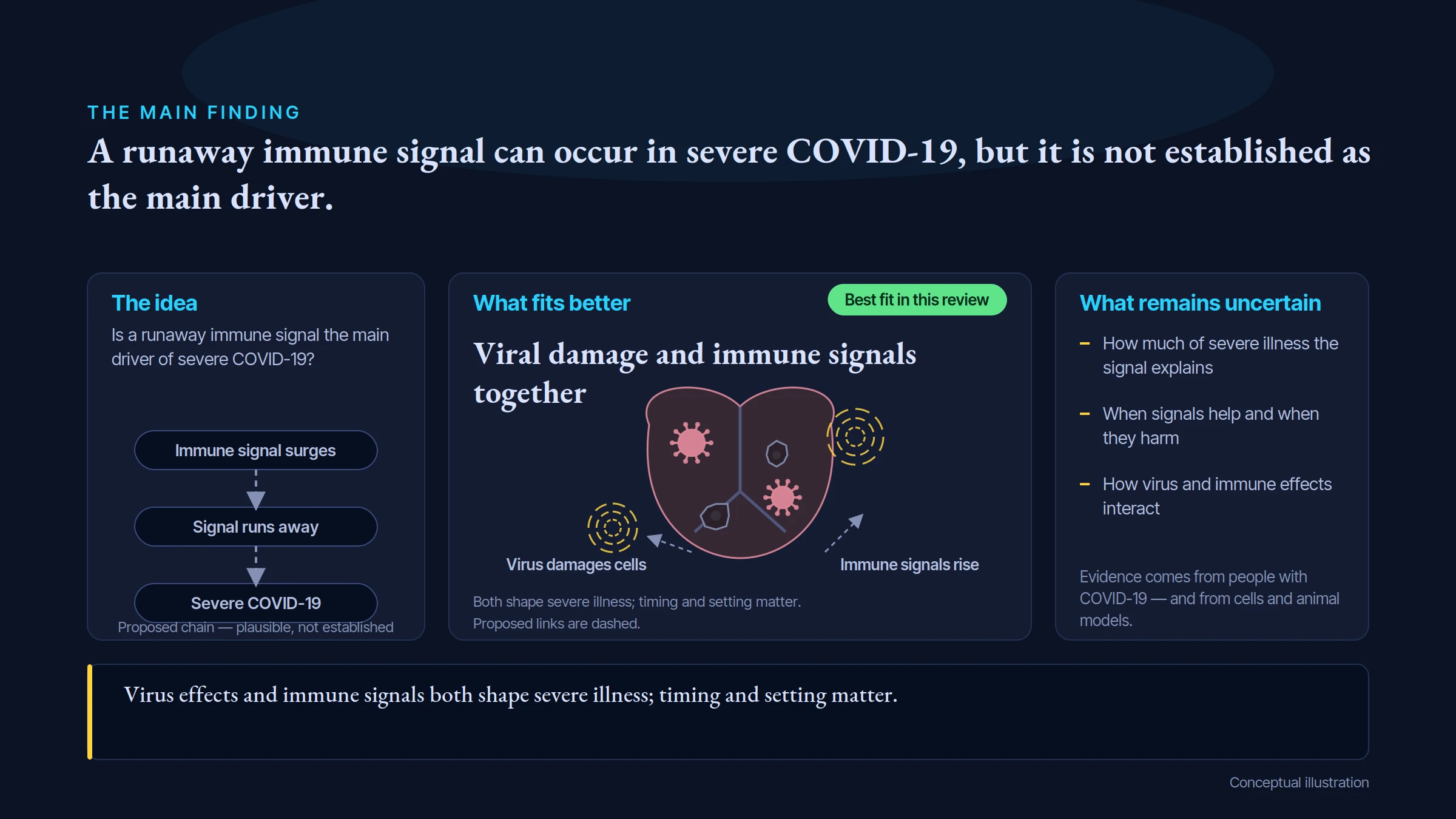
A runaway immune signal can occur in severe COVID-19, but it is not established as the main driver.
The idea
Is a runaway immune signal the main driver of severe COVID-19?
Immune signal surges
Signal runs away
Severe COVID-19
Proposed chain — plausible, not established
What fits better
Best fit in this review
Viral damage and immune signals together
Virus damages cells
Immune signals rise
Both shape severe illness; timing and setting matter.
Proposed links are dashed.
What remains uncertain
How much of severe illness the signal explains
When signals help and when they harm
How virus and immune effects interact
Evidence comes from people with COVID-19 — and from cells and animal models.
Virus effects and immune signals both shape severe illness; timing and setting matter.
Conceptual illustration
This is the specific idea being tested.
Specific inflammatory treatments help in defined conditions. Earlier defence failures and later injury also matter.
A higher rank means a better fit to the evidence in this comparison. It does not prove every part of the leading explanation.
The reviewed hypothesis ranks 5 among 5 models compared; 1 alternative model(s) hold first rank for this stated claim.
Claim under review: rank 5 among 5 compared models.
Leading explanation: Host-state and stage-dependent inflammatory contribution.
Position in this comparison: Last recorded rank.
The causal grade asks how well the stated causal claim is established. This comparison asks which of the assessed explanations fits the reviewed findings better. A leading explanation can remain unproven. Models can overlap or include the tested mechanism; an alternative ahead does not make that mechanism irrelevant. These ordinal ranks apply within this review; they do not measure the size of a difference or rank scientific strength across topics.
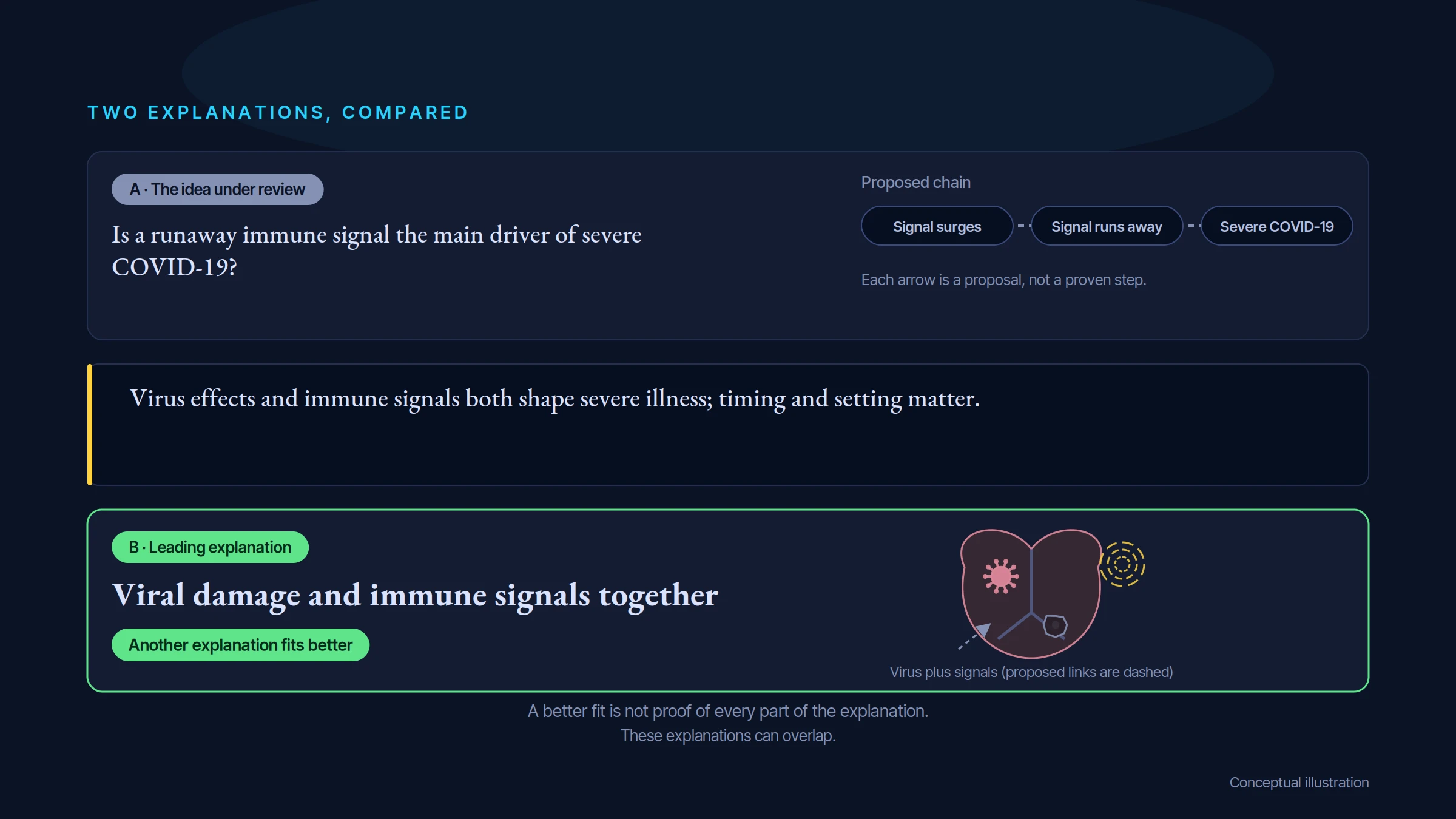
TWO EXPLANATIONS, COMPARED
A · The idea under review
Is a runaway immune signal the main driver of severe COVID-19?
Proposed chain
Signal surges
Signal runs away
Severe COVID-19
Each arrow is a proposal, not a proven step.
Virus effects and immune signals both shape severe illness; timing and setting matter.
B · Leading explanation
Viral damage and immune signals together
Another explanation fits better
Virus plus signals (proposed links are dashed)
A better fit is not proof of every part of the explanation.
These explanations can overlap.
Conceptual illustration
Plausible, not established for the stated claim.
Specific inflammatory treatments help in defined conditions. Earlier defence failures and later injury also matter.
These explanations can overlap. Ranking their fit to the evidence is separate from deciding how firmly a cause has been established.
Rank 1: Host-state and stage-dependent inflammatory contribution — Specific inflammation contributes under defined clinical conditions rather than one universal systemic storm.
Rank 2: Early antiviral interferon failure in susceptible hosts — Inherited or autoimmune disruption of early IFN protection causes susceptibility before downstream inflammation.
Rank 3: Endothelial and immunothrombotic injury — Vascular and coagulation mechanisms interact with infection and inflammation.
Rank 4: Pulmonary compartmental inflammatory injury — Local cytokine, complement and repair abnormalities can differ from blood measurements.
Rank 5: Systemic cytokine-storm primacy — Comparator-magnitude circulating cytokines dominate severe COVID pathology and mortality.
Evidence rating: Γ · Moderate confidence. How the evidence was assessed.
Specific inflammatory treatments help in defined conditions. Earlier defence failures and later injury also matter.
This is an assessment of a causal explanation, not proof that a particular supplement, diet, test, or treatment improves health. A treatment claim needs studies that test the intervention in people and measure meaningful benefits and harms. These findings can help frame research and informed clinical questions, but they do not identify what is right for one person.
Look for the proposed factor and the outcome, in the people or systems covered by the claim.
Immune effects depend on timing and the person. Specific inflammatory treatments help in defined conditions. Earlier defence failures and later injury also matter.
Measure early antiviral defence and later inflammation separately, testing treatments at defined stages.
These illustrations show the key questions tested in the review. They are conceptual drawings, not microscope images or experimental results.
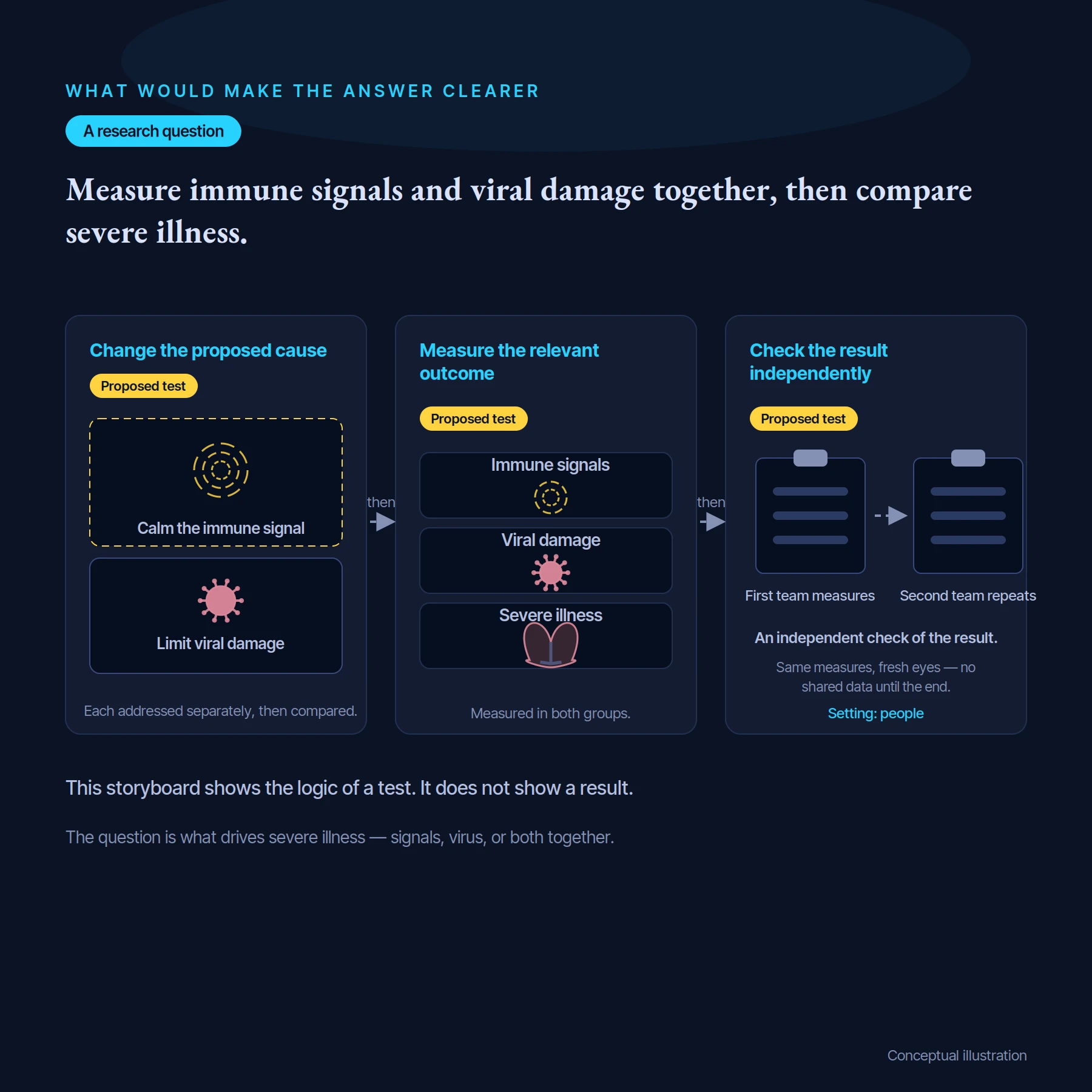
WHAT WOULD MAKE THE ANSWER CLEARER
A research question
Measure immune signals and viral damage together, then compare severe illness.
then
then
Change the proposed cause
Proposed test
Calm the immune signal
Limit viral damage
Each addressed separately, then compared.
Measure the relevant outcome
Immune signals
Viral damage
Severe illness
Measured in both groups.
Check the result independently
First team measures
Second team repeats
An independent check of the result.
Same measures, fresh eyes — no shared data until the end.
Setting: people
This storyboard shows the logic of a test. It does not show a result.
The question is what drives severe illness — signals, virus, or both together.
Conceptual illustration
Measure early antiviral defence and later inflammation separately, testing treatments at defined stages.
Check that the intended change really happened.
Allow for other factors and compare with suitable controls.
Look for independent confirmation and the limits of the effect.
These are questions for research, not a claim that the proposed studies have already succeeded.
Proposed tests: 1 test design(s) are registered in the scorecard.
In plain terms, researchers would change the proposed cause, check that it changed as intended, then measure a meaningful outcome while controlling plausible alternatives. The result should be able to support or count against the claim—not only show that a pathway exists.
Study design: Prospectively enroll prespecified early severe-COVID strata across vaccination/variant and antiviral states; use harmonized contemporaneous blood and dilution-corrected pulmonary cytokine measurements. Randomize mechanistically aligned cytokine blockade with matched antiviral care and factorial vascular treatment where ethical; add a validated compartment-selective instrument in an infected model. Estimate prespecified mediators and attributable outcome effects without defining groups by treatment response.
What would be measured: Mortality and organ-support-free days, viral burden, cytokine target engagement in both compartments, vascular injury and repair, with prespecified longitudinal mediator models
Important controls: Matched assays/lots and sampling, blinded outcome assessment, baseline steroid/antiviral stratification, drug exposure, non-COVID infectious ARDS comparators and registered multiplicity
Result that would support the claim: Comparator-magnitude circulating elevation temporally precedes injury and explains the dominant specifically reversible disease component across prespecified strata after viral/vascular alternatives are addressed
Result that would count against it: Severe injury and mortality persist without the specified systemic magnitude, local target engagement predicts benefit better than blood magnitude, or independently controlled viral/vascular processes explain the predominant outcome effect
Follow the studies, detailed comparisons and evidence ratings behind this guide.
Open the scientific review →