The question
Is accessible DNA required before a cell can turn a gene on?
This is the specific idea being tested.
When does open DNA let a cell read a gene?
Is accessible DNA required before a cell can turn a gene on?
What you need to knowAccessible DNA can help gene activity, but an 'open' DNA test does not by itself show that a gene can be switched on.Relative explanatory fit: Alternative ranked ahead
Why the alternative fits better: Proteins that open DNA often have other jobs too, making the requirement for DNA access hard to isolate. An open but quiet gene may still respond to the right activating signal; being quiet alone does not show it is unable to respond. Opening DNA and switching a gene on are separate questions, and gene activity can also help keep DNA accessible.
Why this matters: Researchers use DNA-accessibility maps to help interpret genetic changes linked to disease. An open region is a clue about gene control, not proof that a particular DNA change causes disease or that the nearby gene is active.
Claim assessed: Chromatin accessibility determines transcriptional competence, such that accessible loci are those available for transcription.
Finding: Overall Γ follows the preregistered primary necessity SC2: strong endogenous remodeler/factor causality exists, but necessity of the measured accessible state itself remains incompletely isolated. SC1 correlation is Β. Broad sufficiency SC3 and universal upstream SC4 are each Β after one-rung falsification downgrades from partial Γ. The alternative aggregation rules would return Β weakest-link and Γ primary/scope-matched.
Evidence scope: 61 primary reports; literature cutoff 2026-10-09; source examination UTC date 2026-10-12; bounded critical review, not exhaustive systematic review.
The grade applies to the stated claim. Model rankings and individual subclaim grades remain separate from the overall causal-evidence grade.
Full scientific assessment and references · Scorecard (JSON) · Review source (Markdown)
HYPOTHESIS CRITIC  /  REVIEW EXPLAINER
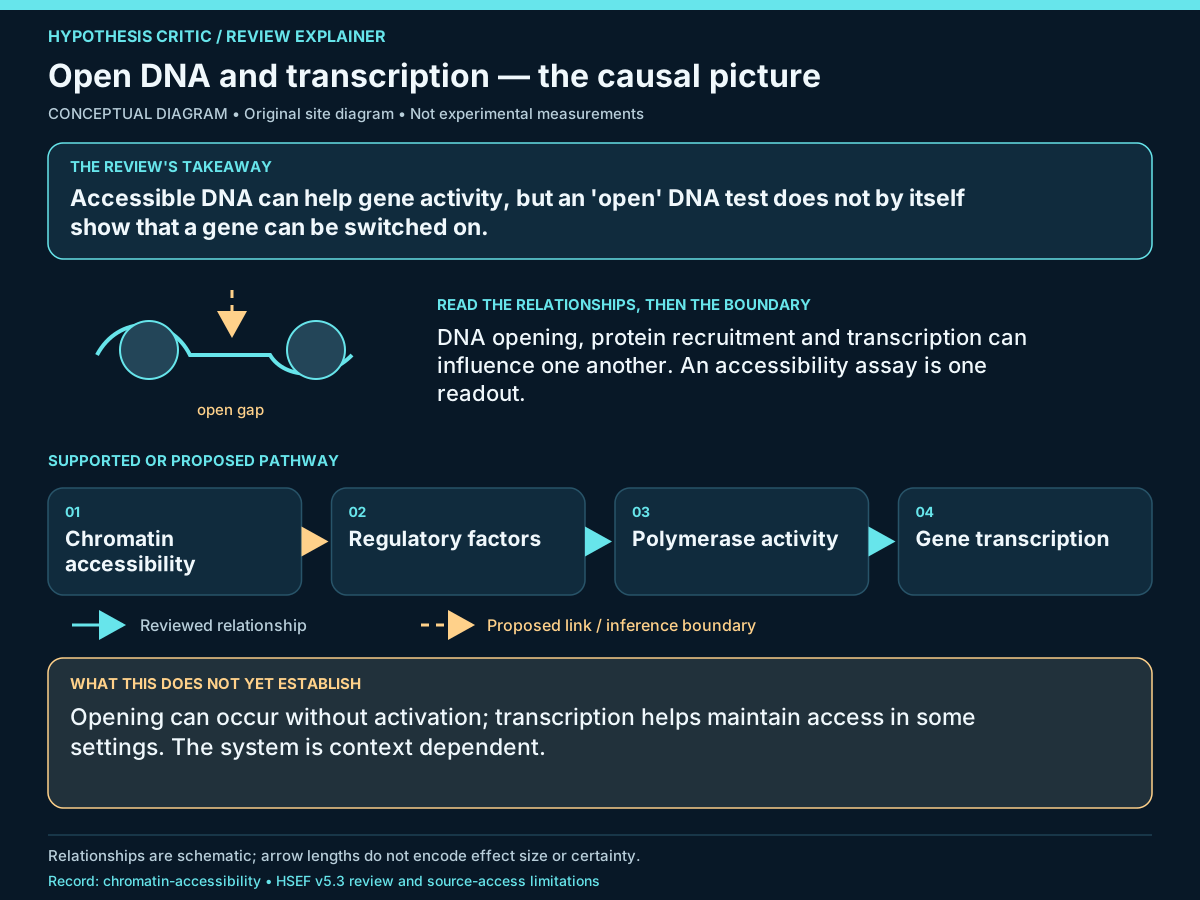
Open DNA and transcription — the causal picture
CONCEPTUAL DIAGRAM  •  Original site diagram  •  Not experimental measurements
THE REVIEW'S TAKEAWAY
Accessible DNA can help gene activity, but an 'open' DNA test does not by itself show that a gene can be switched on.
open gap
READ THE RELATIONSHIPS, THEN THE BOUNDARY
DNA opening, protein recruitment and transcription can influence one another. An accessibility assay is one readout.
SUPPORTED OR PROPOSED PATHWAY
01
Chromatin accessibility
02
Regulatory factors
03
Polymerase activity
04
Gene transcription
Reviewed relationship
Proposed link / inference boundary
WHAT THIS DOES NOT YET ESTABLISH
Opening can occur without activation; transcription helps maintain access in some settings. The system is context dependent.
Relationships are schematic; arrow lengths do not encode effect size or certainty.
Record: chromatin-accessibility  •  HSEF v5.3 review and source-access limitations
This is the specific idea being tested.
Proteins that open DNA often have other jobs too, making the requirement for DNA access hard to isolate. An open but quiet gene may still respond to the right activating signal; being quiet alone does not show it is unable to respond. Opening DNA and switching a gene on are separate questions, and gene activity can also help keep DNA accessible.
A higher rank means a better fit to the evidence in this comparison. It does not prove every part of the leading explanation.
The reviewed hypothesis ranks 5 among 5 models compared; 1 alternative model(s) hold first rank for this stated claim.
Claim under review: rank 5 among 5 compared models.
Leading explanation: Polymerase-remodeler-factor cooperation.
Position in this comparison: Last recorded rank.
The causal grade asks how well the stated causal claim is established. This comparison asks which of the assessed explanations fits the reviewed findings better. A leading explanation can remain unproven. Models can overlap or include the tested mechanism; an alternative ahead does not make that mechanism irrelevant. These ordinal ranks apply within this review; they do not measure the size of a difference or rank scientific strength across topics.
HYPOTHESIS CRITIC  /  REVIEW EXPLAINER
Open DNA and transcription — compare explanations
CONCEPTUAL DIAGRAM  •  Original site diagram  •  Not experimental measurements
THE REVIEW'S TAKEAWAY
Accessible DNA can help gene activity, but an 'open' DNA test does not by itself show that a gene can be switched on.
CLAIM / SIMPLE EXPLANATION
01
Accessible chromatin
02
Claimed competence
03
Activation when stimulated
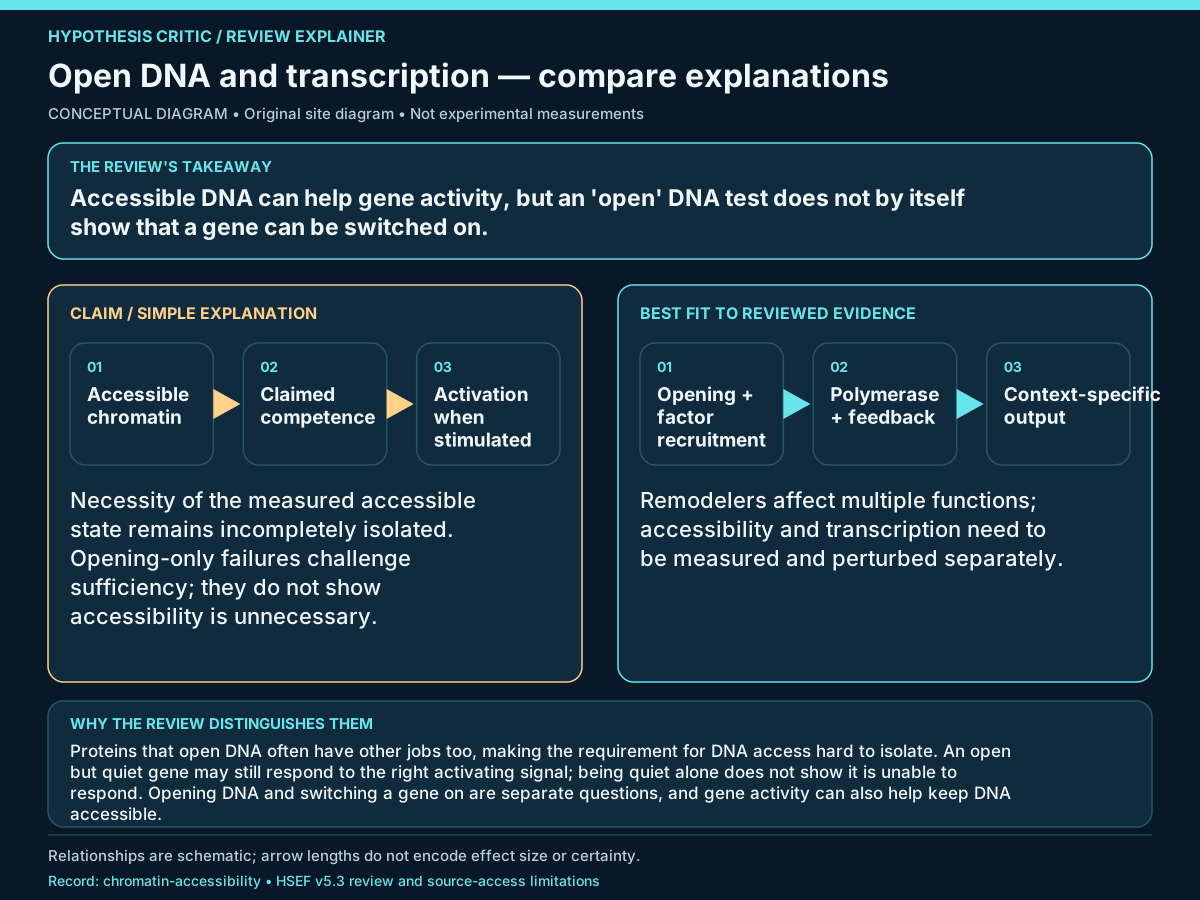
Necessity of the measured accessible state remains incompletely isolated. Opening-only failures challenge sufficiency; they do not show accessibility is unnecessary.
BEST FIT TO REVIEWED EVIDENCE
01
Opening + factor recruitment
02
Polymerase + feedback
03
Context-specific output
Remodelers affect multiple functions; accessibility and transcription need to be measured and perturbed separately.
WHY THE REVIEW DISTINGUISHES THEM
Proteins that open DNA often have other jobs too, making the requirement for DNA access hard to isolate. An open but quiet gene may still respond to the right activating signal; being quiet alone does not show it is unable to respond. Opening DNA and switching a gene on are separate questions, and gene activity can also help keep DNA accessible.
Relationships are schematic; arrow lengths do not encode effect size or certainty.
Record: chromatin-accessibility  •  HSEF v5.3 review and source-access limitations
Plausible, not established for the stated claim.
Proteins that open DNA often have other jobs too, making the requirement for DNA access hard to isolate. An open but quiet gene may still respond to the right activating signal; being quiet alone does not show it is unable to respond. Opening DNA and switching a gene on are separate questions, and gene activity can also help keep DNA accessible.
These explanations can overlap. Ranking their fit to the evidence is separate from deciding how firmly a cause has been established.
Rank 1: Polymerase-remodeler-factor cooperation — Paused polymerase, ATP-dependent remodelers and sequence-specific factors jointly stabilize locus-specific accessible states and transcription.
Rank 2: Pioneer and coactivator specificity — Sequence-specific factors and their recruited coactivators carry regulatory specificity and can create or exploit accessible states.
Rank 3: Permissive accessibility with activation inputs — Accessibility permits selected regulatory interactions but additional activating inputs determine output.
Rank 4: Transcription-produced accessibility in defined contexts — Initiation, pausing or upstream transcription builds or maintains open chromatin in specified windows.
Rank 5: Accessibility directly determines competence — Measured open chromatin universally defines loci available for transcription and directs activation upstream.
Evidence rating: Γ · Moderate confidence. How the evidence was assessed.
Proteins that open DNA often have other jobs too, making the requirement for DNA access hard to isolate. An open but quiet gene may still respond to the right activating signal; being quiet alone does not show it is unable to respond. Opening DNA and switching a gene on are separate questions, and gene activity can also help keep DNA accessible.
Researchers use DNA-accessibility maps to help interpret genetic changes linked to disease. An open region is a clue about gene control, not proof that a particular DNA change causes disease or that the nearby gene is active.
Further reading: Primary study: DNA accessibility and human cancer.
Chromatin: DNA together with the proteins that package and organise it.
Accessibility: How easily a test molecule can reach a stretch of DNA; different tests measure different aspects of access.
Transcription: The process of copying a gene's DNA information into RNA.
Look for the proposed factor and the outcome, in the people or systems covered by the claim.
DNA opening, gene-control proteins and the machinery that reads genes can influence one another. Proteins that open DNA often have other jobs too, making the requirement for DNA access hard to isolate. An open but quiet gene may still respond to the right activating signal; being quiet alone does not show it is unable to respond. Opening DNA and switching a gene on are separate questions, and gene activity can also help keep DNA accessible.
Change DNA access separately from the proteins and machinery that read genes, then apply a controlled activating signal and measure both DNA opening and new RNA production.
HYPOTHESIS CRITIC  /  REVIEW EXPLAINER
Open DNA and transcription — evidence and next test
CONCEPTUAL DIAGRAM  •  Original site diagram  •  Not experimental measurements
THE REVIEW'S TAKEAWAY
Accessible DNA can help gene activity, but an 'open' DNA test does not by itself show that a gene can be switched on.
DIFFERENT EVIDENCE ANSWERS DIFFERENT QUESTIONS
Remodeler perturbations
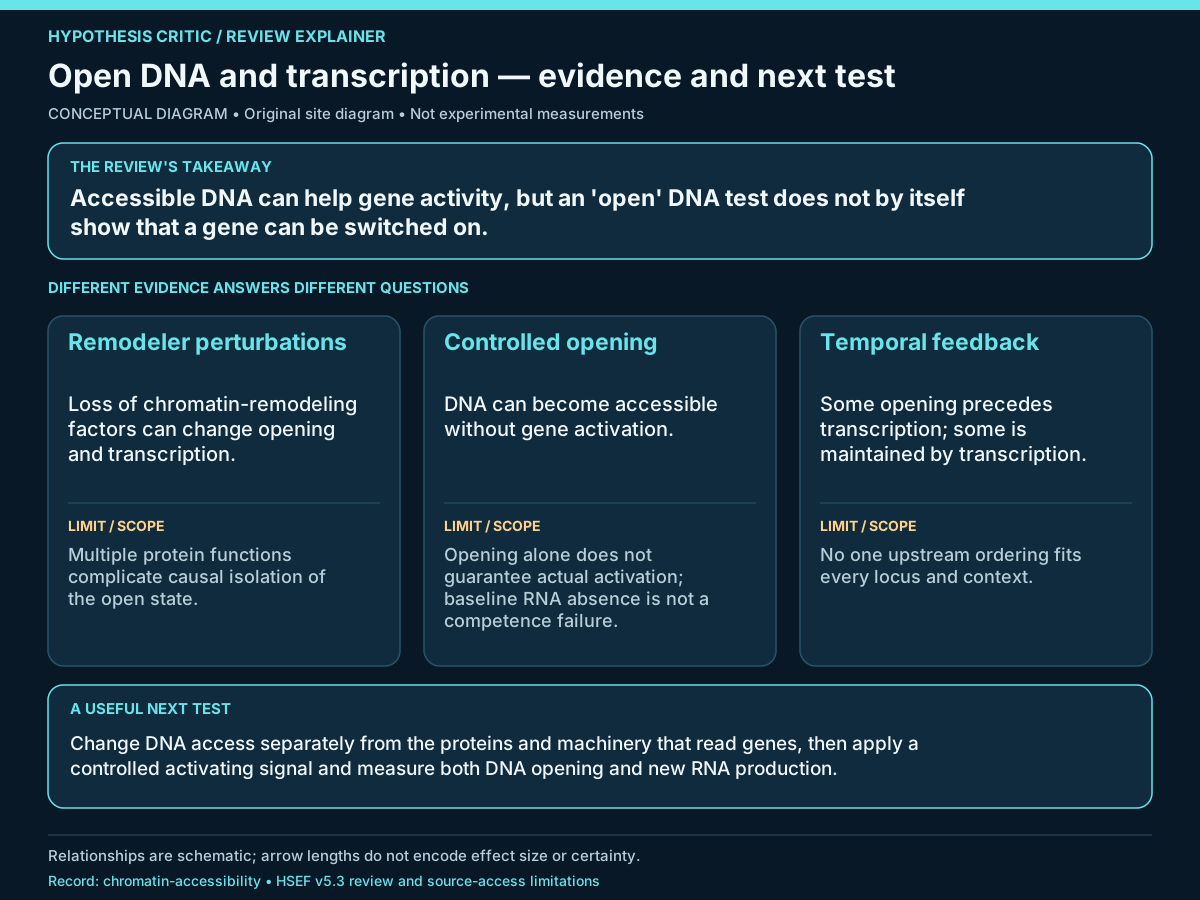
Loss of chromatin-remodeling factors can change opening and transcription.
LIMIT / SCOPE
Multiple protein functions complicate causal isolation of the open state.
Controlled opening
DNA can become accessible without gene activation.
LIMIT / SCOPE
Opening alone does not guarantee actual activation; baseline RNA absence is not a competence failure.
Temporal feedback
Some opening precedes transcription; some is maintained by transcription.
LIMIT / SCOPE
No one upstream ordering fits every locus and context.
A USEFUL NEXT TEST
Change DNA access separately from the proteins and machinery that read genes, then apply a controlled activating signal and measure both DNA opening and new RNA production.
Relationships are schematic; arrow lengths do not encode effect size or certainty.
Record: chromatin-accessibility  •  HSEF v5.3 review and source-access limitations
Change DNA access separately from the proteins and machinery that read genes, then apply a controlled activating signal and measure both DNA opening and new RNA production.
Check that the intended change really happened.
Allow for other factors and compare with suitable controls.
Look for independent confirmation and the limits of the effect.
These are questions for research, not a claim that the proposed studies have already succeeded.
Proposed tests: 1 test design(s) are registered in the scorecard.
In plain terms, researchers would change the proposed cause, check that it changed as intended, then measure a meaningful outcome while controlling plausible alternatives. The result should be able to support or count against the claim—not only show that a pathway exists.
Study design: At prespecified native promoters/enhancers, alter DNA accessibility with an orthogonal state intervention while preserving factor occupancy, activation domains, acetylation/coactivators and polymerase function as far as possible. Apply a matched activating stimulus and measure initiation/bursting with calibrated nascent RNA and single-fiber accessibility. Restore only the accessible state in a matched rescue; retain a dead-HAT opening-without-activation control. Verify cell-cycle distribution, replication stress, viability, target-factor abundance and local cis sequence across developmental/replication windows.
What would be measured: Direct nascent transcription/burst initiation after a matched competence challenge, alongside calibrated bulk and single-fiber DNA access
Important controls: State-specific matched rescue, target/untarget loci, catalytic-dead and recruitment controls, unchanged sequence/factor/coactivator abundance, cell cycle, replication stress, viability and timing
Result that would support the claim: Selective closure blocks the prespecified response and restoring access alone rescues it without restoring other regulator functions; prospectively repeat across distinct native loci/states
Result that would count against it: Adequate state manipulation leaves competence intact, restoration changes only assay signal, or output follows changed coactivator/factor function rather than the measured state
Follow the studies, detailed comparisons and evidence ratings behind this guide.
Open the scientific review →