The question
Are large clusters of DNA control regions a special class that determines what kind of cell a cell becomes?
This is the specific idea being tested.
Are large groups of DNA switches a special kind of control system?
Are large clusters of DNA control regions a special class that determines what kind of cell a cell becomes?
What you need to knowLarge enhancer clusters can be important, but the 'super-enhancer' label does not prove that they all work by one special mechanism.Relative explanatory fit: Alternative ranked ahead
Why the alternative fits better: Removing or rebuilding DNA regions shows important effects at some genes and cooperation in some clusters. It also finds ordinary enhancers that are essential and labelled super-enhancers that are dispensable; the label alone cannot explain every result.
Why this matters: Cancer researchers study drugs that inhibit BET proteins involved in gene control. Effects on cancer-cell gene activity do not by themselves prove a special super-enhancer mechanism or predict a patient's treatment response.
Claim assessed: Super-enhancers are a functionally distinct regulatory class that disproportionately controls cell-identity genes, rather than a quantitative extension of typical enhancers.
Finding: The registered weakest-link returns Β from SC1 and SC2. SC1 is a reproducible operational association, not evidence for qualitative causal class distinction. SC2 has local mechanistic plausibility at Γ, but one native class-distinction prediction challenge lowers it to Β: called clusters can be dispensable while conventional elements are strongly required, and additive/hierarchical or facilitator rules explain many effects. Native nonadditivity is retained and a universal additive counterclaim is rejected. SC3 is Γ for the prespecified distinct-class disproportionate identity claim, while individual native lineage dependencies have real context-specific causality.
Evidence scope: 66 primary reports; literature cutoff 2026-10-09; source examination UTC date 2026-10-12; bounded critical review, not exhaustive systematic review.
The grade applies to the stated claim. Model rankings and individual subclaim grades remain separate from the overall causal-evidence grade.
Full scientific assessment and references · Scorecard (JSON) · Review source (Markdown)
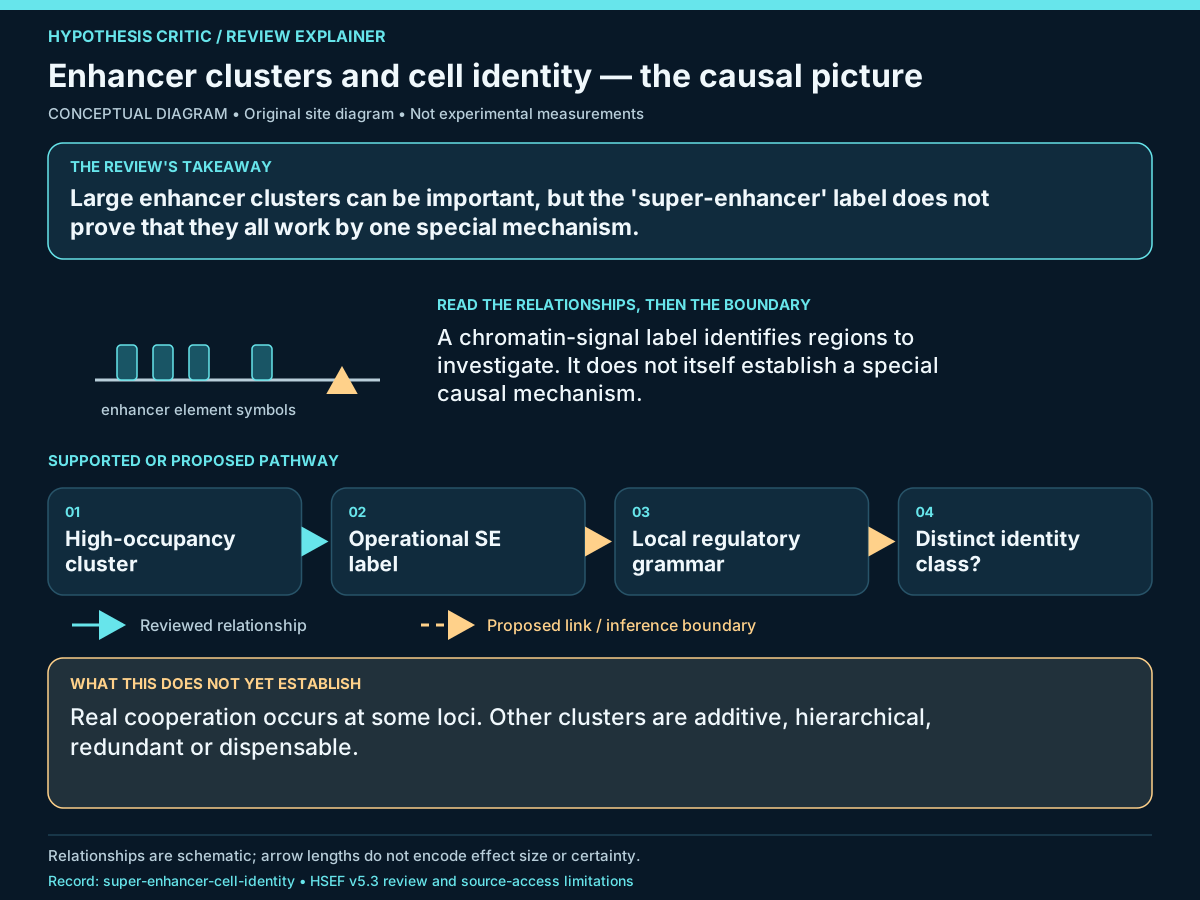
HYPOTHESIS CRITIC  /  REVIEW EXPLAINER
Enhancer clusters and cell identity — the causal picture
CONCEPTUAL DIAGRAM  •  Original site diagram  •  Not experimental measurements
THE REVIEW'S TAKEAWAY
Large enhancer clusters can be important, but the 'super-enhancer' label does not prove that they all work by one special mechanism.
enhancer element symbols
READ THE RELATIONSHIPS, THEN THE BOUNDARY
A chromatin-signal label identifies regions to investigate. It does not itself establish a special causal mechanism.
SUPPORTED OR PROPOSED PATHWAY
01
High-occupancy cluster
02
Operational SE label
03
Local regulatory grammar
04
Distinct identity class?
Reviewed relationship
Proposed link / inference boundary
WHAT THIS DOES NOT YET ESTABLISH
Real cooperation occurs at some loci. Other clusters are additive, hierarchical, redundant or dispensable.
Relationships are schematic; arrow lengths do not encode effect size or certainty.
Record: super-enhancer-cell-identity  •  HSEF v5.3 review and source-access limitations
This is the specific idea being tested.
Removing or rebuilding DNA regions shows important effects at some genes and cooperation in some clusters. It also finds ordinary enhancers that are essential and labelled super-enhancers that are dispensable; the label alone cannot explain every result.
A higher rank means a better fit to the evidence in this comparison. It does not prove every part of the leading explanation.
The reviewed hypothesis ranks 5 among 5 models compared; 1 alternative model(s) hold first rank for this stated claim.
Claim under review: rank 5 among 5 compared models.
Leading explanation: Facilitator grammar and architectural cluster.
Position in this comparison: Last recorded rank.
The causal grade asks how well the stated causal claim is established. This comparison asks which of the assessed explanations fits the reviewed findings better. A leading explanation can remain unproven. Models can overlap or include the tested mechanism; an alternative ahead does not make that mechanism irrelevant. These ordinal ranks apply within this review; they do not measure the size of a difference or rank scientific strength across topics.
HYPOTHESIS CRITIC  /  REVIEW EXPLAINER
Enhancer clusters and cell identity — compare explanations
CONCEPTUAL DIAGRAM  •  Original site diagram  •  Not experimental measurements
THE REVIEW'S TAKEAWAY
Large enhancer clusters can be important, but the 'super-enhancer' label does not prove that they all work by one special mechanism.
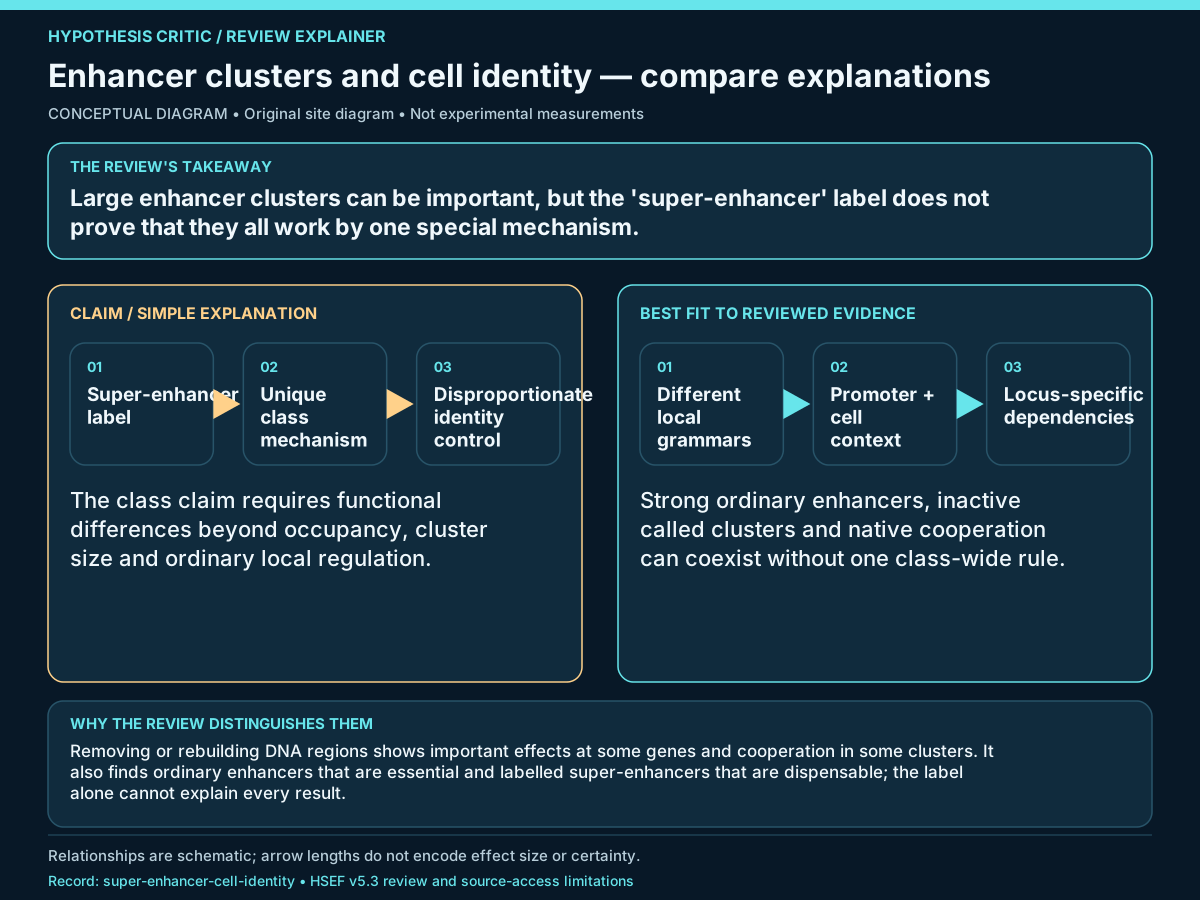
CLAIM / SIMPLE EXPLANATION
01
Super-enhancer label
02
Unique class mechanism
03
Disproportionate identity control
The class claim requires functional differences beyond occupancy, cluster size and ordinary local regulation.
BEST FIT TO REVIEWED EVIDENCE
01
Different local grammars
02
Promoter + cell context
03
Locus-specific dependencies
Strong ordinary enhancers, inactive called clusters and native cooperation can coexist without one class-wide rule.
WHY THE REVIEW DISTINGUISHES THEM
Removing or rebuilding DNA regions shows important effects at some genes and cooperation in some clusters. It also finds ordinary enhancers that are essential and labelled super-enhancers that are dispensable; the label alone cannot explain every result.
Relationships are schematic; arrow lengths do not encode effect size or certainty.
Record: super-enhancer-cell-identity  •  HSEF v5.3 review and source-access limitations
Association only for the stated claim.
Removing or rebuilding DNA regions shows important effects at some genes and cooperation in some clusters. It also finds ordinary enhancers that are essential and labelled super-enhancers that are dispensable; the label alone cannot explain every result.
These explanations can overlap. Ranking their fit to the evidence is separate from deciding how firmly a cause has been established.
Rank 1: Facilitator grammar and architectural cluster — Nonactivating elements and their positions support adjacent activators, with local interaction and recruitment rules.
Rank 2: Additive or hierarchical locus control region — Unequal activators, redundancy, stage dependence and promoter compatibility explain much cluster behavior.
Rank 3: Transcriptional-load drug sensitivity — General coactivator and elongation dependence can make highly active genes drug-sensitive.
Rank 4: LLPS coactivator condensate — Multivalent assemblies concentrate machinery and may enhance selected bursts.
Rank 5: Emergent-synergy super-enhancer class — High-ChIP clusters share a distinct nonadditive mechanism that determines identity beyond conventional clusters.
Evidence rating: Β · Moderate confidence. How the evidence was assessed.
Removing or rebuilding DNA regions shows important effects at some genes and cooperation in some clusters. It also finds ordinary enhancers that are essential and labelled super-enhancers that are dispensable; the label alone cannot explain every result.
Cancer researchers study drugs that inhibit BET proteins involved in gene control. Effects on cancer-cell gene activity do not by themselves prove a special super-enhancer mechanism or predict a patient's treatment response.
Further reading: Primary study: BET inhibition and DNA contact.
Enhancer: A DNA region that can help increase a gene's activity.
Super-enhancer: A research label for a cluster with unusually strong signals for selected gene-control proteins or chemical marks.
Cell identity: The pattern of gene activity and functions that makes a cell a particular type.
BET proteins: Proteins that recognise chemical marks on DNA-packaging proteins and help regulate gene activity.
Look for the proposed factor and the outcome, in the people or systems covered by the claim.
Different clusters combine control regions that add together, depend on one another or provide backup. Removing or rebuilding DNA regions shows important effects at some genes and cooperation in some clusters. It also finds ordinary enhancers that are essential and labelled super-enhancers that are dispensable; the label alone cannot explain every result.
Rebuild matched large and ordinary enhancer clusters in their normal chromosome locations, then compare gene activity and cell identity using criteria set before the experiment.
HYPOTHESIS CRITIC  /  REVIEW EXPLAINER
Enhancer clusters and cell identity — evidence and next test
CONCEPTUAL DIAGRAM  •  Original site diagram  •  Not experimental measurements
THE REVIEW'S TAKEAWAY
Large enhancer clusters can be important, but the 'super-enhancer' label does not prove that they all work by one special mechanism.
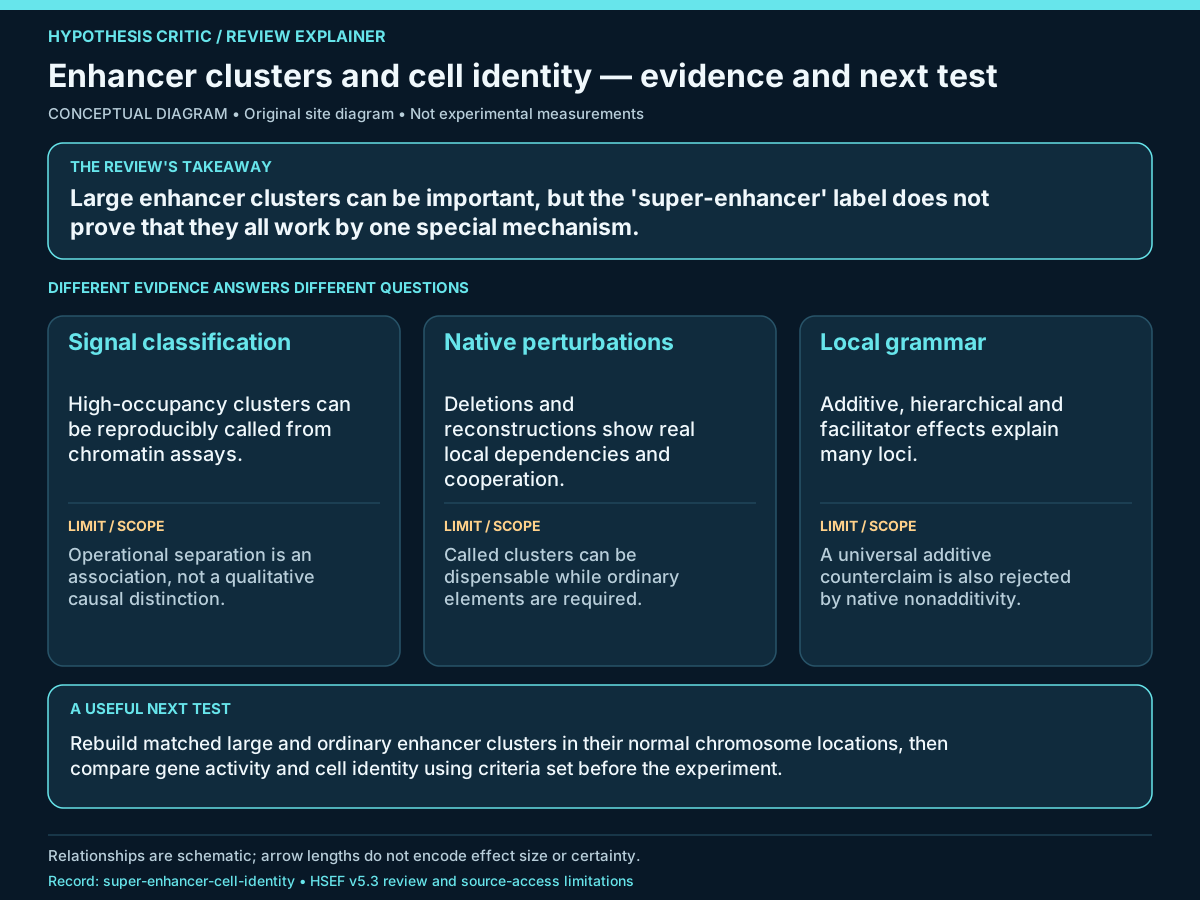
DIFFERENT EVIDENCE ANSWERS DIFFERENT QUESTIONS
Signal classification
High-occupancy clusters can be reproducibly called from chromatin assays.
LIMIT / SCOPE
Operational separation is an association, not a qualitative causal distinction.
Native perturbations
Deletions and reconstructions show real local dependencies and cooperation.
LIMIT / SCOPE
Called clusters can be dispensable while ordinary elements are required.
Local grammar
Additive, hierarchical and facilitator effects explain many loci.
LIMIT / SCOPE
A universal additive counterclaim is also rejected by native nonadditivity.
A USEFUL NEXT TEST
Rebuild matched large and ordinary enhancer clusters in their normal chromosome locations, then compare gene activity and cell identity using criteria set before the experiment.
Relationships are schematic; arrow lengths do not encode effect size or certainty.
Record: super-enhancer-cell-identity  •  HSEF v5.3 review and source-access limitations
Rebuild matched large and ordinary enhancer clusters in their normal chromosome locations, then compare gene activity and cell identity using criteria set before the experiment.
Check that the intended change really happened.
Allow for other factors and compare with suitable controls.
Look for independent confirmation and the limits of the effect.
These are questions for research, not a claim that the proposed studies have already succeeded.
Proposed tests: 1 test design(s) are registered in the scorecard.
In plain terms, researchers would change the proposed cause, check that it changed as intended, then measure a meaningful outcome while controlling plausible alternatives. The result should be able to support or count against the claim—not only show that a pathway exists.
Study design: Compare a prespecified multi-lineage panel of high-ChIP clusters and conventional clusters matched for constituent number, occupancy, baseline output, spacing and promoter compatibility using native combinatorial deletions and reconstruction with lineage-state tracking.
What would be measured: Interaction coefficients for nascent output, single-cell lineage state and physiological function across complete sampled allele series
Important controls: Native-position and matched-expression rescue, intact trans alleles, equally active conventional clusters, developmentally matched cells, viability and global transcription
Result that would support the claim: SE classification predicts reproducible class-specific nonadditive interactions and functional identity dependence after all matched covariates, with specific rescue
Result that would count against it: Matched conventional clusters show the same interaction grammar, or effects reduce to local promoter, facilitator, stage or load parameters independently of classification
Follow the studies, detailed comparisons and evidence ratings behind this guide.
Open the scientific review →