The question
Does long-term exposure to LDL particles increase artery disease risk?
This is the specific idea being tested.
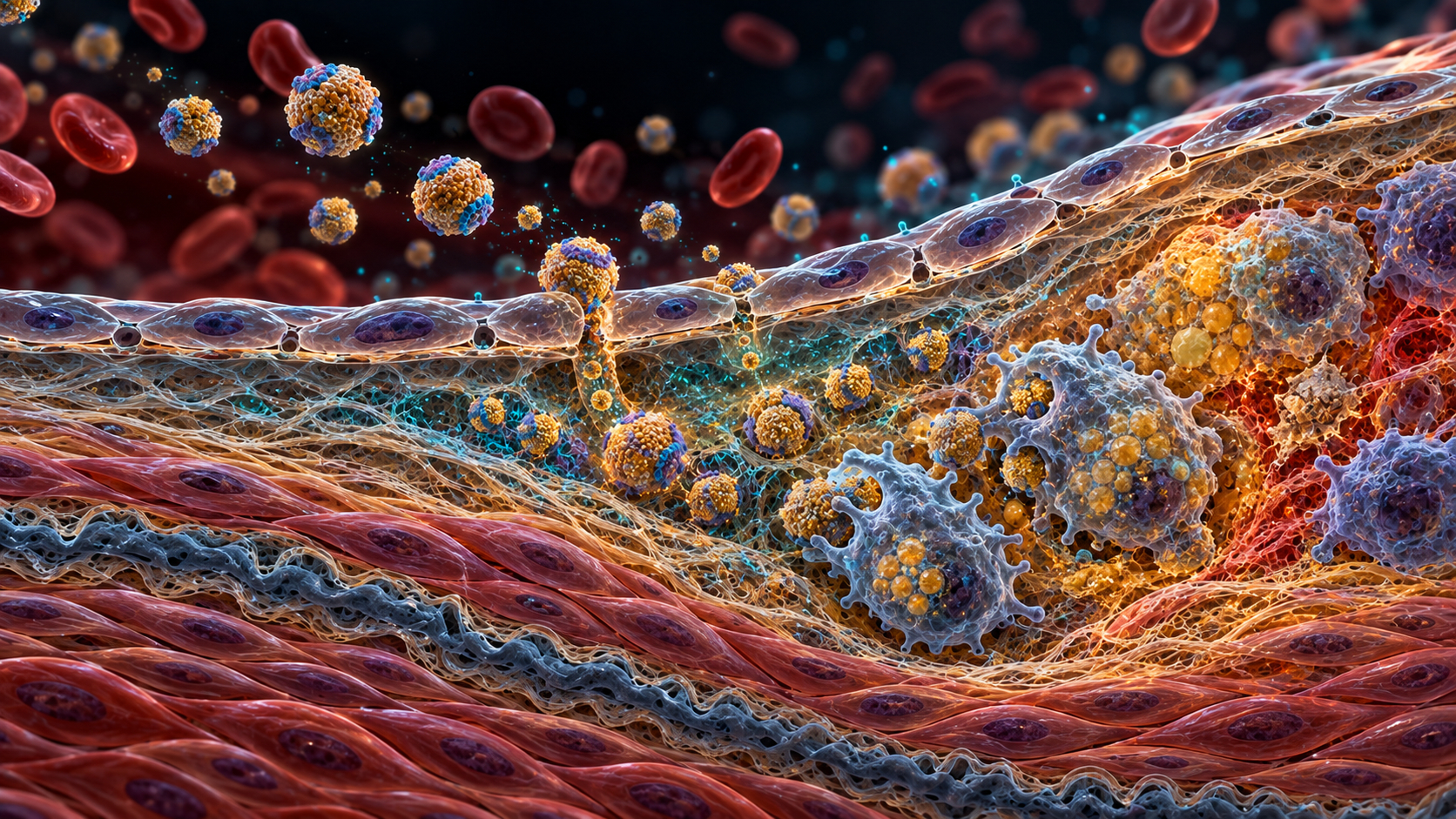
Does long-term exposure to LDL particles increase artery disease risk?
What you need to knowLDL exposure has strong causal support. A wider model including other artery-retained particles explains more.Relative explanatory fit: Alternative ranked ahead
Why the alternative fits better: LDL, remnant particles and lipoprotein(a) can matter. Particle counts can explain risk differences LDL cholesterol alone misses.
Claim assessed: In humans, a higher cumulative circulating concentration of LDL-class apoB-containing particles increases atherosclerotic cardiovascular disease risk by increasing the flux and retention of those particles in the arterial intima; interventions that reduce this exposure should reduce atherosclerotic events.
Finding: Cumulative LDL-class apoB exposure is a primary causal driver of ASCVD (SC1, SC3, SC5 at Η; SC2 at Θ). The submitted wording adds that particle concentration (number) is the operative quantity; that is well supported against LDL-C but contested against total cholesterol cargo, and per-particle risk varies by particle class [20,35,36]. The preregistered weakest-link rule therefore returns Ζ; scope-matched aggregation would return Η.
Evidence scope: Primary mechanistic, human genetic, randomized outcome, imaging, discordance, and counterevidence through 2026-09-29. Full text was read wherever accessible and abstract-only rows are labeled. The attached packet (SHA256 7E097D3D50D2068F68BDB1CD022DF4A045DAC46A9F25E51262EC7568E9DB11EB) was treated as methodology, not scientific evidence. Red-team pass added CETP-inhibitor, discordance-cohort, per-particle-heterogeneity, FH-sequencing and CANTOS evidence through 2026-09-30.
The grade applies to the stated claim. Model rankings and individual subclaim grades remain separate from the overall causal-evidence grade.
Full scientific assessment and references · Scorecard (JSON) · Review source (Markdown)
THE MAIN FINDING
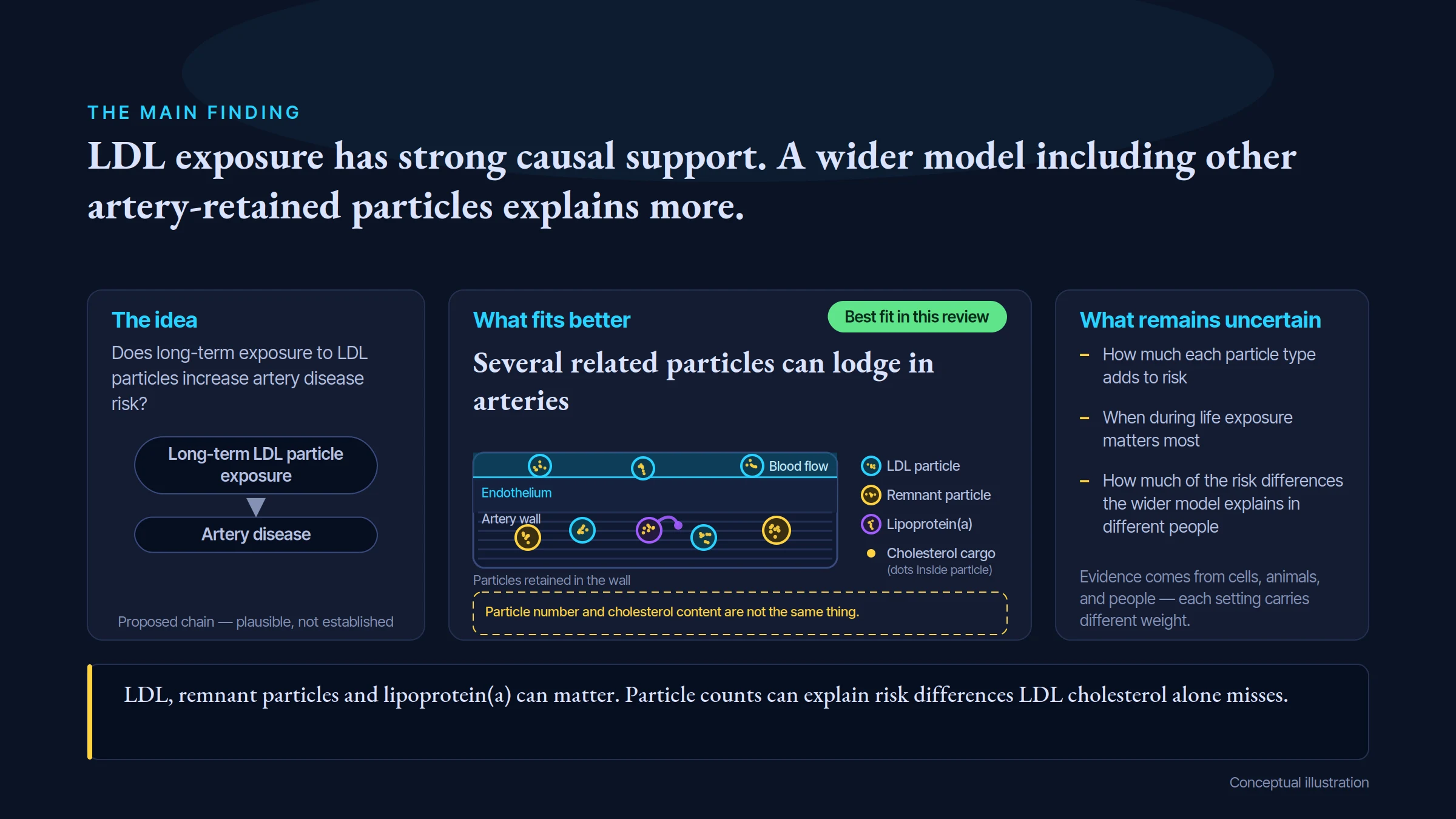
LDL exposure has strong causal support. A wider model including other artery-retained particles explains more.
The idea
Does long-term exposure to LDL particles increase artery disease risk?
Long-term LDL particle exposure
Artery disease
Proposed chain — plausible, not established
What fits better
Best fit in this review
Several related particles can lodge in arteries
Blood flow
Endothelium
Artery wall
Particles retained in the wall
LDL particle
Remnant particle
Lipoprotein(a)
Cholesterol cargo (dots inside particle)
Particle number and cholesterol content are not the same thing.
What remains uncertain
How much each particle type adds to risk
When during life exposure matters most
How much of the risk differences the wider model explains in different people
Evidence comes from cells, animals, and people — each setting carries different weight.
LDL, remnant particles and lipoprotein(a) can matter. Particle counts can explain risk differences LDL cholesterol alone misses.
Conceptual illustration
This is the specific idea being tested.
LDL, remnant particles and lipoprotein(a) can matter. Particle counts can explain risk differences LDL cholesterol alone misses.
A higher rank means a better fit to the evidence in this comparison. It does not prove every part of the leading explanation.
The reviewed hypothesis ranks 2 among 5 models compared; 1 alternative model(s) hold first rank for this stated claim.
Claim under review: rank 2 among 5 compared models.
Leading explanation: Broader apoB-particle retention model.
Position in this comparison: Next after leading rank.
The causal grade asks how well the stated causal claim is established. This comparison asks which of the assessed explanations fits the reviewed findings better. A leading explanation can remain unproven. Models can overlap or include the tested mechanism; an alternative ahead does not make that mechanism irrelevant. These ordinal ranks apply within this review; they do not measure the size of a difference or rank scientific strength across topics.
TWO EXPLANATIONS, COMPARED
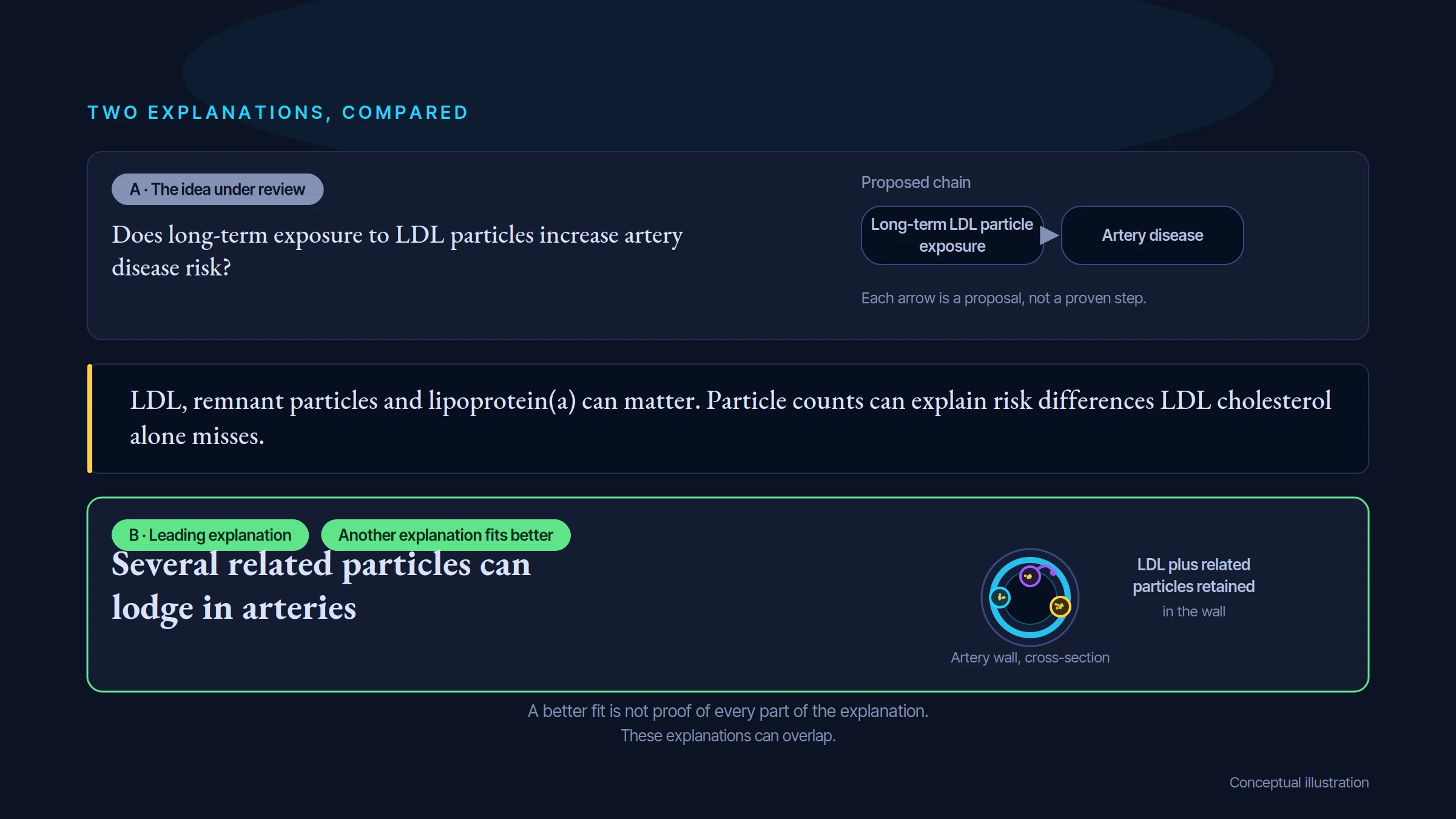
A · The idea under review
Does long-term exposure to LDL particles increase artery disease risk?
Proposed chain
Long-term LDL particle exposure
Artery disease
Each arrow is a proposal, not a proven step.
LDL, remnant particles and lipoprotein(a) can matter. Particle counts can explain risk differences LDL cholesterol alone misses.
B · Leading explanation
Another explanation fits better
Several related particles can lodge in arteries
Artery wall, cross-section
LDL plus related particles retained
in the wall
A better fit is not proof of every part of the explanation.
These explanations can overlap.
Conceptual illustration
Strong, scope-limited evidence for the stated claim.
LDL, remnant particles and lipoprotein(a) can matter. Particle counts can explain risk differences LDL cholesterol alone misses.
These explanations can overlap. Ranking their fit to the evidence is separate from deciding how firmly a cause has been established.
Rank 1: Broader apoB-particle retention model — Cumulative exposure to all arterial-retained apoB-containing particles is the causal lipid burden; LDL usually supplies most particles but is not the only atherogenic class.
Rank 2: LDL-particle concentration model — The cumulative number of circulating LDL particles drives atherogenesis through arterial entry and retention.
Rank 3: Cholesterol-cargo model — The cholesterol carried into and retained within the arterial wall, better represented by non-HDL-C, is more causally important than particle number itself.
Rank 4: Plaque-instability and thrombosis model — Inflammation, plaque rupture or erosion, and thrombosis dominate the conversion of existing plaque into an acute clinical event.
Rank 5: Inflammation or endothelial-injury-first model — Inflammation or endothelial dysfunction initiates atherosclerosis, while LDL is only a permissive substrate or downstream amplifier.
Evidence rating: Ζ · Moderate confidence. How the evidence was assessed.
LDL, remnant particles and lipoprotein(a) can matter. Particle counts can explain risk differences LDL cholesterol alone misses.
For human health, this strengthens the rationale for finding and managing atherosclerotic risk, including LDL-related risk, with evidence-based clinical care. Multiple kinds of LDL-lowering treatment reduce cardiovascular events in appropriate groups. It also means that a single cholesterol result should be interpreted as part of a wider risk picture that can include blood pressure, diabetes, smoking, family history, kidney disease, lipoprotein(a), age, and existing vascular disease—not as a complete personal forecast.
Look for the proposed factor and the outcome, in the people or systems covered by the claim.
Several related particles can lodge in arteries. LDL, remnant particles and lipoprotein(a) can matter. Particle counts can explain risk differences LDL cholesterol alone misses.
Distinguish particle number from cholesterol content when measuring exposure and artery events.
These illustrations show the key questions tested in the review. They are conceptual drawings, not microscope images or experimental results.

Inherited differences that create lifelong differences in LDL-related exposure change coronary and atherosclerotic risk in the predicted direction and approximately according to cumulative exposure.

Reducing LDL-related particle exposure through independent pharmacologic mechanisms reduces hard atherosclerotic cardiovascular events and can slow or reverse plaque progression.
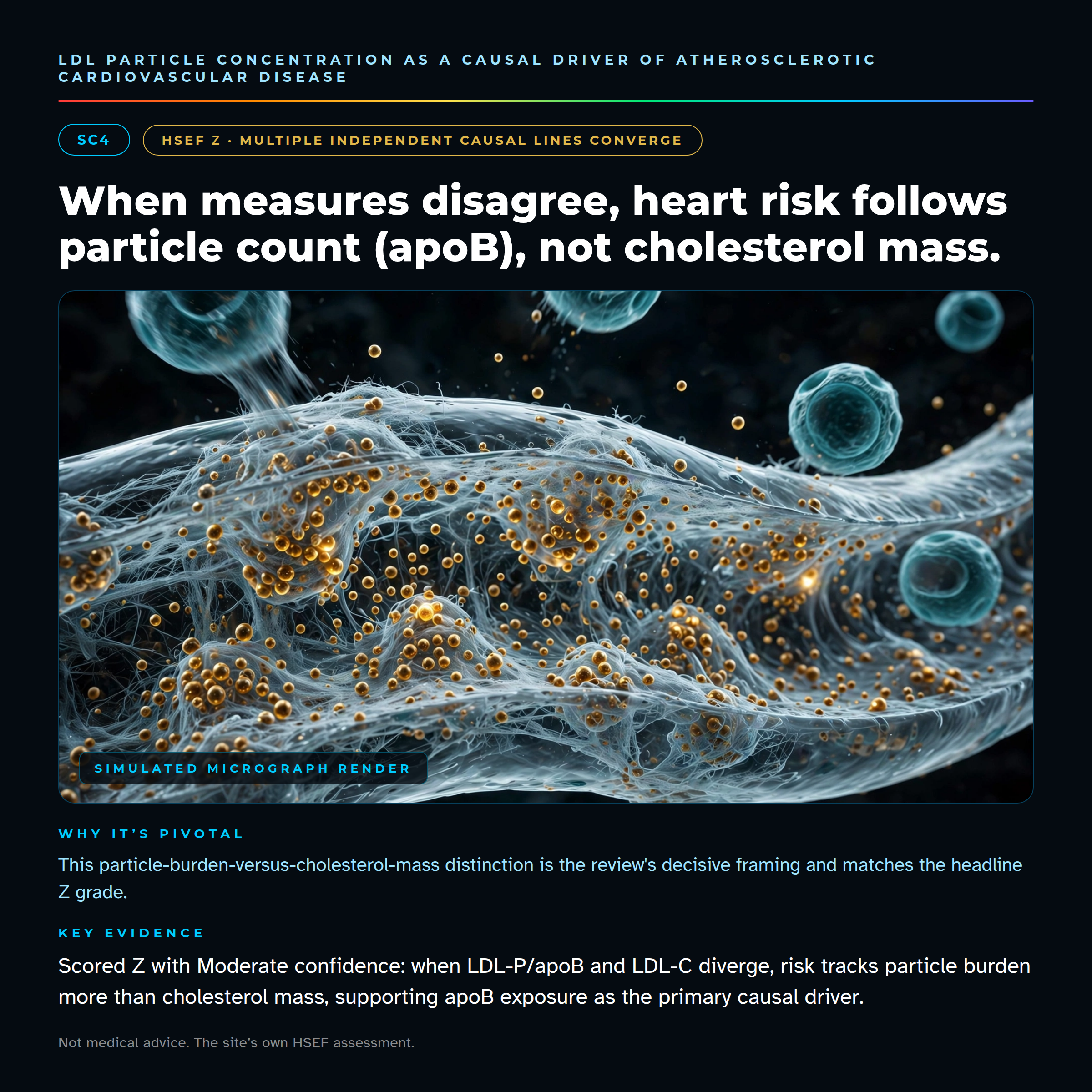
When LDL particle number or apoB and LDL-C are discordant, causal and prospective risk tracks particle burden more closely than cholesterol mass per particle.
WHAT WOULD MAKE THE ANSWER CLEARER
A research question
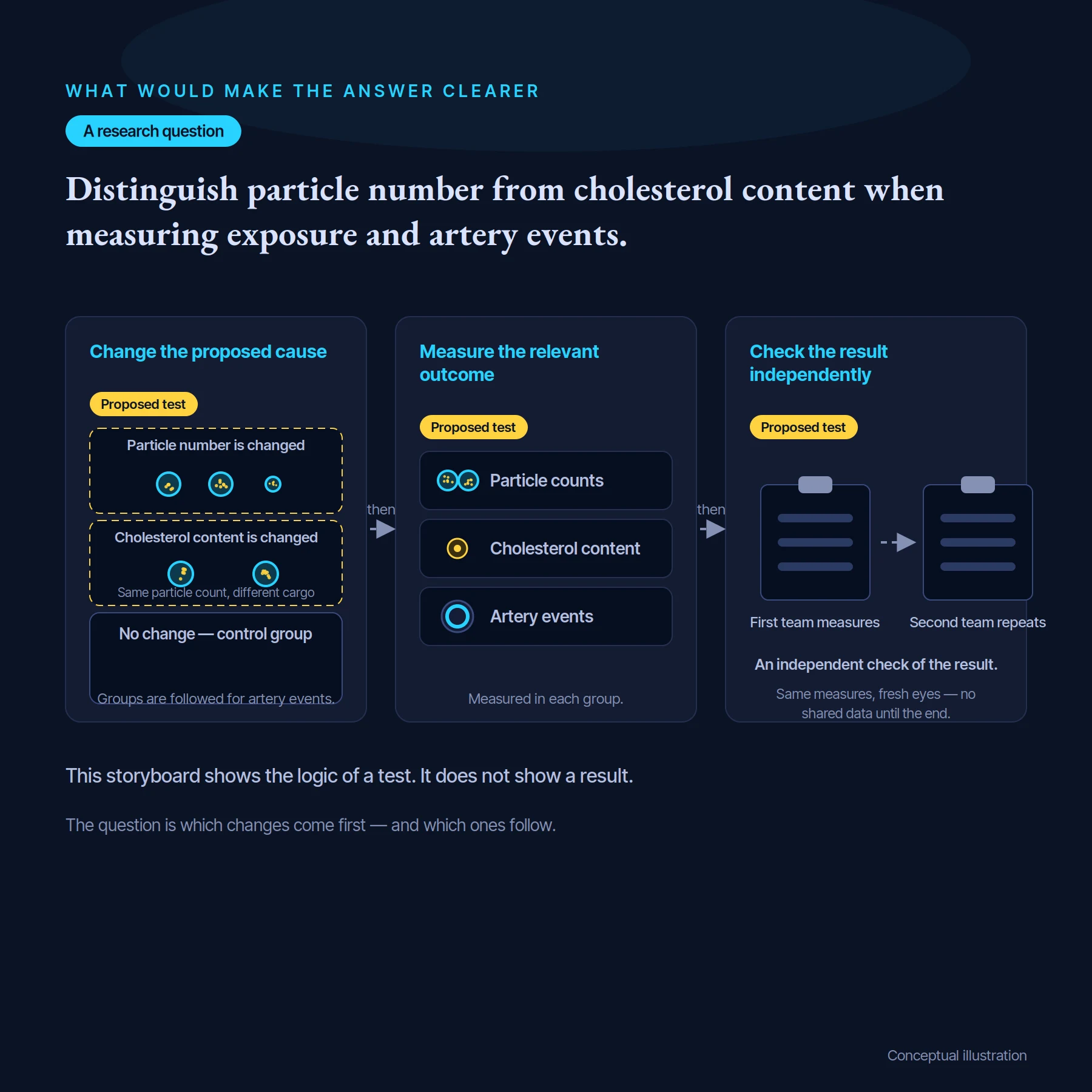
Distinguish particle number from cholesterol content when measuring exposure and artery events.
then
then
Change the proposed cause
Proposed test
Particle number is changed
Cholesterol content is changed
Same particle count, different cargo
No change — control group
Groups are followed for artery events.
Measure the relevant outcome
Particle counts
Cholesterol content
Artery events
Measured in each group.
Check the result independently
First team measures
Second team repeats
An independent check of the result.
Same measures, fresh eyes — no shared data until the end.
This storyboard shows the logic of a test. It does not show a result.
The question is which changes come first — and which ones follow.
Conceptual illustration
Distinguish particle number from cholesterol content when measuring exposure and artery events.
Check that the intended change really happened.
Allow for other factors and compare with suitable controls.
Look for independent confirmation and the limits of the effect.
These are questions for research, not a claim that the proposed studies have already succeeded.
Proposed tests: 3 test design(s) are registered in the scorecard.
In plain terms, researchers would change the proposed cause, check that it changed as intended, then measure a meaningful outcome while controlling plausible alternatives. The result should be able to support or count against the claim—not only show that a pathway exists.
Study design: Use genetic instruments or a randomized therapy combination that produces prespecified opposite changes in apoB (or LDL-P) and non-HDL cholesterol, recording particle class (LDL, remnant, Lp(a)).
What would be measured: Hard ASCVD events plus serial arterial plaque imaging and directly measured LDL-P, apoB, remnant cholesterol, and LDL-C.
Important controls: Equal achieved cholesterol cargo with different particle number, and the reciprocal contrast, with adherence and exposure duration verified.
Result that would support the claim: Risk and plaque change consistently follow particle number after cholesterol cargo is separated.
Result that would count against it: Risk and plaque change consistently follow cholesterol cargo after particle number is separated.
Study design: Use labeled autologous apoB-particle tracers and validated arterial-wall imaging before and after a selective lowering intervention, prospectively partitioning LDL, remnants, and lipoprotein(a).
What would be measured: Particle-specific arterial entry/retention, plaque lipid change, inflammatory response, and subsequent plaque progression.
Important controls: Matched plasma cholesterol cargo and off-target inflammatory effects, with blinded image analysis.
Result that would support the claim: Change in arterial particle flux and retention mediates plaque response independently of cargo.
Result that would count against it: Plaque response is unrelated to change in arterial particle flux or retention once cargo is controlled.
Study design: Before unblinding, register the event reduction predicted by LDL-C, apoB and non-HDL-C models from achieved changes, then compare with the observed result; replicate in a second trial or cohort.
What would be measured: Observed hazard ratio versus each model's prediction, with achieved LDL-C, apoB, non-HDL-C and LDL-P reported.
Important controls: Predictions locked before unblinding; adherence-adjusted exposure; duration matched to the genetic and CTT estimates.
Result that would support the claim: Benefit matches the apoB prediction and is smaller than the LDL-C prediction.
Result that would count against it: Benefit matches the LDL-C prediction and exceeds what the smaller apoB change predicts.
Follow the studies, detailed comparisons and evidence ratings behind this guide.
Open the scientific review →