The question
Does Xist RNA directly hold silencing machinery in place as a continuous scaffold?
This is the specific idea being tested.
Does Xist RNA directly hold silencing machinery in place as a continuous scaffold?
What you need to knowXist helps silence a chromosome, but a continuous direct scaffold is not established as the mechanism.Relative explanatory fit: Alternative ranked ahead
Why the alternative fits better: RNA-binding adaptors and separate effectors connect Xist to silencing without a continuous direct tether.
Claim assessed: Xist RNA directly binds and structurally tethers PRC1 and PRC2 across the inactive X chromosome, and this continuous Polycomb scaffold establishes X-linked silencing.
Finding: The preregistered primary-subclaim rule uses SC2, giving Γ for direct continuous Polycomb scaffolding. SC1 is Η within initiation-competent mammalian contexts, while SC3 is Γ and SC4 Β for their stronger mechanism claims. Weakest-link sensitivity is Β. Evidence for Xist necessity and modular Polycomb causality is retained and cannot replace the nominal structural claim.
Evidence scope: 65 primary reports; literature cutoff 2026-10-09; source examination UTC date 2026-10-09; bounded critical review, not exhaustive systematic review.
The grade applies to the stated claim. Model rankings and individual subclaim grades remain separate from the overall causal-evidence grade.
Full scientific assessment and references · Scorecard (JSON) · Review source (Markdown)
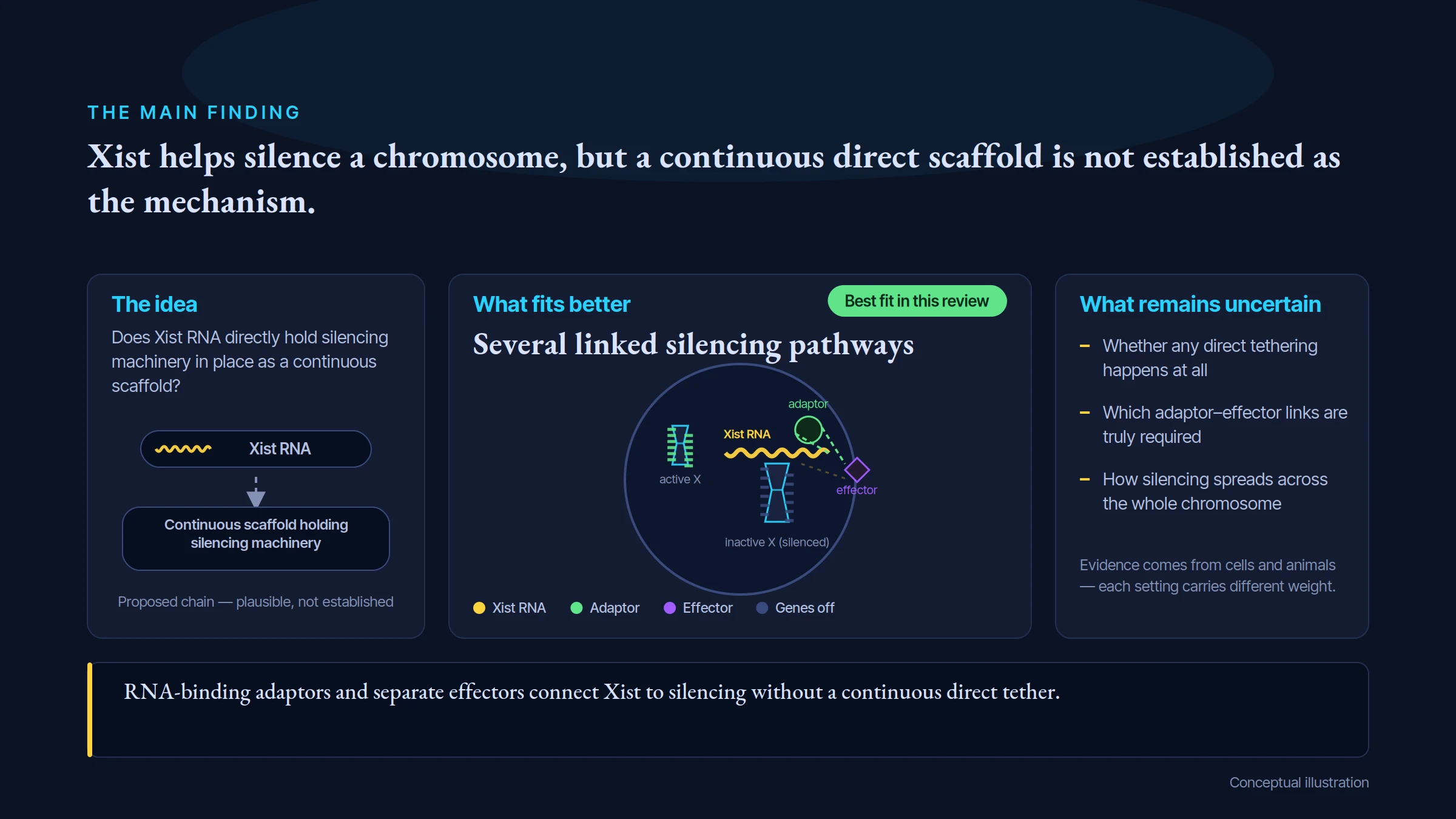
THE MAIN FINDING
Xist helps silence a chromosome, but a continuous direct scaffold is not established as the mechanism.
The idea
Does Xist RNA directly hold silencing machinery in place as a continuous scaffold?
Xist RNA
Continuous scaffold holding silencing machinery
Proposed chain — plausible, not established
What fits better
Several linked silencing pathways
Best fit in this review
Nucleus: Xist RNA, adaptor, and separate effectors at the inactive X
Xist RNA
Adaptor
Effector
Genes off
What remains uncertain
Whether any direct tethering happens at all
Which adaptor–effector links are truly required
How silencing spreads across the whole chromosome
Evidence comes from cells and animals — each setting carries different weight.
RNA-binding adaptors and separate effectors connect Xist to silencing without a continuous direct tether.
Conceptual illustration
This is the specific idea being tested.
RNA-binding adaptors and separate effectors connect Xist to silencing without a continuous direct tether.
A higher rank means a better fit to the evidence in this comparison. It does not prove every part of the leading explanation.
The reviewed hypothesis ranks 5 among 5 models compared; 1 alternative model(s) hold first rank for this stated claim.
Claim under review: rank 5 among 5 compared models.
Leading explanation: Modular effector pathways with a PRC1-first Polycomb cascade.
Position in this comparison: Last recorded rank.
The causal grade asks how well the stated causal claim is established. This comparison asks which of the assessed explanations fits the reviewed findings better. A leading explanation can remain unproven. Models can overlap or include the tested mechanism; an alternative ahead does not make that mechanism irrelevant. These ordinal ranks apply within this review; they do not measure the size of a difference or rank scientific strength across topics.
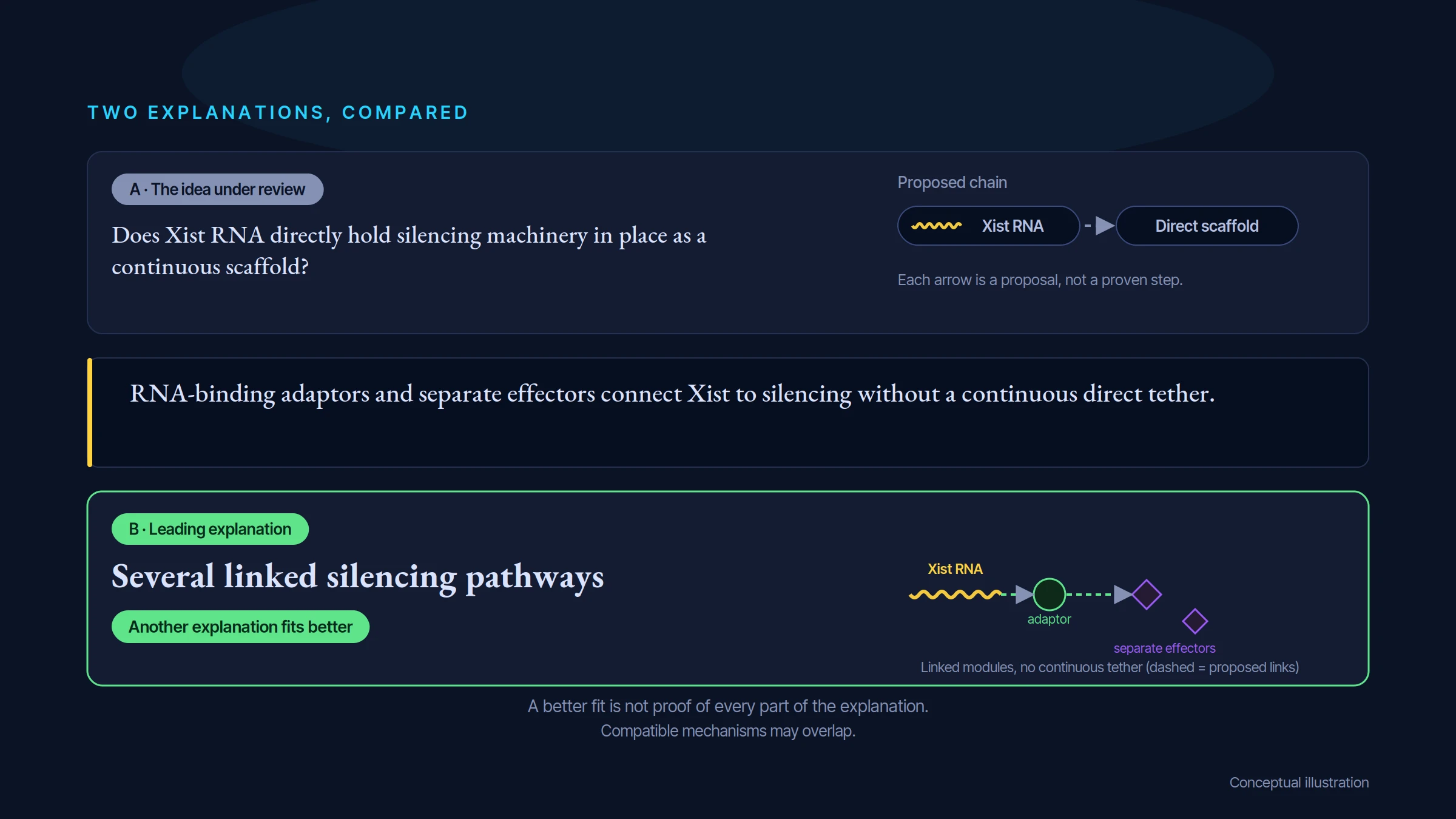
TWO EXPLANATIONS, COMPARED
A · The idea under review
Does Xist RNA directly hold silencing machinery in place as a continuous scaffold?
Proposed chain
Xist RNA
Continuous direct scaffold
Each arrow is a proposal, not a proven step.
RNA-binding adaptors and separate effectors connect Xist to silencing without a continuous direct tether.
B · Leading explanation
Several linked silencing pathways
Another explanation fits better
Xist RNA
RNA-binding adaptor
Separate effectors
Linked modules, no continuous tether (dashed = proposed links)
A better fit is not proof of every part of the explanation.
Compatible mechanisms may overlap.
Conceptual illustration
Plausible, not established for the stated claim.
RNA-binding adaptors and separate effectors connect Xist to silencing without a continuous direct tether.
These explanations can overlap. Ranking their fit to the evidence is separate from deciding how firmly a cause has been established.
Rank 1: Modular effector pathways with a PRC1-first Polycomb cascade — SPEN and Polycomb can contribute in parallel; hnRNPK bridges Xist to PCGF3/5, followed by catalytic chromatin recruitment.
Rank 2: Xist-seeded protein assembly and spatial amplification — Sparse RNA nucleates enriched effectors; compaction improves access to genes.
Rank 3: Dynamic RNA contact and catalytic release — PRC2 contacts RNA transiently while folding/release regulates catalytic access.
Rank 4: Chromatin feedback and redundant maintenance — Marks, architecture and RNA spreading reinforce one another with lineage-dependent memory.
Rank 5: Direct continuous Polycomb smart scaffold — Xist directly and continuously tethers both PRCs as the initiating silencing structure.
Evidence rating: Γ · Moderate confidence. How the evidence was assessed.
RNA-binding adaptors and separate effectors connect Xist to silencing without a continuous direct tether.
The preregistered primary-subclaim rule uses SC2, giving Γ for direct continuous Polycomb scaffolding. SC1 is Η within initiation-competent mammalian contexts, while SC3 is Γ and SC4 Β for their stronger mechanism claims. Weakest-link sensitivity is Β. Evidence for Xist necessity and modular Polycomb causality is retained and cannot replace the nominal structural claim.
Look for the proposed factor and the outcome, in the people or systems covered by the claim.
Several linked silencing pathways. RNA-binding adaptors and separate effectors connect Xist to silencing without a continuous direct tether.
Separate RNA attachment, adaptor recruitment and silencing reactions while measuring chromosome-wide gene activity.
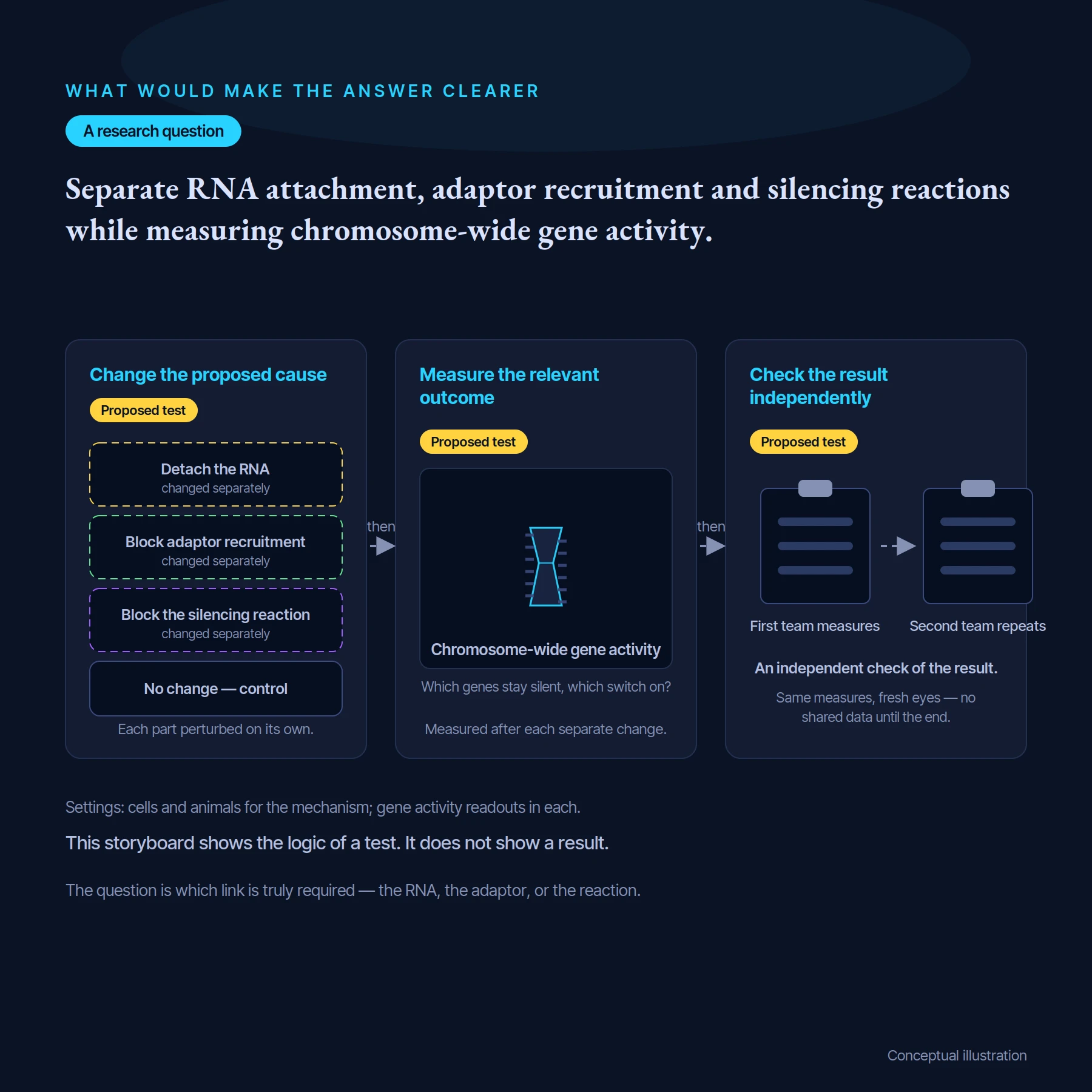
WHAT WOULD MAKE THE ANSWER CLEARER
A research question
Separate RNA attachment, adaptor recruitment and silencing reactions while measuring chromosome-wide gene activity.
then
then
Change the proposed cause
Proposed test
Detach the RNA
changed separately
Block adaptor recruitment
changed separately
Block the silencing reaction
changed separately
No change — control
Each part perturbed on its own.
Measure the relevant outcome
Chromosome-wide gene activity
Which genes stay silent, which switch on?
Measured after each separate change.
Check the result independently
First team measures
Second team repeats
An independent check of the result.
Same measures, fresh eyes — no shared data until the end.
Settings: cells and animals for the mechanism; gene activity readouts in each.
This storyboard shows the logic of a test. It does not show a result.
The question is which link is truly required — the RNA, the adaptor, or the reaction.
Conceptual illustration
Separate RNA attachment, adaptor recruitment and silencing reactions while measuring chromosome-wide gene activity.
Check that the intended change really happened.
Allow for other factors and compare with suitable controls.
Look for independent confirmation and the limits of the effect.
These are questions for research, not a claim that the proposed studies have already succeeded.
Proposed tests: 1 test design(s) are registered in the scorecard.
In plain terms, researchers would change the proposed cause, check that it changed as intended, then measure a meaningful outcome while controlling plausible alternatives. The result should be able to support or count against the claim—not only show that a pathway exists.
Study design: At native female Xist expression, selectively disrupt a mapped direct RNA interface for each PRC while preserving SPEN, hnRNPK, RNA abundance and localization; compare initiation with expression-matched interface rescue and acute nascent allele-specific transcription.
What would be measured: RNA occupancy, UV-supported contact, PRC catalytic marks and gene-resolved nascent repression measured separately over initiation
Important controls: Adapter-binding, RNA-processing, cell-cycle, global transcription and viability controls; wild-type and binding-deficient matched rescue; independent mammalian lineage
Result that would support the claim: Loss of only the direct tether prevents initiation and native matched rescue restores both contact and repression across defined genes
Result that would count against it: Silencing persists without the direct tether, or rescue restores contact without repression while adapter/effector pathways explain the output
Follow the studies, detailed comparisons and evidence ratings behind this guide.
Open the scientific review →