The question
Does tau spreading between connected nerve cells drive degeneration?
This is the specific idea being tested.
Does tau spreading between connected nerve cells drive degeneration?
What you need to knowTau can spread, but nerve-cell vulnerability better explains some patterns of damage.Relative explanatory fit: Alternative ranked ahead
Why the alternative fits better: Cell type, tau interactions and internal protein handling help explain which cells die. Tau movement is a separate question.
Claim assessed: Pathological tau spreads between anatomically connected neurons by templated seeding, and this cell-to-cell propagation drives the progression of neurodegeneration in tauopathies.
Finding: The preregistered weakest-link conjunction returns Γ. Longitudinal human network progression, recipient-host conversion experiments and causal modifiers make the claim more than association alone. None of the assembled lines selectively establishes that spontaneous templated neuronal propagation is necessary for the neuronal-loss trajectory across tauopathies. Defined laboratory capability is credited, while selective propagation mediation is the remaining gate.
Evidence scope: 66 primary reports; literature cutoff 2026-10-06; source examination UTC date 2026-10-06; bounded critical review, not exhaustive systematic review.
The grade applies to the stated claim. Model rankings and individual subclaim grades remain separate from the overall causal-evidence grade.
Full scientific assessment and references · Scorecard (JSON) · Review source (Markdown)
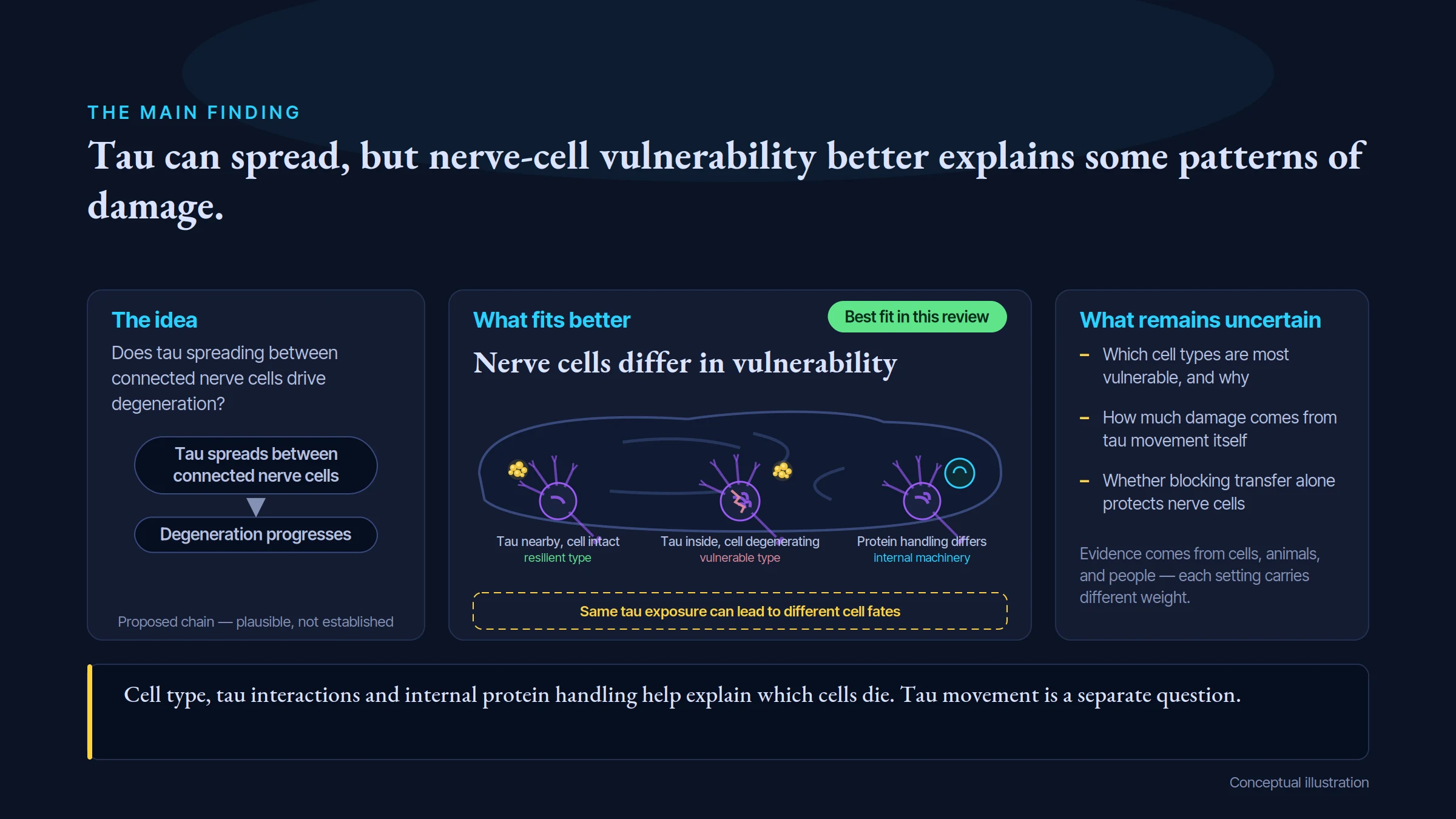
THE MAIN FINDING
Tau can spread, but nerve-cell vulnerability better explains some patterns of damage.
The idea
Does tau spreading between connected nerve cells drive degeneration?
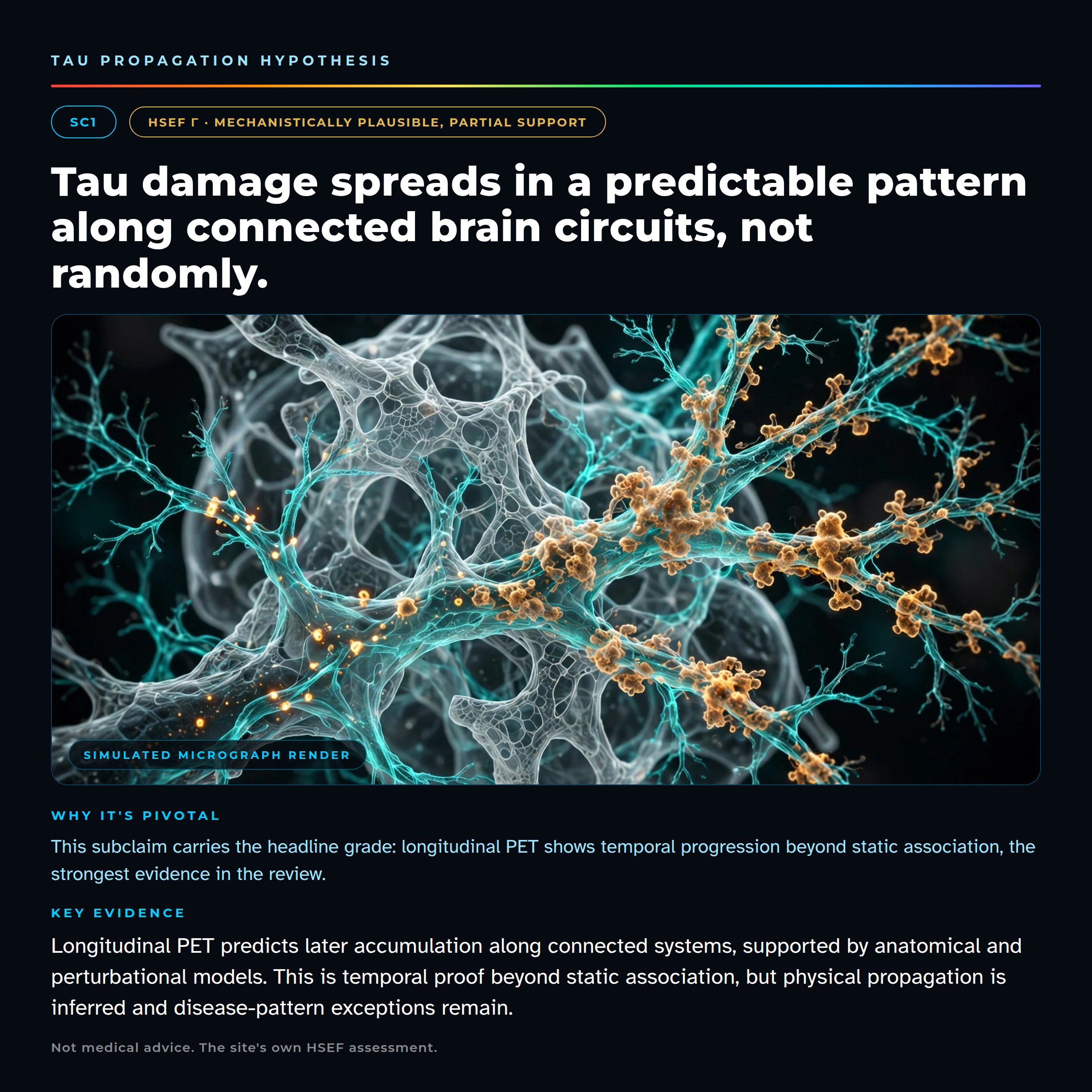
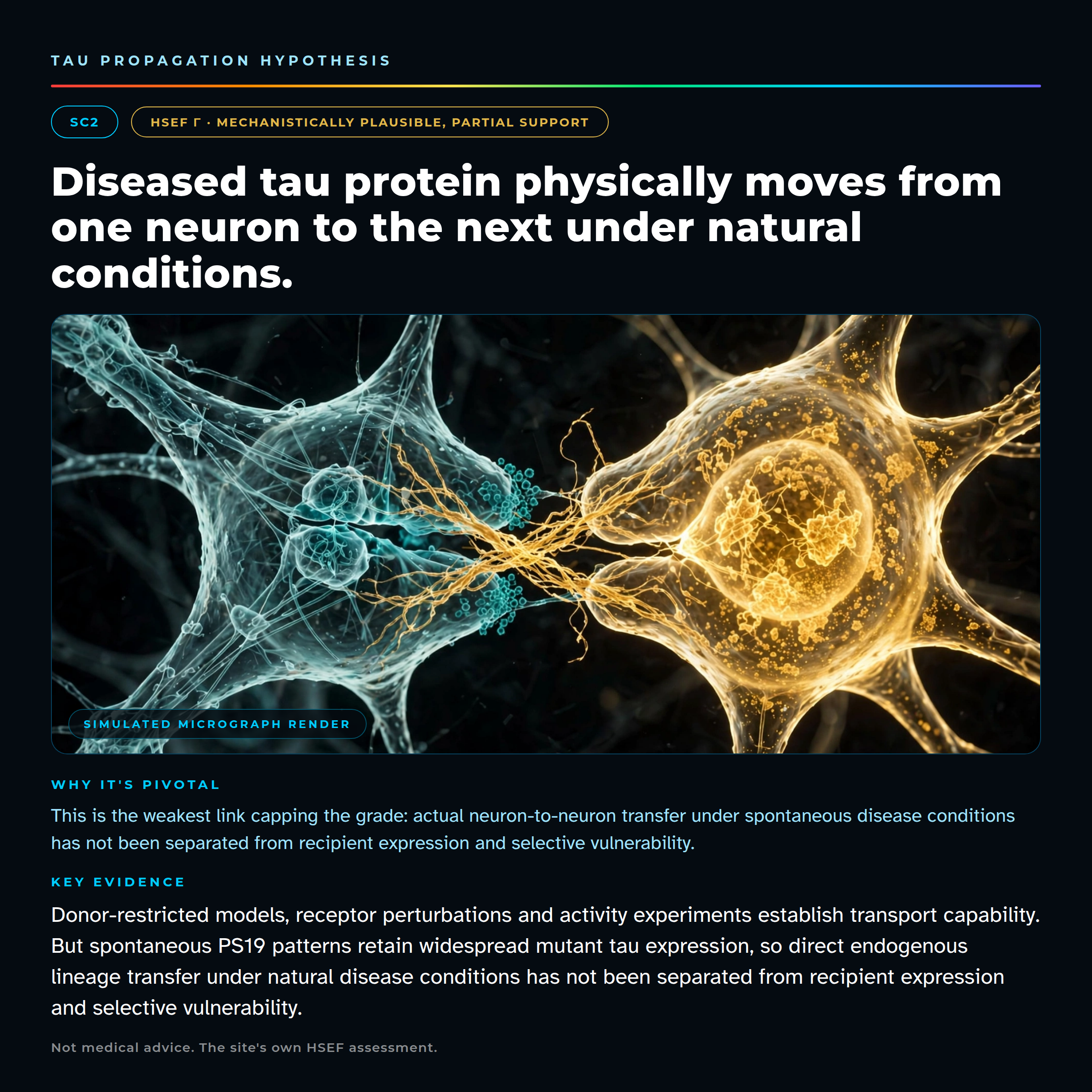
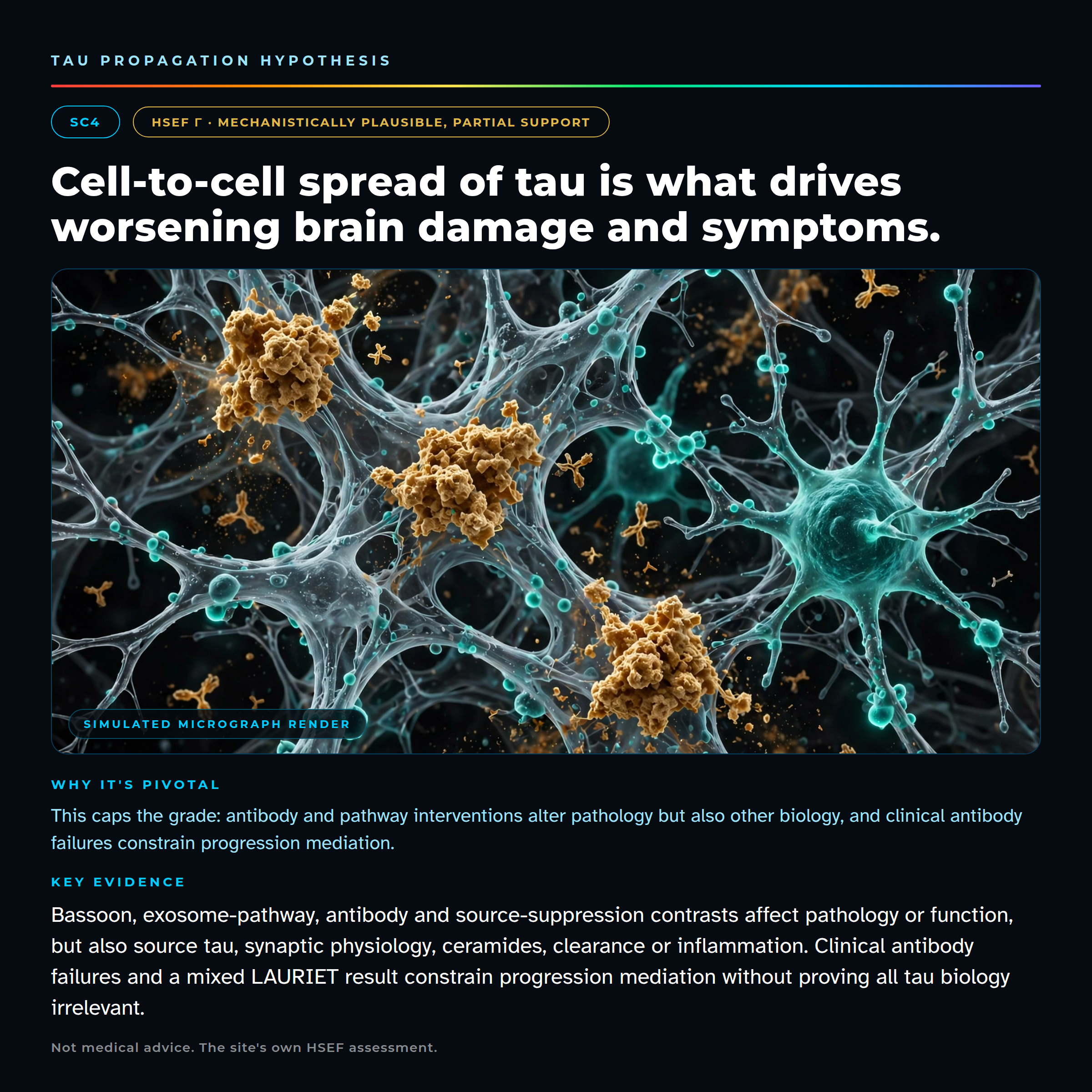
Tau spreads between connected nerve cells
Degeneration progresses
Proposed chain — plausible, not established
What fits better
Best fit in this review
Nerve cells differ in vulnerability
Tau nearby, cell intact
Resilient cell type
Tau inside, cell degenerating
Vulnerable cell type
Protein handling differs
Internal protein machinery
Same tau exposure can lead to different cell fates
What remains uncertain
Which cell types are most vulnerable, and why
How much damage comes from tau movement itself
Whether blocking transfer alone protects nerve cells
Evidence comes from cells, animals, and people — each setting carries different weight.
Cell type, tau interactions and internal protein handling help explain which cells die. Tau movement is a separate question.
Conceptual illustration
This is the specific idea being tested.
Cell type, tau interactions and internal protein handling help explain which cells die. Tau movement is a separate question.
A higher rank means a better fit to the evidence in this comparison. It does not prove every part of the leading explanation.
The reviewed hypothesis ranks 2 among 5 models compared; 1 alternative model(s) hold first rank for this stated claim.
Claim under review: rank 2 among 5 compared models.
Leading explanation: Cell-autonomous selective vulnerability.
Position in this comparison: Next after leading rank.
The causal grade asks how well the stated causal claim is established. This comparison asks which of the assessed explanations fits the reviewed findings better. A leading explanation can remain unproven. Models can overlap or include the tested mechanism; an alternative ahead does not make that mechanism irrelevant. These ordinal ranks apply within this review; they do not measure the size of a difference or rank scientific strength across topics.
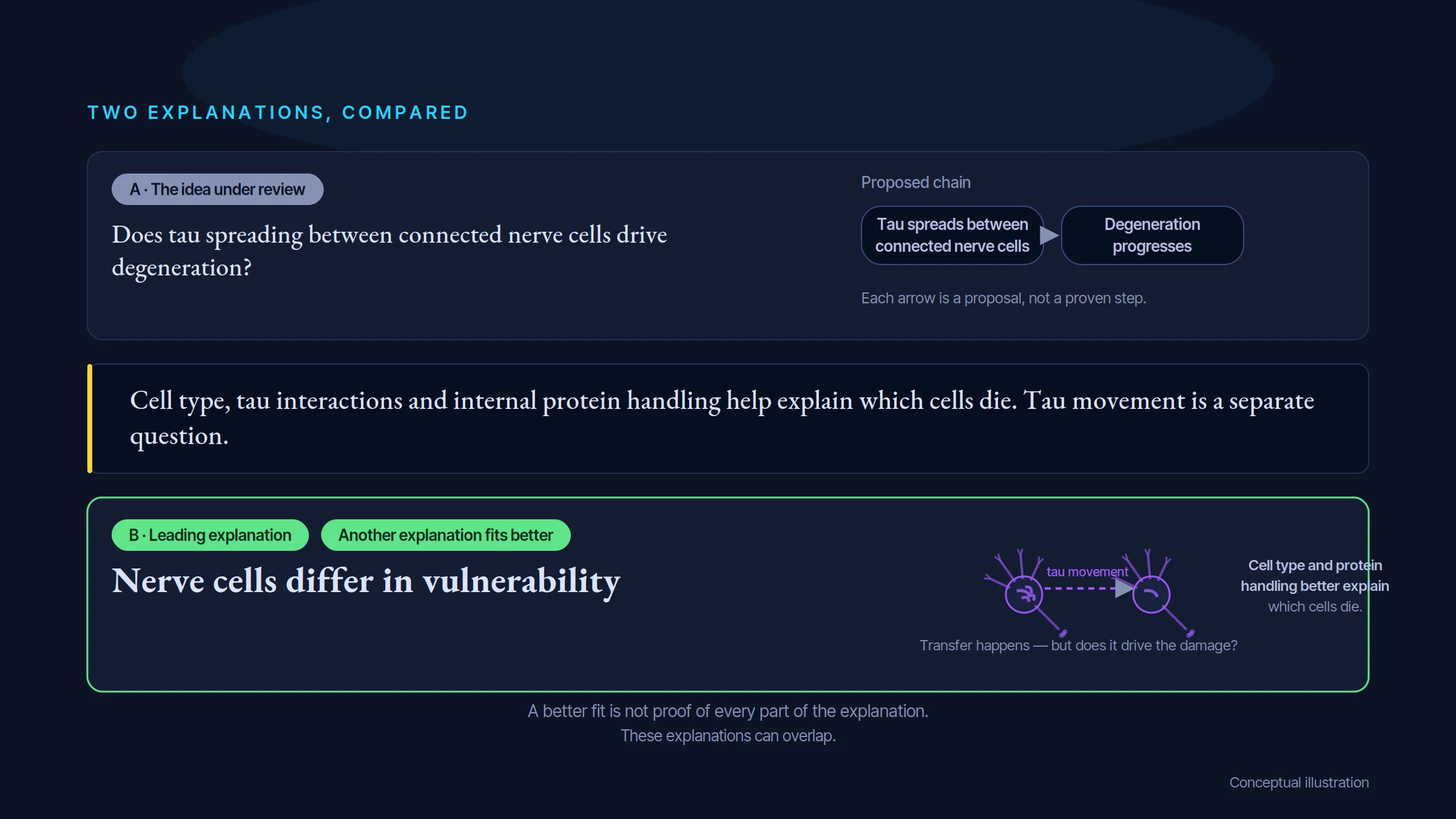
TWO EXPLANATIONS, COMPARED
A · The idea under review
Does tau spreading between connected nerve cells drive degeneration?
Proposed chain
Tau spreads between connected nerve cells
Degeneration progresses
Each arrow is a proposal, not a proven step.
Cell type, tau interactions and internal protein handling help explain which cells die. Tau movement is a separate question.
B · Leading explanation
Another explanation fits better
Nerve cells differ in vulnerability
Tau movement between cells
Transfer happens — but does it drive the damage?
Cell type and protein handling better explain which cells die
A better fit is not proof of every part of the explanation.
These explanations can overlap.
Conceptual illustration
Plausible, not established for the stated claim.
Cell type, tau interactions and internal protein handling help explain which cells die. Tau movement is a separate question.
These explanations can overlap. Ranking their fit to the evidence is separate from deciding how firmly a cause has been established.
Rank 1: Cell-autonomous selective vulnerability — Intrinsic neuronal type, synaptic tau binding and proteostasis help determine which cells degenerate.
Rank 2: Templated neuronal propagation — Donor tau transfer recruits recipient substrate and helps advance pathology.
Rank 3: Transfer without neurotoxicity — Transferred material can move independently of recipient templating or lethal consequences.
Rank 4: Upstream proteostatic failure — Endolysosomal escape and cellular clearance determine tau competence and intrinsic toxicity.
Rank 5: Shared microenvironment pseudo-spread — Network activity and glial environments create correlated pathology without obligatory neuron-to-neuron transfer.
Evidence rating: Γ · Moderate confidence. How the evidence was assessed.
Cell type, tau interactions and internal protein handling help explain which cells die. Tau movement is a separate question.
This is an assessment of a causal explanation, not proof that a particular supplement, diet, test, or treatment improves health. A treatment claim needs studies that test the intervention in people and measure meaningful benefits and harms. These findings can help frame research and informed clinical questions, but they do not identify what is right for one person.
Look for the proposed factor and the outcome, in the people or systems covered by the claim.
Nerve cells differ in vulnerability. Cell type, tau interactions and internal protein handling help explain which cells die. Tau movement is a separate question.
Block transfer without changing tau's source or cell survival, measuring conversion and degeneration separately.
These illustrations show the key questions tested in the review. They are conceptual drawings, not microscope images or experimental results.
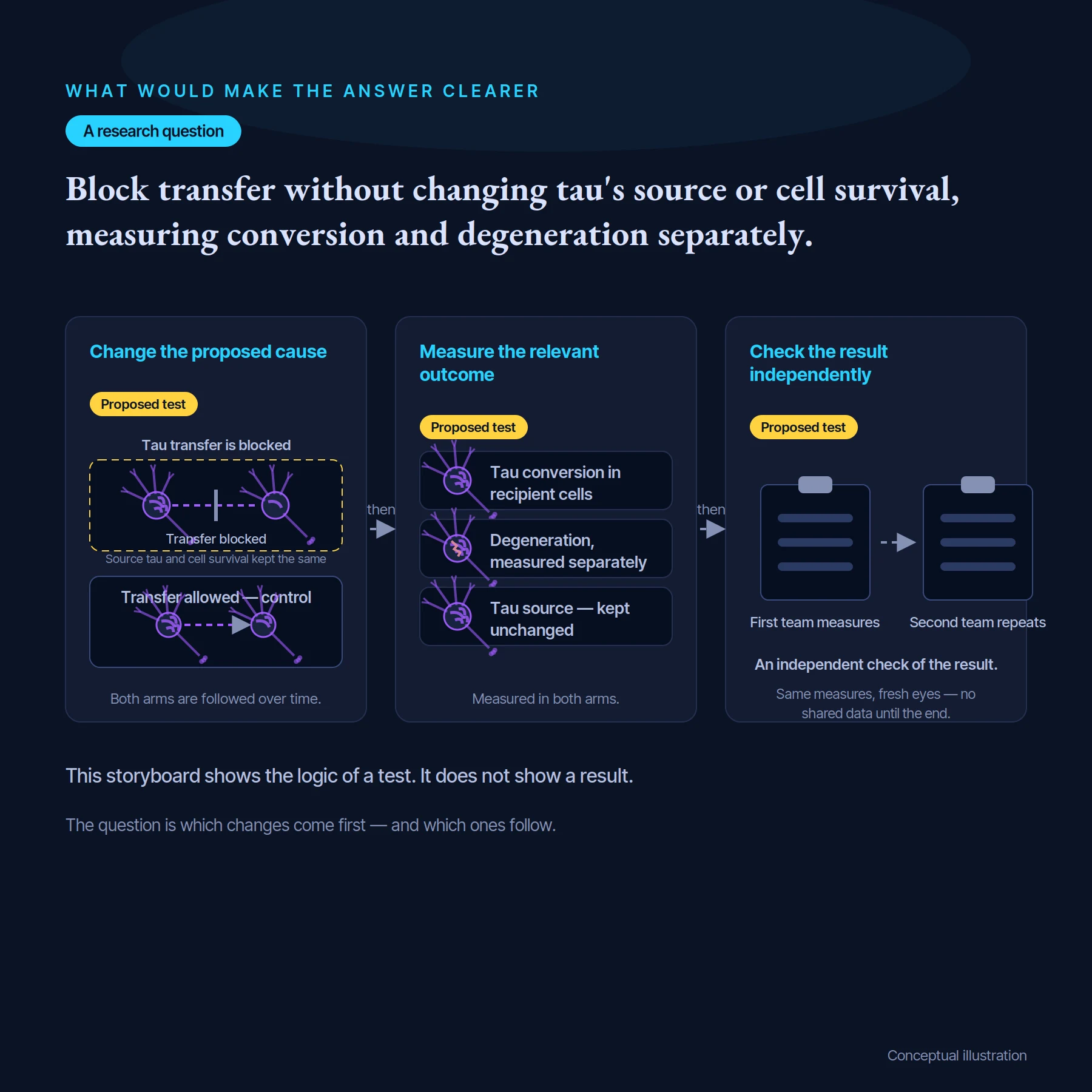
WHAT WOULD MAKE THE ANSWER CLEARER
A research question
Block transfer without changing tau's source or cell survival, measuring conversion and degeneration separately.
then
then
Change the proposed cause
Proposed test
Tau transfer is blocked
Transfer blocked
Source tau and cell survival kept the same
Transfer allowed — control
Both arms are followed over time.
Measure the relevant outcome
Proposed test
Tau conversion in recipient cells
Degeneration, measured separately
Tau source — kept unchanged
Measured in both arms.
Check the result independently
Proposed test
First team measures
Second team repeats
An independent check of the result.
Same measures, fresh eyes — no shared data until the end.
This storyboard shows the logic of a test. It does not show a result.
The question is which changes come first — and which ones follow.
Conceptual illustration
Block transfer without changing tau's source or cell survival, measuring conversion and degeneration separately.
Check that the intended change really happened.
Allow for other factors and compare with suitable controls.
Look for independent confirmation and the limits of the effect.
These are questions for research, not a claim that the proposed studies have already succeeded.
Proposed tests: 1 test design(s) are registered in the scorecard.
In plain terms, researchers would change the proposed cause, check that it changed as intended, then measure a meaningful outcome while controlling plausible alternatives. The result should be able to support or count against the claim—not only show that a pathway exists.
Study design: In spontaneous tauopathy with physiological donor and recipient tau, induce a selective transfer/conversion block after pathology onset and provide mechanistically matched rescue, with source tau burden and neuronal physiology held comparable.
What would be measured: Direct recipient lineage conversion, regional spread, blinded neuron counts and cognitive/functional trajectory
Important controls: Donor and recipient allele tags, source load, synaptic/lysosomal viability, transfer-independent intracellular toxicity and sham rescue
Result that would support the claim: Selective interruption reduces new recipient conversion and subsequent neuronal loss, and matched rescue restores both
Result that would count against it: Verified selective interruption leaves neuronal-loss progression unchanged or worsens it while matched intrinsic-toxicity control explains the trajectory
Follow the studies, detailed comparisons and evidence ratings behind this guide.
Open the scientific review →