The question
Does low vitamin D cause many diseases beyond bone problems?
This is the specific idea being tested.

Does low vitamin D cause many diseases beyond bone problems?
What you need to knowLow vitamin D can mark poor health without causing every associated disease.Relative explanatory fit: Alternative ranked ahead
Why the alternative fits better: Shared health and lifestyle factors lower vitamin D and raise disease risk. Specific deficiency effects may still matter.
Claim assessed: Low circulating 25-hydroxyvitamin D is a causal contributor to non-skeletal disease, such that supplementation reduces incidence.
Finding: Overall Γ is a partial-mechanism assessment for the registered broad prevention claim, not a denial of vitamin-D biology or skeletal indications. Robust null trials and attenuated secondary evidence prevent a broad positive causal crossing; genetic and disease-specific findings keep this above a purely associational interpretation.
Evidence scope: 50 primary reports; literature cutoff 2026-10-09; source examination UTC date 2026-10-10; bounded critical review, not exhaustive systematic review.
The grade applies to the stated claim. Model rankings and individual subclaim grades remain separate from the overall causal-evidence grade.
Full scientific assessment and references · Scorecard (JSON) · Review source (Markdown)
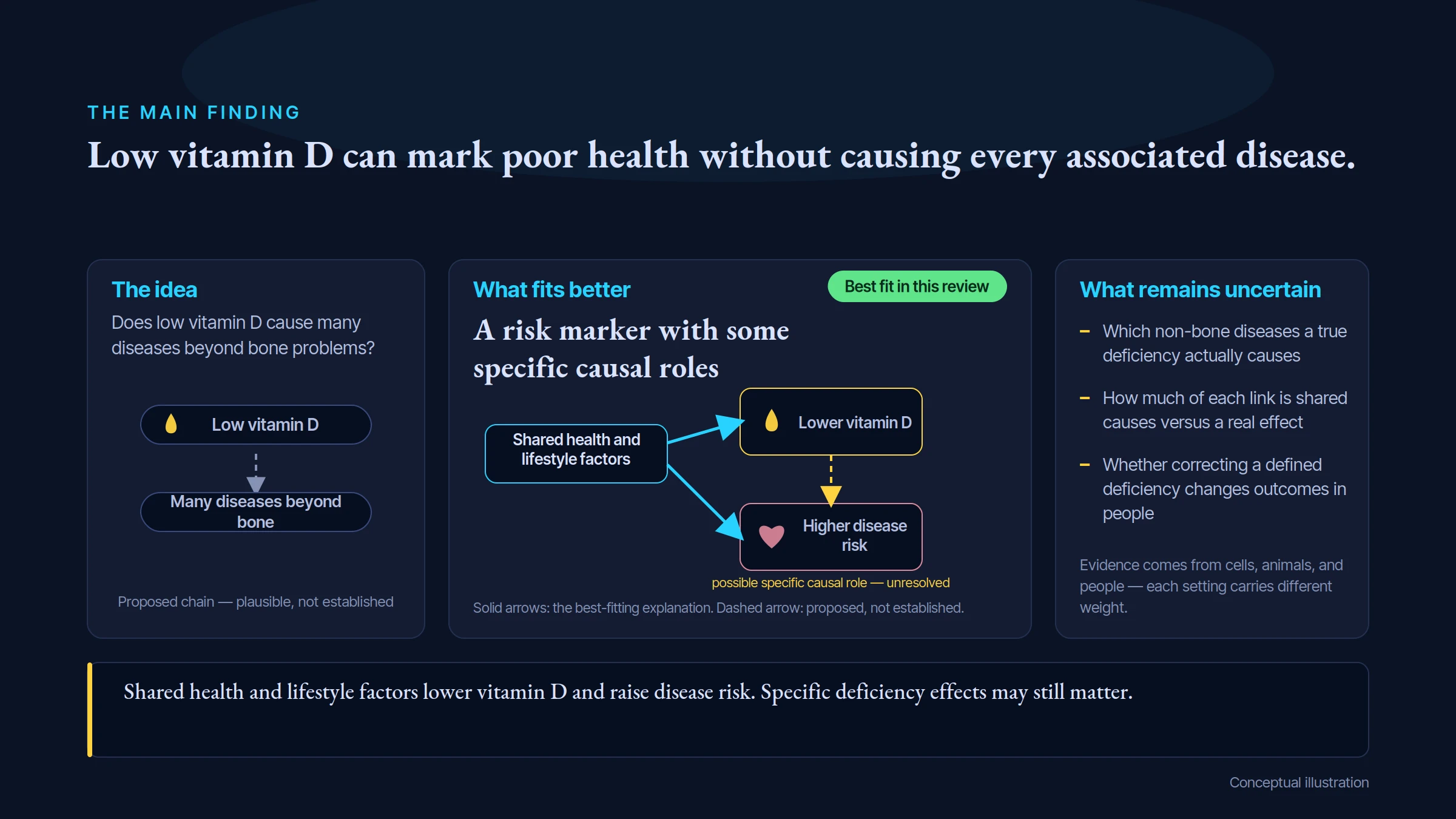
THE MAIN FINDING
Low vitamin D can mark poor health without causing every associated disease.
The idea
Does low vitamin D cause many diseases beyond bone problems?
Low vitamin D
Many diseases beyond bone
Proposed chain — plausible, not established
What fits better
A risk marker with some specific causal roles
Best fit in this review
Shared health and lifestyle factors
Lower vitamin D
Higher disease risk
Possible specific causal role — unresolved (dashed = proposed)
Solid arrows: the best-fitting explanation. Dashed arrow: proposed, not established.
What remains uncertain
Which non-bone diseases a true deficiency actually causes
How much of each link is shared causes versus a real effect
Whether correcting a defined deficiency changes outcomes in people
Evidence comes from cells, animals, and people — each setting carries different weight.
Shared health and lifestyle factors lower vitamin D and raise disease risk. Specific deficiency effects may still matter.
Conceptual illustration
This is the specific idea being tested.
Shared health and lifestyle factors lower vitamin D and raise disease risk. Specific deficiency effects may still matter.
A higher rank means a better fit to the evidence in this comparison. It does not prove every part of the leading explanation.
The reviewed hypothesis ranks 2 among 4 models compared; 1 alternative model(s) hold first rank for this stated claim.
Claim under review: rank 2 among 4 compared models.
Leading explanation: Risk marker with selective causal effects.
Position in this comparison: Next after leading rank.
The causal grade asks how well the stated causal claim is established. This comparison asks which of the assessed explanations fits the reviewed findings better. A leading explanation can remain unproven. Models can overlap or include the tested mechanism; an alternative ahead does not make that mechanism irrelevant. These ordinal ranks apply within this review; they do not measure the size of a difference or rank scientific strength across topics.
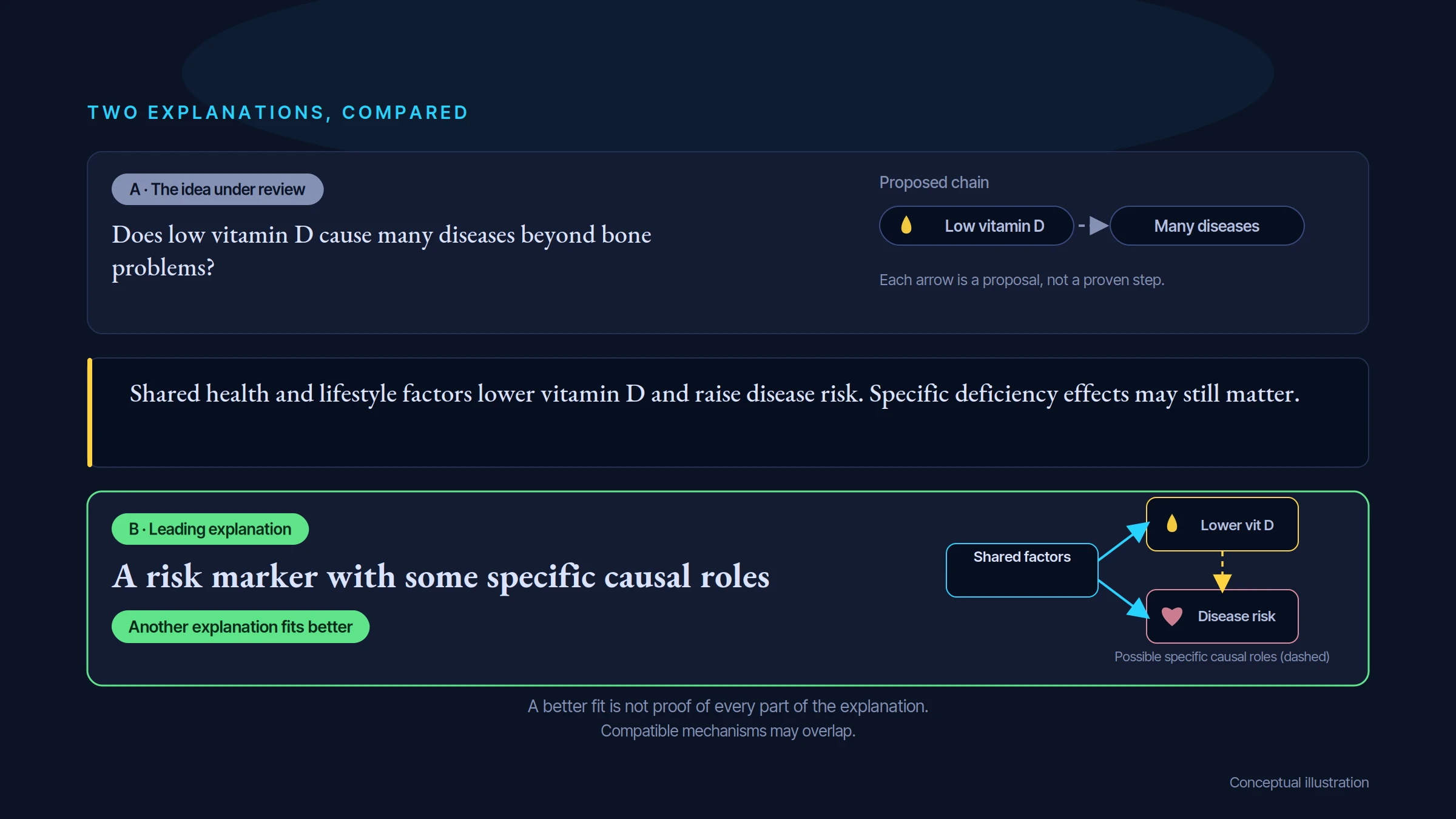
TWO EXPLANATIONS, COMPARED
A · The idea under review
Does low vitamin D cause many diseases beyond bone problems?
Proposed chain
Low vitamin D
Many non-bone diseases
Each arrow is a proposal, not a proven step.
Shared health and lifestyle factors lower vitamin D and raise disease risk. Specific deficiency effects may still matter.
B · Leading explanation
A risk marker with some specific causal roles
Another explanation fits better
Shared health and lifestyle factors
Lower vitamin D
Higher disease risk
Possible specific causal roles (dashed = proposed)
A better fit is not proof of every part of the explanation.
Compatible mechanisms may overlap.
Conceptual illustration
Plausible, not established for the stated claim.
Shared health and lifestyle factors lower vitamin D and raise disease risk. Specific deficiency effects may still matter.
These explanations can overlap. Ranking their fit to the evidence is separate from deciding how firmly a cause has been established.
Rank 1: Risk marker with selective causal effects — Low vitamin D is often a marker of shared causes, with possible disease- and deficiency-specific causal contributions.
Rank 2: Broad deficiency-driven nonskeletal disease — Low vitamin D is an upstream common cause whose correction prevents multiple disease categories.
Rank 3: Predominantly reverse causation/confounding — Illness, adiposity, sun exposure and behavior influence both vitamin-D levels and risk.
Rank 4: Baseline-dependent immune modulation — Effects may be concentrated in prespecified deficient or disease-specific strata.
Evidence rating: Γ · Moderate confidence. How the evidence was assessed.
Shared health and lifestyle factors lower vitamin D and raise disease risk. Specific deficiency effects may still matter.
Overall Γ is a partial-mechanism assessment for the registered broad prevention claim, not a denial of vitamin-D biology or skeletal indications. Robust null trials and attenuated secondary evidence prevent a broad positive causal crossing; genetic and disease-specific findings keep this above a purely associational interpretation.
Look for the proposed factor and the outcome, in the people or systems covered by the claim.
A risk marker with some specific causal roles. Shared health and lifestyle factors lower vitamin D and raise disease risk. Specific deficiency effects may still matter.
Test correction of a defined deficiency against specific disease outcomes in controlled studies.
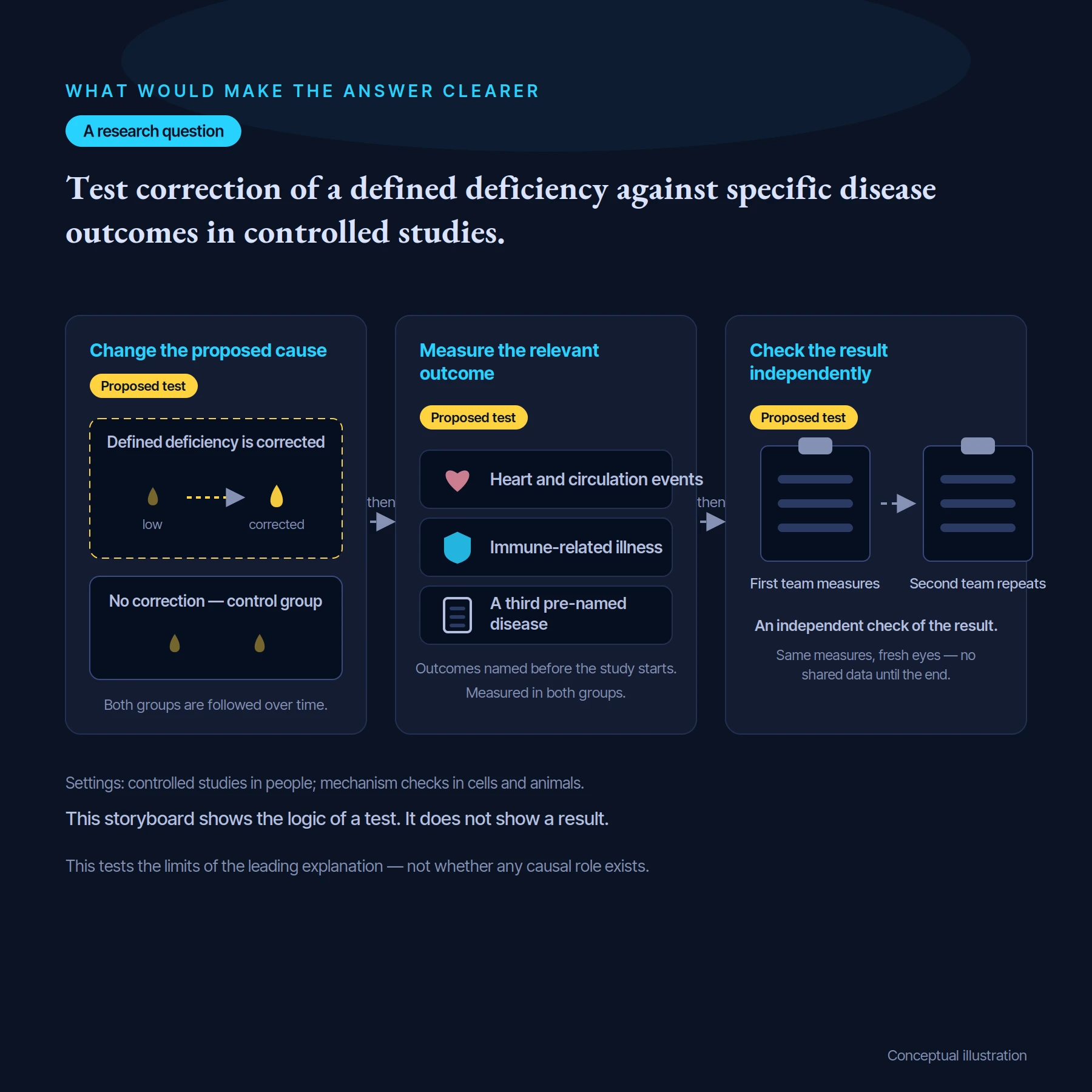
WHAT WOULD MAKE THE ANSWER CLEARER
A research question
Test correction of a defined deficiency against specific disease outcomes in controlled studies.
then
then
Change the proposed cause
Proposed test
Defined deficiency is corrected
low (before)
corrected (after)
No correction — control group
Both groups are followed over time.
Measure the relevant outcome
Heart and circulation events
Immune-related illness
A third pre-named disease
Specific disease outcomes, named before the study starts
Measured in both groups.
Check the result independently
First team measures
Second team repeats
An independent check of the result.
Same measures, fresh eyes — no shared data until the end.
Settings: controlled studies in people; mechanism checks in cells and animals.
This storyboard shows the logic of a test. It does not show a result.
This tests the limits of the leading explanation — not whether any causal role exists.
Conceptual illustration
Test correction of a defined deficiency against specific disease outcomes in controlled studies.
Check that the intended change really happened.
Allow for other factors and compare with suitable controls.
Look for independent confirmation and the limits of the effect.
These are questions for research, not a claim that the proposed studies have already succeeded.
Proposed tests: 1 test design(s) are registered in the scorecard.
In plain terms, researchers would change the proposed cause, check that it changed as intended, then measure a meaningful outcome while controlling plausible alternatives. The result should be able to support or count against the claim—not only show that a pathway exists.
Study design: Randomize correction within prespecified, safely enrolled baseline-deficiency strata, using registered disease-specific incidence endpoints and measured biochemical engagement; compare across strata without conditioning on achieved levels.
What would be measured: Confirmed disease incidence and function, biochemical engagement and treatment adherence
Important controls: Baseline definition before outcomes, ethical deficiency treatment rules, adjudication blinded to allocation and multiplicity control
Result that would support the claim: Reproducible clinically meaningful prevention in the registered deficiency/disease scope
Result that would count against it: Verified correction without the prespecified incidence effect at adequate precision and follow-up
Follow the studies, detailed comparisons and evidence ratings behind this guide.
Open the scientific review →