The question
Are accumulated mutations the primary cause that starts and sustains cancer?
This is the specific idea being tested.
Are accumulated mutations the primary cause that starts and sustains cancer?
What you need to knowMutations can cause cancer in defined settings, but including tissue conditions explains more of the evidence.Relative explanatory fit: Alternative ranked ahead
Why the alternative fits better: Genetic changes, cell type, surroundings and gene regulation jointly affect cancer behaviour.
Claim assessed: Sequential somatic driver mutations are the primary initiating and sustaining cause of cancer.
Finding: The preregistered scope-matched SC3 gate returns Ε: causal validity with explicit context limits. Driver identification reaches Ζ and defined initiation/maintenance dependencies reach Η through endogenous autochthonous genetics, restoration/rechallenge, human genomic natural history and genotype-selected hard clinical outcomes. The set is not re-capped by culture or xenograft limitations. Broad primacy requires a representative comparison of mutation, tissue and cell-state causation across initiation, maintenance and relapse; that burden is not established by genetic relevance alone. Benign driver clones challenge sufficiency, not the strong causal genetic evidence.
Evidence scope: 70 primary reports; literature cutoff 2026-10-06; source examination UTC date 2026-10-06; bounded critical review, not exhaustive systematic review.
The grade applies to the stated claim. Model rankings and individual subclaim grades remain separate from the overall causal-evidence grade.
Full scientific assessment and references · Scorecard (JSON) · Review source (Markdown)
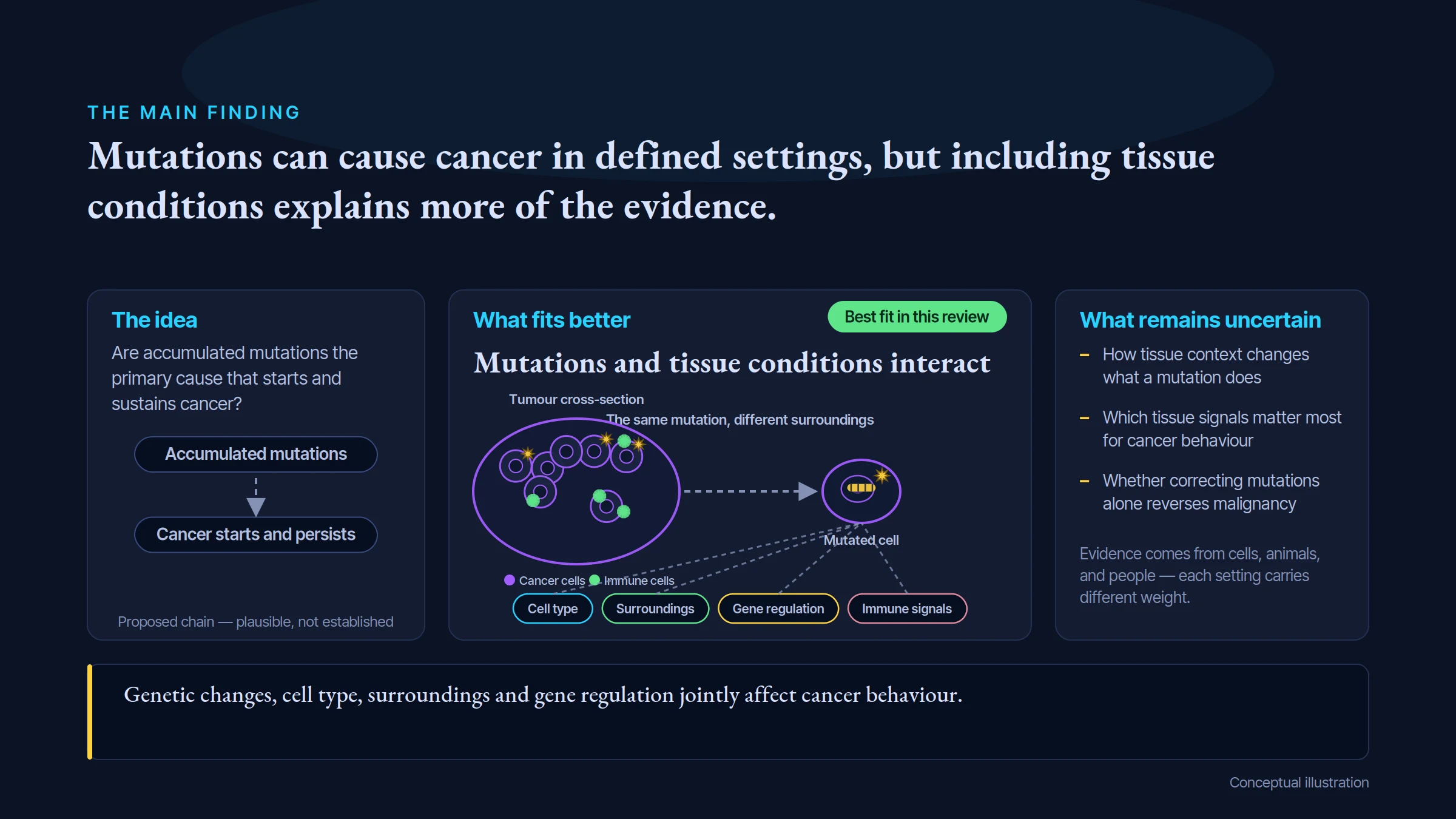
THE MAIN FINDING
Mutations can cause cancer in defined settings, but including tissue conditions explains more of the evidence.
The idea
Are accumulated mutations the primary cause that starts and sustains cancer?
Accumulated mutations
Cancer starts and persists
Proposed chain — plausible, not established
What fits better
Best fit in this review
Mutations and tissue conditions interact
The same mutation, different surroundings
Tumour cross-section
Cancer cells
Immune cells
Mutated cell
Cell type
Surroundings
Gene regulation
Immune signals
What remains uncertain
How tissue context changes what a mutation does
Which tissue signals matter most for cancer behaviour
Whether correcting mutations alone reverses malignancy
Evidence comes from cells, animals, and people — each setting carries different weight.
Genetic changes, cell type, surroundings and gene regulation jointly affect cancer behaviour.
Conceptual illustration
This is the specific idea being tested.
Genetic changes, cell type, surroundings and gene regulation jointly affect cancer behaviour.
A higher rank means a better fit to the evidence in this comparison. It does not prove every part of the leading explanation.
The reviewed hypothesis ranks 2 among 5 models compared; 1 alternative model(s) hold first rank for this stated claim.
Claim under review: rank 2 among 5 compared models.
Leading explanation: Integrated mutation–tissue model.
Position in this comparison: Next after leading rank.
The causal grade asks how well the stated causal claim is established. This comparison asks which of the assessed explanations fits the reviewed findings better. A leading explanation can remain unproven. Models can overlap or include the tested mechanism; an alternative ahead does not make that mechanism irrelevant. These ordinal ranks apply within this review; they do not measure the size of a difference or rank scientific strength across topics.
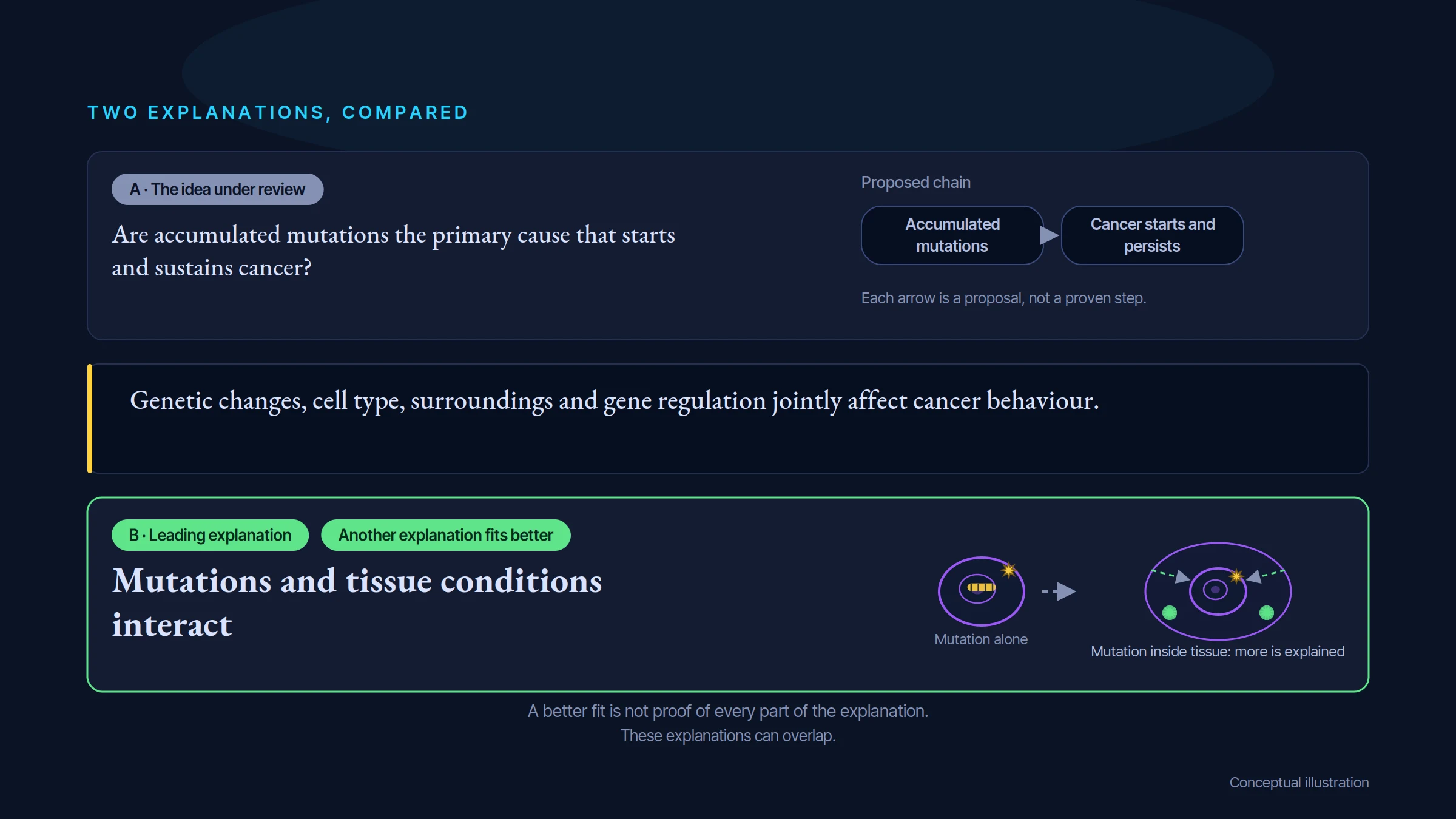
TWO EXPLANATIONS, COMPARED
A · The idea under review
Are accumulated mutations the primary cause that starts and sustains cancer?
Proposed chain
Accumulated mutations
Cancer starts and persists
Each arrow is a proposal, not a proven step.
Genetic changes, cell type, surroundings and gene regulation jointly affect cancer behaviour.
B · Leading explanation
Another explanation fits better
Mutations and tissue conditions interact
Mutation alone
Mutation inside tissue: more is explained
A better fit is not proof of every part of the explanation.
These explanations can overlap.
Conceptual illustration
Causal in a specific setting for the stated claim.
Genetic changes, cell type, surroundings and gene regulation jointly affect cancer behaviour.
These explanations can overlap. Ranking their fit to the evidence is separate from deciding how firmly a cause has been established.
Rank 1: Integrated mutation–tissue model — Genetic lesions, lineage, niche and regulatory state jointly determine specified cancer behavior.
Rank 2: Somatic mutation primacy — Sequential somatic drivers dominate cancer initiation and maintenance across cancers.
Rank 3: Nongenetic malignant states — Chromatin and differentiation memory can initiate or sustain malignant/tolerant states in specified contexts.
Rank 4: Chromosomal instability first — Chromosome instability can initiate or facilitate escape in defined models.
Rank 5: Tissue organization field theory — Tissue disorganization is the primary initiating and sustaining cause across cancers.
Evidence rating: Ε · Moderate confidence. How the evidence was assessed.
Genetic changes, cell type, surroundings and gene regulation jointly affect cancer behaviour.
This is an assessment of a causal explanation, not proof that a particular supplement, diet, test, or treatment improves health. A treatment claim needs studies that test the intervention in people and measure meaningful benefits and harms. These findings can help frame research and informed clinical questions, but they do not identify what is right for one person.
Look for the proposed factor and the outcome, in the people or systems covered by the claim.
Mutations and tissue conditions interact. Genetic changes, cell type, surroundings and gene regulation jointly affect cancer behaviour.
Correct mutations and change surrounding tissue separately and together, tracking malignant behaviour.
These illustrations show the key questions tested in the review. They are conceptual drawings, not microscope images or experimental results.
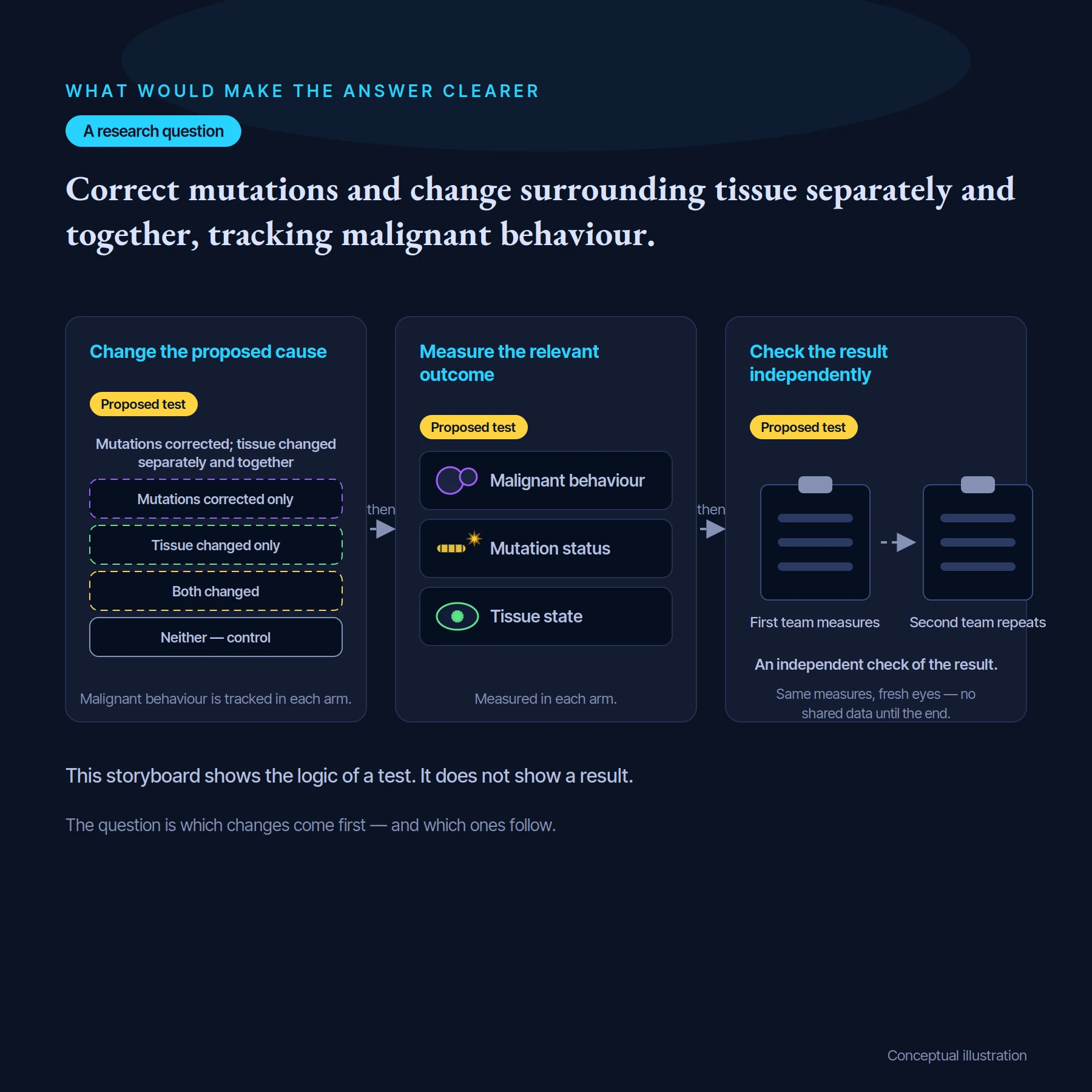
WHAT WOULD MAKE THE ANSWER CLEARER
A research question
Correct mutations and change surrounding tissue separately and together, tracking malignant behaviour.
then
then
Change the proposed cause
Proposed test
Mutations corrected; tissue changed
separately and together
Mutations corrected only
Tissue changed only
Both changed
Neither — control
Malignant behaviour is tracked in each arm.
Measure the relevant outcome
Proposed test
Malignant behaviour
Mutation status
Tissue state
Measured in each arm.
Check the result independently
Proposed test
First team measures
Second team repeats
An independent check of the result.
Same measures, fresh eyes — no shared data until the end.
This storyboard shows the logic of a test. It does not show a result.
The question is which changes come first — and which ones follow.
Conceptual illustration
Correct mutations and change surrounding tissue separately and together, tracking malignant behaviour.
Check that the intended change really happened.
Allow for other factors and compare with suitable controls.
Look for independent confirmation and the limits of the effect.
These are questions for research, not a claim that the proposed studies have already succeeded.
Proposed tests: 1 test design(s) are registered in the scorecard.
In plain terms, researchers would change the proposed cause, check that it changed as intended, then measure a meaningful outcome while controlling plausible alternatives. The result should be able to support or count against the claim—not only show that a pathway exists.
Study design: Across predeclared representative histologies, use lineage-resolved native cancers with selective driver correction/restoration and factorial niche/chromatin perturbations, preserving viability and measuring both early initiation and established maintenance/relapse.
What would be measured: Native malignant incidence, longitudinal tumor burden, lineage persistence, metastasis, survival and recurrence with allele-sensitive genome/state monitoring
Important controls: Matched passenger editing, inactive perturbation, normal mutant clones, unchanged baseline viability, tissue lineage and restoration of the specific driver versus matched state rescue
Result that would support the claim: Driver loss/correction suppresses initiation and sustained malignancy across contexts, matched restoration rescues it, and residual tissue/state effects account for only bounded exceptions
Result that would count against it: Verified driver correction leaves sustained malignancy in representative native contexts, or genotype-matched initiation depends dominantly on a separable tissue/state perturbation despite the same genetic state
Follow the studies, detailed comparisons and evidence ratings behind this guide.
Open the scientific review →