The question
Does BPC-157 speed up tissue healing in people?
This is the specific idea being tested.
Does BPC-157 speed up tissue healing in people?
What you need to knowPromising animal findings do not establish that BPC-157 safely heals tendons, ligaments or the gut in people.Relative explanatory fit: Alternative ranked ahead
Why the alternative fits better: Results in rats fit a limited repair effect. Human reports do not show controlled, structural healing throughout the body.
Claim assessed: For each prespecified tissue category—tendon, ligament, and gastrointestinal mucosa—in humans with objectively confirmed injury, a defined BPC-157 product delivered systemically causes faster structural healing than concurrent control.
Finding: Systemic rat tendon and ligament experiments, rat gastrointestinal injury models (including two independent groups) and tendon-cell work establish biological plausibility and partial-system causal support, and cross Δ within the rat (SC5). The human literature contains a two-person IV administration report and local, uncontrolled symptom reports; the one controlled human trial was local and null-compatible. No controlled systemic structural-healing result exists in tendon, ligament or gut mucosa, so every gating subclaim is Γ.
Evidence scope: Primary human, animal, ex vivo, pharmacokinetic, registry, systematic-review, and FDA records through 2026-09-29. Full text was read wherever accessible; abstract-only and partial records are labeled. The attached HSEF v5.4 packet (SHA256 7E097D3D50D2068F68BDB1CD022DF4A045DAC46A9F25E51262EC7568E9DB11EB) was treated as methodology, not biological evidence.
The grade applies to the stated claim. Model rankings and individual subclaim grades remain separate from the overall causal-evidence grade.
Full scientific assessment and references · Scorecard (JSON) · Review source (Markdown)
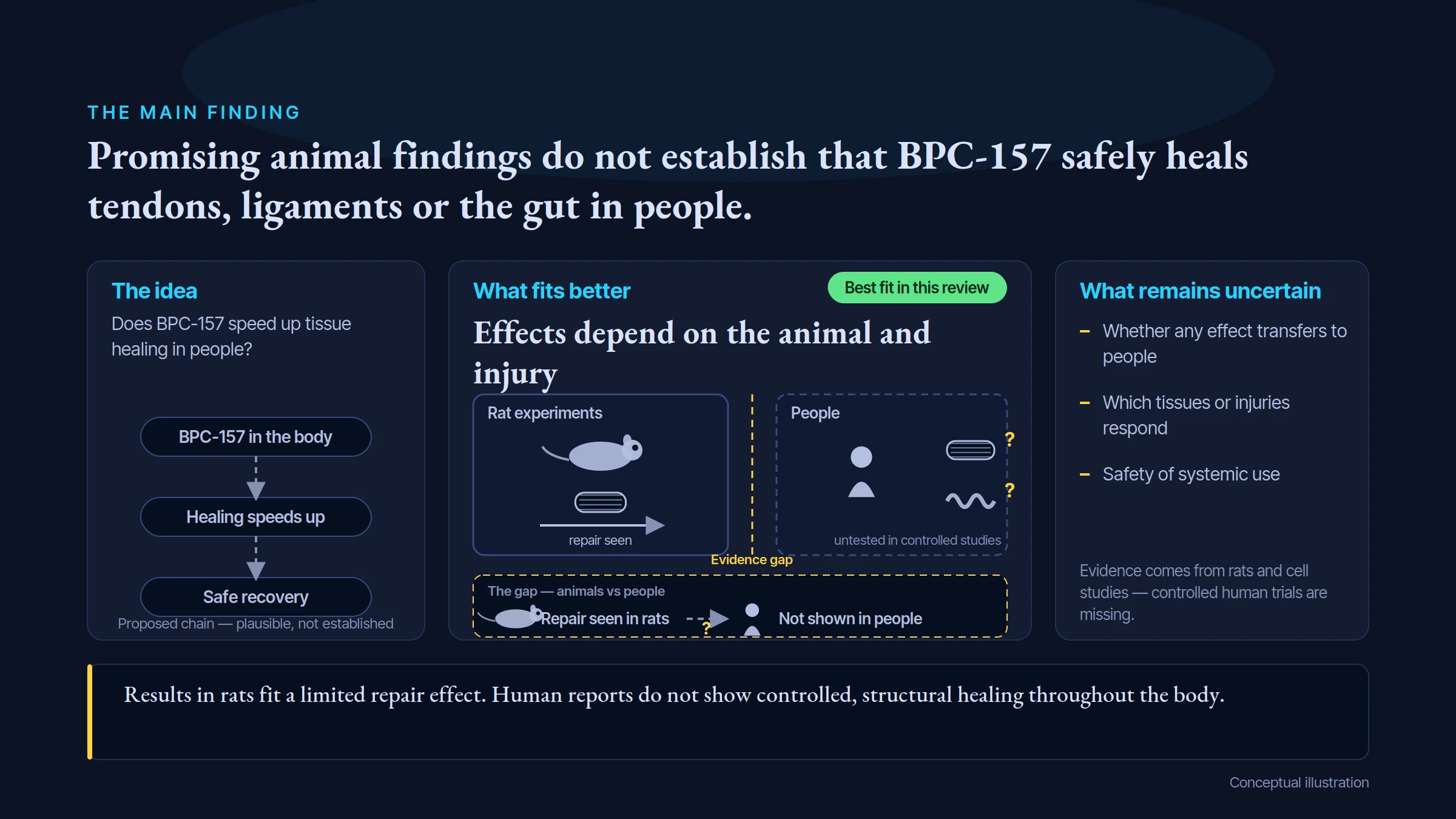
THE MAIN FINDING
Promising animal findings do not establish that BPC-157 safely heals tendons, ligaments or the gut in people.
The idea
Does BPC-157 speed up tissue healing in people?
BPC-157 in the body
Healing speeds up
Safe recovery
Proposed chain — plausible, not established
What fits better
Effects depend on the animal and injury
Best fit in this review
Rat experiments
repair seen
Evidence gap
People
untested in controlled studies
The gap — animals vs people
Repair seen in rats
Not shown in people
What remains uncertain
Whether any effect transfers to people
Which tissues or injuries respond
Safety of systemic use
Evidence comes from rats and cell studies — controlled human trials are missing.
Results in rats fit a limited repair effect. Human reports do not show controlled, structural healing throughout the body.
Conceptual illustration
This is the specific idea being tested.
Results in rats fit a limited repair effect. Human reports do not show controlled, structural healing throughout the body.
A higher rank means a better fit to the evidence in this comparison. It does not prove every part of the leading explanation.
The reviewed hypothesis ranks 3 among 4 models compared; 1 alternative model(s) hold first rank for this stated claim.
Claim under review: rank 3 among 4 compared models.
Leading explanation: Species- and injury-model-specific repair modulation.
Position in this comparison: Between leading and last ranks.
The causal grade asks how well the stated causal claim is established. This comparison asks which of the assessed explanations fits the reviewed findings better. A leading explanation can remain unproven. Models can overlap or include the tested mechanism; an alternative ahead does not make that mechanism irrelevant. These ordinal ranks apply within this review; they do not measure the size of a difference or rank scientific strength across topics.
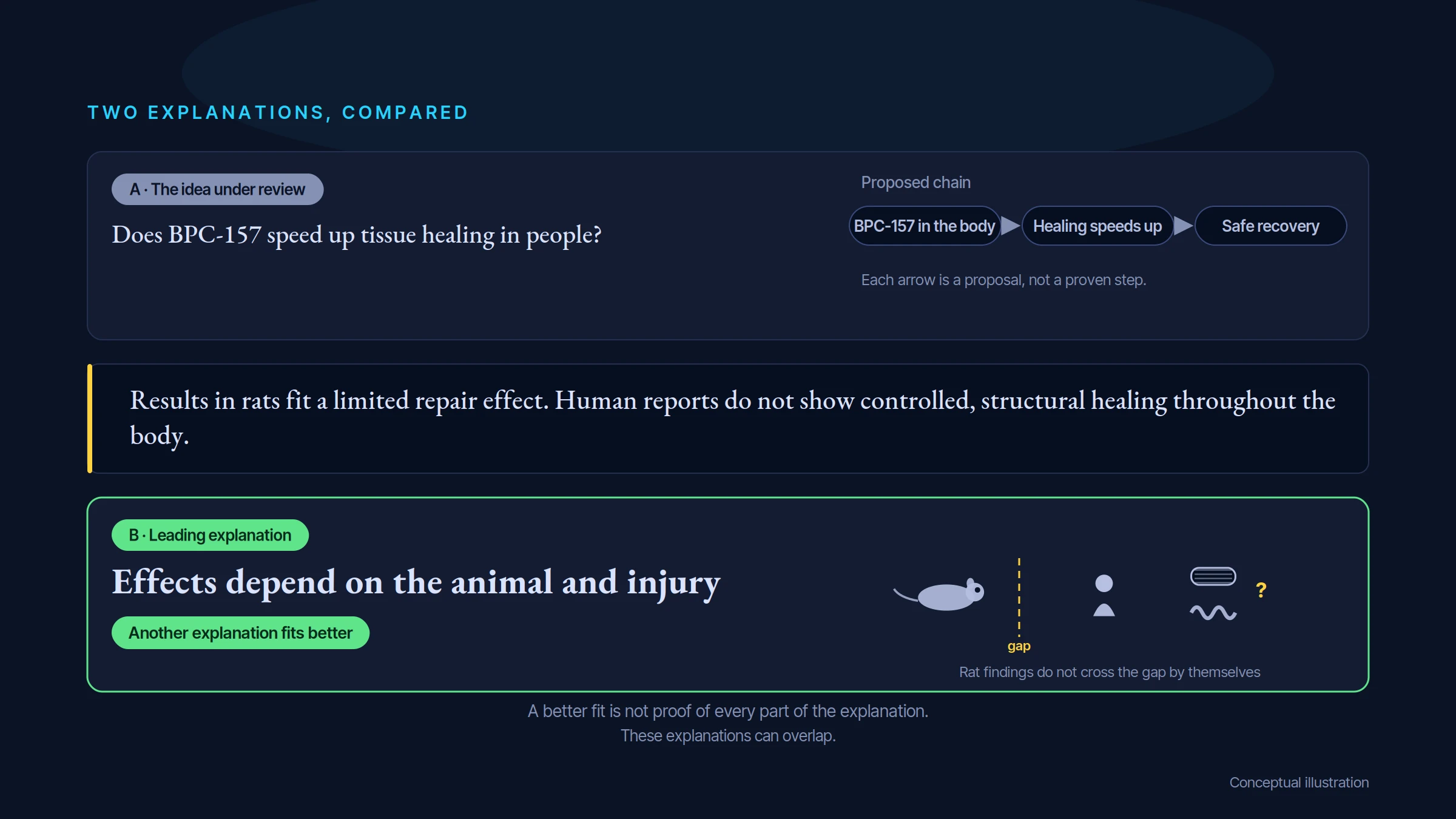
TWO EXPLANATIONS, COMPARED
A · The idea under review
Does BPC-157 speed up tissue healing in people?
Proposed chain
BPC-157 in the body
Healing speeds up
Safe recovery
Each arrow is a proposal, not a proven step.
Results in rats fit a limited repair effect. Human reports do not show controlled, structural healing throughout the body.
B · Leading explanation
Effects depend on the animal and injury
Another explanation fits better
gap
Rat findings do not cross the gap by themselves
A better fit is not proof of every part of the explanation.
These explanations can overlap.
Conceptual illustration
Plausible, not established for the stated claim.
Results in rats fit a limited repair effect. Human reports do not show controlled, structural healing throughout the body.
These explanations can overlap. Ranking their fit to the evidence is separate from deciding how firmly a cause has been established.
Rank 1: Species- and injury-model-specific repair modulation — BPC-157 can modify repair in selected rodent injury models, but the magnitude, target, exposure, and tissue boundary do not yet translate into demonstrated human systemic healing.
Rank 2: Local symptom modification without demonstrated structural repair — The published human signals reflect local treatment, procedure effects, pain modulation, natural history, expectation, or regression to the mean rather than proven systemic tissue regeneration.
Rank 3: Systemic multi-tissue human repair accelerator — A defined systemic BPC-157 regimen causally accelerates tendon, ligament, and gut mucosal structural healing in humans.
Rank 4: No specific pharmacologic repair effect — Apparent human benefits reflect natural history, expectation and procedure context, and the concentrated rat literature reflects laboratory-specific protocols or reporting; BPC-157 has no specific repair activity.
Evidence rating: Γ · Low confidence. How the evidence was assessed.
Results in rats fit a limited repair effect. Human reports do not show controlled, structural healing throughout the body.
For human treatment, the appropriate implication is that a properly designed clinical trial is still needed, with a defined product, measured exposure, meaningful imaging or tissue outcomes, and adequate safety follow-up. Animal findings can help generate that trial; they cannot show that a commercially obtained product will heal a human injury, shorten rehabilitation, or prevent surgery. They are also not a reason to defer assessment of a serious tendon, ligament, abdominal, or gastrointestinal problem.
Look for the proposed factor and the outcome, in the people or systems covered by the claim.
Effects depend on the animal and injury. Results in rats fit a limited repair effect. Human reports do not show controlled, structural healing throughout the body.
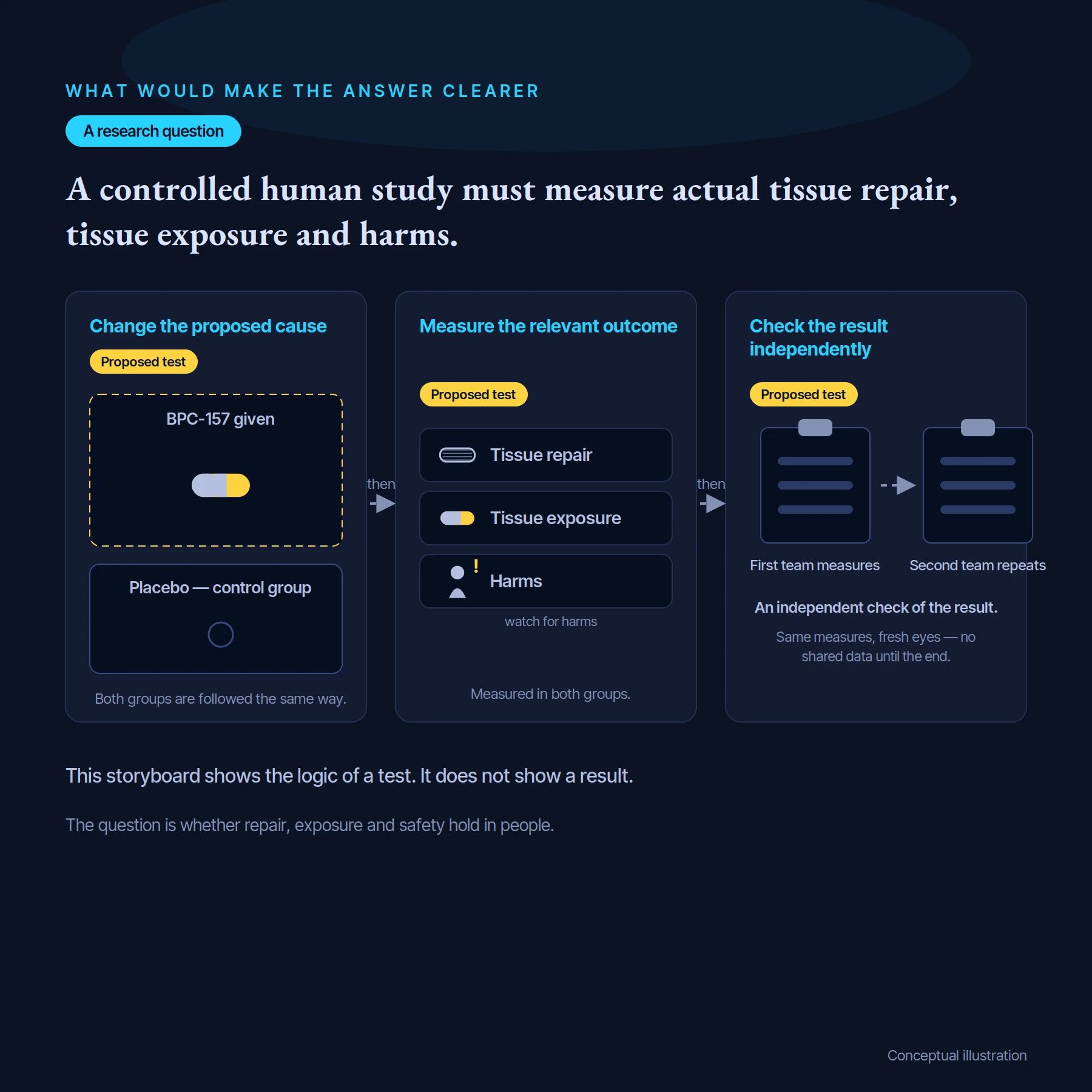
A controlled human study must measure actual tissue repair, tissue exposure and harms.
These illustrations show the key questions tested in the review. They are conceptual drawings, not microscope images or experimental results.
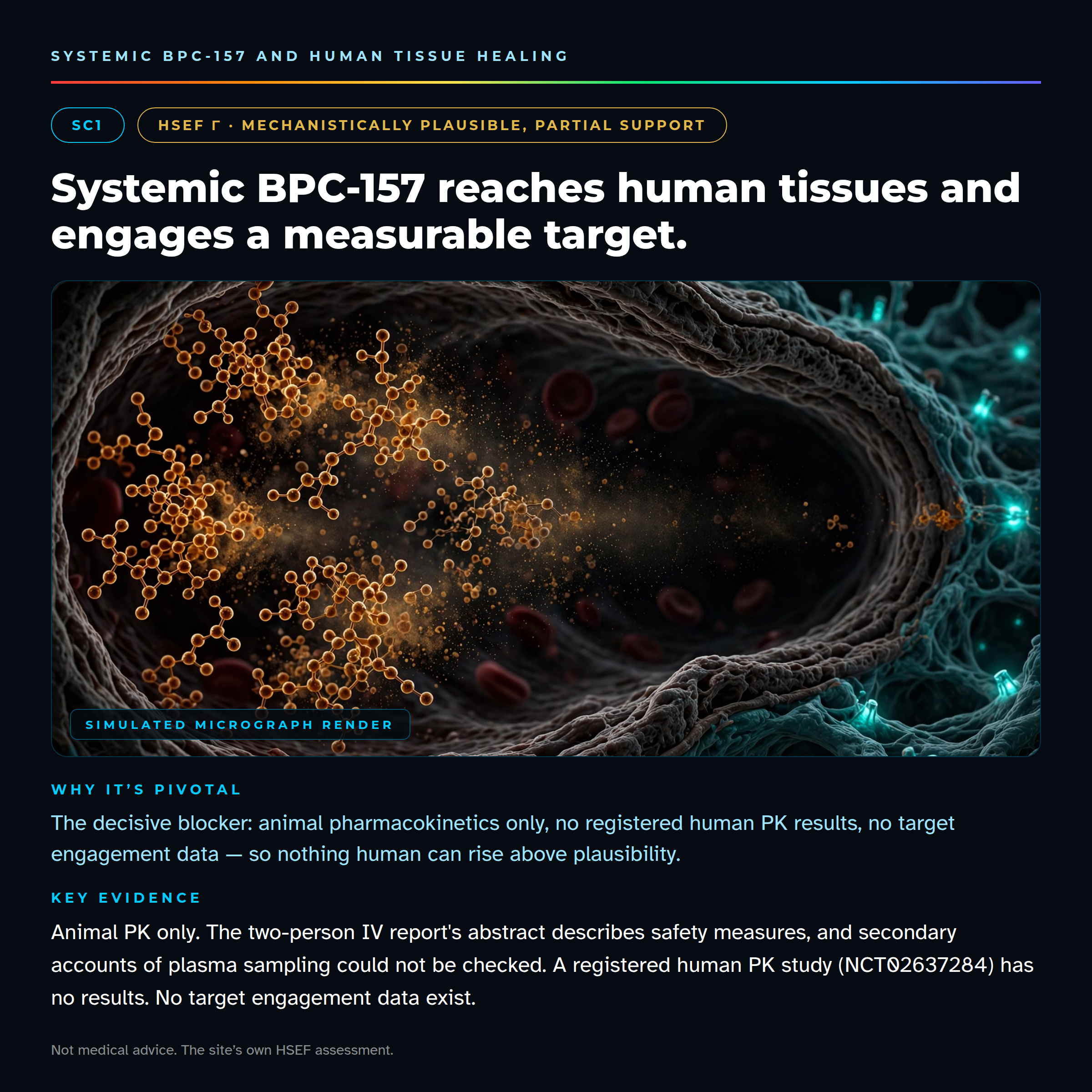
A defined systemic BPC-157 regimen produces interpretable human exposure and target engagement suitable for testing tissue healing.
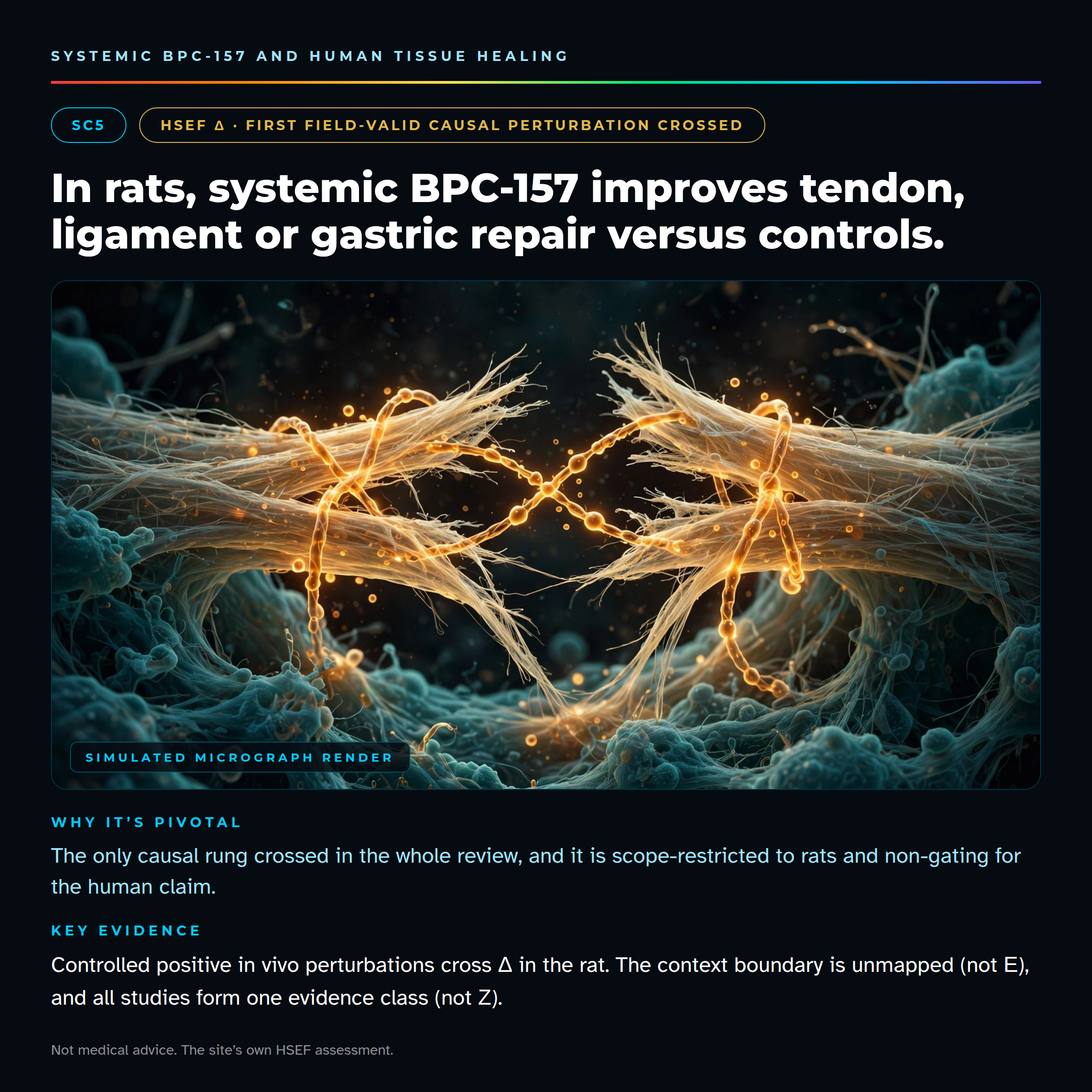
In rat injury models, systemically administered BPC-157 improves functional, biomechanical or histological repair of tendon, ligament or gastric mucosa compared with concurrent controls.
WHAT WOULD MAKE THE ANSWER CLEARER
A research question
A controlled human study must measure actual tissue repair, tissue exposure and harms.
then
then
Change the proposed cause
Proposed test
BPC-157 given
Placebo — control group
Both groups are followed the same way.
Measure the relevant outcome
Tissue repair
Tissue exposure
watch for harms
Harms
Measured in both groups.
Check the result independently
Proposed test
First team measures
Second team repeats
An independent check of the result.
Same measures, fresh eyes — no shared data until the end.
This storyboard shows the logic of a test. It does not show a result.
The question is whether repair, exposure and safety hold in people.
Conceptual illustration
A controlled human study must measure actual tissue repair, tissue exposure and harms.
Check that the intended change really happened.
Allow for other factors and compare with suitable controls.
Look for independent confirmation and the limits of the effect.
These are questions for research, not a claim that the proposed studies have already succeeded.
Proposed tests: 4 test design(s) are registered in the scorecard.
In plain terms, researchers would change the proposed cause, check that it changed as intended, then measure a meaningful outcome while controlling plausible alternatives. The result should be able to support or count against the claim—not only show that a pathway exists.
Study design: Randomize adults after standardized arthroscopic rotator-cuff repair to a fully characterized systemic BPC-157 product or matched placebo on top of the same rehabilitation protocol.
What would be measured: Serial MRI or quantitative ultrasound of tendon integrity and re-tear, blinded structural scoring, strength and validated function, human PK, target engagement, adverse events, and product-quality assays.
Important controls: Predefine lesion and repair class, surgical technique, rehabilitation, analgesia, rescue treatment, imaging time points, missing-data handling, and independent image analysis; verify comparator and enrollment fields before recruitment.
Result that would support the claim: A reproducible, clinically meaningful improvement in blinded structural healing with coherent exposure-response and functional concordance.
Result that would count against it: Adequate systemic exposure and target engagement without faster structural healing, or any apparent benefit confined to pain without tissue repair.
Study design: Randomize patients with MRI-confirmed acute grade II ligament injury to systemic BPC-157 or placebo with identical bracing and rehabilitation.
What would be measured: Serial quantitative MRI or ultrasound, instrumented laxity, return-to-function, re-injury, PK/target engagement, and safety.
Important controls: Stratify by ligament and injury grade before randomization, centralize imaging, blind outcome assessors, and prohibit local peptide co-interventions.
Result that would support the claim: Faster structural continuity and mechanical stability replicated in an independent trial.
Result that would count against it: No structural or mechanical advantage despite confirmed exposure, or benefit only in subjective symptoms.
Study design: In a defined gastrointestinal mucosal disease, randomize systemic BPC-157 or placebo on stable background care and separate the systemic regimen from any local luminal formulation.
What would be measured: Central blinded endoscopic and histological healing, clinical remission, durability after treatment, human PK, tissue target engagement, and safety.
Important controls: Use a validated endpoint, adequate duration, prespecified multiplicity and missing-data rules, stable concomitant therapy, and product identity/purity testing.
Result that would support the claim: A replicated systemic exposure-response with concordant endoscopic, histological, and clinical improvement.
Result that would count against it: No endoscopic or histological advantage with verified systemic exposure, even if symptoms or biomarkers improve.
Study design: A laboratory unconnected to the originating programme runs preregistered, adequately powered, blinded replications of the rat Achilles-transection and MCL-transection models with systemic BPC-157 versus vehicle.
What would be measured: Load to failure, stiffness, functional index, blinded histology and collagen organization at prespecified time points; full outcome reporting.
Important controls: Preregistered sample size and analysis plan; blinded allocation and assessment; characterized peptide identity and purity; vehicle control; both repaired and unrepaired tendon models.
Result that would support the claim: Reproduction of structural and biomechanical benefit outside the originating programme would raise SC5 confidence (it would not raise the human-scope letter).
Result that would count against it: Adequately powered null results across tendon and ligament models would lower SC5 and reinforce the Low confidence band.
Follow the studies, detailed comparisons and evidence ratings behind this guide.
Open the scientific review →