The question
Can restoring youthful gene-control patterns reverse normal ageing?
This is the specific idea being tested.
Can restoring youthful gene-control patterns reverse normal ageing?
What you need to knowChanging gene-control patterns may improve some measures, but reversing normal ageing through information restoration remains unproven.Relative explanatory fit: Alternative ranked ahead
Why the alternative fits better: Improvements after reprogramming do not by themselves identify which process caused the benefit.
Claim assessed: During normal mammalian aging, progressive loss of cell-type-specific epigenetic regulatory information is a primary rate-limiting cause of organismal functional decline; selectively restoring the prior youthful regulatory state, while retaining cell identity and without genotoxic selection, dedifferentiation, tumorigenesis, unrelated repair effects, and proliferative effects, should reproducibly reverse established aging phenotypes and extend healthspan.
Finding: Epigenetic states are causally manipulable and functional reversal is demonstrated in constrained mouse tissues, most convincingly aged retina. The evidence does not isolate progressive information loss from damage responses or establish restoration of a defined youthful state as the mediator, primary rate-limiting cause, or broadly replicated healthspan intervention.
Evidence scope: Primary mechanistic and intervention evidence through 2026-09-30. Full text was read wherever lawfully accessible; partial and abstract-only records are labeled. The attached HSEF v5.4 packet (SHA256 7E097D3D50D2068F68BDB1CD022DF4A045DAC46A9F25E51262EC7568E9DB11EB) was treated as methodology, not scientific evidence.
The grade applies to the stated claim. Model rankings and individual subclaim grades remain separate from the overall causal-evidence grade.
Full scientific assessment and references · Scorecard (JSON) · Review source (Markdown)
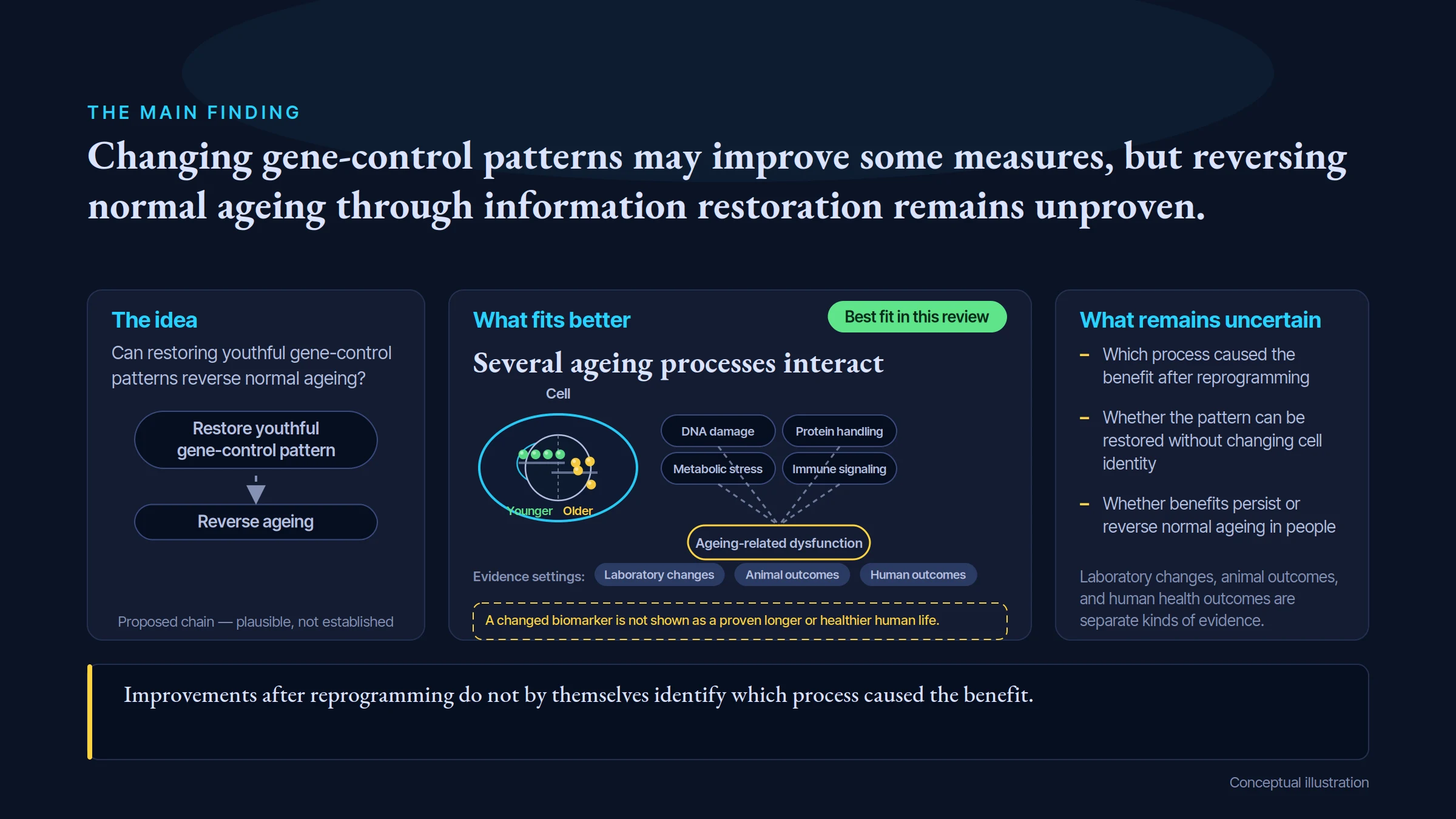
THE MAIN FINDING
Changing gene-control patterns may improve some measures, but reversing normal ageing through information restoration remains unproven.
The idea
Can restoring youthful gene-control patterns reverse normal ageing?
Restore youthful gene-control pattern
Reverse ageing
Proposed chain — plausible, not established
What fits better
Best fit in this review
Several ageing processes interact
Cell
Younger gene-control pattern
Older gene-control pattern
DNA damage
Protein handling
Metabolic stress
Immune signaling
Ageing-related dysfunction
Evidence settings
Laboratory changes
Animal outcomes
Human outcomes
A changed biomarker is not shown as a proven longer or healthier human life.
What remains uncertain
Which process caused the benefit after reprogramming
Whether the pattern can be restored without changing cell identity
Whether benefits persist or reverse normal ageing in people
Laboratory changes, animal outcomes, and human health outcomes are separate kinds of evidence.
Improvements after reprogramming do not by themselves identify which process caused the benefit.
Conceptual illustration
This is the specific idea being tested.
Improvements after reprogramming do not by themselves identify which process caused the benefit.
A higher rank means a better fit to the evidence in this comparison. It does not prove every part of the leading explanation.
The reviewed hypothesis ranks 3 among 5 models compared; 1 alternative model(s) hold first rank for this stated claim.
Claim under review: rank 3 among 5 compared models.
Leading explanation: Interacting hallmarks.
Position in this comparison: Between leading and last ranks.
The causal grade asks how well the stated causal claim is established. This comparison asks which of the assessed explanations fits the reviewed findings better. A leading explanation can remain unproven. Models can overlap or include the tested mechanism; an alternative ahead does not make that mechanism irrelevant. These ordinal ranks apply within this review; they do not measure the size of a difference or rank scientific strength across topics.
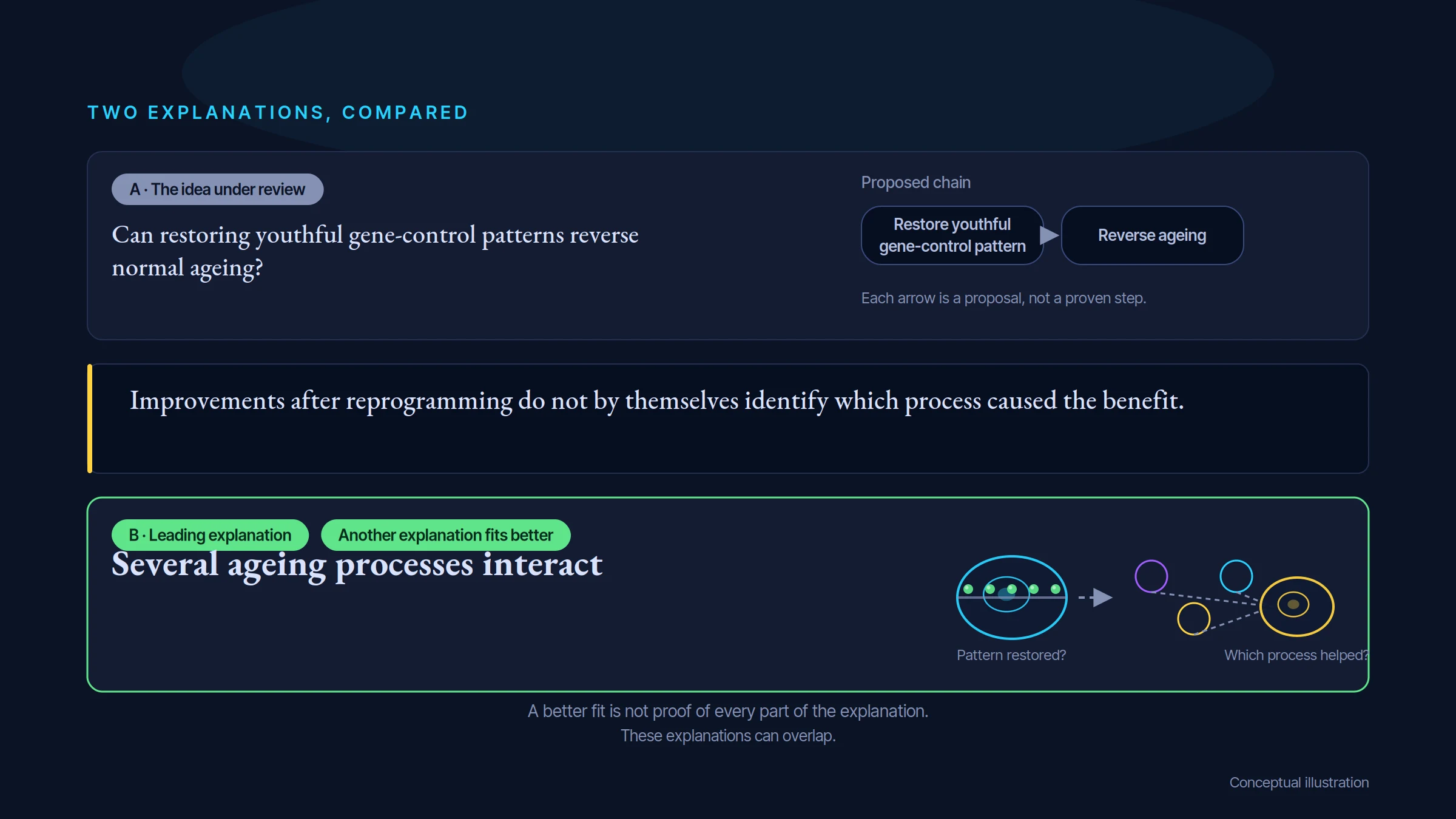
TWO EXPLANATIONS, COMPARED
A · The idea under review
Can restoring youthful gene-control patterns reverse normal ageing?
Proposed chain
Restore youthful gene-control pattern
Reverse ageing
Each arrow is a proposal, not a proven step.
Improvements after reprogramming do not by themselves identify which process caused the benefit.
B · Leading explanation
Another explanation fits better
Several ageing processes interact
Pattern restored?
Which process helped?
A better fit is not proof of every part of the explanation.
These explanations can overlap.
Conceptual illustration
Plausible, not established for the stated claim.
Improvements after reprogramming do not by themselves identify which process caused the benefit.
These explanations can overlap. Ranking their fit to the evidence is separate from deciding how firmly a cause has been established.
Rank 1: Interacting hallmarks —
Rank 2: Regeneration and state transition —
Rank 3: Epigenetic-information primacy —
Rank 4: Genotoxic trauma and survivorship —
Rank 5: Clock and composition —
Evidence rating: Γ · High confidence. How the evidence was assessed.
Improvements after reprogramming do not by themselves identify which process caused the benefit.
The work is a research programme, not an available anti-ageing treatment. It motivates experiments that must separate genuine restoration from stress responses, cell selection, regeneration, or measurement changes, and then test durability and cancer risk. For now, it does not justify clinics or products claiming to reset biological age, reverse ageing, or replace prevention and care for diseases that become more common with age.
Look for the proposed factor and the outcome, in the people or systems covered by the claim.
Several ageing processes interact. Improvements after reprogramming do not by themselves identify which process caused the benefit.
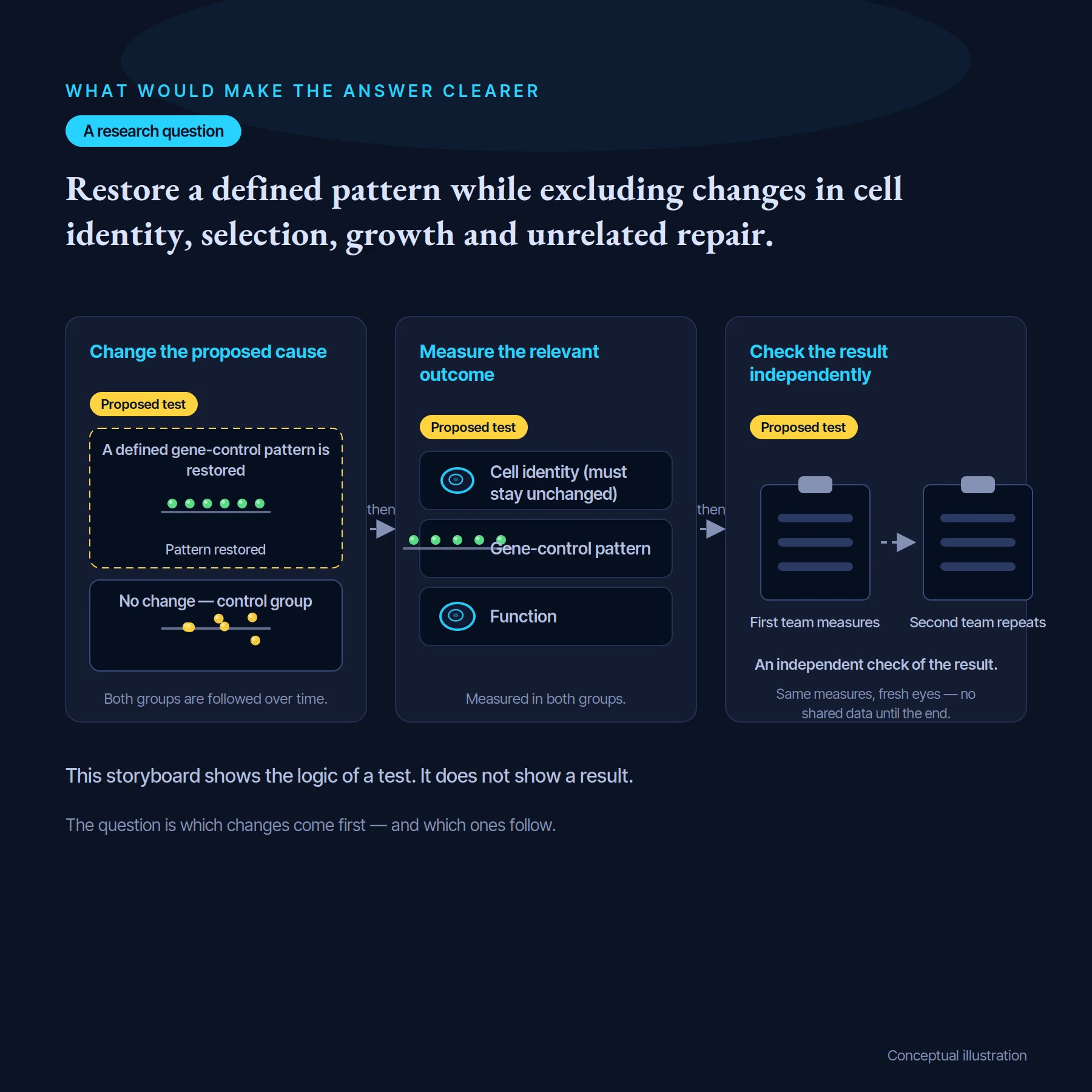
Restore a defined pattern while excluding changes in cell identity, selection, growth and unrelated repair.
These illustrations show the key questions tested in the review. They are conceptual drawings, not microscope images or experimental results.
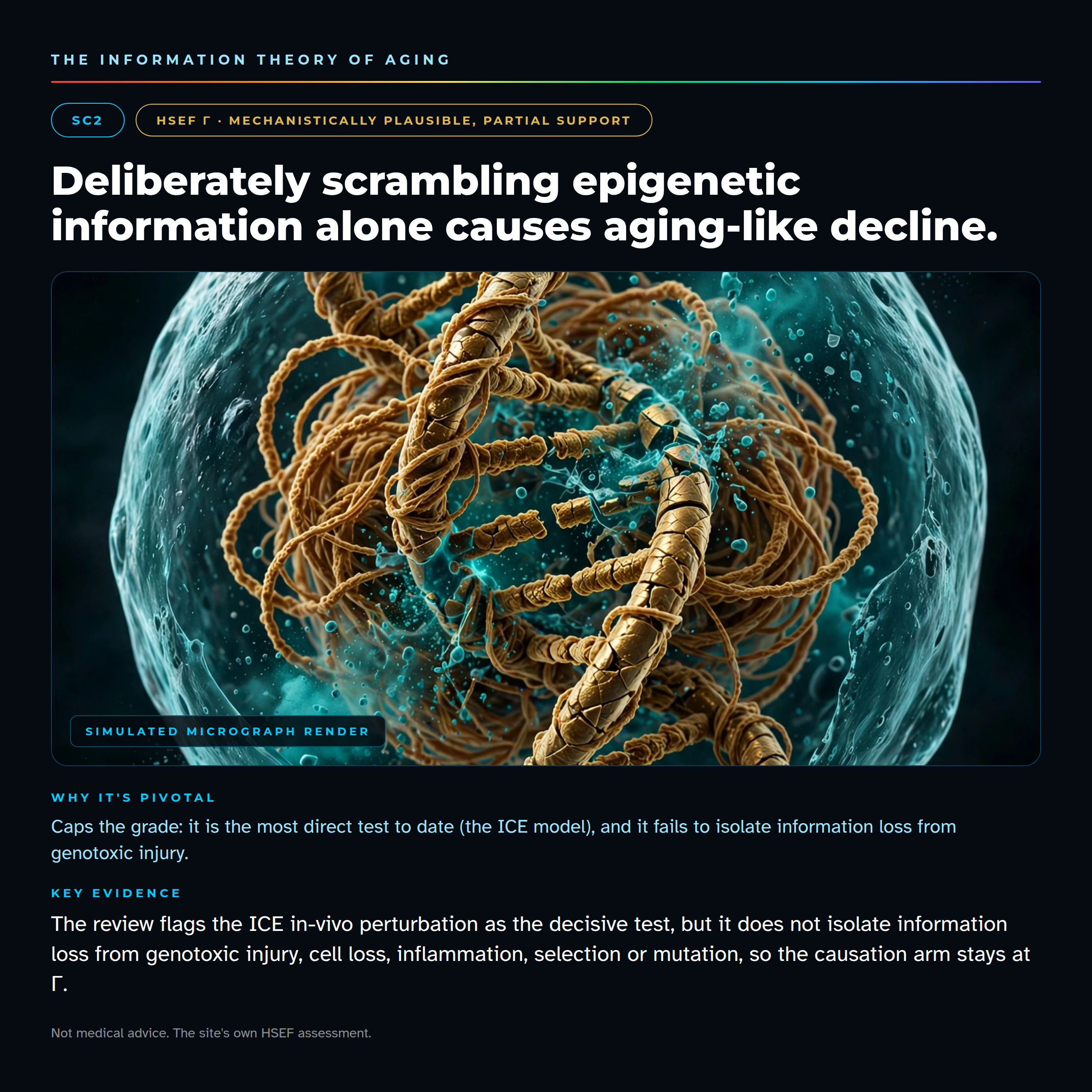
Experimentally induced loss or scrambling of epigenetic information is sufficient to cause aging-like functional decline independently of genotoxic injury, cell loss, inflammation, selection, and mutation.
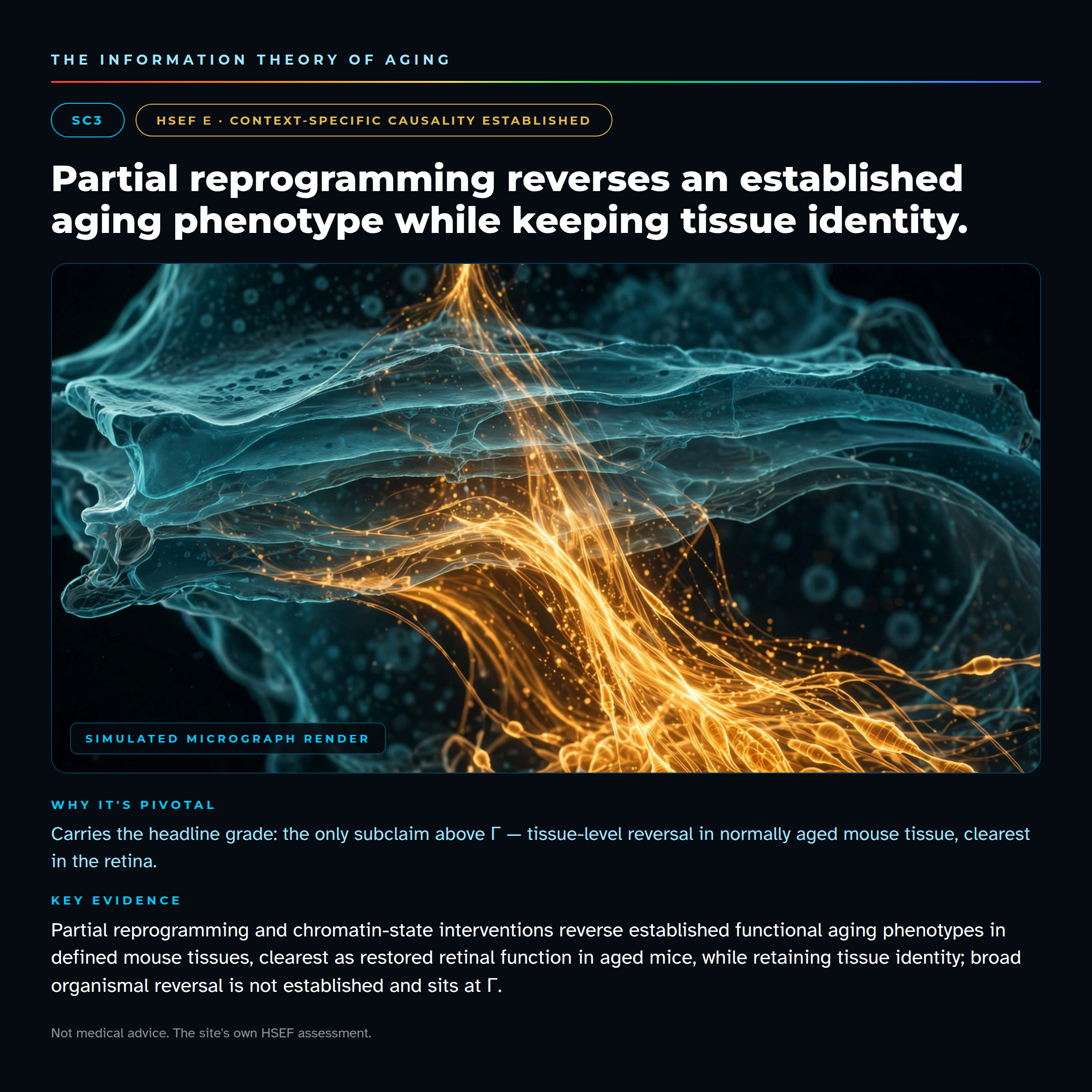
Partial reprogramming or another chromatin-state intervention reverses an established functional aging phenotype while retaining tissue identity.
WHAT WOULD MAKE THE ANSWER CLEARER
A research question
Restore a defined pattern while excluding changes in cell identity, selection, growth and unrelated repair.
then
then
Change the proposed cause
Proposed test
A defined gene-control pattern is restored
Pattern restored
No change — control group
Both groups are followed over time.
Measure the relevant outcome
Cell identity (must stay unchanged)
Gene-control pattern
Function
Measured in both groups.
Check the result independently
First team measures
Second team repeats
An independent check of the result.
Same measures, fresh eyes — no shared data until the end.
This storyboard shows the logic of a test. It does not show a result.
The question is which changes come first — and which ones follow.
Conceptual illustration
Restore a defined pattern while excluding changes in cell identity, selection, growth and unrelated repair.
Check that the intended change really happened.
Allow for other factors and compare with suitable controls.
Look for independent confirmation and the limits of the effect.
These are questions for research, not a claim that the proposed studies have already succeeded.
Proposed tests: 3 test design(s) are registered in the scorecard.
In plain terms, researchers would change the proposed cause, check that it changed as intended, then measure a meaningful outcome while controlling plausible alternatives. The result should be able to support or count against the claim—not only show that a pathway exists.
Result that would support the claim: State-specific decline followed by functional rescue when the same state is restored, without injury or selection.
Result that would count against it: Molecular state change without phenotype, or phenotype explained by damage, cell loss, inflammation, or altered cell composition.
Result that would support the claim: Functional benefit follows the targeted state, disappears when restoration is blocked, and is rescued by the selective rewrite.
Result that would count against it: OSK benefit persists when the proposed state restoration is prevented, or selective restoration moves clocks without function.
Result that would support the claim: Concordant healthspan benefit with acceptable pathology and a prespecified state-function relationship across species.
Result that would count against it: No replicated healthspan benefit, benefit limited to molecular clocks, or unacceptable neoplasia and organ toxicity.
Follow the studies, detailed comparisons and evidence ratings behind this guide.
Open the scientific review →