The question
Is lingering virus or viral material the main cause of Long COVID?
This is the specific idea being tested.
Is lingering virus or viral material the main cause of Long COVID?
What you need to knowLingering viral material may contribute, but several lasting post-infection processes fit the varied symptoms better.Relative explanatory fit: Alternative ranked ahead
Why the alternative fits better: Immune, blood-vessel, nerve and tissue-injury processes differ across symptom patterns. One reservoir explanation does not cover them all.
Claim assessed: Persistent SARS-CoV-2 antigen or RNA in tissue reservoirs is a primary cause of post-acute COVID-19 symptoms.
Finding: Overall Γ follows SC3. Human tissue associations and mechanistic models supply partial support, but primary clinical maintenance by persistent SARS-CoV-2 has not been identified. Antiviral nulls are important counterevidence to accessible replication, not evidence that every tissue reservoir was eliminated.
Evidence scope: 56 primary reports; literature cutoff 2026-10-09; source examination UTC date 2026-10-10; bounded critical review, not exhaustive systematic review.
The grade applies to the stated claim. Model rankings and individual subclaim grades remain separate from the overall causal-evidence grade.
Full scientific assessment and references · Scorecard (JSON) · Review source (Markdown)
THE MAIN FINDING
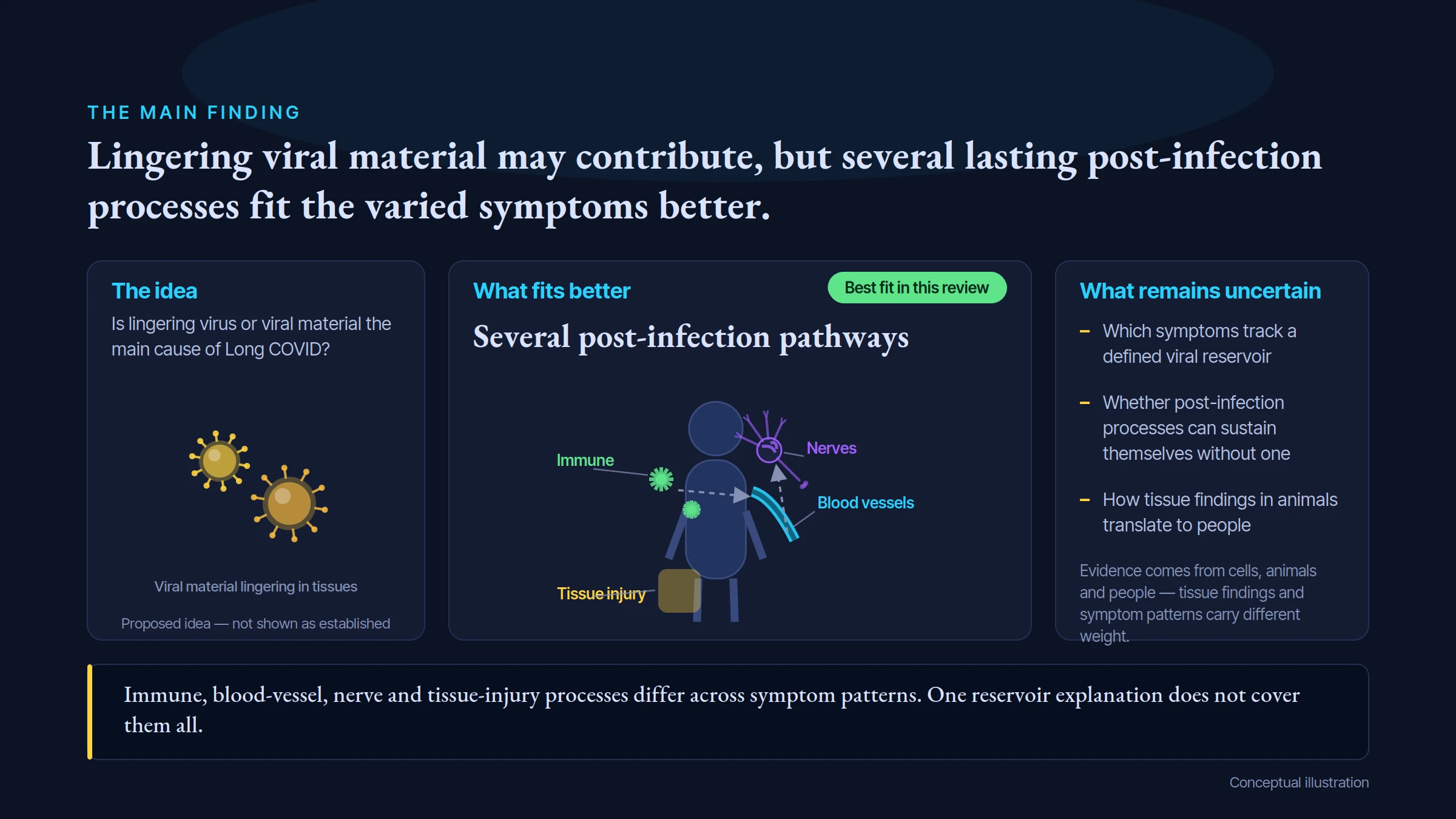
Lingering viral material may contribute, but several lasting post-infection processes fit the varied symptoms better.
The idea
Is lingering virus or viral material the main cause of Long COVID?
Viral material lingering in tissues
Proposed idea — not shown as established
What fits better
Best fit in this review
Several post-infection pathways
Immune processes
Blood-vessel processes
Nerve processes
Tissue-injury processes
What remains uncertain
Which symptoms track a defined viral reservoir
Whether post-infection processes can sustain themselves without one
How tissue findings in animals translate to people
Evidence comes from cells, animals and people — tissue findings and symptom patterns carry different weight.
Immune, blood-vessel, nerve and tissue-injury processes differ across symptom patterns. One reservoir explanation does not cover them all.
Conceptual illustration
This is the specific idea being tested.
Immune, blood-vessel, nerve and tissue-injury processes differ across symptom patterns. One reservoir explanation does not cover them all.
A higher rank means a better fit to the evidence in this comparison. It does not prove every part of the leading explanation.
The reviewed hypothesis ranks 2 among 4 models compared; 1 alternative model(s) hold first rank for this stated claim.
Claim under review: rank 2 among 4 compared models.
Leading explanation: Heterogeneous post-infection maintenance pathways.
Position in this comparison: Next after leading rank.
The causal grade asks how well the stated causal claim is established. This comparison asks which of the assessed explanations fits the reviewed findings better. A leading explanation can remain unproven. Models can overlap or include the tested mechanism; an alternative ahead does not make that mechanism irrelevant. These ordinal ranks apply within this review; they do not measure the size of a difference or rank scientific strength across topics.
TWO EXPLANATIONS, COMPARED
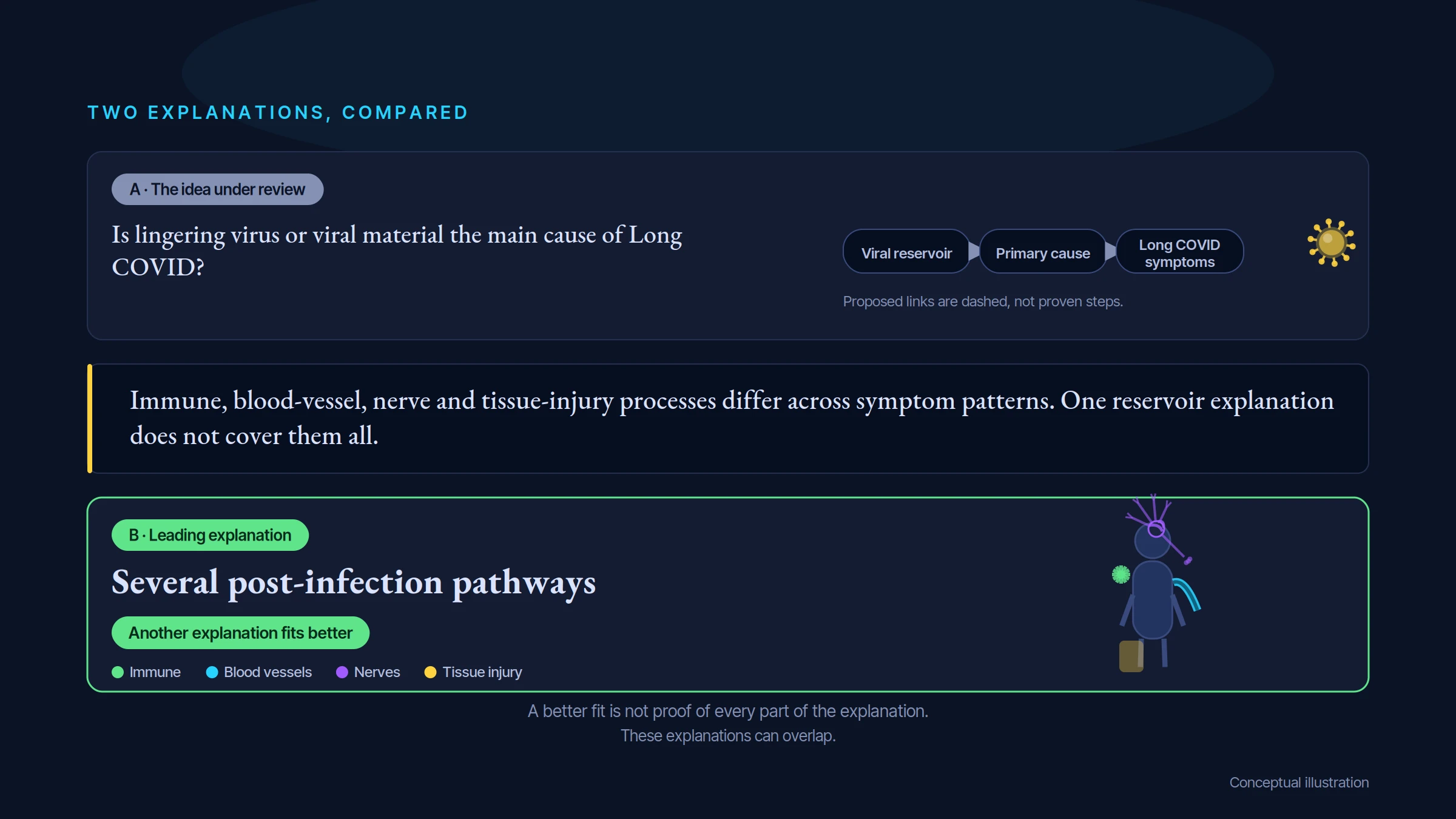
A · The idea under review
Is lingering virus or viral material the main cause of Long COVID?
Viral reservoir
Primary cause
Long COVID symptoms
Proposed links are dashed, not proven steps.
Immune, blood-vessel, nerve and tissue-injury processes differ across symptom patterns. One reservoir explanation does not cover them all.
B · Leading explanation
Several post-infection pathways
Another explanation fits better
Immune
Blood vessels
Nerves
Tissue injury
A better fit is not proof of every part of the explanation.
These explanations can overlap.
Conceptual illustration
Plausible, not established for the stated claim.
Immune, blood-vessel, nerve and tissue-injury processes differ across symptom patterns. One reservoir explanation does not cover them all.
These explanations can overlap. Ranking their fit to the evidence is separate from deciding how firmly a cause has been established.
Rank 1: Heterogeneous post-infection maintenance pathways — Immune, vascular, neural and tissue-injury pathways may contribute differently across phenotypes.
Rank 2: Viral-reservoir primacy — Persistent viral material maintains most symptoms through continued immune signaling.
Rank 3: Autonomous postinfectious immune maintenance — Immune pathology may persist after the initiating virus is cleared.
Rank 4: Residual injury with impaired repair — Microvascular, muscle and small-fiber injuries may maintain selected functional deficits.
Evidence rating: Γ · Moderate confidence. How the evidence was assessed.
Immune, blood-vessel, nerve and tissue-injury processes differ across symptom patterns. One reservoir explanation does not cover them all.
Overall Γ follows SC3. Human tissue associations and mechanistic models supply partial support, but primary clinical maintenance by persistent SARS-CoV-2 has not been identified. Antiviral nulls are important counterevidence to accessible replication, not evidence that every tissue reservoir was eliminated.
Look for the proposed factor and the outcome, in the people or systems covered by the claim.
Several post-infection pathways. Immune, blood-vessel, nerve and tissue-injury processes differ across symptom patterns. One reservoir explanation does not cover them all.
Measure a defined reservoir and symptoms, testing whether selective reduction improves matching symptoms.
WHAT WOULD MAKE THE ANSWER CLEARER
A research question
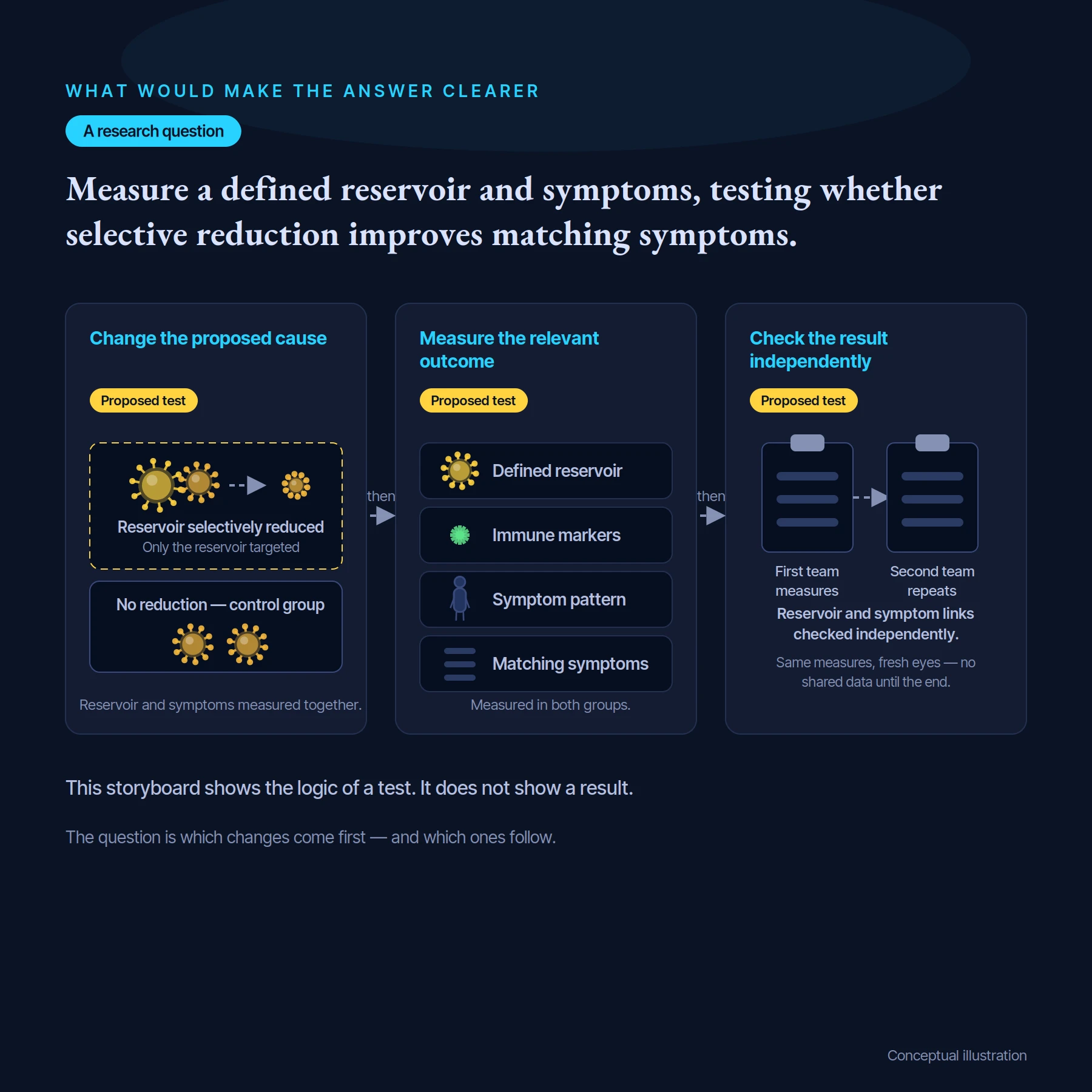
Measure a defined reservoir and symptoms, testing whether selective reduction improves matching symptoms.
then
then
Change the proposed cause
Proposed test
Reservoir selectively reduced
Only the reservoir targeted
No reduction — control group
Reservoir and symptoms measured together.
Measure the relevant outcome
Proposed test
Defined reservoir
Immune markers
Symptom pattern
Matching symptoms
Measured in both groups.
Check the result independently
Proposed test
First team measures
Second team repeats
Reservoir and symptom links checked independently.
Same measures, fresh eyes — no shared data until the end.
This storyboard shows the logic of a test. It does not show a result.
The question is which changes come first — and which ones follow.
Conceptual illustration
Measure a defined reservoir and symptoms, testing whether selective reduction improves matching symptoms.
Check that the intended change really happened.
Allow for other factors and compare with suitable controls.
Look for independent confirmation and the limits of the effect.
These are questions for research, not a claim that the proposed studies have already succeeded.
Proposed tests: 1 test design(s) are registered in the scorecard.
In plain terms, researchers would change the proposed cause, check that it changed as intended, then measure a meaningful outcome while controlling plausible alternatives. The result should be able to support or count against the claim—not only show that a pathway exists.
Study design: Randomize a reservoir-directed intervention in a prespecified persistent-material phenotype, quantify relevant tissue target engagement before symptom change, and compare with matched placebo and infection-recovered controls.
What would be measured: Longitudinal tissue viral material/replication assays, immune mediators and prespecified functional symptom trajectories
Important controls: Blinding integrity, relevant compartment sampling, reinfection monitoring and unchanged supportive treatment
Result that would support the claim: Verified specific reservoir reduction precedes clinically meaningful improvement and predicted immune normalization
Result that would count against it: Verified adequate relevant-reservoir clearance leaves the predicted symptoms unchanged over the registered horizon
Follow the studies, detailed comparisons and evidence ratings behind this guide.
Open the scientific review →