The question
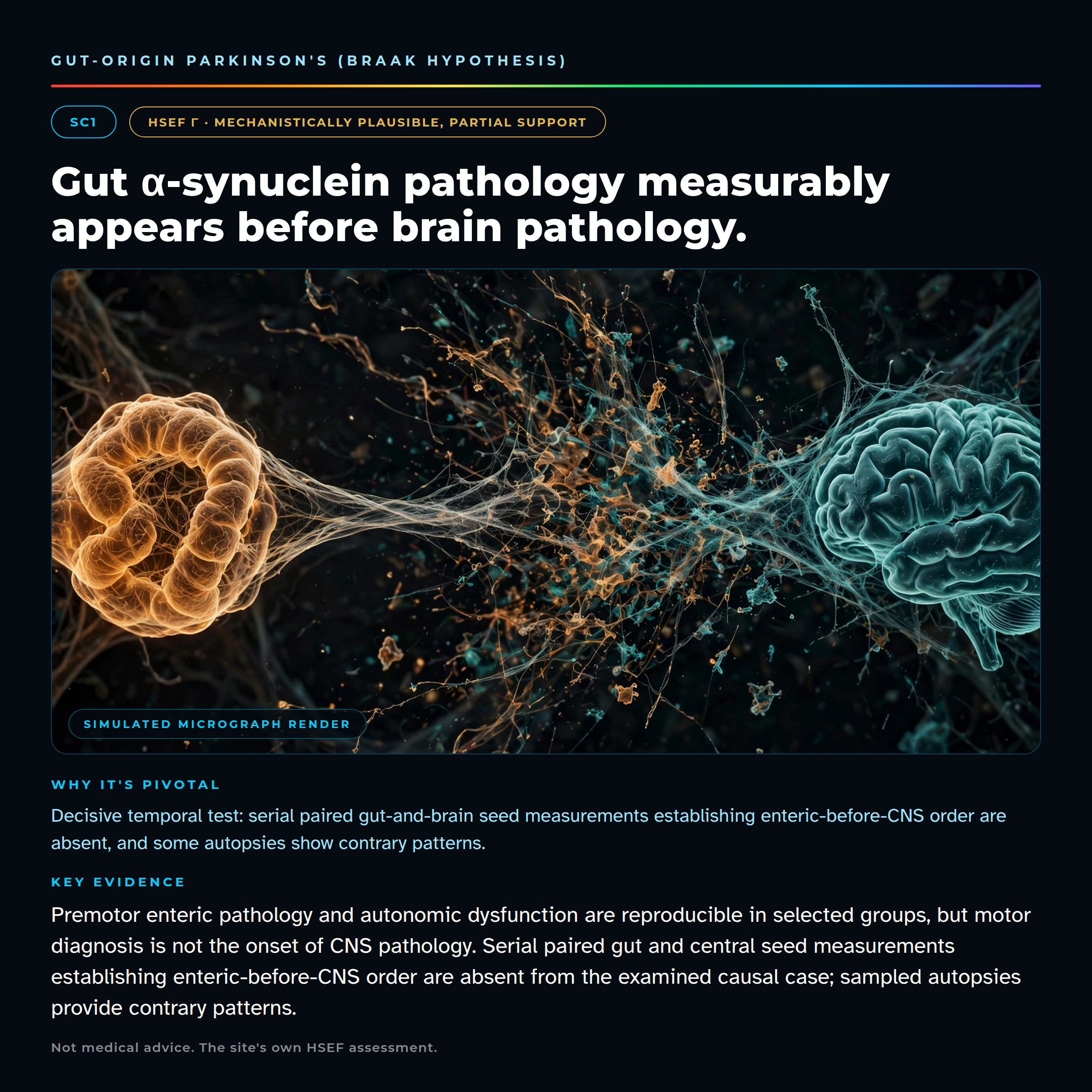
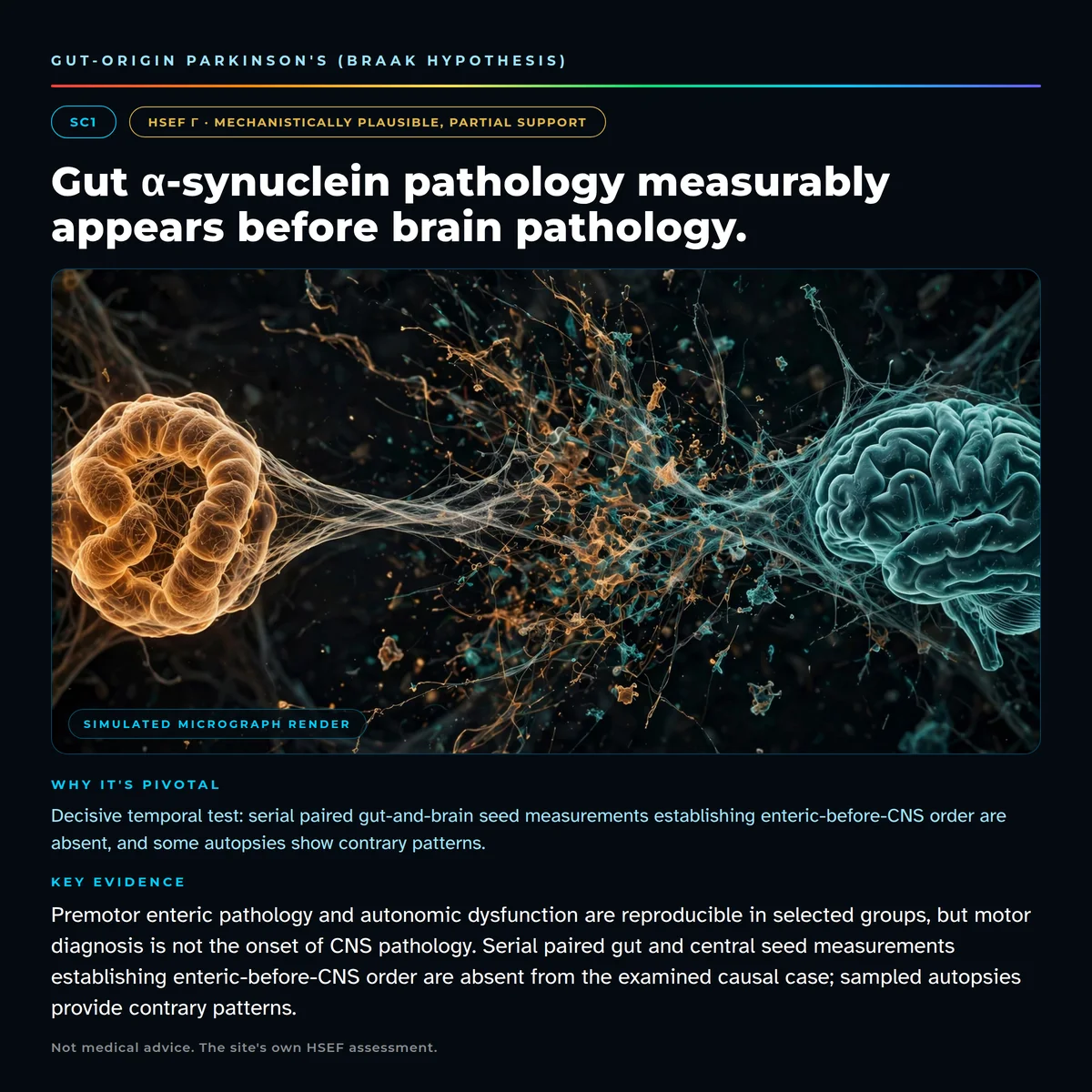
Does Parkinson's usually begin in the gut and travel to the brain?
This is the specific idea being tested.
Does Parkinson's usually begin in the gut and travel to the brain?
What you need to knowA gut-first route may fit some people, but a mixture of gut-first and brain-first routes fits better.Relative explanatory fit: Alternative ranked ahead
Why the alternative fits better: Some people show early problems mainly outside the brain; others show them mainly in the brain. One route does not explain both.
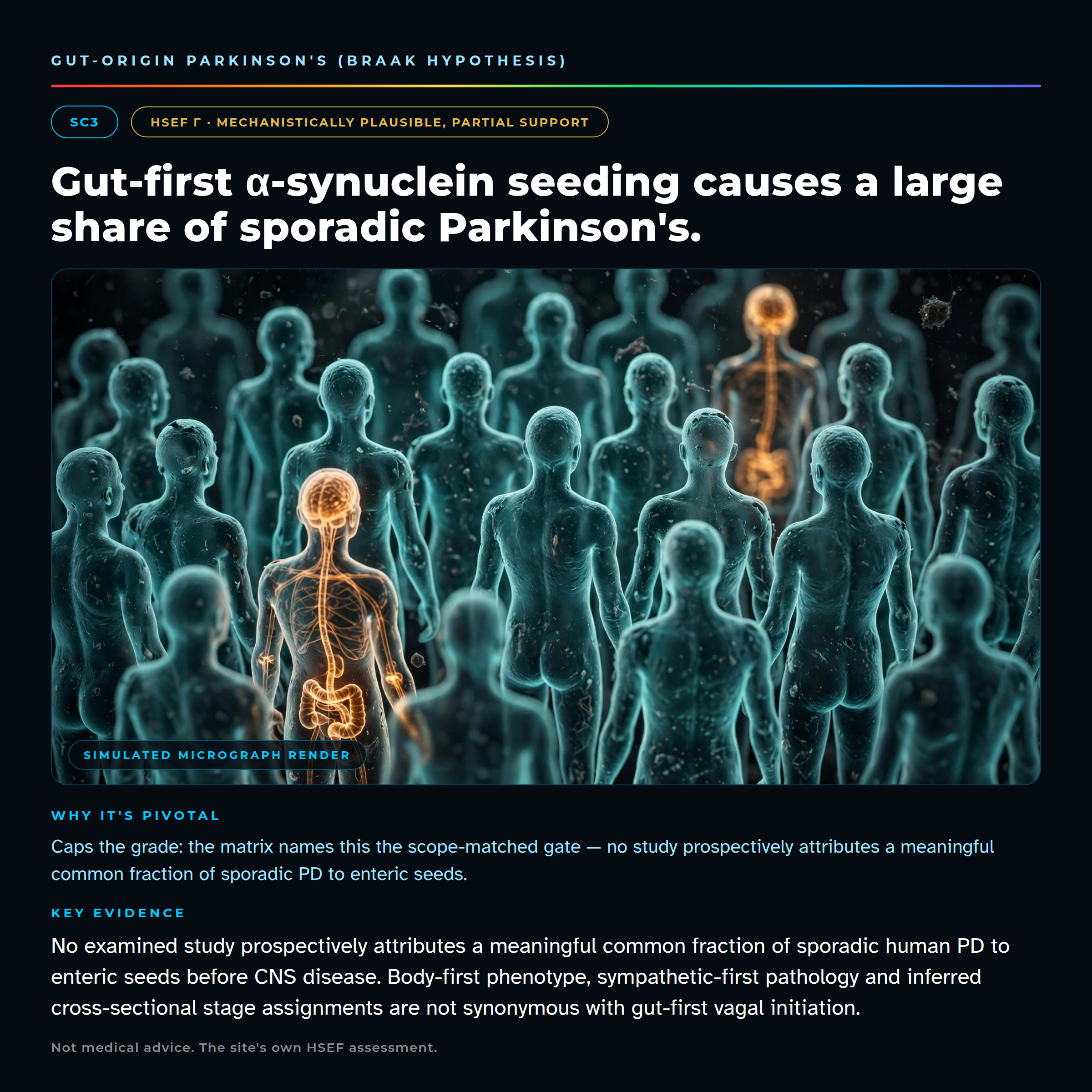
Claim assessed: Sporadic Parkinson disease commonly begins with enteric alpha-synuclein pathology that ascends through vagal connections to the CNS and drives nigrostriatal neurodegeneration.
Finding: Γ for the registered common sporadic enteric-vagal initiation claim. Scope-matched aggregation uses SC3; primary-subclaim and weakest-link sensitivities also return Γ. The assembled evidence exceeds association alone through timing, animal pathway tests and human natural experiments, but does not cross the full-scope initiation dependency threshold. Conditional transport capability is established in particular engineered models, and human body-first phenotypes are separately supported; neither is silently substituted for common natural gut initiation.
Evidence scope: 69 primary reports; literature cutoff 2026-10-05; source examination UTC date 2026-10-06; bounded critical review, not exhaustive systematic review.
The grade applies to the stated claim. Model rankings and individual subclaim grades remain separate from the overall causal-evidence grade.
Full scientific assessment and references · Scorecard (JSON) · Review source (Markdown)
THE MAIN FINDING
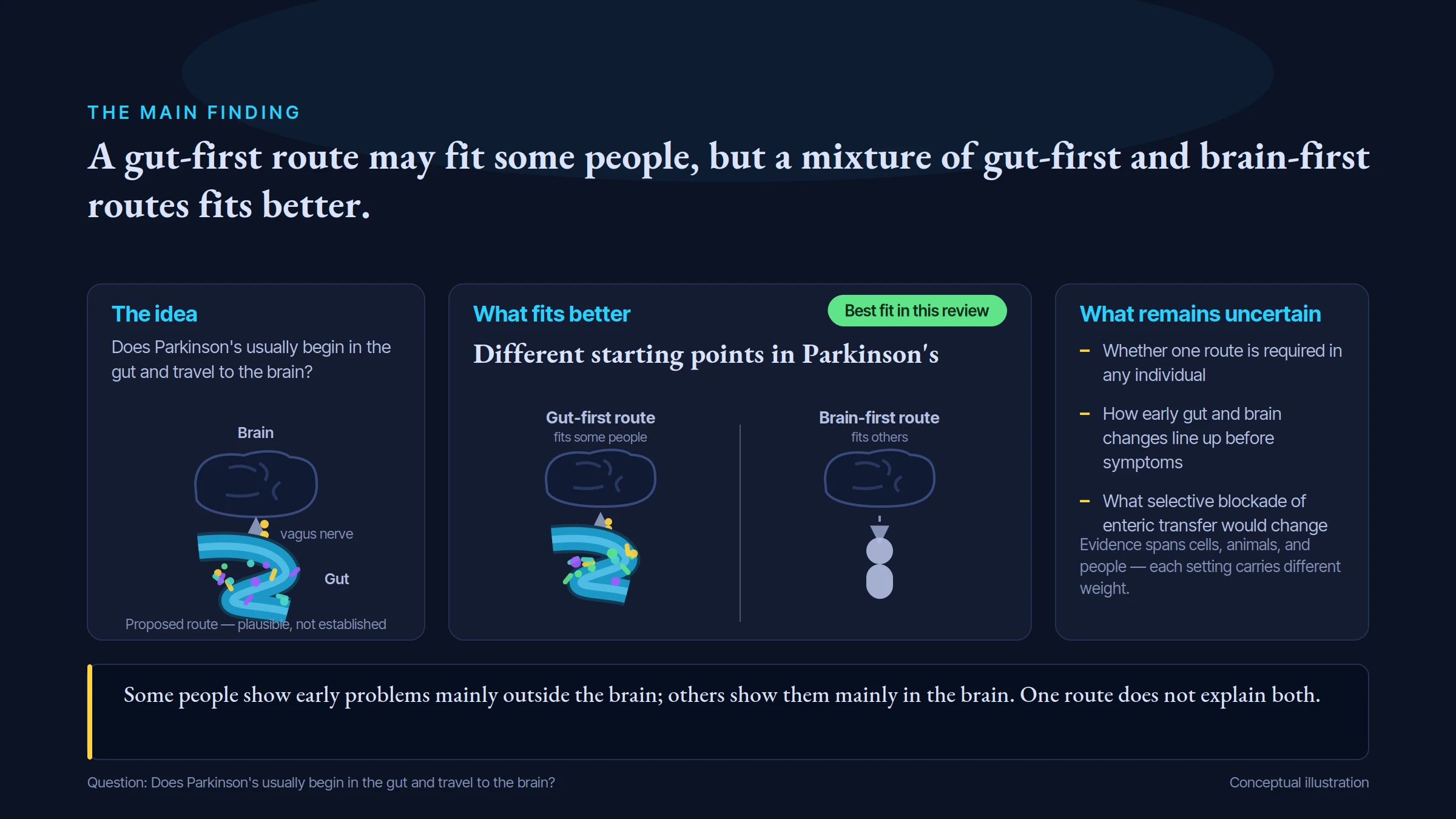
A gut-first route may fit some people, but a mixture of gut-first and brain-first routes fits better.
The idea
Does Parkinson's usually begin in the gut and travel to the brain?
Brain
vagus nerve
Gut
Proposed route — plausible, not established
What fits better
Best fit in this review
Different starting points in Parkinson's
Gut-first route
fits some people
Brain-first route
fits others
What remains uncertain
Whether one route is required in any individual
How early gut and brain changes line up before symptoms
What selective blockade of enteric transfer would change
Evidence spans cells, animals, and people — each setting carries different weight.
Some people show early problems mainly outside the brain; others show them mainly in the brain. One route does not explain both.
Conceptual illustration
Question: Does Parkinson's usually begin in the gut and travel to the brain?
This is the specific idea being tested.
Some people show early problems mainly outside the brain; others show them mainly in the brain. One route does not explain both.
A higher rank means a better fit to the evidence in this comparison. It does not prove every part of the leading explanation.
The reviewed hypothesis ranks 4 among 5 models compared; 1 alternative model(s) hold first rank for this stated claim.
Claim under review: rank 4 among 5 compared models.
Leading explanation: Heterogeneous body-first and brain-first trajectories.
Position in this comparison: Between leading and last ranks.
The causal grade asks how well the stated causal claim is established. This comparison asks which of the assessed explanations fits the reviewed findings better. A leading explanation can remain unproven. Models can overlap or include the tested mechanism; an alternative ahead does not make that mechanism irrelevant. These ordinal ranks apply within this review; they do not measure the size of a difference or rank scientific strength across topics.
TWO EXPLANATIONS, COMPARED
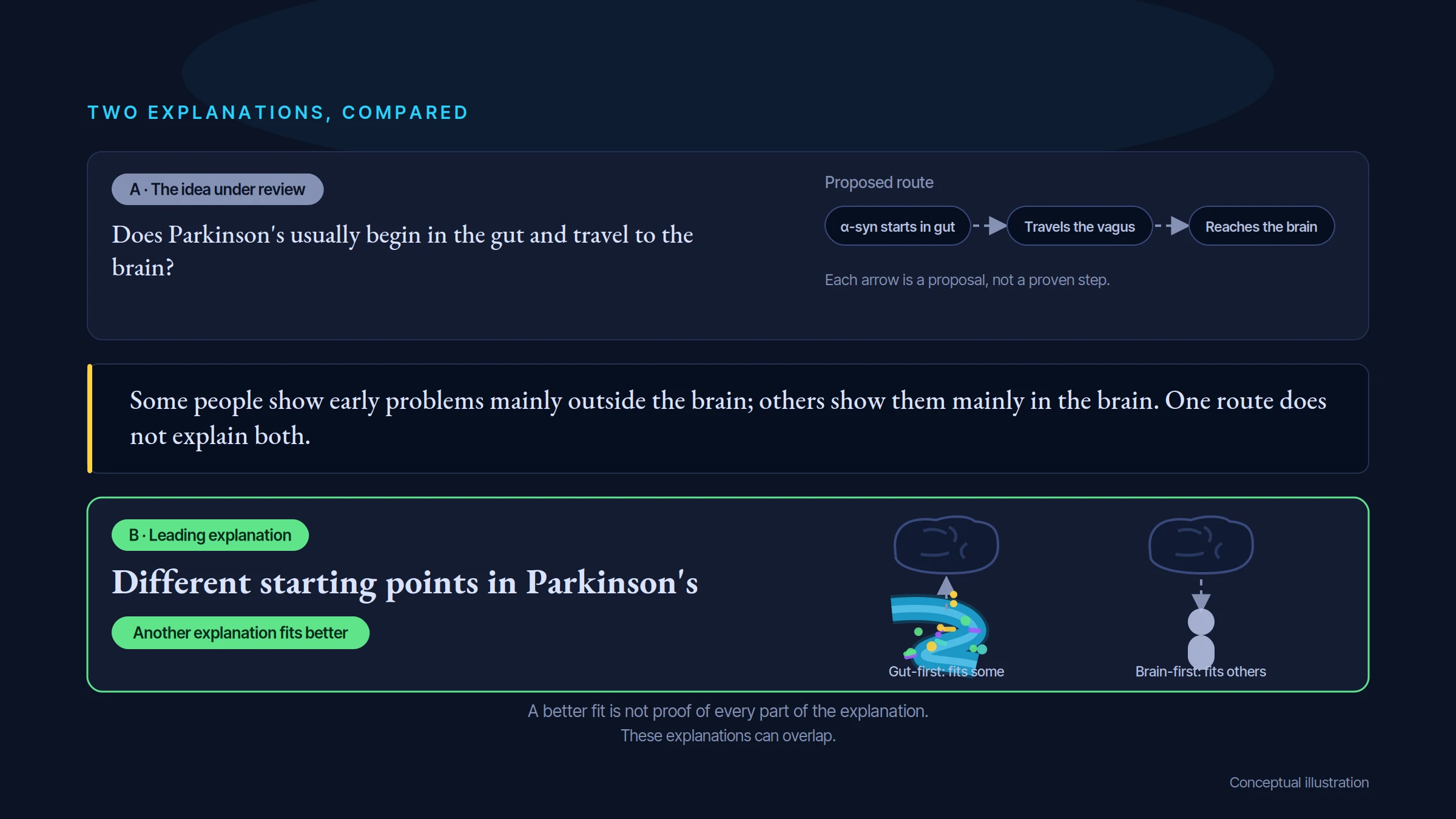
A · The idea under review
Does Parkinson's usually begin in the gut and travel to the brain?
Proposed route
α-syn starts in gut
Travels the vagus
Reaches the brain
Each arrow is a proposal, not a proven step.
Some people show early problems mainly outside the brain; others show them mainly in the brain. One route does not explain both.
B · Leading explanation
Different starting points in Parkinson's
Another explanation fits better
Gut-first: fits some
Brain-first: fits others
A better fit is not proof of every part of the explanation.
These explanations can overlap.
Conceptual illustration
Plausible, not established for the stated claim.
Some people show early problems mainly outside the brain; others show them mainly in the brain. One route does not explain both.
These explanations can overlap. Ranking their fit to the evidence is separate from deciding how firmly a cause has been established.
Rank 1: Heterogeneous body-first and brain-first trajectories — Different individuals have peripheral-predominant or brain-predominant early dysfunction.
Rank 2: Brain-first descending dissemination — Central pathology can precede peripheral involvement and spread outward.
Rank 3: Indirect microbial and immune risk modification — Gut perturbations can affect nigral vulnerability through metabolites, barrier and immune pathways.
Rank 4: Common enteric-vagal origin — Enteric seeds usually initiate sporadic PD and ascend to cause nigral degeneration.
Rank 5: Parallel multi-organ vulnerability — A shared systemic/genetic insult affects gut and brain without obligatory seed transfer.
Evidence rating: Γ · Moderate confidence. How the evidence was assessed.
Some people show early problems mainly outside the brain; others show them mainly in the brain. One route does not explain both.
This is an assessment of a causal explanation, not proof that a particular supplement, diet, test, or treatment improves health. A treatment claim needs studies that test the intervention in people and measure meaningful benefits and harms. These findings can help frame research and informed clinical questions, but they do not identify what is right for one person.
Look for the proposed factor and the outcome, in the people or systems covered by the claim.
Different starting points in Parkinson's. Some people show early problems mainly outside the brain; others show them mainly in the brain. One route does not explain both.
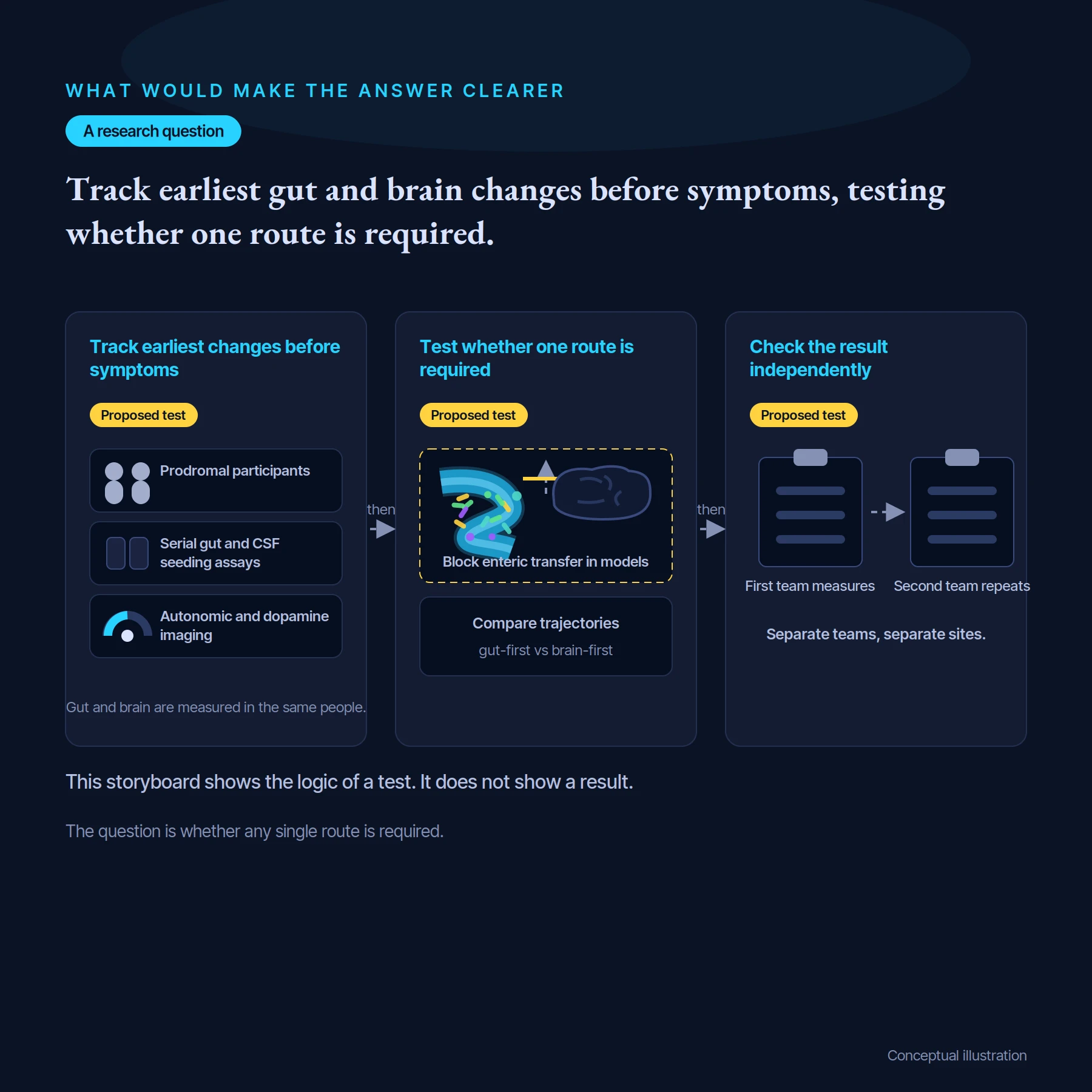
Track earliest gut and brain changes before symptoms, testing whether one route is required.
These illustrations show the key questions tested in the review. They are conceptual drawings, not microscope images or experimental results.
WHAT WOULD MAKE THE ANSWER CLEARER
A research question
Track earliest gut and brain changes before symptoms, testing whether one route is required.
then
then
Track earliest changes before symptoms
Proposed test
Prodromal participants
Serial gut and CSF seeding assays
Autonomic and dopamine imaging
Gut and brain are measured in the same people.
Test whether one route is required
Proposed test
Block enteric transfer in models
Compare trajectories
gut-first vs brain-first
Check the result independently
Proposed test
First team measures
Second team repeats
Separate teams, separate sites.
This storyboard shows the logic of a test. It does not show a result.
The question is whether any single route is required.
Conceptual illustration
Track earliest gut and brain changes before symptoms, testing whether one route is required.
Check that the intended change really happened.
Allow for other factors and compare with suitable controls.
Look for independent confirmation and the limits of the effect.
These are questions for research, not a claim that the proposed studies have already succeeded.
Proposed tests: 1 test design(s) are registered in the scorecard.
In plain terms, researchers would change the proposed cause, check that it changed as intended, then measure a meaningful outcome while controlling plausible alternatives. The result should be able to support or count against the claim—not only show that a pathway exists.
Study design: Enroll representative prodromal participants before RBD/motor diagnosis, pair serial compartment-specific gut and CSF seeding with autonomic/dopamine imaging, and quantify predefined origin classes. In native disease-relevant models, selectively block enteric pathological-alpha-synuclein transfer while preserving vagal physiology and metabolite/immune signals, with matched restoration and independent replication.
What would be measured: Compartment-specific first positivity, validated detection limits, later nigral neuronal survival and clinical progression, plus a population-attributable gut-origin fraction
Important controls: Brain-/sympathetic-first comparators; blinded repeated assays; transit/medication/diet adjustment; normal-alpha-synuclein controls; vagal-function preservation; immune/metabolite controls; matched species-specific restoration
Result that would support the claim: Enteric seeds precede central involvement in a substantial prespecified fraction; selective mediator interruption prevents subsequent central spread and degeneration with restoration restoring the sequence
Result that would count against it: Central seeds precede gut signals, most peripheral-first cases arise elsewhere, or verified enteric-transfer blockade leaves degeneration unchanged while altering only gut function
Follow the studies, detailed comparisons and evidence ratings behind this guide.
Open the scientific review →