The question
Is depression caused by low serotonin, with antidepressants correcting the shortage?
This is the specific idea being tested.
Is depression caused by low serotonin, with antidepressants correcting the shortage?
What you need to knowAntidepressants can help without proving depression is caused by a serotonin shortage. An inflammation-related explanation ranks higher in this review.Relative explanatory fit: Alternative ranked ahead
Why the alternative fits better: Depression can accompany inflammatory illness, and inflammatory signals can bring on symptoms. This fits findings a simple shortage model misses.
Claim assessed: Deficient serotonin neurotransmission is a proximate cause of major depressive disorder, and SSRIs relieve major depressive disorder by correcting that serotonin deficit.
Finding: Weakest-link over SC1=Γ, SC2=Γ, SC3=Γ, SC4=Δ gives Γ. The mechanism is plausible and has partial human support - an unblinded challenge study, the pharmacology of the drugs themselves, and one positive human mediator manipulation; what has not been shown is the endogenous, disease-relevant causal dependency the claim asserts - that a serotonin deficiency exists in depression and that correcting it is how treatment works.
Evidence scope: Canonical evidence base. Seventeen sources: the eight of the input grading, four of which required identifier correction and one of which was a composite of three records, plus nine added by the omission audit in both directions - the published critique of and reply to the umbrella review, the two large null genetic studies, the challenge-PET release-capacity study, the active-placebo Cochrane review, the patient-level severity re-analysis, a belief-transmission survey for the divergence basis, and an interferon incidence meta-analysis for the tournament.
The grade applies to the stated claim. Model rankings and individual subclaim grades remain separate from the overall causal-evidence grade.
Full scientific assessment and references · Scorecard (JSON) · Review source (Markdown)
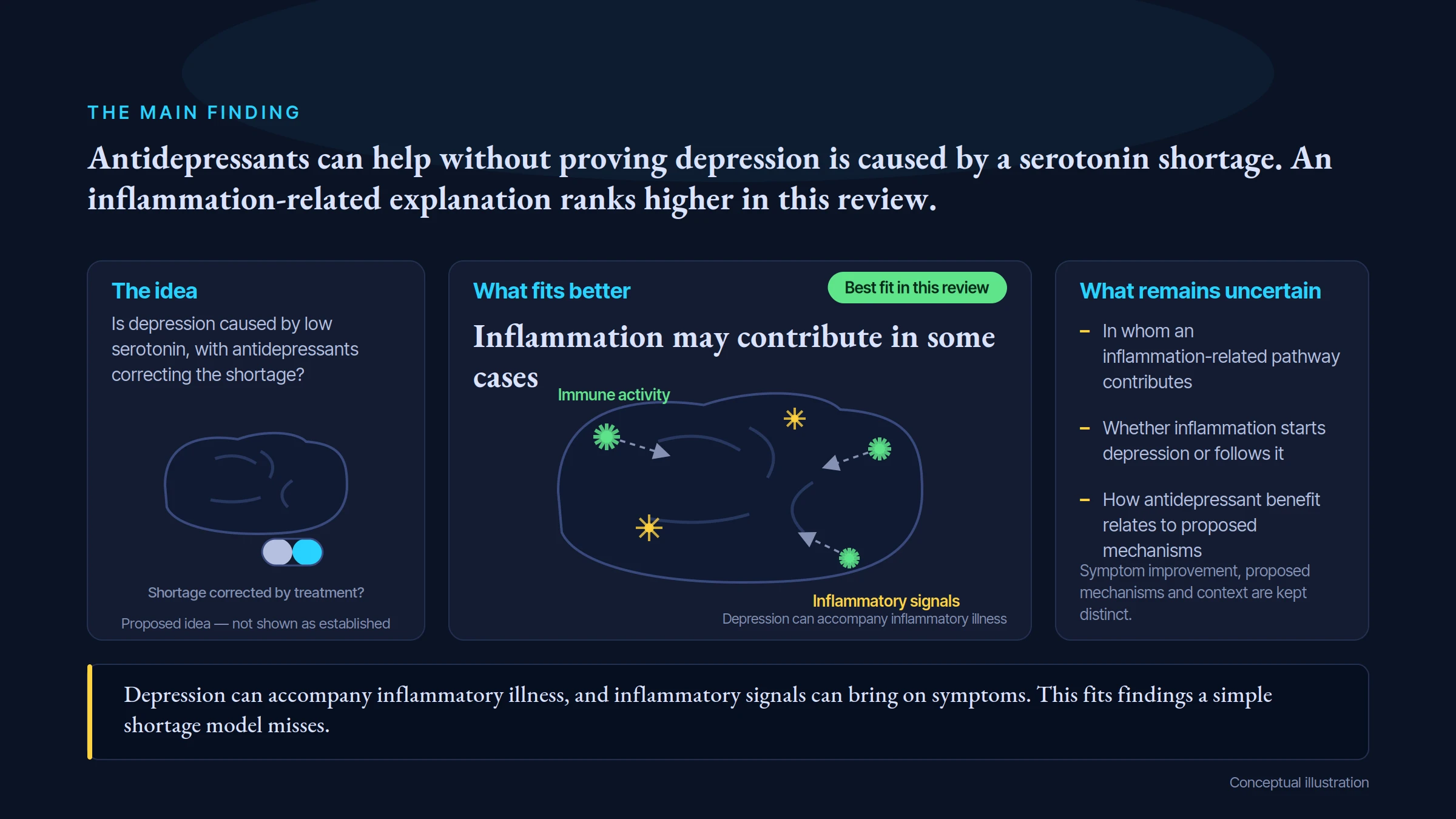
THE MAIN FINDING
Antidepressants can help without proving depression is caused by a serotonin shortage. An inflammation-related explanation ranks higher in this review.
The idea
Is depression caused by low serotonin, with antidepressants correcting the shortage?
Shortage corrected by treatment?
Proposed idea — not shown as established
What fits better
Best fit in this review
Inflammation may contribute in some cases
Immune activity
Inflammatory signals
Depression can accompany inflammatory illness
What remains uncertain
In whom an inflammation-related pathway contributes
Whether inflammation starts depression or follows it
How antidepressant benefit relates to proposed mechanisms
Symptom improvement, proposed mechanisms and context are kept distinct.
Depression can accompany inflammatory illness, and inflammatory signals can bring on symptoms. This fits findings a simple shortage model misses.
Conceptual illustration
This is the specific idea being tested.
Depression can accompany inflammatory illness, and inflammatory signals can bring on symptoms. This fits findings a simple shortage model misses.
A higher rank means a better fit to the evidence in this comparison. It does not prove every part of the leading explanation.
The reviewed hypothesis ranks 2 among 5 models compared; 1 alternative model(s) hold first rank for this stated claim.
Claim under review: rank 2 among 5 compared models.
Leading explanation: Neuroinflammation hypothesis.
Position in this comparison: Next after leading rank.
The causal grade asks how well the stated causal claim is established. This comparison asks which of the assessed explanations fits the reviewed findings better. A leading explanation can remain unproven. Models can overlap or include the tested mechanism; an alternative ahead does not make that mechanism irrelevant. These ordinal ranks apply within this review; they do not measure the size of a difference or rank scientific strength across topics.
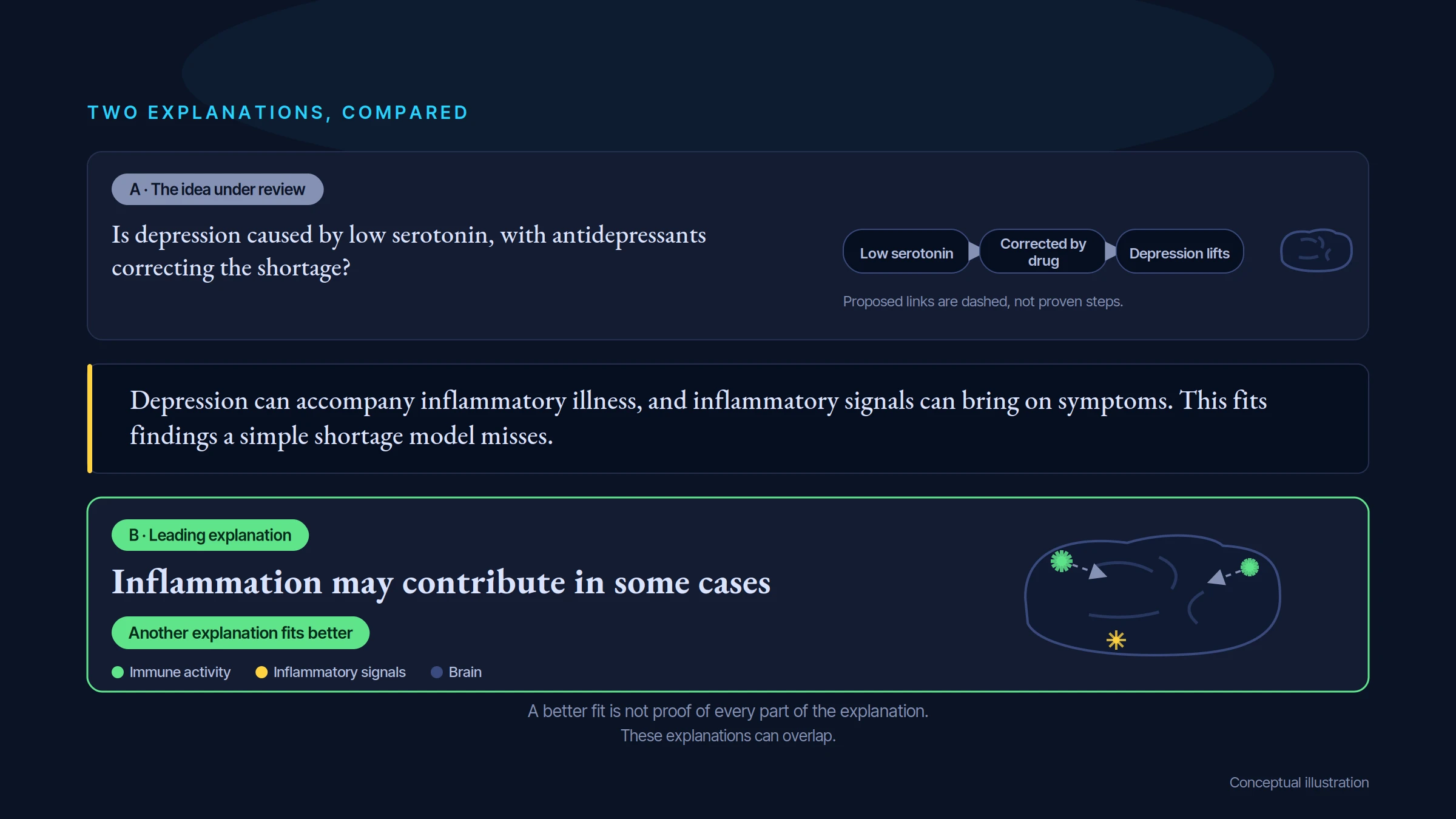
TWO EXPLANATIONS, COMPARED
A · The idea under review
Is depression caused by low serotonin, with antidepressants correcting the shortage?
Low serotonin
Corrected by drug
Depression lifts
Proposed links are dashed, not proven steps.
Depression can accompany inflammatory illness, and inflammatory signals can bring on symptoms. This fits findings a simple shortage model misses.
B · Leading explanation
Inflammation may contribute in some cases
Another explanation fits better
Immune activity
Inflammatory signals
Brain
A better fit is not proof of every part of the explanation.
These explanations can overlap.
Conceptual illustration
Plausible, not established for the stated claim.
Depression can accompany inflammatory illness, and inflammatory signals can bring on symptoms. This fits findings a simple shortage model misses.
These explanations can overlap. Ranking their fit to the evidence is separate from deciding how firmly a cause has been established.
Rank 1: Neuroinflammation hypothesis — MDD is initiated and maintained by elevated peripheral and central inflammatory mediators, which dysregulate monoamine metabolism and impair neuroplasticity.
Rank 2: Serotonin deficiency hypothesis — Deficient serotonin neurotransmission causes MDD and SSRIs relieve it by correcting that deficiency.
Rank 3: Neuroplasticity / BDNF hypothesis — MDD reflects impaired synaptic plasticity and reduced BDNF signalling; antidepressants act by restoring plasticity rather than by correcting a monoamine deficit.
Rank 4: Psychosocial stress model — MDD is primarily initiated and maintained by adverse psychosocial stressors acting on a vulnerable substrate, with biological changes downstream.
Rank 5: Default mode network / neural circuit hypothesis — MDD reflects aberrant connectivity in the default mode network and frontal-limbic circuits, and treatment works by normalising it.
Evidence rating: Γ · Moderate confidence. How the evidence was assessed.
Depression can accompany inflammatory illness, and inflammatory signals can bring on symptoms. This fits findings a simple shortage model misses.
This limits a popular explanation of why SSRIs work; it does not show that SSRIs never help. On average, SSRIs can outperform placebo, while the exact pathway, the size of benefit for a particular person, and the best combination of medication, psychological therapy, social support, and other care remain individual questions. The more accurate message is that a treatment can be useful even when its simplified marketing story is incomplete.
Look for the proposed factor and the outcome, in the people or systems covered by the claim.
Inflammation may contribute in some cases. Depression can accompany inflammatory illness, and inflammatory signals can bring on symptoms. This fits findings a simple shortage model misses.
Test proposed pathways in defined groups, measuring symptoms and accounting for treatment effects.
These illustrations show the key questions tested in the review. They are conceptual drawings, not microscope images or experimental results.
Deficient serotonin neurotransmission is a proximate cause of the initiation or maintenance of major depressive disorder.
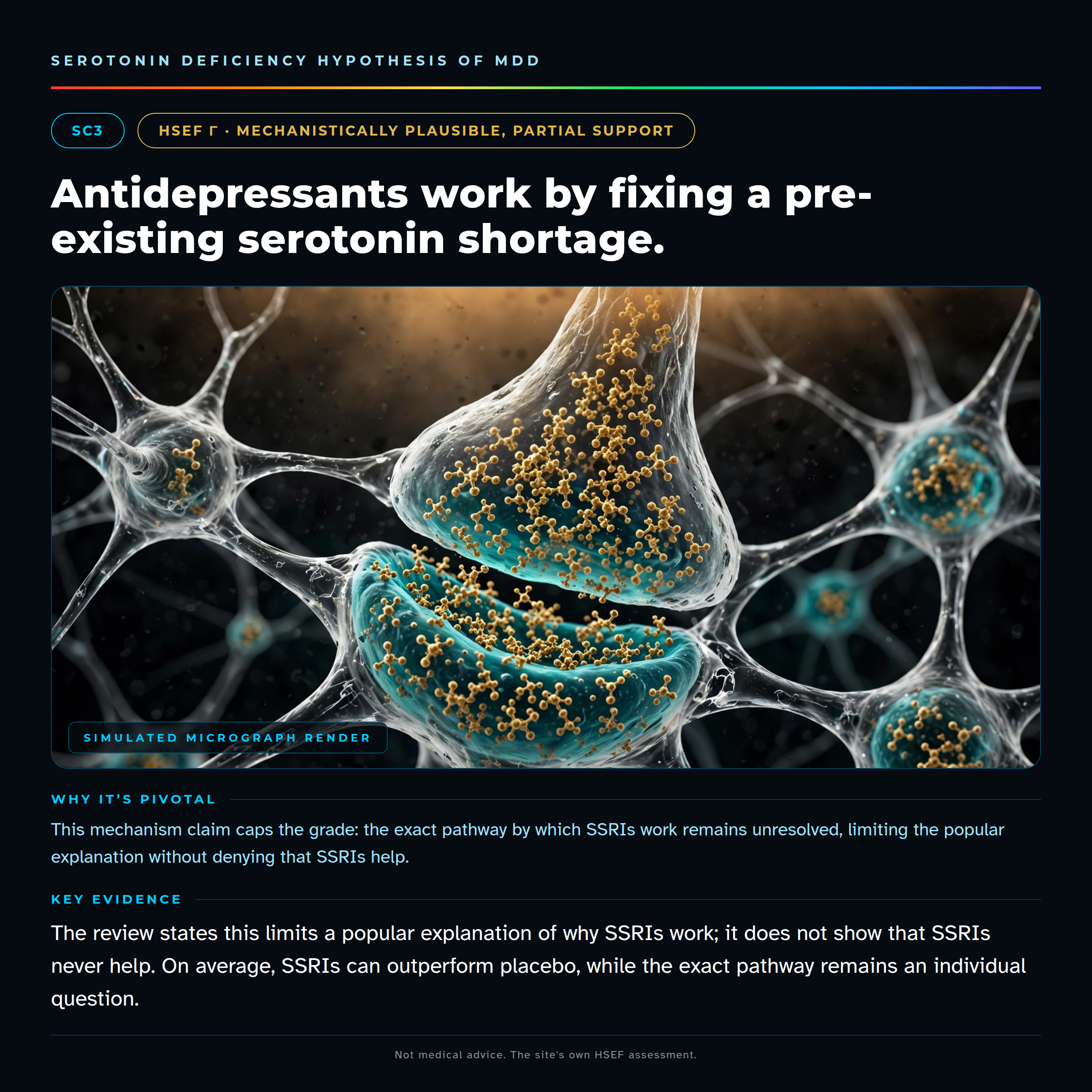
SSRIs relieve major depressive disorder specifically by correcting a pre-existing serotonin deficit rather than by any other mechanism.
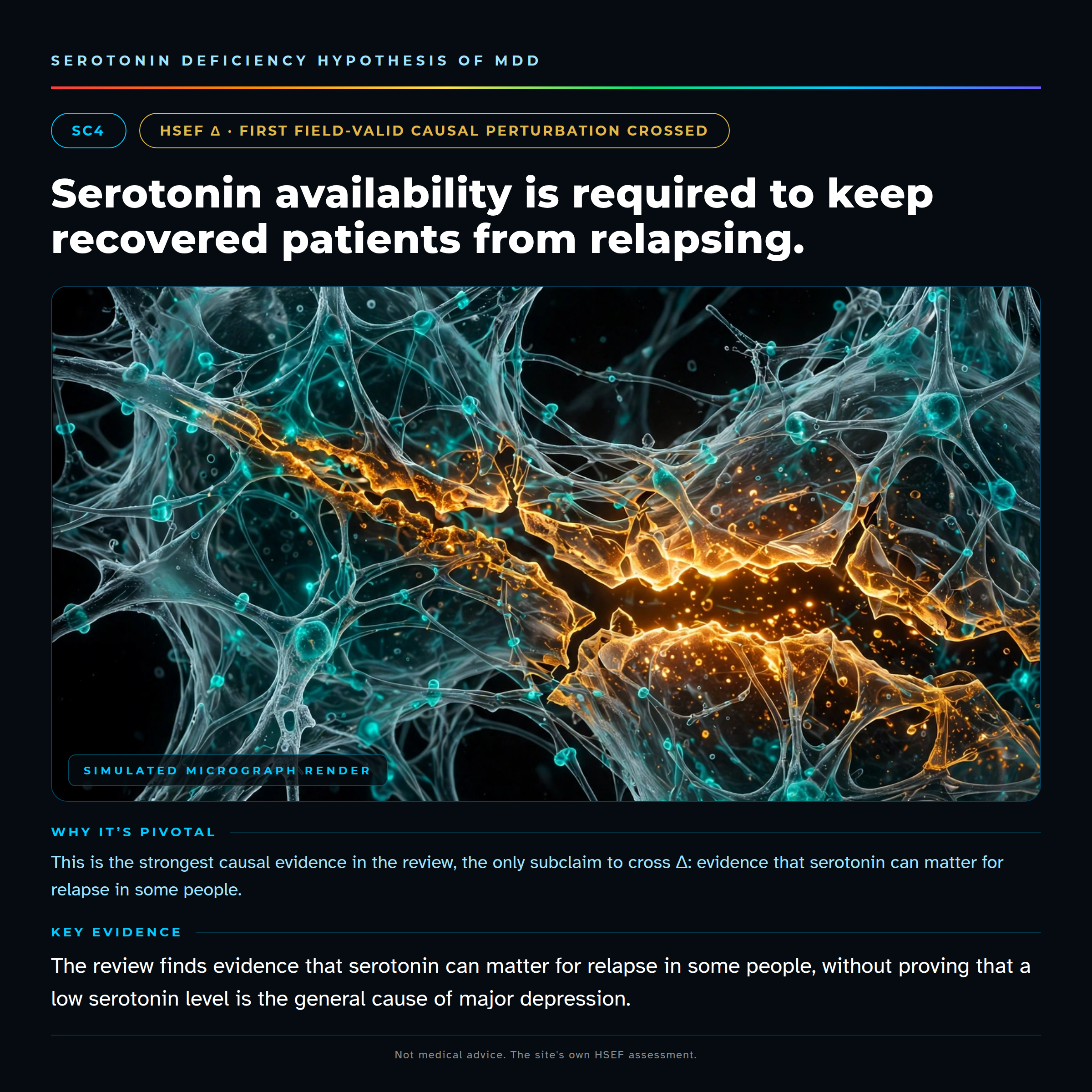
Serotonin availability is causally required to maintain the recovered state in people with a history of major depressive disorder.
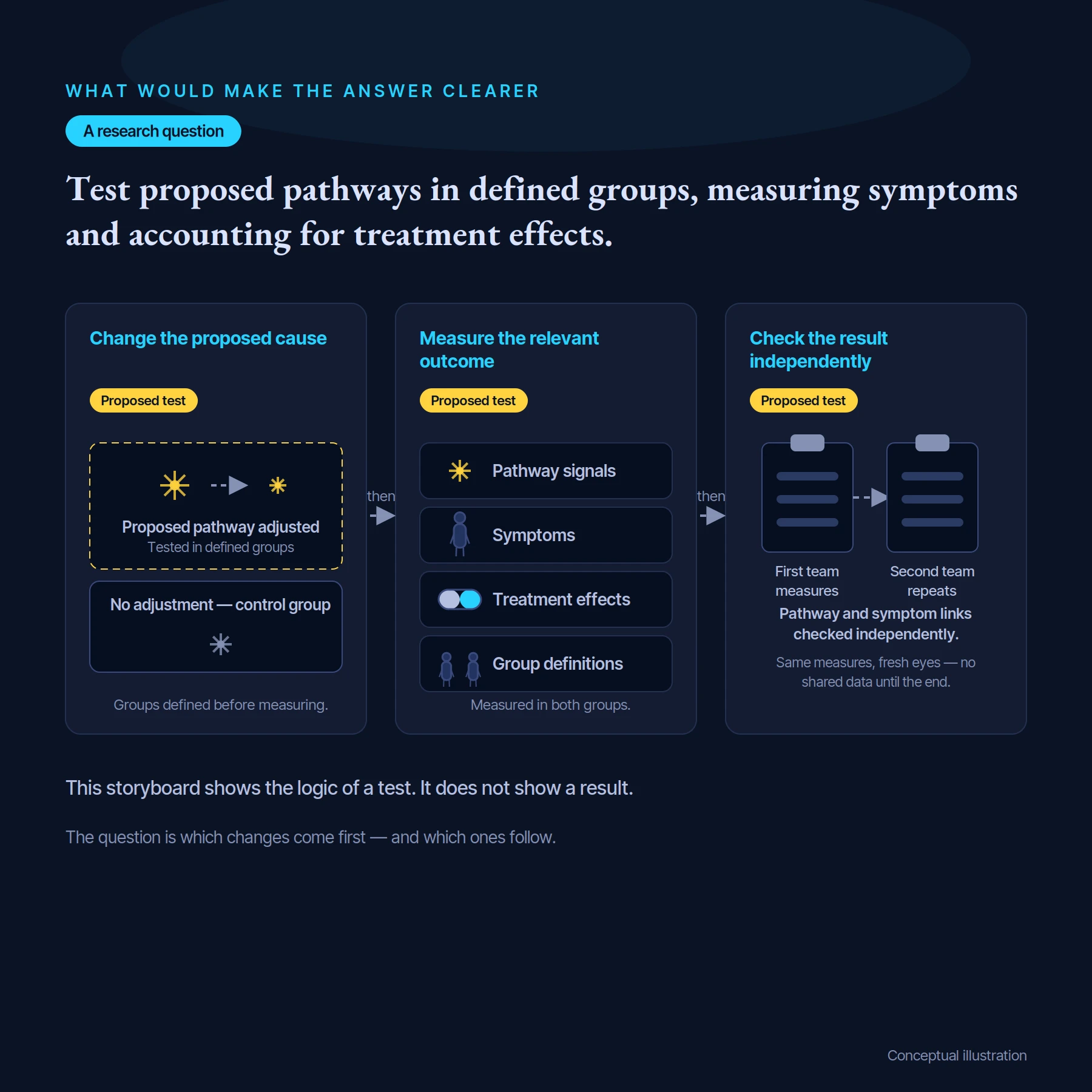
WHAT WOULD MAKE THE ANSWER CLEARER
A research question
Test proposed pathways in defined groups, measuring symptoms and accounting for treatment effects.
then
then
Change the proposed cause
Proposed test
Proposed pathway adjusted
Tested in defined groups
No adjustment — control group
Groups defined before measuring.
Measure the relevant outcome
Proposed test
Pathway signals
Symptoms
Treatment effects
Group definitions
Measured in both groups.
Check the result independently
Proposed test
First team measures
Second team repeats
Pathway and symptom links checked independently.
Same measures, fresh eyes — no shared data until the end.
This storyboard shows the logic of a test. It does not show a result.
The question is which changes come first — and which ones follow.
Conceptual illustration
Test proposed pathways in defined groups, measuring symptoms and accounting for treatment effects.
Check that the intended change really happened.
Allow for other factors and compare with suitable controls.
Look for independent confirmation and the limits of the effect.
These are questions for research, not a claim that the proposed studies have already succeeded.
Proposed tests: 3 test design(s) are registered in the scorecard.
In plain terms, researchers would change the proposed cause, check that it changed as intended, then measure a meaningful outcome while controlling plausible alternatives. The result should be able to support or count against the claim—not only show that a pathway exists.
Study design: Blinded, within-subject acute tryptophan depletion versus a balanced amino-acid control in adults with a current, first-episode depressive episode who have never taken a psychotropic drug, with a parallel arm receiving a depletion procedure matched for amino-acid load and cerebrovascular effect but not for tryptophan.
What would be measured: Change in a clinician-rated depression score at 6 and 24 hours, with plasma tryptophan to large-neutral-amino-acid ratio as the manipulation check and a serotonergic neuroendocrine or imaging index to demonstrate the manipulation acted where it is claimed to.
Important controls: The matched non-tryptophan-depleting arm, which separates serotonergic depletion from the procedure's other effects - the specificity gap that currently caps SC4 at Δ.
Result that would support the claim: Clinically meaningful worsening under depletion but not under the matched control would cross Δ for SC1 and would be the first positive field-valid perturbation for the causation clause.
Result that would count against it: No difference between depletion and control in drug-naive depressed patients, with a confirmed manipulation check, would leave SC1 at Γ permanently and would place the depletion effect wholly in the previously-treated or previously-depressed state.
Study design: Pre-registered randomised trial of an SSRI against an active placebo chosen to reproduce its early side-effect profile, with allocation-guess and confidence ratings collected from participants and from raters at every visit.
What would be measured: Pre-registered primary symptom outcome, analysed both unadjusted and adjusted for guessed allocation, with the guess-accuracy distribution reported.
Important controls: The allocation-guess data themselves; a trial that does not report them reproduces the gap this review identifies rather than closing it.
Result that would support the claim: A drug effect surviving adjustment for guessed allocation would cross Δ for SC2 and would remove the largest single objection to the efficacy clause.
Result that would count against it: No drug-comparator difference among participants who guessed correctly at chance level would place SC2 below its current ceiling and would trigger the rubric's first falsification pattern.
Study design: Prospective cohort within a randomised SSRI trial in which baseline serotonergic function is measured independently - for example by a challenge paradigm of the kind used in C6 - before randomisation, with response analysed by baseline stratum.
What would be measured: Pre-registered interaction between baseline serotonergic index and drug-placebo difference.
Important controls: Blinding of the baseline index to treatment allocation and of the outcome raters to the index, and a pre-registered stratum definition, so the strata cannot be fitted after outcomes are known (pitfall 22).
Result that would support the claim: Benefit concentrated in a pre-defined low-function stratum would be the first evidence that SSRIs correct a deficit rather than displacing a system that was not deficient, and would cross Δ for SC3.
Result that would count against it: Equal benefit regardless of baseline serotonergic function would refute the deficit-correction clause directly; SC3 would move from 'not demonstrated' to 'shown not to be'.
Follow the studies, detailed comparisons and evidence ratings behind this guide.
Open the scientific review →