The question
Do combinations of marks on DNA-packaging proteins act as a code for gene activity?
This is the specific idea being tested.
Do combinations of marks on DNA-packaging proteins act as a code for gene activity?
What you need to knowSome marks affect genes in particular settings. A universal combination-based code is not established.Relative explanatory fit: Alternative ranked ahead
Why the alternative fits better: Individual marks and the proteins they recruit can tune particular genes without a shared code determining every output.
Claim assessed: Specific combinations of histone modifications are read as a combinatorial code that causally specifies transcriptional outputs beyond the effects of individual marks.
Finding: The preregistered SC3 gate returns Γ. Structural recognition, cellular recruitment and engineered reporter combinations make the mechanism plausible, while direct endogenous factorial mark dependence beyond individual effects remains unresolved. This is not a refutation of histone function: SC2 reaches Ζ on independent mark/reader perturbations with functional outcomes, and the observational SC1 stays Β on its own evidence class. Recent bivalent-reader and NURF results are included rather than inheriting the index grade uncritically.
Evidence scope: 62 primary reports; literature cutoff 2026-10-08; source examination UTC date 2026-10-09; bounded critical review, not exhaustive systematic review.
The grade applies to the stated claim. Model rankings and individual subclaim grades remain separate from the overall causal-evidence grade.
Full scientific assessment and references · Scorecard (JSON) · Review source (Markdown)
THE MAIN FINDING
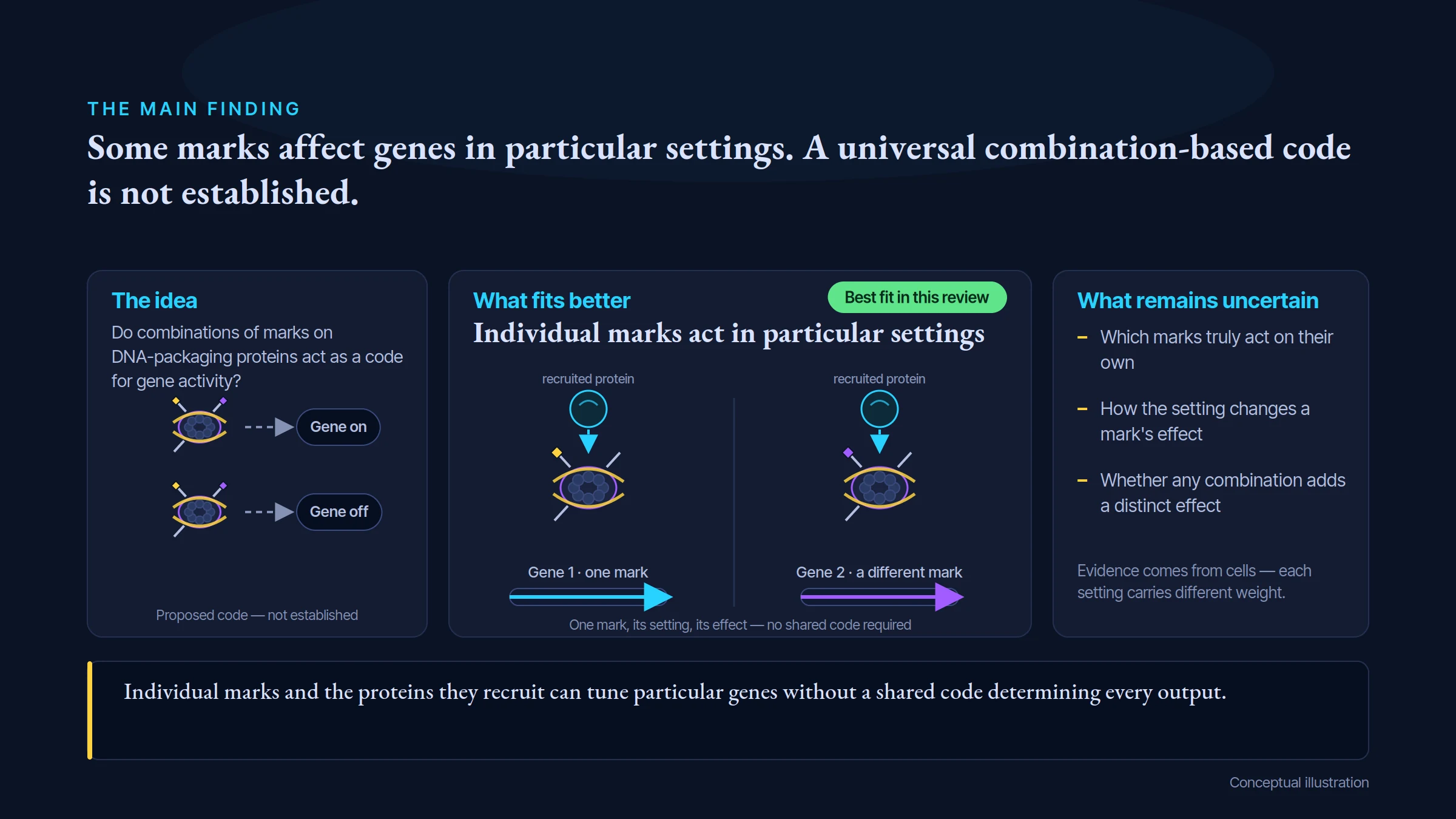
Some marks affect genes in particular settings. A universal combination-based code is not established.
The idea
What fits better
What remains uncertain
Do combinations of marks on DNA-packaging proteins act as a code for gene activity?
Gene on
Gene off
Proposed code — not established
Individual marks act in particular settings
Best fit in this review
Gene 1 · one mark
recruited protein
Gene 2 · a different mark
recruited protein
One mark, its setting, its effect — no shared code required
Which marks truly act on their own
How the setting changes a mark's effect
Whether any combination adds a distinct effect
Evidence comes from cells — each setting carries different weight.
Individual marks and the proteins they recruit can tune particular genes without a shared code determining every output.
Conceptual illustration
This is the specific idea being tested.
Individual marks and the proteins they recruit can tune particular genes without a shared code determining every output.
A higher rank means a better fit to the evidence in this comparison. It does not prove every part of the leading explanation.
The reviewed hypothesis ranks 3 among 5 models compared; 1 alternative model(s) hold first rank for this stated claim.
Claim under review: rank 3 among 5 compared models.
Leading explanation: Context-defined individual-mark functions.
Position in this comparison: Between leading and last ranks.
The causal grade asks how well the stated causal claim is established. This comparison asks which of the assessed explanations fits the reviewed findings better. A leading explanation can remain unproven. Models can overlap or include the tested mechanism; an alternative ahead does not make that mechanism irrelevant. These ordinal ranks apply within this review; they do not measure the size of a difference or rank scientific strength across topics.
TWO EXPLANATIONS, COMPARED
A · The idea under review
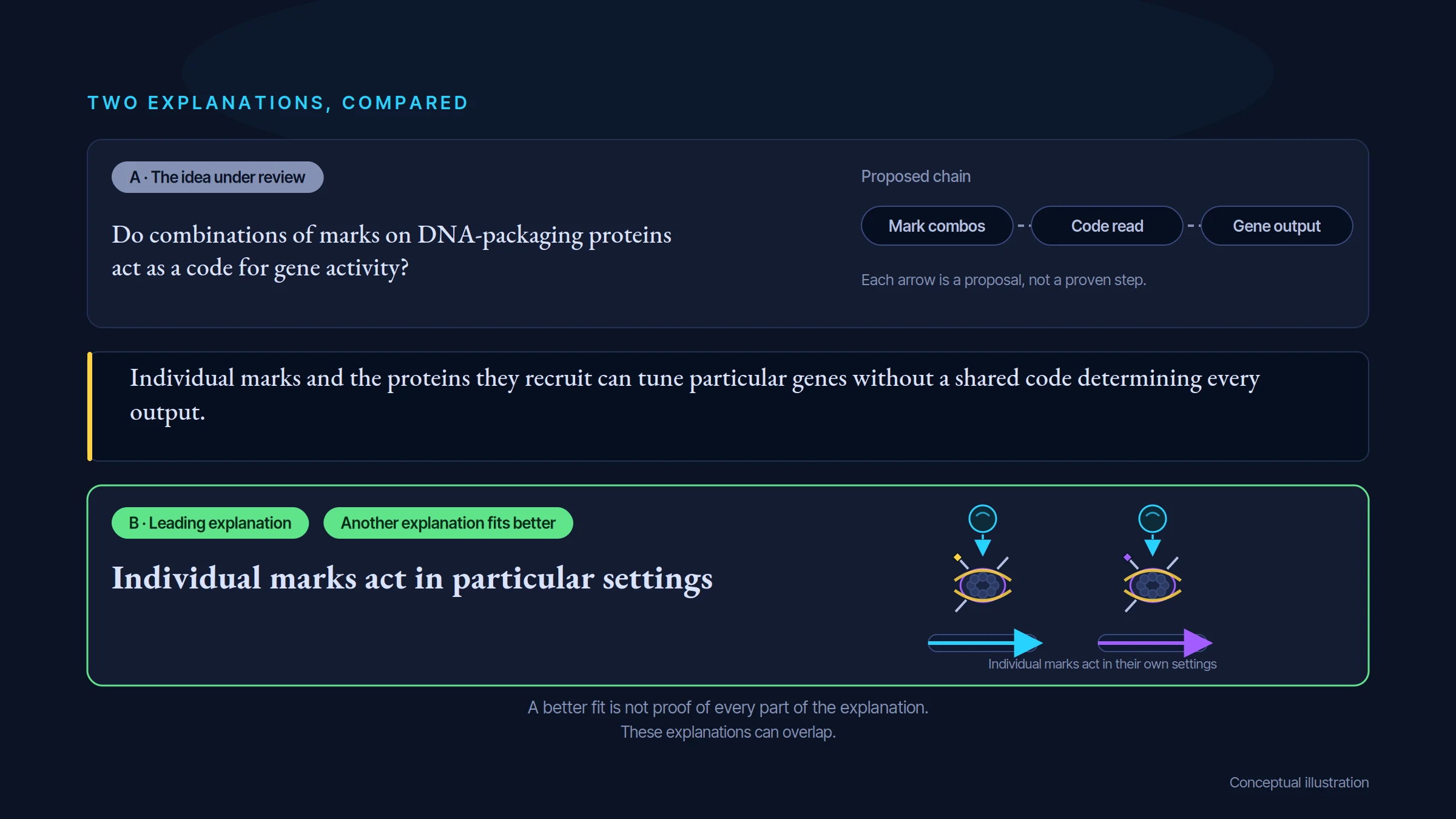
Do combinations of marks on DNA-packaging proteins act as a code for gene activity?
Proposed chain
Mark combos
Code read
Gene output
Each arrow is a proposal, not a proven step.
Individual marks and the proteins they recruit can tune particular genes without a shared code determining every output.
B · Leading explanation
Individual marks act in particular settings
Another explanation fits better
Individual marks act in their own settings
A better fit is not proof of every part of the explanation.
These explanations can overlap.
Conceptual illustration
Plausible, not established for the stated claim.
Individual marks and the proteins they recruit can tune particular genes without a shared code determining every output.
These explanations can overlap. Ranking their fit to the evidence is separate from deciding how firmly a cause has been established.
Rank 1: Context-defined individual-mark functions — Individual marks and recruited factors tune transcription at selected loci rather than encoding a universal vocabulary.
Rank 2: Reader-writer feedback and state stabilization — Multivalent readers and writer feedback stabilize states initiated by sequence factors and signaling.
Rank 3: Strict combinatorial instruction — Specific mark combinations encode emergent transcription outputs beyond constituent effects.
Rank 4: Cumulative acetylation and charge effects — Some acetylation effects follow total charge/accessibility rather than site-combination identity.
Rank 5: Transcriptional consequence and metabolic readout — Some marks record ongoing transcription or metabolic context instead of independently instructing it.
Evidence rating: Γ · Moderate confidence. How the evidence was assessed.
Individual marks and the proteins they recruit can tune particular genes without a shared code determining every output.
The preregistered SC3 gate returns Γ. Structural recognition, cellular recruitment and engineered reporter combinations make the mechanism plausible, while direct endogenous factorial mark dependence beyond individual effects remains unresolved. This is not a refutation of histone function: SC2 reaches Ζ on independent mark/reader perturbations with functional outcomes, and the observational SC1 stays Β on its own evidence class. Recent bivalent-reader and NURF results are included rather than inheriting the index grade uncritically.
Look for the proposed factor and the outcome, in the people or systems covered by the claim.
Individual marks act in particular settings. Individual marks and the proteins they recruit can tune particular genes without a shared code determining every output.
Change marks separately and together at the same gene to test whether the combination adds a distinct effect.
WHAT WOULD MAKE THE ANSWER CLEARER
A research question
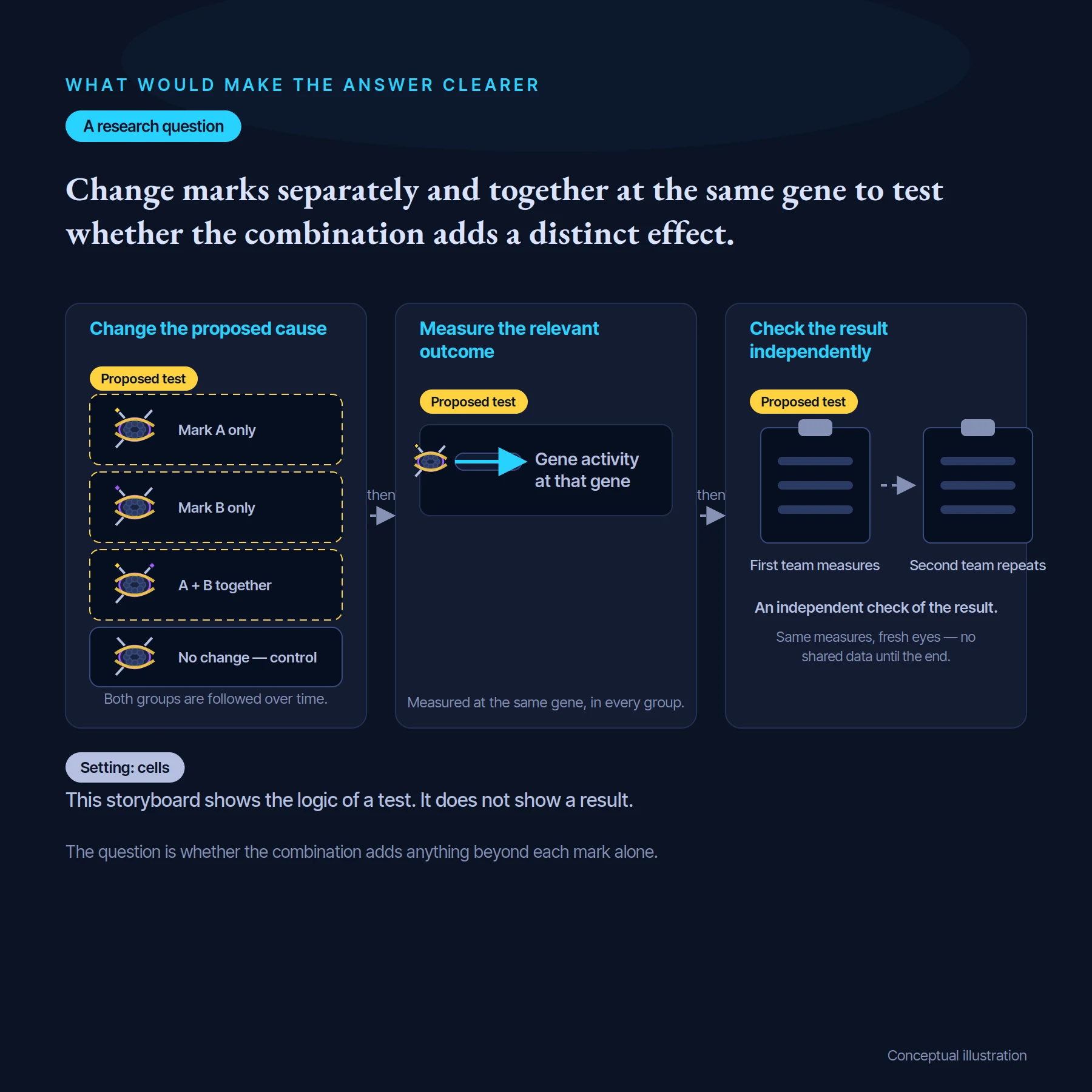
Change marks separately and together at the same gene to test whether the combination adds a distinct effect.
then
then
Change the proposed cause
Proposed test
Measure the relevant outcome
Proposed test
Check the result independently
Proposed test
Mark A only
Mark B only
A + B together
No change — control
Gene activity at that gene
Measured at the same gene, in every group.
First team measures
Second team repeats
An independent check of the result.
Same measures, fresh eyes — no shared data until the end.
Both groups are followed over time.
Setting: cells
This storyboard shows the logic of a test. It does not show a result.
The question is whether the combination adds anything beyond each mark alone.
Conceptual illustration
Change marks separately and together at the same gene to test whether the combination adds a distinct effect.
Check that the intended change really happened.
Allow for other factors and compare with suitable controls.
Look for independent confirmation and the limits of the effect.
These are questions for research, not a claim that the proposed studies have already succeeded.
Proposed tests: 1 test design(s) are registered in the scorecard.
In plain terms, researchers would change the proposed cause, check that it changed as intended, then measure a meaningful outcome while controlling plausible alternatives. The result should be able to support or count against the claim—not only show that a pathway exists.
Study design: Perform a preregistered factorial edit of two specific native histone marks at defined TRIM33 or BPTF loci while maintaining writer proteins; pair with expression-matched reader mutants preserving each single-mark affinity but losing paired recognition, and rescue under matched signal/cell-cycle conditions.
What would be measured: Absolute nascent transcription and single-cell output with an explicit interaction contrast, locus-resolved paired mark occupancy and reader binding
Important controls: Single-mark edits, charge-preserving controls where feasible, catalytic-dead recruitment, scaffold-preserving mutants, cell cycle/viability/replication-stress measurements, and unaffected prespecified loci
Result that would support the claim: Combination-selective loss abolishes a reproducible interaction beyond additive effects and a paired-reading-competent rescue restores it at native loci
Result that would count against it: RNA effects reduce to single-mark action, writer scaffolding, charge, secondary cell-state change or promoter sequence despite loss of paired recognition
Follow the studies, detailed comparisons and evidence ratings behind this guide.
Open the scientific review →