The question
Does the protein mesh lining the nucleus switch genes off by holding DNA at the nuclear edge?
This is the specific idea being tested.
Is the edge of the nucleus a gene-off switch?
Does the protein mesh lining the nucleus switch genes off by holding DNA at the nuclear edge?
What you need to knowThe nuclear lining can affect DNA organisation and gene activity, but contact with the edge is not a universal off switch.Relative explanatory fit: Alternative ranked ahead
Why the alternative fits better: Attaching certain genes to the nuclear edge can reduce their activity, but releasing DNA does not always switch genes on. Removing lining proteins can also change cell stress and mechanics, and short-term effects can differ from longer-term ones.
Why this matters: Changes in lamin proteins are relevant to rare disorders called laminopathies, including progeria. Studying these conditions can reveal roles for nuclear structure, but their effects do not establish one universal way the nuclear lining controls genes.
Claim assessed: The nuclear lamina globally regulates gene expression by tethering and silencing lamina-associated domains, rather than serving a primarily mechanical role.
Finding: Scope-matched aggregation is fixed to global SC4 and yields Γ. SC2 has mapped context-specific Ε support, while SC1 remains Β and direct enzyme-recruitment necessity SC3 remains Γ. Whole-lamin deletion can change thousands of genes yet still fail to establish direct global repression: changes can be bidirectional, follow mechanics/stress, or depend on other envelope tethers. This is not a judgment that lamins lack regulatory function.
Evidence scope: 60 primary reports; literature cutoff 2026-10-09; source examination UTC date 2026-10-12; bounded critical review, not exhaustive systematic review.
The grade applies to the stated claim. Model rankings and individual subclaim grades remain separate from the overall causal-evidence grade.
Full scientific assessment and references · Scorecard (JSON) · Review source (Markdown)
HYPOTHESIS CRITIC  /  REVIEW EXPLAINER
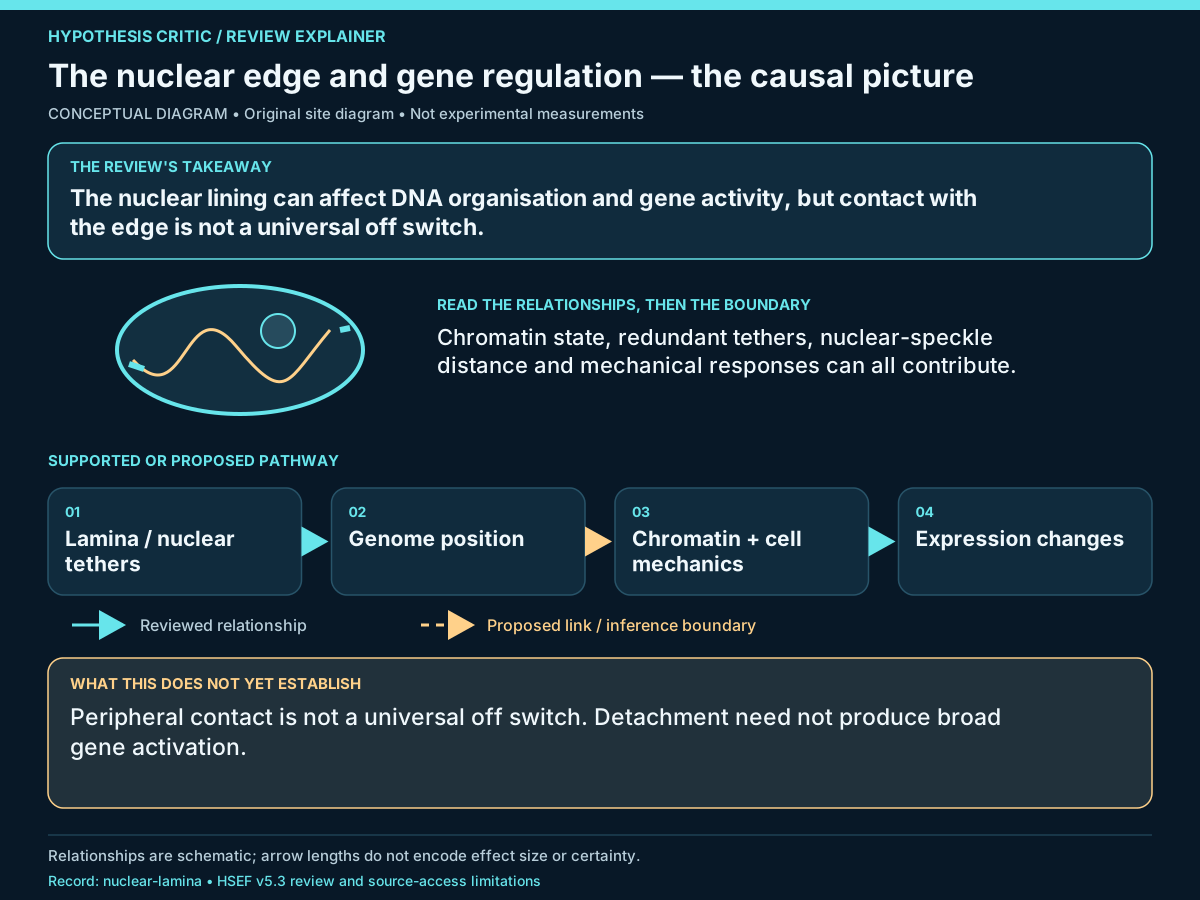
The nuclear edge and gene regulation — the causal picture
CONCEPTUAL DIAGRAM  •  Original site diagram  •  Not experimental measurements
THE REVIEW'S TAKEAWAY
The nuclear lining can affect DNA organisation and gene activity, but contact with the edge is not a universal off switch.
READ THE RELATIONSHIPS, THEN THE BOUNDARY
Chromatin state, redundant tethers, nuclear-speckle distance and mechanical responses can all contribute.
SUPPORTED OR PROPOSED PATHWAY
01
Lamina / nuclear tethers
02
Genome position
03
Chromatin + cell mechanics
04
Expression changes
Reviewed relationship
Proposed link / inference boundary
WHAT THIS DOES NOT YET ESTABLISH
Peripheral contact is not a universal off switch. Detachment need not produce broad gene activation.
Relationships are schematic; arrow lengths do not encode effect size or certainty.
Record: nuclear-lamina  •  HSEF v5.3 review and source-access limitations
This is the specific idea being tested.
Attaching certain genes to the nuclear edge can reduce their activity, but releasing DNA does not always switch genes on. Removing lining proteins can also change cell stress and mechanics, and short-term effects can differ from longer-term ones.
A higher rank means a better fit to the evidence in this comparison. It does not prove every part of the leading explanation.
The reviewed hypothesis ranks 5 among 5 models compared; 1 alternative model(s) hold first rank for this stated claim.
Claim under review: rank 5 among 5 compared models.
Leading explanation: Spatial partitioning and speckle-distance regulation.
Position in this comparison: Last recorded rank.
The causal grade asks how well the stated causal claim is established. This comparison asks which of the assessed explanations fits the reviewed findings better. A leading explanation can remain unproven. Models can overlap or include the tested mechanism; an alternative ahead does not make that mechanism irrelevant. These ordinal ranks apply within this review; they do not measure the size of a difference or rank scientific strength across topics.
HYPOTHESIS CRITIC  /  REVIEW EXPLAINER
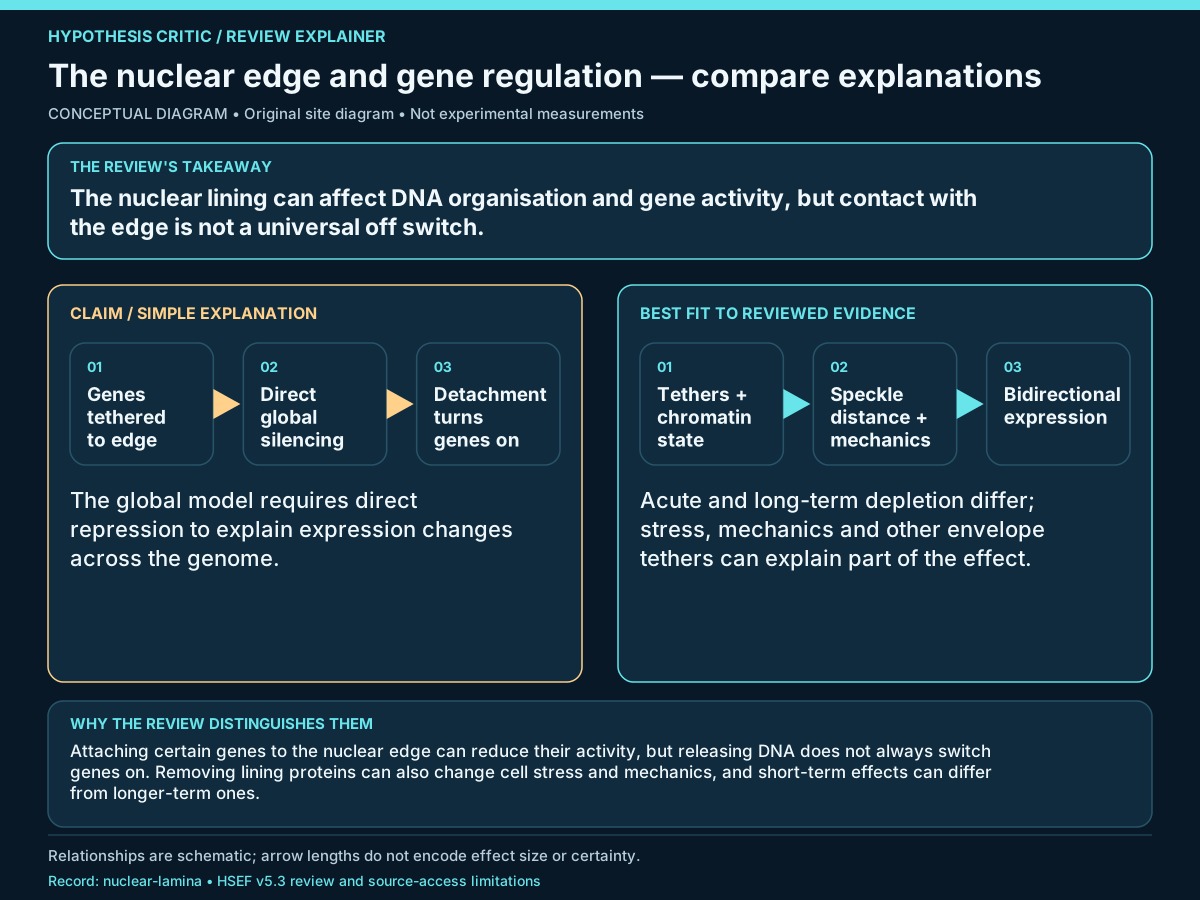
The nuclear edge and gene regulation — compare explanations
CONCEPTUAL DIAGRAM  •  Original site diagram  •  Not experimental measurements
THE REVIEW'S TAKEAWAY
The nuclear lining can affect DNA organisation and gene activity, but contact with the edge is not a universal off switch.
CLAIM / SIMPLE EXPLANATION
01
Genes tethered to edge
02
Direct global silencing
03
Detachment turns genes on
The global model requires direct repression to explain expression changes across the genome.
BEST FIT TO REVIEWED EVIDENCE
01
Tethers + chromatin state
02
Speckle distance + mechanics
03
Bidirectional expression
Acute and long-term depletion differ; stress, mechanics and other envelope tethers can explain part of the effect.
WHY THE REVIEW DISTINGUISHES THEM
Attaching certain genes to the nuclear edge can reduce their activity, but releasing DNA does not always switch genes on. Removing lining proteins can also change cell stress and mechanics, and short-term effects can differ from longer-term ones.
Relationships are schematic; arrow lengths do not encode effect size or certainty.
Record: nuclear-lamina  •  HSEF v5.3 review and source-access limitations
Plausible, not established for the stated claim.
Attaching certain genes to the nuclear edge can reduce their activity, but releasing DNA does not always switch genes on. Removing lining proteins can also change cell stress and mechanics, and short-term effects can differ from longer-term ones.
These explanations can overlap. Ranking their fit to the evidence is separate from deciding how firmly a cause has been established.
Rank 1: Spatial partitioning and speckle-distance regulation — Lamina-related topology constrains access to activating compartments and supports context-dependent transcription.
Rank 2: Redundant inner-membrane tether network — LBR, LAP2, PRR14 and LEM proteins provide cell-specific anchoring with lamin cooperation rather than one indispensable filament mechanism.
Rank 3: Mechanotransduction and stress signaling — Nuclear/cytoskeletal mechanics and damage responses cause a subset of transcription changes after lamin loss.
Rank 4: Chromatin self-organization with peripheral adhesion — Heterochromatin compaction and self-association set much organization; envelope contacts provide a boundary condition.
Rank 5: Direct global lamina enzymatic repression — Lamina filaments recruit indispensable enzymatic silencers across LADs and cell states.
Evidence rating: Γ · Moderate confidence. How the evidence was assessed.
Attaching certain genes to the nuclear edge can reduce their activity, but releasing DNA does not always switch genes on. Removing lining proteins can also change cell stress and mechanics, and short-term effects can differ from longer-term ones.
Changes in lamin proteins are relevant to rare disorders called laminopathies, including progeria. Studying these conditions can reveal roles for nuclear structure, but their effects do not establish one universal way the nuclear lining controls genes.
Nucleus: The compartment that contains most of a cell's DNA.
Nuclear lamina: A protein mesh just inside the membrane surrounding the nucleus.
Tethering: Attaching DNA to another nuclear structure, such as the nuclear edge.
Look for the proposed factor and the outcome, in the people or systems covered by the claim.
DNA packing, several kinds of attachment, nearby nuclear structures and cell mechanics all influence gene activity. Attaching certain genes to the nuclear edge can reduce their activity, but releasing DNA does not always switch genes on. Removing lining proteins can also change cell stress and mechanics, and short-term effects can differ from longer-term ones.
Make and reverse a selective change while measuring DNA position, gene activity and cell health together, separating attachment from stress and mechanical effects.
HYPOTHESIS CRITIC  /  REVIEW EXPLAINER
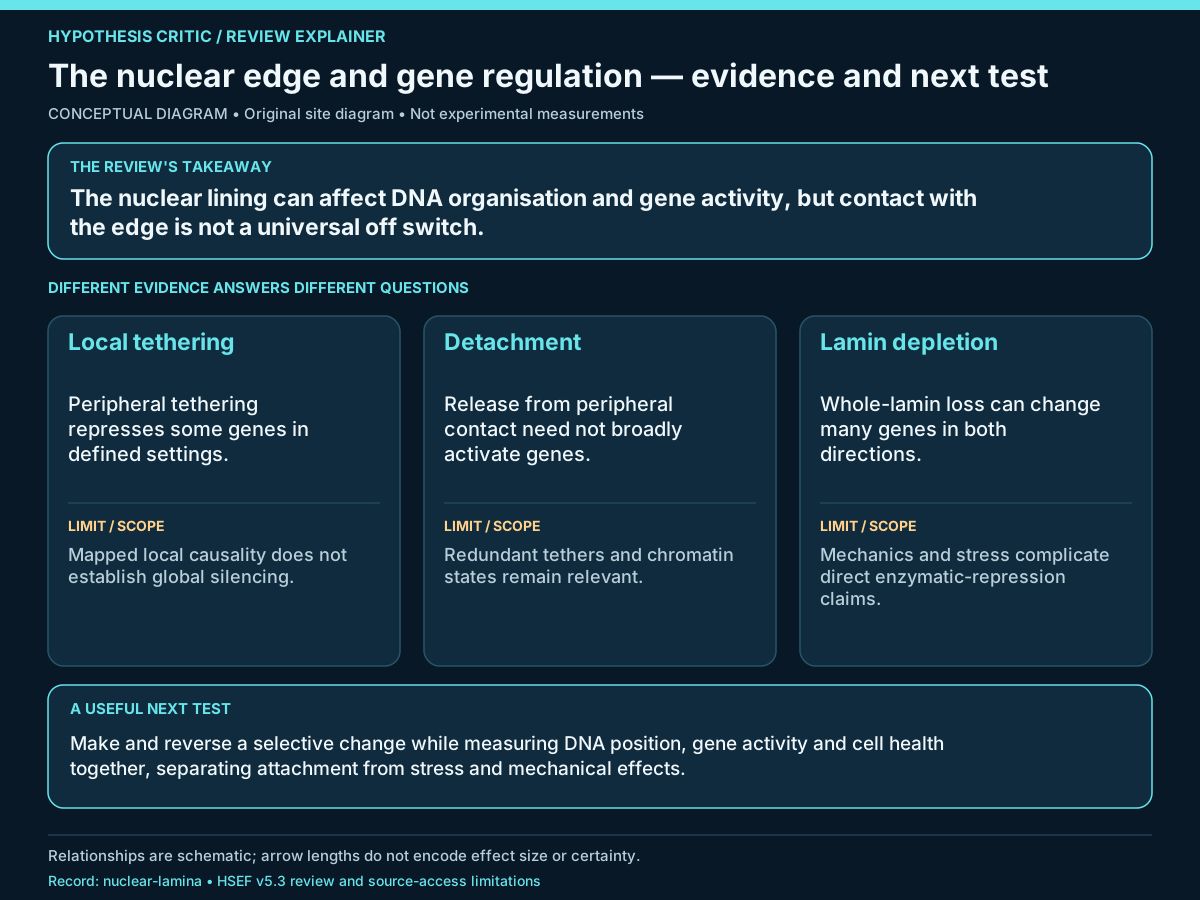
The nuclear edge and gene regulation — evidence and next test
CONCEPTUAL DIAGRAM  •  Original site diagram  •  Not experimental measurements
THE REVIEW'S TAKEAWAY
The nuclear lining can affect DNA organisation and gene activity, but contact with the edge is not a universal off switch.
DIFFERENT EVIDENCE ANSWERS DIFFERENT QUESTIONS
Local tethering
Peripheral tethering represses some genes in defined settings.
LIMIT / SCOPE
Mapped local causality does not establish global silencing.
Detachment
Release from peripheral contact need not broadly activate genes.
LIMIT / SCOPE
Redundant tethers and chromatin states remain relevant.
Lamin depletion
Whole-lamin loss can change many genes in both directions.
LIMIT / SCOPE
Mechanics and stress complicate direct enzymatic-repression claims.
A USEFUL NEXT TEST
Make and reverse a selective change while measuring DNA position, gene activity and cell health together, separating attachment from stress and mechanical effects.
Relationships are schematic; arrow lengths do not encode effect size or certainty.
Record: nuclear-lamina  •  HSEF v5.3 review and source-access limitations
Make and reverse a selective change while measuring DNA position, gene activity and cell health together, separating attachment from stress and mechanical effects.
Check that the intended change really happened.
Allow for other factors and compare with suitable controls.
Look for independent confirmation and the limits of the effect.
These are questions for research, not a claim that the proposed studies have already succeeded.
Proposed tests: 1 test design(s) are registered in the scorecard.
In plain terms, researchers would change the proposed cause, check that it changed as intended, then measure a meaningful outcome while controlling plausible alternatives. The result should be able to support or count against the claim—not only show that a pathway exists.
Study design: Engineer an endogenous lamin allele that loses a specified silencer interaction while preserving filament mechanics, envelope integrity and redundant-tether localization. Compare it with a mechanical-defect allele and expression-matched rescue across predefined stem and differentiated states. Perform short-time-course native nascent RNA plus contact/speckle mapping, with cell-cycle, replication stress and viability controls. Re-tether the enzyme selectively at native affected loci to test whether repression is restored before downstream damage.
What would be measured: Native nascent transcription, locus contact/topology and speckle distance, independent mechanics and nuclear-integrity measurements
Important controls: Endogenous protein levels, enzyme catalytic competence, tether complement, mechanical rescue, cell state/time, cell cycle, replication stress, viability and expression-matched rescue
Result that would support the claim: Selective recruitment loss derepresses prespecified native LAD outputs across states, with interaction/locus-specific rescue and no mechanical or global-collapse explanation
Result that would count against it: Tether/recruitment loss leaves repression intact or changes RNA only after mechanics, stress, differentiation or global transcription collapse
Follow the studies, detailed comparisons and evidence ratings behind this guide.
Open the scientific review →