The question
Does avoiding routine childhood vaccines prevent autism and improve children's health?
This is the specific idea being tested.

Does avoiding routine childhood vaccines prevent autism and improve children's health?
What you need to knowAvoiding childhood vaccination has no demonstrated autism-prevention benefit and leaves children without protection from particular infections.Relative explanatory fit: Alternative ranked ahead
Why the alternative fits better: Studies comparing vaccinated children, different formulations and vaccination timing do not establish the proposed autism link. Infection-prevention trials and outbreak studies address a separate benefit of vaccination. Rare vaccine adverse events deserve their own assessment rather than being confused with the autism claim.
For health decisions: Skipping routine vaccination is not an evidence-based way to prevent autism; vaccine benefits and genuine adverse-event risks should be discussed separately.
Claim assessed: Avoiding routine childhood vaccination prevents autism and produces a better overall health outcome in children eligible for routine immunization.
Finding: Overall Α follows preregistered primary SC3: avoiding eligible routine vaccination has no verified autism-prevention/net-health benefit in the examined originals. SC1 and SC2 are also Α because the set establishes no credible reproducible positive clinical vaccine-ASD association; restricted toxicity findings are retained without importing their inference into human ASD. Separate SC4 reaches Η through randomized antigen-specific prevention plus independently structured exposure/refusal/outbreak evidence. The harm score does not itself assign the nominal benefit score.
Evidence scope: 62 primary reports; literature cutoff 2026-10-12; source examination UTC date 2026-10-12; bounded critical review, not exhaustive systematic review.
The grade applies to the stated claim. Model rankings and individual subclaim grades remain separate from the overall causal-evidence grade.
Full scientific assessment and references · Scorecard (JSON) · Review source (Markdown)
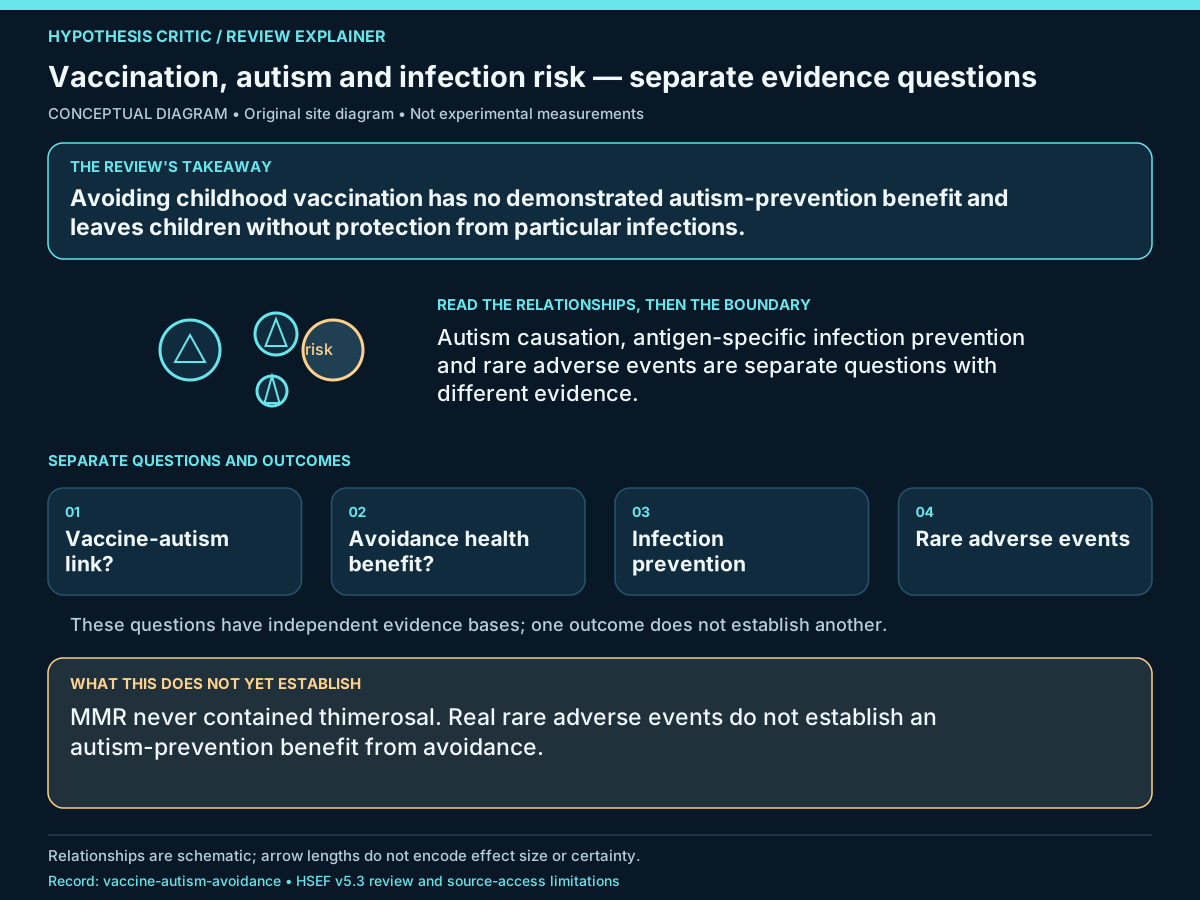
HYPOTHESIS CRITIC  /  REVIEW EXPLAINER
Vaccination, autism and infection risk — separate evidence questions
CONCEPTUAL DIAGRAM  •  Original site diagram  •  Not experimental measurements
THE REVIEW'S TAKEAWAY
Avoiding childhood vaccination has no demonstrated autism-prevention benefit and leaves children without protection from particular infections.
risk
READ THE RELATIONSHIPS, THEN THE BOUNDARY
Autism causation, antigen-specific infection prevention and rare adverse events are separate questions with different evidence.
SEPARATE QUESTIONS AND OUTCOMES
01
Vaccine-autism link?
02
Avoidance health benefit?
03
Infection prevention
04
Rare adverse events
These questions have independent evidence bases; one outcome does not establish another.
WHAT THIS DOES NOT YET ESTABLISH
MMR never contained thimerosal. Real rare adverse events do not establish an autism-prevention benefit from avoidance.
Relationships are schematic; arrow lengths do not encode effect size or certainty.
Record: vaccine-autism-avoidance  •  HSEF v5.3 review and source-access limitations
This is the specific idea being tested.
Studies comparing vaccinated children, different formulations and vaccination timing do not establish the proposed autism link. Infection-prevention trials and outbreak studies address a separate benefit of vaccination. Rare vaccine adverse events deserve their own assessment rather than being confused with the autism claim.
A higher rank means a better fit to the evidence in this comparison. It does not prove every part of the leading explanation.
The reviewed hypothesis ranks 4 among 4 models compared; 1 alternative model(s) hold first rank for this stated claim.
Claim under review: rank 4 among 4 compared models.
Leading explanation: Pathogen-specific protection with adverse-event boundaries.
Position in this comparison: Last recorded rank.
The causal grade asks how well the stated causal claim is established. This comparison asks which of the assessed explanations fits the reviewed findings better. A leading explanation can remain unproven. Models can overlap or include the tested mechanism; an alternative ahead does not make that mechanism irrelevant. These ordinal ranks apply within this review; they do not measure the size of a difference or rank scientific strength across topics.
HYPOTHESIS CRITIC  /  REVIEW EXPLAINER
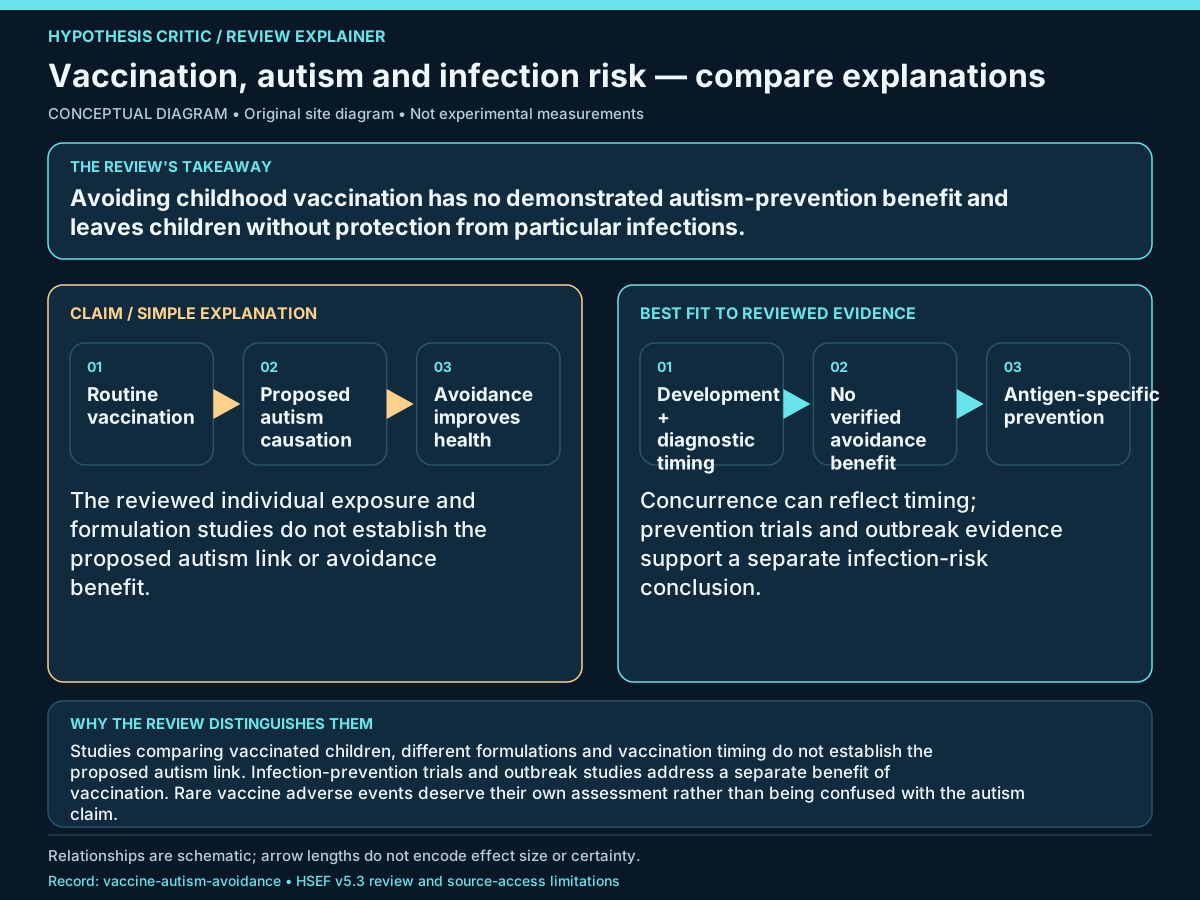
Vaccination, autism and infection risk — compare explanations
CONCEPTUAL DIAGRAM  •  Original site diagram  •  Not experimental measurements
THE REVIEW'S TAKEAWAY
Avoiding childhood vaccination has no demonstrated autism-prevention benefit and leaves children without protection from particular infections.
CLAIM / SIMPLE EXPLANATION
01
Routine vaccination
02
Proposed autism causation
03
Avoidance improves health
The reviewed individual exposure and formulation studies do not establish the proposed autism link or avoidance benefit.
BEST FIT TO REVIEWED EVIDENCE
01
Development + diagnostic timing
02
No verified avoidance benefit
03
Antigen-specific prevention
Concurrence can reflect timing; prevention trials and outbreak evidence support a separate infection-risk conclusion.
WHY THE REVIEW DISTINGUISHES THEM
Studies comparing vaccinated children, different formulations and vaccination timing do not establish the proposed autism link. Infection-prevention trials and outbreak studies address a separate benefit of vaccination. Rare vaccine adverse events deserve their own assessment rather than being confused with the autism claim.
Relationships are schematic; arrow lengths do not encode effect size or certainty.
Record: vaccine-autism-avoidance  •  HSEF v5.3 review and source-access limitations
Not established for the stated claim.
Studies comparing vaccinated children, different formulations and vaccination timing do not establish the proposed autism link. Infection-prevention trials and outbreak studies address a separate benefit of vaccination. Rare vaccine adverse events deserve their own assessment rather than being confused with the autism claim.
These explanations can overlap. Ranking their fit to the evidence is separate from deciding how firmly a cause has been established.
Rank 1: Pathogen-specific protection with adverse-event boundaries — Immunization reduces defined clinical infection risks while formulation, age and contraindications determine specific adverse-event risks.
Rank 2: Developmental liability and diagnostic timing — Familial developmental liability and age-dependent recognition can coincide with vaccination timing without vaccine causation.
Rank 3: Ascertainment and exposure misclassification — Healthcare contact, early-intervention requirements, calendar trends and reporting alter apparent vaccine-autism associations.
Rank 4: Autism prevention by vaccine avoidance — Avoiding routine vaccines prevents autism and improves eligible children's overall health.
Evidence rating: Α · High confidence. How the evidence was assessed.
Studies comparing vaccinated children, different formulations and vaccination timing do not establish the proposed autism link. Infection-prevention trials and outbreak studies address a separate benefit of vaccination. Rare vaccine adverse events deserve their own assessment rather than being confused with the autism claim.
The reviewed evidence does not support withholding routine childhood vaccines to prevent autism. Vaccines protect against particular infections, and avoiding them removes that protection. Genuine rare adverse events and individual contraindications require separate assessment with the child's healthcare team; they do not establish the proposed autism-prevention benefit.
Further reading: WHO: vaccines and autism evidence.
Look for the proposed factor and the outcome, in the people or systems covered by the claim.
Autism's development and the timing of diagnosis can overlap with vaccination, while vaccines prevent specific infections. Studies comparing vaccinated children, different formulations and vaccination timing do not establish the proposed autism link. Infection-prevention trials and outbreak studies address a separate benefit of vaccination. Rare vaccine adverse events deserve their own assessment rather than being confused with the autism claim.
Study existing differences in vaccination exposure with reliable diagnoses, careful timing and suitable controls, while separately tracking infections and adverse events.
HYPOTHESIS CRITIC  /  REVIEW EXPLAINER
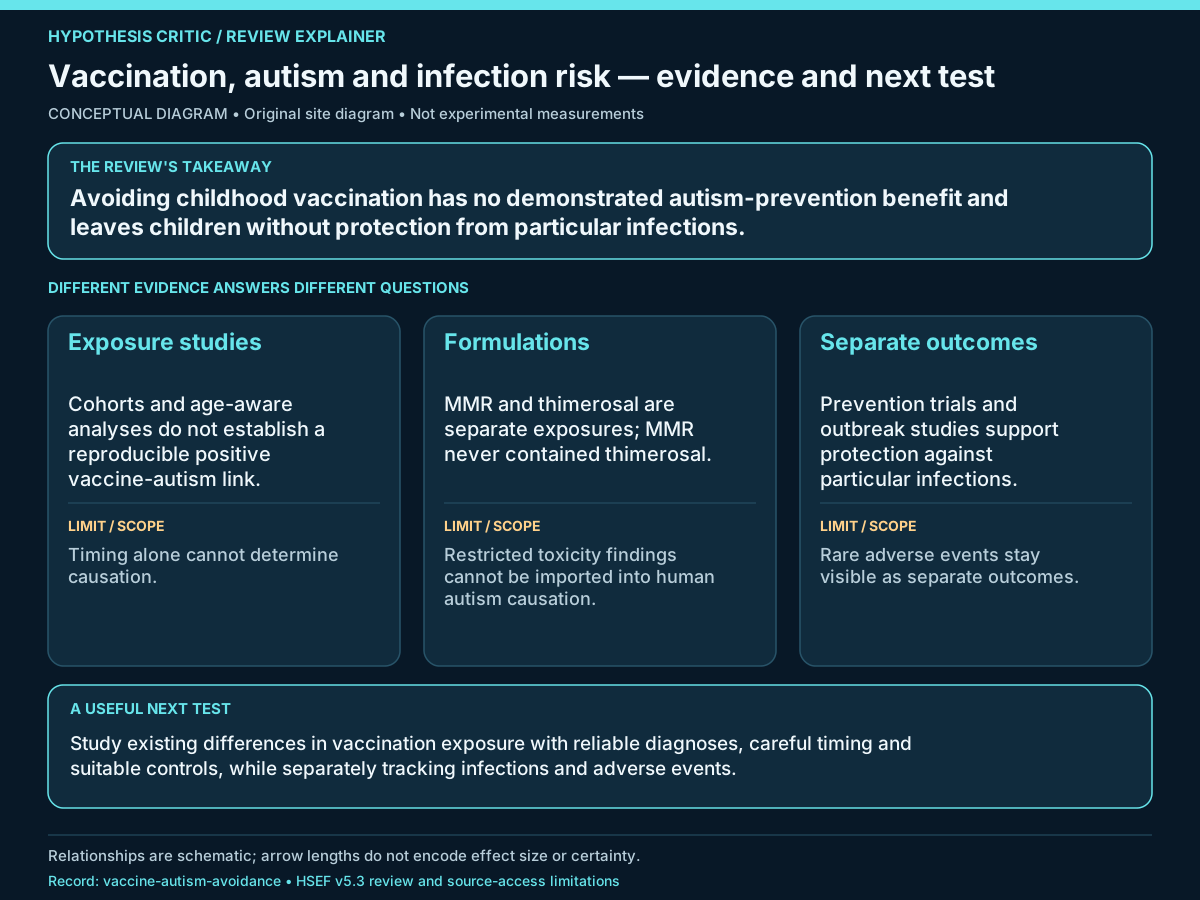
Vaccination, autism and infection risk — evidence and next test
CONCEPTUAL DIAGRAM  •  Original site diagram  •  Not experimental measurements
THE REVIEW'S TAKEAWAY
Avoiding childhood vaccination has no demonstrated autism-prevention benefit and leaves children without protection from particular infections.
DIFFERENT EVIDENCE ANSWERS DIFFERENT QUESTIONS
Exposure studies
Cohorts and age-aware analyses do not establish a reproducible positive vaccine-autism link.
LIMIT / SCOPE
Timing alone cannot determine causation.
Formulations
MMR and thimerosal are separate exposures; MMR never contained thimerosal.
LIMIT / SCOPE
Restricted toxicity findings cannot be imported into human autism causation.
Separate outcomes
Prevention trials and outbreak studies support protection against particular infections.
LIMIT / SCOPE
Rare adverse events stay visible as separate outcomes.
A USEFUL NEXT TEST
Study existing differences in vaccination exposure with reliable diagnoses, careful timing and suitable controls, while separately tracking infections and adverse events.
Relationships are schematic; arrow lengths do not encode effect size or certainty.
Record: vaccine-autism-avoidance  •  HSEF v5.3 review and source-access limitations
Study existing differences in vaccination exposure with reliable diagnoses, careful timing and suitable controls, while separately tracking infections and adverse events.
Check that the intended change really happened.
Allow for other factors and compare with suitable controls.
Look for independent confirmation and the limits of the effect.
These are questions for research, not a claim that the proposed studies have already succeeded.
Proposed tests: 1 test design(s) are registered in the scorecard.
In plain terms, researchers would change the proposed cause, check that it changed as intended, then measure a meaningful outcome while controlling plausible alternatives. The result should be able to support or count against the claim—not only show that a pathway exists.
Study design: Pre-register a target-trial emulation of existing naturally varying vaccine timing or historical matched formulations without withholding recommended vaccination. Define eligibility and familial risk before outcomes, validate exposure and incident diagnosis, use correct time-at-risk and age landmarks, measure healthcare contact and independent negative controls, and link confirmed infection, serious morbidity and specific adverse events over a stated horizon. Independently replicate absolute net outcomes and proposed dose predictions; no responder-only or postdiagnosis susceptibility scope.
What would be measured: Validated incident ASD and absolute pathogen-specific morbidity/serious adverse-event outcomes in an eligible population over prespecified follow-up
Important controls: Matched formulation/age/exposure opportunity, time-varying confounding, healthcare-use and diagnostic-latency validation, familial risk, calendar/cohort changes, independent outcome ascertainment, genuine contraindications defined before outcomes
Result that would support the claim: An independently replicated dose/formulation effect predicts incident ASD before concerns arise, and avoidance's absolute benefits exceed the lost infection protection and measured harms within a prespecified eligible context
Result that would count against it: Adequate clinical exposure contrasts remain null for ASD or inferred associations track contact/reporting/calendar rather than dose; avoidance produces infection harm without replicated autism prevention
Follow the studies, detailed comparisons and evidence ratings behind this guide.
Open the scientific review →