The question
Do carbohydrates cause obesity mainly by raising insulin and driving fat storage?
This is the specific idea being tested.
Do carbohydrates cause obesity mainly by raising insulin and driving fat storage?
What you need to knowCarbohydrates change insulin, but that does not establish insulin as the main cause of common obesity.Relative explanatory fit: Alternative ranked ahead
Why the alternative fits better: Different diets can produce similar long-term results, while food properties affect intake. Insulin alone does not explain this.
Claim assessed: In common human obesity, a diet high in glycemic load is the primary modifiable upstream cause: its hormonal response, centred on a raised insulin-to-glucagon ratio, shifts fuel partitioning toward adipose storage and lowers fuel availability to other tissues, which increases hunger and lowers energy expenditure, so that fat storage drives positive energy balance rather than following from it; after an adaptation period of weeks, a lower-glycemic-load diet should therefore raise energy expenditure at equal energy and protein intake and reduce ad libitum intake.
Finding: The endocrine link (carbohydrate/glycemic load → insulin and insulin-to-glucagon ratio) reaches Η on two independent causal lines. The downstream chain remains Γ: isocaloric fat-balance predictions are negative in short studies and untested at long duration; expenditure gains after adaptation are contested and lack a fat-loss correlate; GI effects on hunger, intake and regain are positive in defined contexts but insulin mediation failed its direct test; the responder rule failed its prespecified replication; and primacy has no necessity or rate-limitation evidence. Weakest-link, primary-subclaim and scope-matched aggregation all return Γ.
Evidence scope: Primary human feeding, long-term randomized, animal-genetic, human-genetic, and correspondence literature through 2026-09-30. Full text read where retrievable in the red-team pass; abstract-only and metadata-only records are labelled and carry no number beyond what was read.
The grade applies to the stated claim. Model rankings and individual subclaim grades remain separate from the overall causal-evidence grade.
Full scientific assessment and references · Scorecard (JSON) · Review source (Markdown)
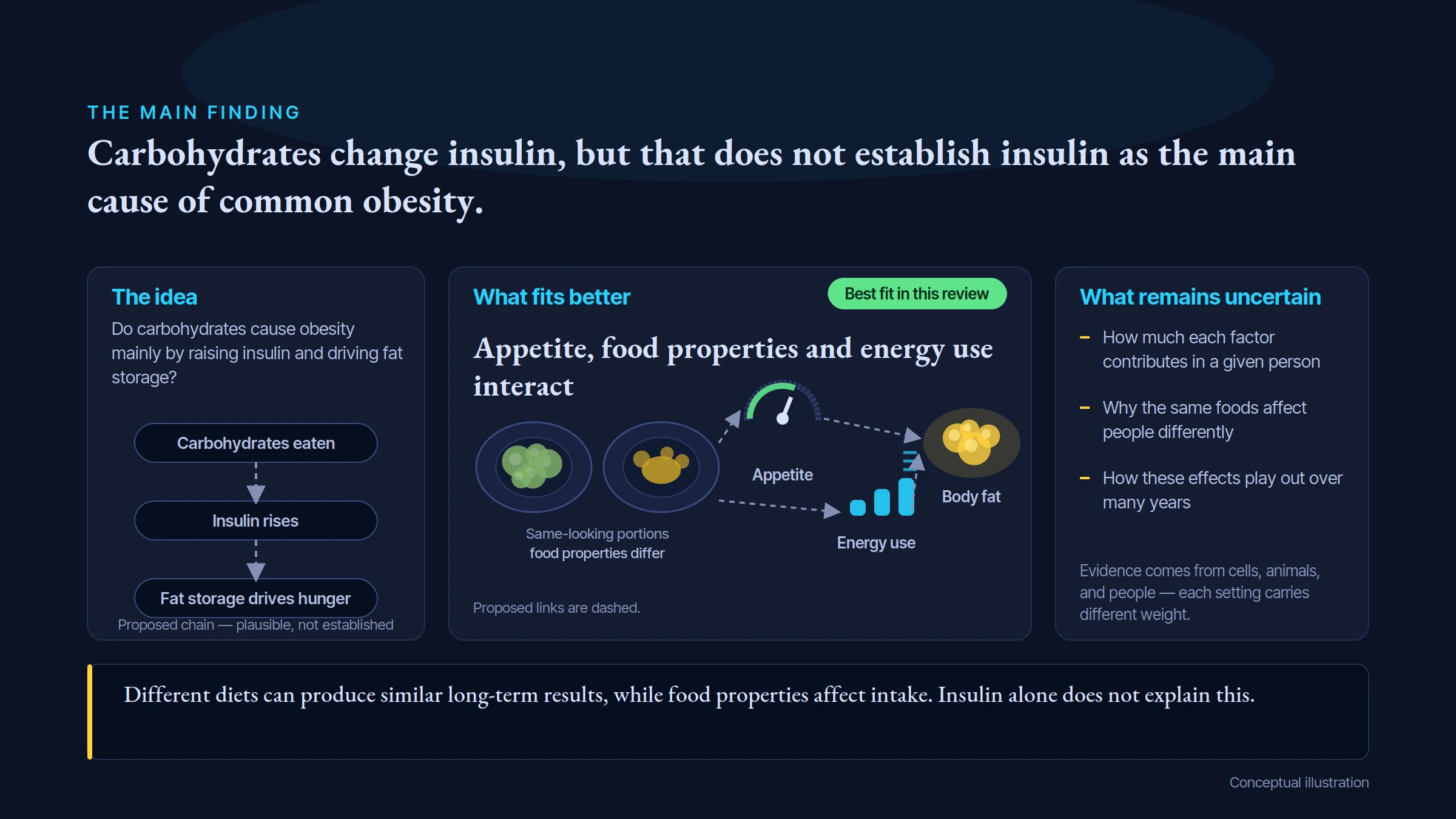
THE MAIN FINDING
Carbohydrates change insulin, but that does not establish insulin as the main cause of common obesity.
The idea
Do carbohydrates cause obesity mainly by raising insulin and driving fat storage?
Carbohydrates eaten
Insulin rises
Fat storage drives hunger
Proposed chain — plausible, not established
What fits better
Best fit in this review
Appetite, food properties and energy use interact
Same-looking portions
food properties differ
Appetite
Energy use
Body fat
Proposed links are dashed.
What remains uncertain
How much each factor contributes in a given person
Why the same foods affect people differently
How these effects play out over many years
Evidence comes from cells, animals, and people — each setting carries different weight.
Different diets can produce similar long-term results, while food properties affect intake. Insulin alone does not explain this.
Conceptual illustration
This is the specific idea being tested.
Different diets can produce similar long-term results, while food properties affect intake. Insulin alone does not explain this.
A higher rank means a better fit to the evidence in this comparison. It does not prove every part of the leading explanation.
The reviewed hypothesis ranks 4 among 4 models compared; 1 alternative model(s) hold first rank for this stated claim.
Claim under review: rank 4 among 4 compared models.
Leading explanation: Integrated energy-homeostasis model.
Position in this comparison: Last recorded rank.
The causal grade asks how well the stated causal claim is established. This comparison asks which of the assessed explanations fits the reviewed findings better. A leading explanation can remain unproven. Models can overlap or include the tested mechanism; an alternative ahead does not make that mechanism irrelevant. These ordinal ranks apply within this review; they do not measure the size of a difference or rank scientific strength across topics.
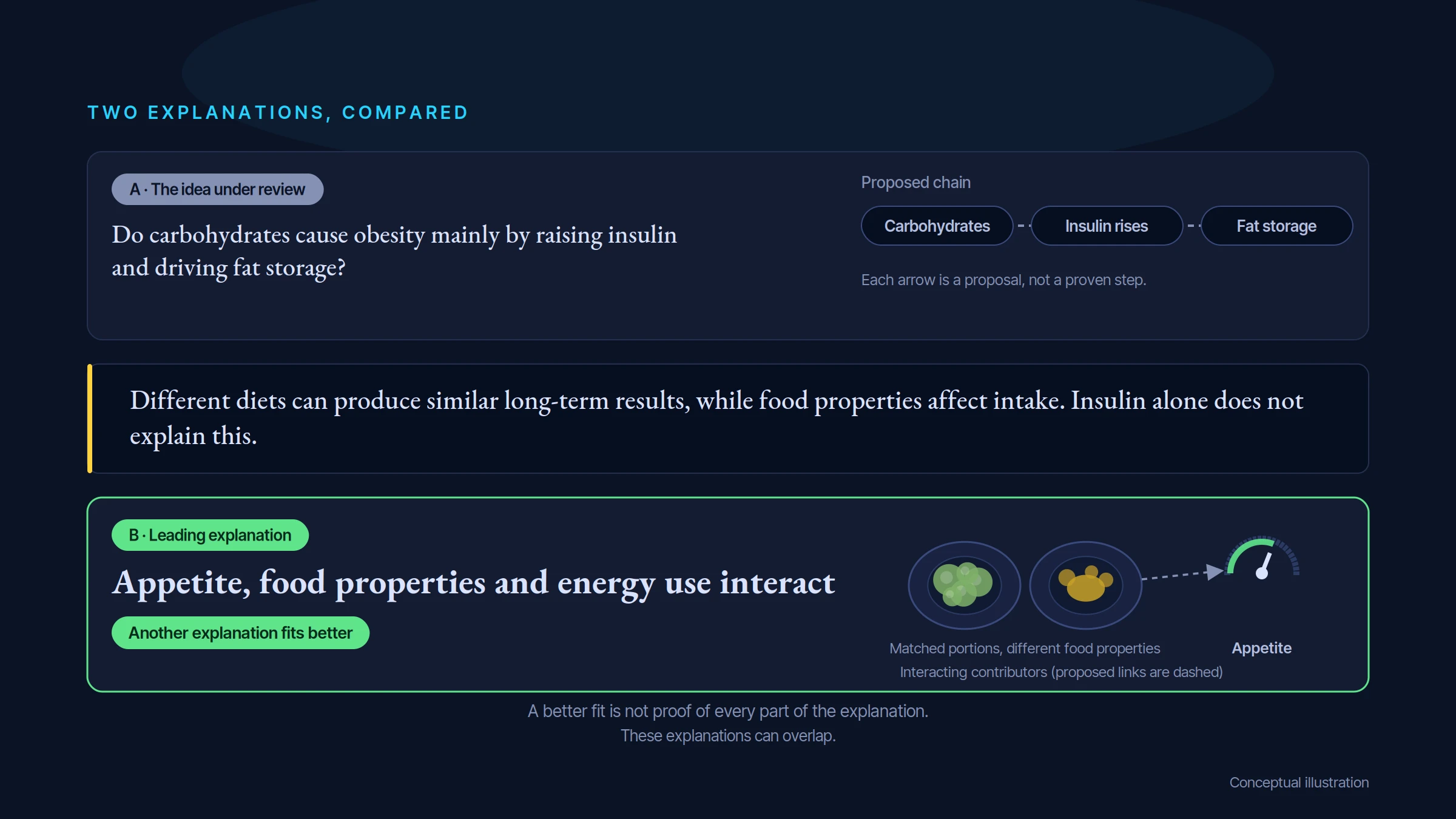
TWO EXPLANATIONS, COMPARED
A · The idea under review
Do carbohydrates cause obesity mainly by raising insulin and driving fat storage?
Proposed chain
Carbohydrates
Insulin rises
Fat storage
Each arrow is a proposal, not a proven step.
Different diets can produce similar long-term results, while food properties affect intake. Insulin alone does not explain this.
B · Leading explanation
Appetite, food properties and energy use interact
Another explanation fits better
Matched portions, different food properties
Appetite
Interacting contributors (proposed links are dashed)
A better fit is not proof of every part of the explanation.
These explanations can overlap.
Conceptual illustration
Plausible, not established for the stated claim.
Different diets can produce similar long-term results, while food properties affect intake. Insulin alone does not explain this.
These explanations can overlap. Ranking their fit to the evidence is separate from deciding how firmly a cause has been established.
Rank 1: Integrated energy-homeostasis model — Brain, endocrine, autonomic, adipose, gut, muscle, genetic, and environmental signals jointly regulate intake, expenditure, and partitioning; insulin is one signal within that system.
Rank 2: Food-form and dietary-architecture model — Energy density, eating rate, texture, palatability, protein leverage, fiber matrix, and processing can alter voluntary intake and weight independently of a uniquely carbohydrate-driven insulin pathway.
Rank 3: Context-specific carbohydrate sensitivity — High glycemic load or high insulin secretion worsens appetite or adiposity in identifiable people or dietary contexts, without being the universal primary cause of obesity.
Rank 4: Primary carbohydrate-insulin model — Carbohydrate-induced insulin diverts fuel into adipose tissue, causes hunger and lower expenditure, and is the dominant cause of common obesity independently of energy intake as such.
Evidence rating: Γ · High confidence. How the evidence was assessed.
Different diets can produce similar long-term results, while food properties affect intake. Insulin alone does not explain this.
This leaves room for different dietary approaches to help different people, especially when they are nutritionally adequate and sustainable. It does not make carbohydrate restriction a universally superior treatment, nor does it show that body weight is simply the result of willpower or one hormone. In practice, obesity treatment can involve nutrition, physical activity, sleep, medicines, mental-health support, management of related disease, and, for some people, bariatric procedures—choices that need an individual assessment.
Look for the proposed factor and the outcome, in the people or systems covered by the claim.
Appetite, food properties and energy use interact. Different diets can produce similar long-term results, while food properties affect intake. Insulin alone does not explain this.
Compare diets while measuring insulin, appetite, intake, energy use and body fat.
These illustrations show the key questions tested in the review. They are conceptual drawings, not microscope images or experimental results.
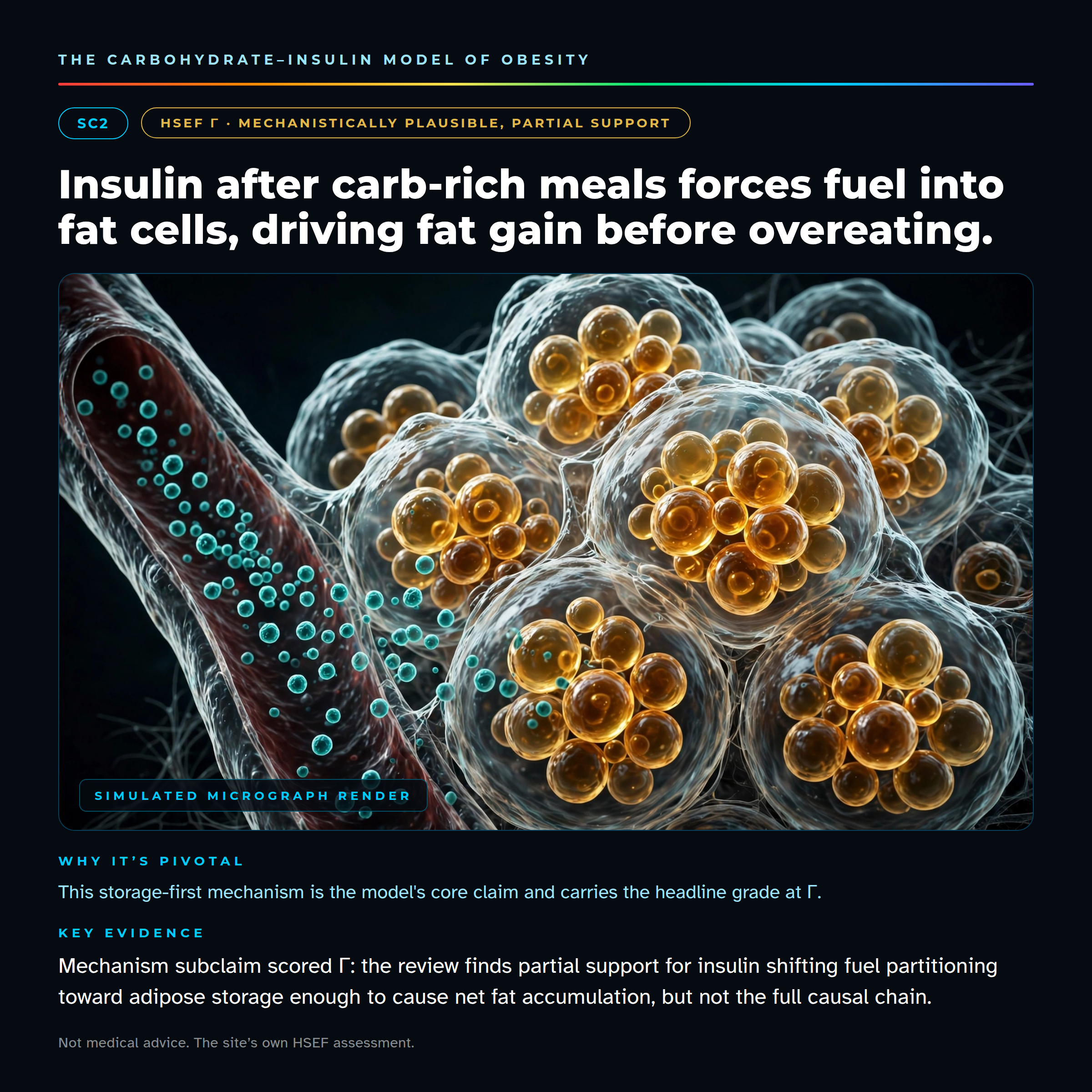
The carbohydrate-driven insulin response shifts fuel partitioning toward adipose storage enough to cause net fat accumulation in humans, so that storage precedes and drives positive energy balance.
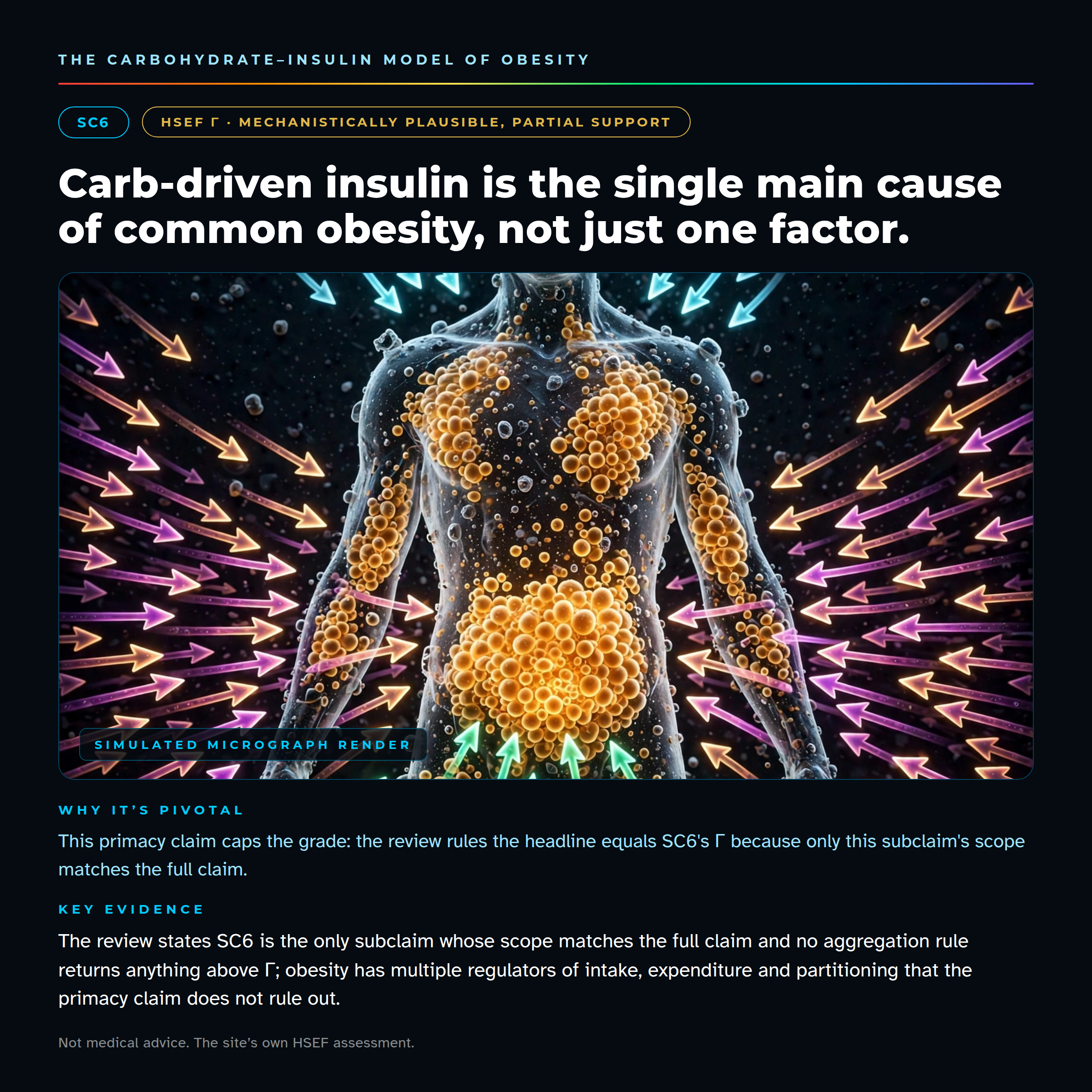
The carbohydrate-insulin pathway is the primary, necessary, or rate-limiting cause of common human obesity rather than one contributor among multiple regulators of energy intake, expenditure, and partitioning.
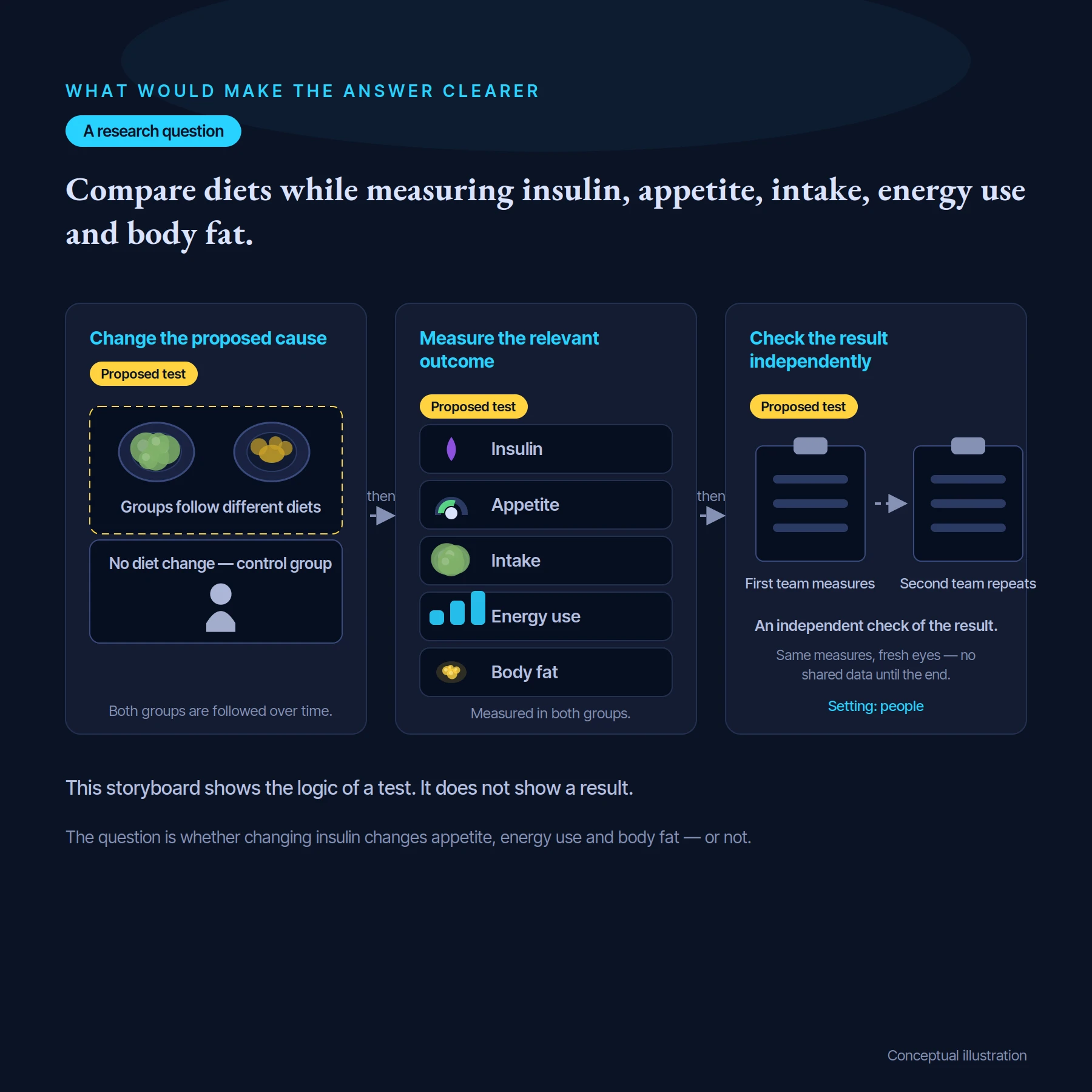
WHAT WOULD MAKE THE ANSWER CLEARER
A research question
Compare diets while measuring insulin, appetite, intake, energy use and body fat.
then
then
Change the proposed cause
Proposed test
Groups follow different diets
No diet change — control group
Both groups are followed over time.
Measure the relevant outcome
Insulin
Appetite
Intake
Energy use
Body fat
Measured in both groups.
Check the result independently
First team measures
Second team repeats
An independent check of the result.
Same measures, fresh eyes — no shared data until the end.
Setting: people
This storyboard shows the logic of a test. It does not show a result.
The question is whether changing insulin changes appetite, energy use and body fat — or not.
Conceptual illustration
Compare diets while measuring insulin, appetite, intake, energy use and body fat.
Check that the intended change really happened.
Allow for other factors and compare with suitable controls.
Look for independent confirmation and the limits of the effect.
These are questions for research, not a claim that the proposed studies have already succeeded.
Proposed tests: 3 test design(s) are registered in the scorecard.
In plain terms, researchers would change the proposed cause, check that it changed as intended, then measure a meaningful outcome while controlling plausible alternatives. The result should be able to support or count against the claim—not only show that a pathway exists.
Study design: Randomize adults with overweight or obesity to a factorial design crossing high versus low glycemic load with minimally processed versus ultra-processed food architecture for at least 8-12 weeks (past the proposed adaptation window), then include a prespecified ad-libitum phase.
What would be measured: Daily intake, hunger, insulin/C-peptide and glucagon, glucose, free fatty acids, ketones, substrate oxidation, doubly labelled water (with food quotient recorded) and chamber expenditure, body fat, and metabolic-flux mediation.
Important controls: Clamp protein, offered energy density, palatability targets, fiber type, sodium, meal schedule, and food mass where feasible; blind analysis; specify washout or parallel groups; audit adherence and unaccounted energy.
Result that would support the claim: A reproducible high-glycemic-load effect on intake and fat gain quantitatively mediated by insulin across both processing conditions.
Result that would count against it: Large insulin separation without the predicted hunger, intake, expenditure, or fat-mass ordering after food architecture is controlled.
Study design: Within a controlled dietary platform, alter carbohydrate-driven insulin exposure using two mechanistically distinct, clinically acceptable perturbations and include a rescue that restores insulin signaling without restoring the carbohydrate exposure.
What would be measured: Adipose lipolysis and esterification flux, circulating fuels, hypothalamic or behavioral appetite proxies, ad-libitum intake, expenditure, and fat balance.
Important controls: Match glycemia and other counter-regulatory hormones where possible, measure drug-specific off-target effects, and prespecify temporal mediation from insulin to fuels to appetite.
Result that would support the claim: Selective insulin reduction abolishes the fuel, hunger, and intake phenotype, and pathway-specific rescue restores it.
Result that would count against it: Hunger and intake track carbohydrate or food properties when insulin is dissociated, or the phenotype persists when insulin exposure is selectively reduced.
Study design: Use one fixed, pre-registered baseline insulin-secretion definition (e.g. INS-30 with a registered cut point) in at least two independent randomized trials with the same low- and high-glycemic-load diets.
What would be measured: Prespecified diet-by-phenotype interaction on fat mass and weight, plus appetite and expenditure mediation.
Important controls: Register the cut point and interaction model before enrollment, maintain meaningful diet separation, harmonize protein and diet quality, and avoid post-outcome responder definitions.
Result that would support the claim: A consistent clinically meaningful interaction in the same independently defined metabolic subgroup.
Result that would count against it: No replicated interaction or opposite-direction interactions across trials.
Follow the studies, detailed comparisons and evidence ratings behind this guide.
Open the scientific review →