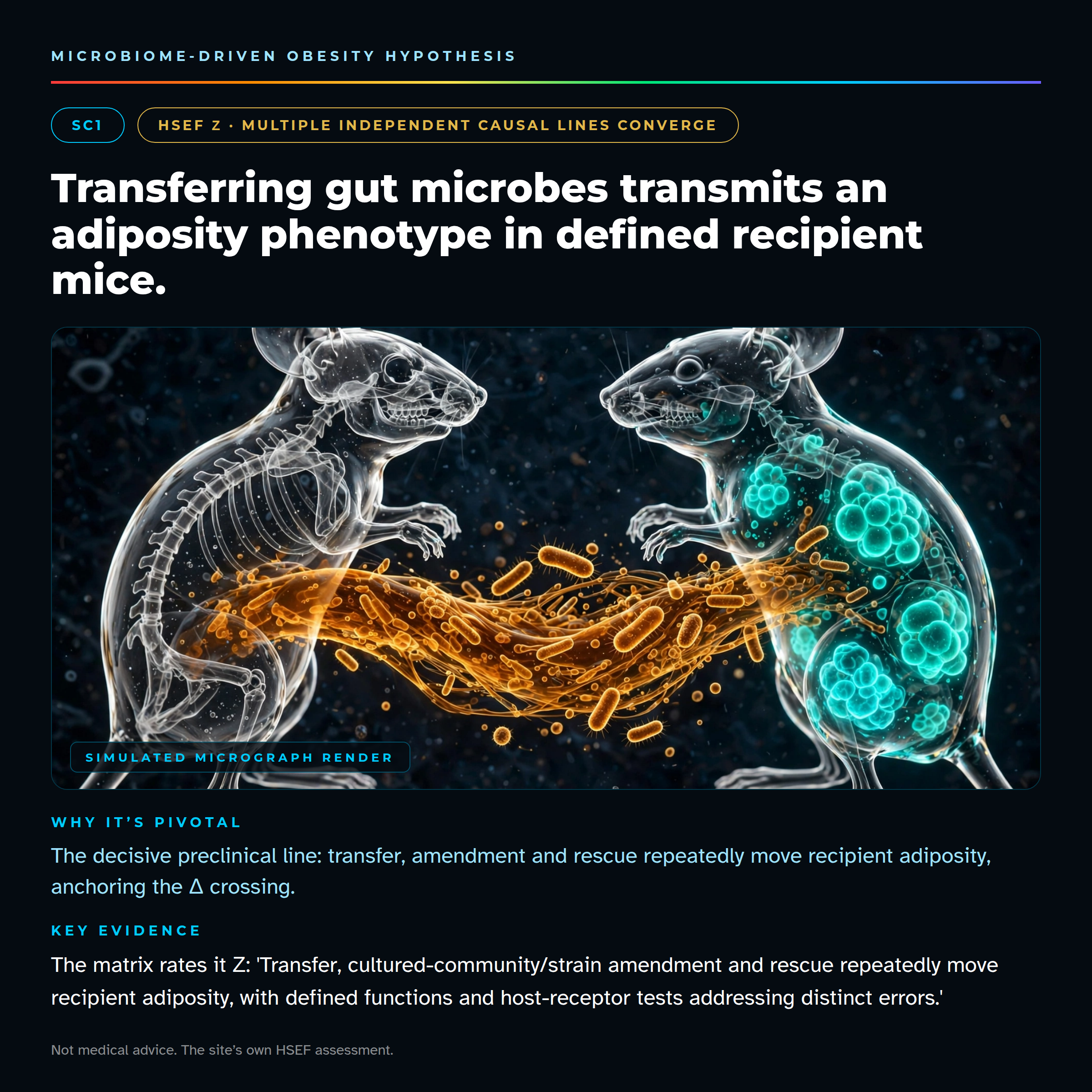
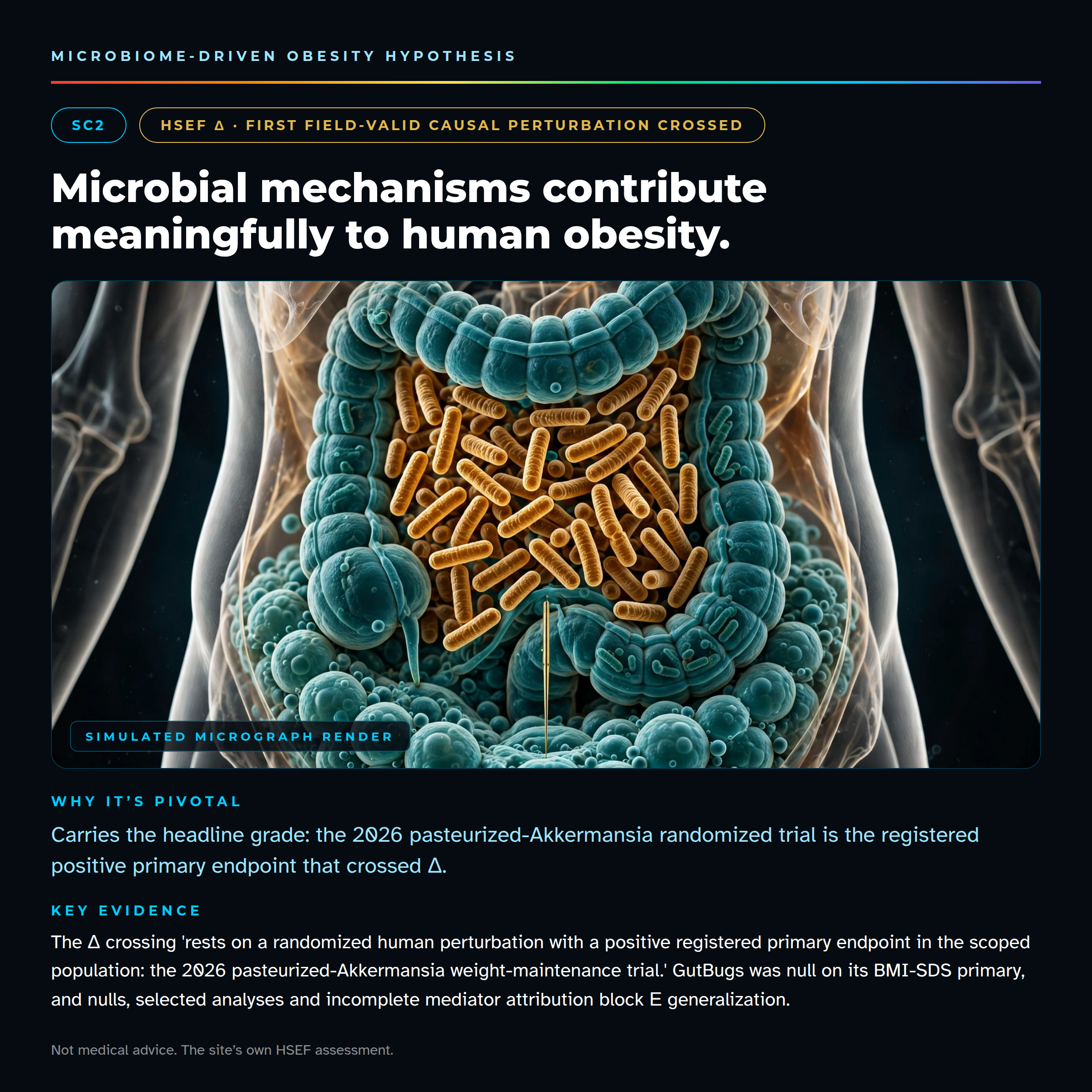
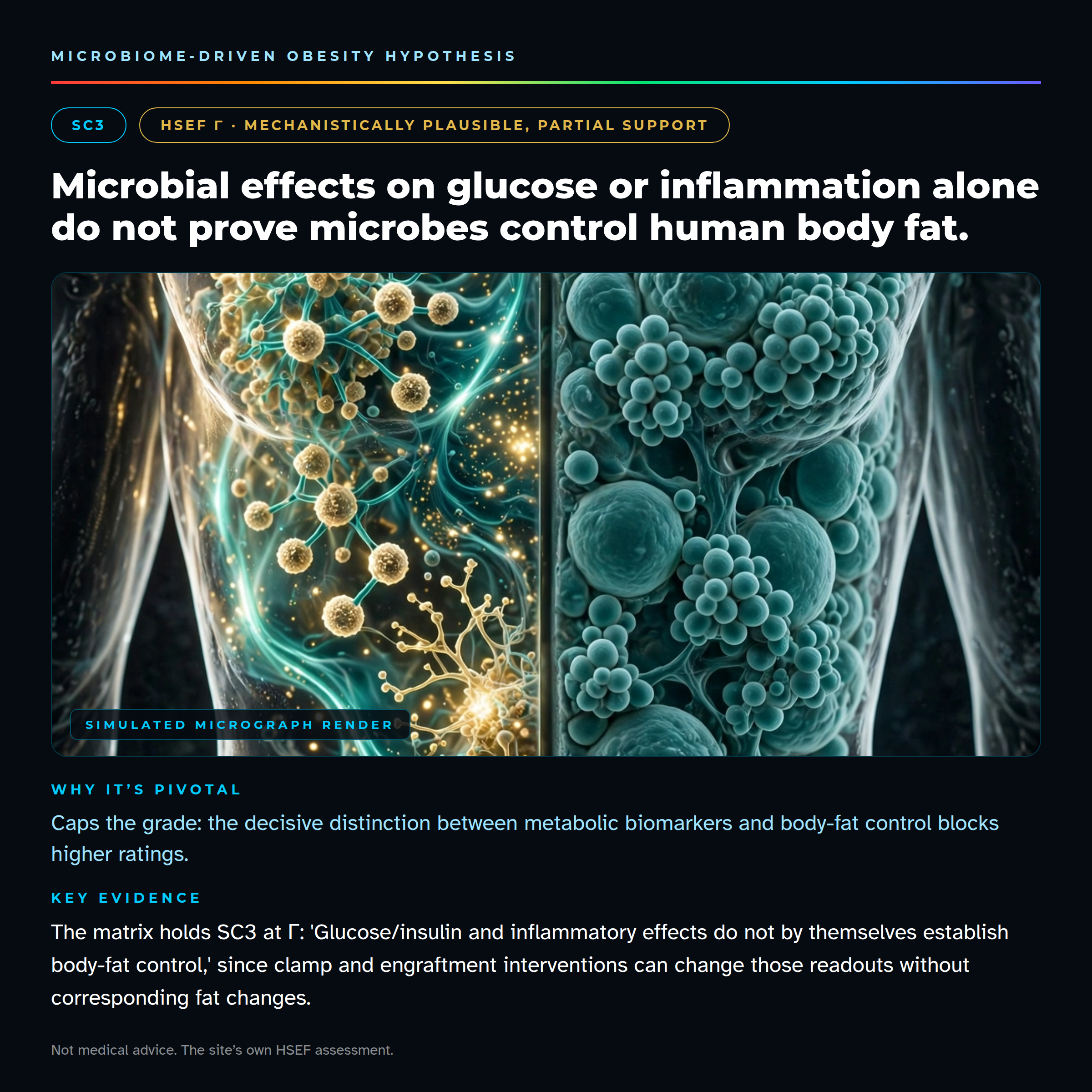
The question
Do gut microbes drive human fat gain beyond diet and energy regulation?
This is the specific idea being tested.
Do gut microbes drive human fat gain beyond diet and energy regulation?
What you need to knowThere is limited causal evidence, but a model combining diet, the body and microbes fits better than microbes alone.Relative explanatory fit: Alternative ranked ahead
Why the alternative fits better: Food changes microbial activity and energy exposure. Microbial effects depend on physiology and diet.
Claim assessed: Gut microbial configuration causally drives human fat accumulation through energy harvest, microbial products and endocrine signalling, beyond diet and host physiology.
Finding: The preregistered scope-matched human-contribution gate SC2 yields Δ / Moderate. Selected controlled human adiposity contrasts cross the in-vivo causal boundary, so a blanket Γ on mouse-to-human inference is not reapplied to the convergent human set. SC1 reaches scoped Ζ for animal transmissibility/rescue; SC3 remains Γ for the endpoint-substitution inference. Weakest-link sensitivity is Γ, primary-subclaim and scope-matched Δ. A stronger universal or primary human-driver reading would remain Γ; that is a separate burden, not a requirement silently added to the registered contribution gate.
Evidence scope: 68 primary reports; cutoff 2026-10-05; bounded critical review, not exhaustive systematic review.
The grade applies to the stated claim. Model rankings and individual subclaim grades remain separate from the overall causal-evidence grade.
Full scientific assessment and references · Scorecard (JSON) · Review source (Markdown)
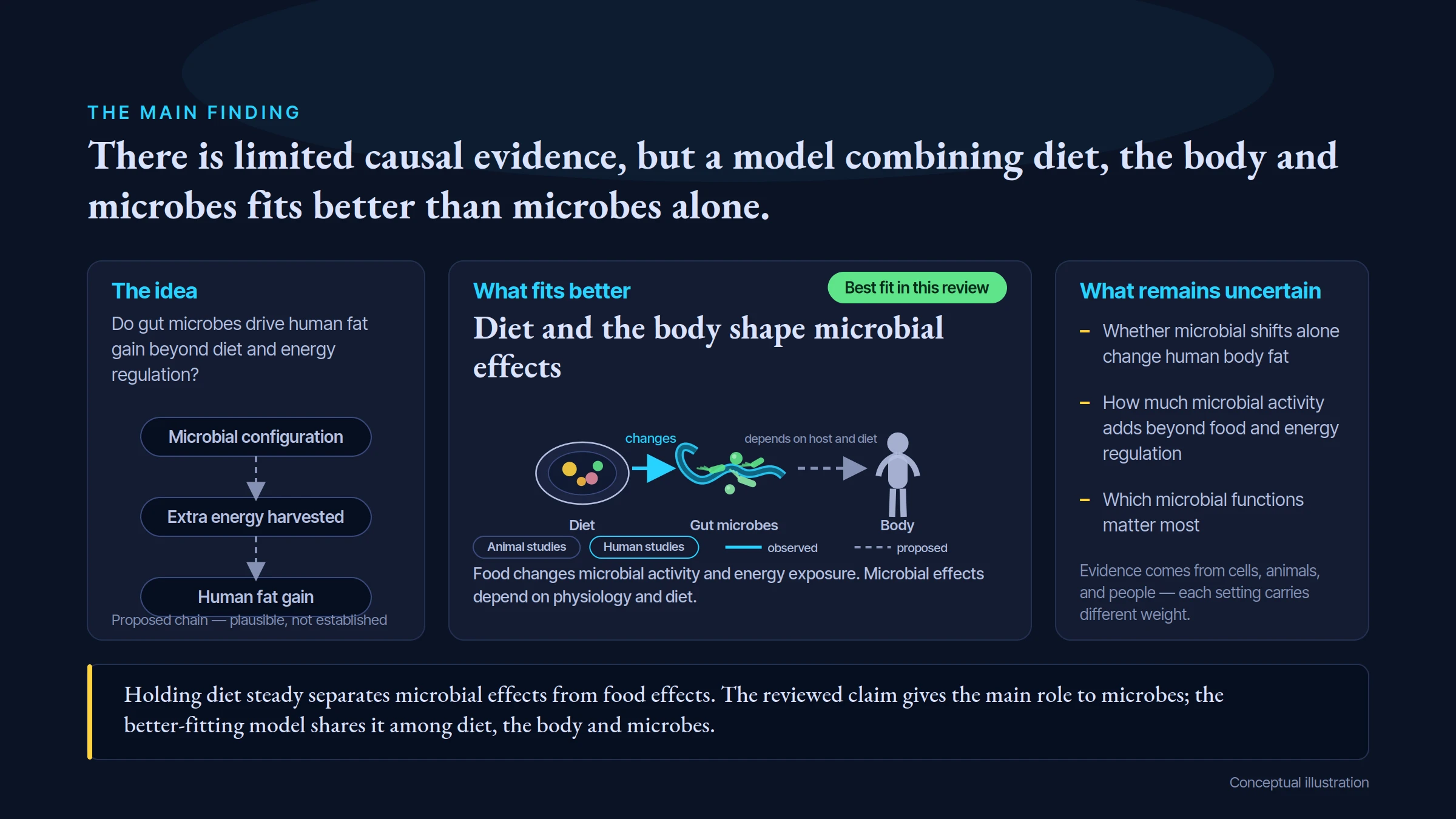
THE MAIN FINDING
There is limited causal evidence, but a model combining diet, the body and microbes fits better than microbes alone.
The idea
Do gut microbes drive human fat gain beyond diet and energy regulation?
Microbial configuration
Extra energy harvested
Human fat gain
Proposed chain — plausible, not established
What fits better
Diet and the body shape microbial effects
Best fit in this review
Food changes microbial activity (observed)
Microbial effects depend on host and diet (proposed link, gated)
Diet
Gut microbes
Body
Animal studies
Human studies
solid line: observed relationship
dashed line: proposed relationship
Food changes microbial activity and energy exposure. Microbial effects depend on physiology and diet.
What remains uncertain
Whether microbial shifts alone change human body fat
How much microbial activity adds beyond food and energy regulation
Which microbial functions matter most
Evidence comes from cells, animals, and people — each setting carries different weight.
Holding diet steady separates microbial effects from food effects. The reviewed claim gives the main role to microbes; the better-fitting model shares it among diet, the body and microbes.
Conceptual illustration
This is the specific idea being tested.
Food changes microbial activity and energy exposure. Microbial effects depend on physiology and diet.
A higher rank means a better fit to the evidence in this comparison. It does not prove every part of the leading explanation.
The reviewed hypothesis ranks 3 among 5 models compared; 1 alternative model(s) hold first rank for this stated claim.
Claim under review: rank 3 among 5 compared models.
Leading explanation: Diet and host energy balance with microbial interaction.
Position in this comparison: Between leading and last ranks.
The causal grade asks how well the stated causal claim is established. This comparison asks which of the assessed explanations fits the reviewed findings better. A leading explanation can remain unproven. Models can overlap or include the tested mechanism; an alternative ahead does not make that mechanism irrelevant. These ordinal ranks apply within this review; they do not measure the size of a difference or rank scientific strength across topics.
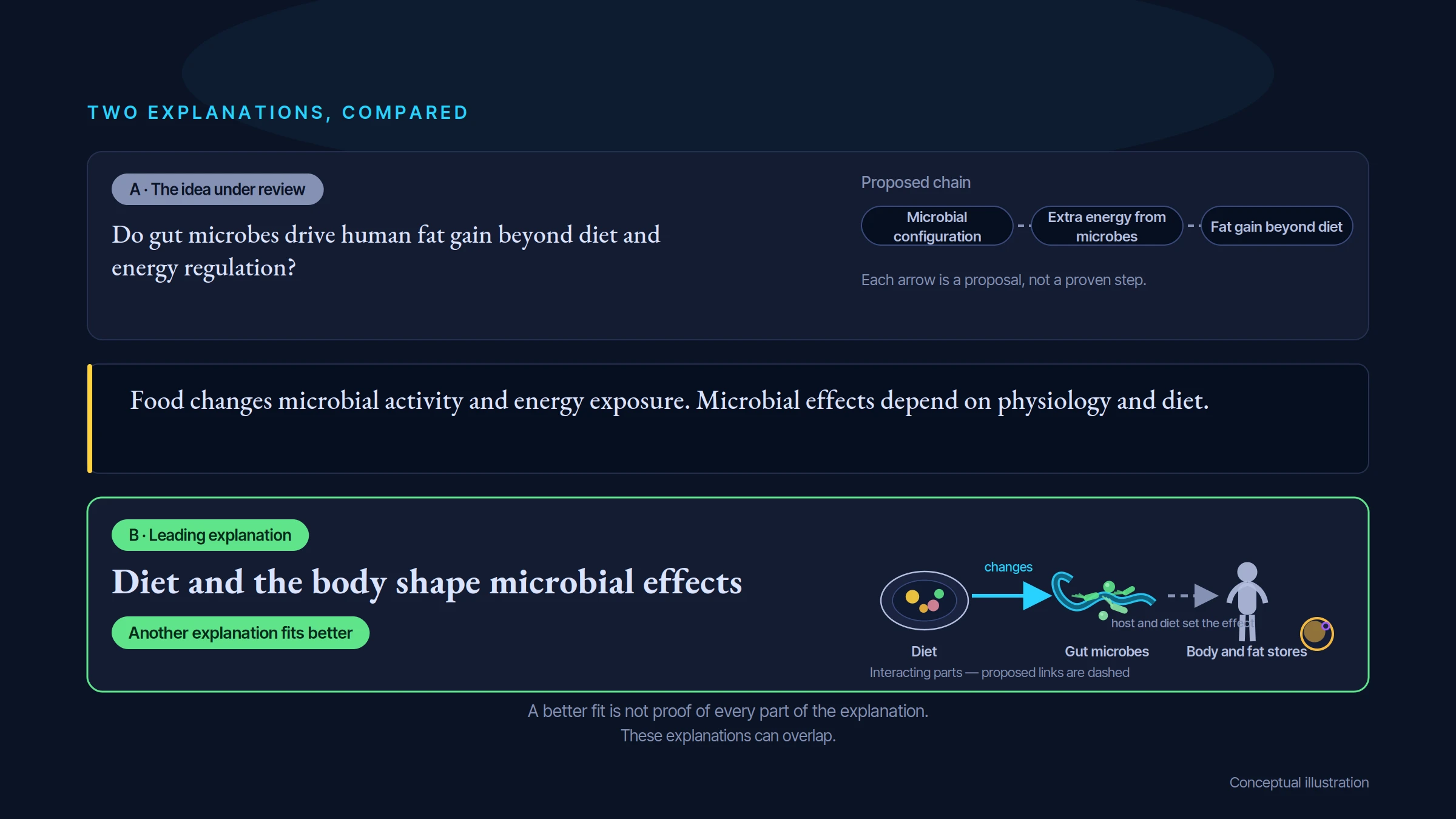
TWO EXPLANATIONS, COMPARED
A · The idea under review
Do gut microbes drive human fat gain beyond diet and energy regulation?
Proposed chain
Microbial configuration
Extra energy from microbes
Fat gain beyond diet
Each arrow is a proposal, not a proven step.
Food changes microbial activity and energy exposure. Microbial effects depend on physiology and diet.
B · Leading explanation
Diet and the body shape microbial effects
Another explanation fits better
Food changes microbial activity (observed)
Host and diet set the effect
Diet
Gut microbes
Body and fat stores
Interacting parts — proposed links are dashed
A better fit is not proof of every part of the explanation.
These explanations can overlap.
Conceptual illustration
First causal test for the stated claim.
Food changes microbial activity and energy exposure. Microbial effects depend on physiology and diet.
These explanations can overlap. Ranking their fit to the evidence is separate from deciding how firmly a cause has been established.
Rank 1: Diet and host energy balance with microbial interaction — Diet supplies substrate and changes microbial ecology; microbial effects depend on energy exposure and host physiology.
Rank 2: Metabolic-health modulation with partly independent adiposity — Microbial interventions can modify insulin, bile or inflammation without a large or consistent body-fat effect.
Rank 3: Microbial human adiposity contribution — The registered contributory claim: specific microbial interventions can modify human fat accumulation under bounded conditions.
Rank 4: Host physiology and reverse direction — Host genes, pregnancy, medication and energy exposure can remodel microbes before the measured phenotype.
Rank 5: Homeostatic compensation — Microbial calories and signalling can be offset or redirected by appetite, expenditure and absorptive adaptation.
Evidence rating: Δ · Moderate confidence. How the evidence was assessed.
Food changes microbial activity and energy exposure. Microbial effects depend on physiology and diet.
This is an assessment of a causal explanation, not proof that a particular supplement, diet, test, or treatment improves health. A treatment claim needs studies that test the intervention in people and measure meaningful benefits and harms. These findings can help frame research and informed clinical questions, but they do not identify what is right for one person.
Look for the proposed factor and the outcome, in the people or systems covered by the claim.
Diet and the body shape microbial effects. Food changes microbial activity and energy exposure. Microbial effects depend on physiology and diet.
Hold dietary energy and conditions steady while changing microbial functions and measuring body fat.
These illustrations show the key questions tested in the review. They are conceptual drawings, not microscope images or experimental results.
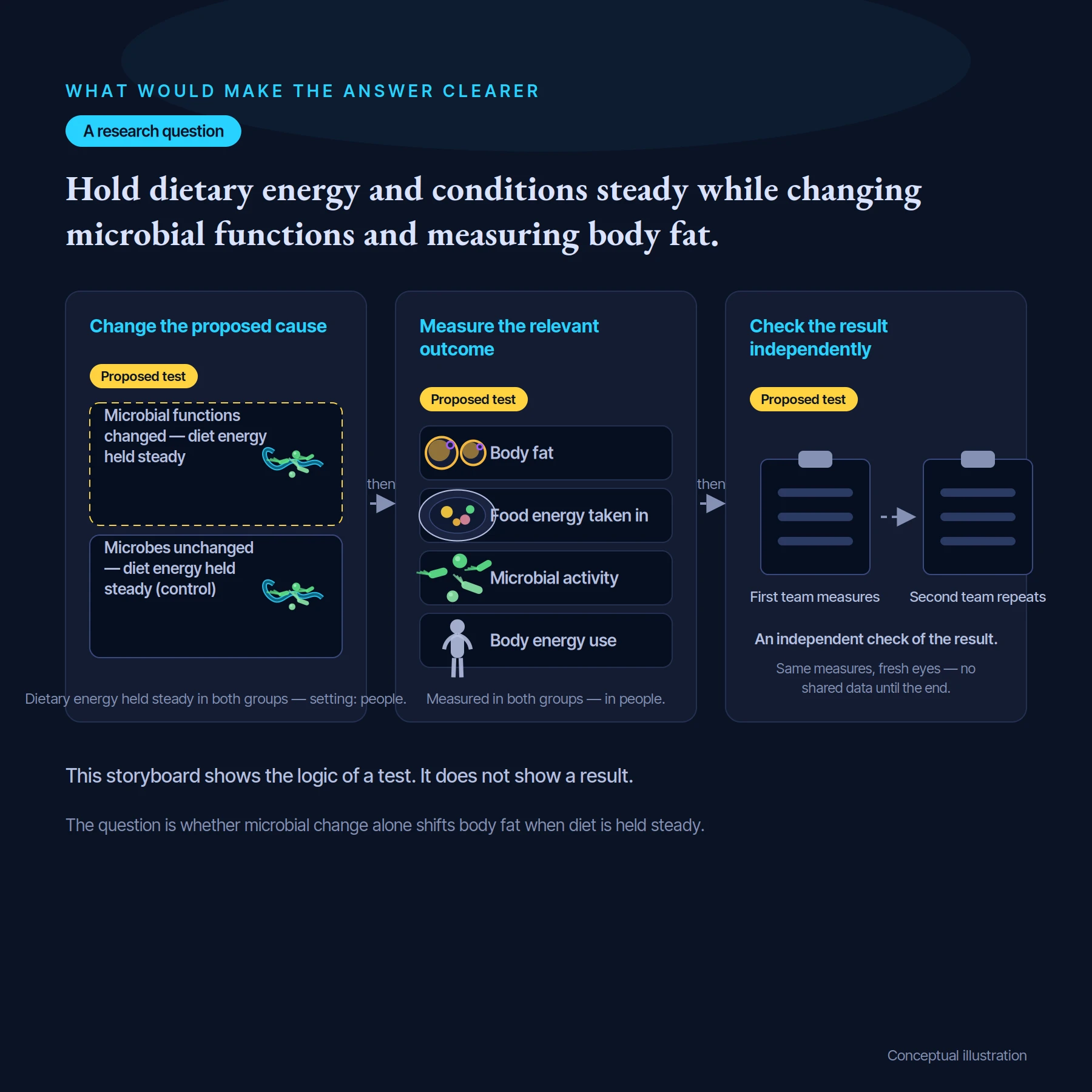
WHAT WOULD MAKE THE ANSWER CLEARER
A research question
Hold dietary energy and conditions steady while changing microbial functions and measuring body fat.
then
then
Change the proposed cause
Proposed test
Microbial functions changed — diet energy held steady
Microbes unchanged — diet energy held steady (control)
Dietary energy held steady in both groups — setting: people.
Measure the relevant outcome
Proposed test
Body fat
Food energy taken in
Microbial activity
Body energy use
Measured in both groups — in people.
Check the result independently
Proposed test
First team measures
Second team repeats
An independent check of the result.
Same measures, fresh eyes — no shared data until the end.
This storyboard shows the logic of a test. It does not show a result.
The question is whether microbial change alone shifts body fat when diet is held steady.
Conceptual illustration
Hold dietary energy and conditions steady while changing microbial functions and measuring body fat.
Check that the intended change really happened.
Allow for other factors and compare with suitable controls.
Look for independent confirmation and the limits of the effect.
These are questions for research, not a claim that the proposed studies have already succeeded.
Proposed tests: 1 test design(s) are registered in the scorecard.
In plain terms, researchers would change the proposed cause, check that it changed as intended, then measure a meaningful outcome while controlling plausible alternatives. The result should be able to support or count against the claim—not only show that a pathway exists.
Study design: Randomize a prespecified human obesity population to a defined live strain/consortium, an otherwise matched inactive microbial preparation and placebo, under matched dietary exposure. Use a registered fat-mass primary ITT endpoint over6-12 months, separate maintenance from initial loss, and measure strain/function exposure, energy intake/loss, expenditure and candidate mediators longitudinally. Confirm the same function with subtraction/addition and rescue in two independent recipient facilities; replicate clinical effects in a separate cohort.
What would be measured: DXA total fat mass and validated visceral fat, with distinct body weight, energy absorption, clamp and hormone outcomes; predefined between-arm contrasts and mediator timing
Important controls: Allocation concealment, blinding, full ITT/missing-data sensitivity, inactive-factor control, stable medications, stratified baseline microbiome/sex/diet, exposure/engraftment measures, clinical multiplicity and cage/diet-batch controls
Result that would support the claim: A prespecified clinically meaningful fat difference with confirmed microbial functional exposure and independently replicated causal pathway, beyond matched dietary exposure without assuming unchanged appetite is required
Result that would count against it: Adequate exposure with a precise fat-primary null across prespecified contexts, inactive product matching live efficacy without the nominated function, or loss of the effect after dietary/host and missing-data controls
Follow the studies, detailed comparisons and evidence ratings behind this guide.
Open the scientific review →