The question
Does the immune system stop some cancers from emerging or progressing?
This is the specific idea being tested.

Does the immune system stop some cancers from emerging or progressing?
What you need to knowImmune control has strong support, but can hold cancer in check without removing every cancer cell.Relative explanatory fit: Alternative ranked ahead
Why the alternative fits better: Viable tumour cells can survive under immune control and later escape. This explains more than complete removal alone.
Claim assessed: Innate and adaptive immune surveillance causally suppresses the emergence and progression of cancers by recognizing and controlling transformed cells.
Finding: Ζ for the preregistered SC1 scope-matched emergence-restraint gate, with Η established-tumour control and Γ elimination-dominance reported separately. The nominal claim says suppresses emergence/progression, not that all cancers require failed immunity or that suppression must sterilize cells. Weakest-link Γ is an explicit sensitivity to the additional elimination-exclusive subclaim, not a reason to demote the nominal restraint claim. The assembled set crosses Δ/Ε/Ζ through temporally and antigen-resolved native tests, orthogonal innate/adaptive mechanisms, human immune-status contrasts and randomized residual-outgrowth prevention; no single broad-deficiency leg is used as the sole instrument.
Evidence scope: 65 primary reports; literature cutoff 2026-10-05; source examination UTC date 2026-10-06; bounded critical review, not exhaustive systematic review.
The grade applies to the stated claim. Model rankings and individual subclaim grades remain separate from the overall causal-evidence grade.
Full scientific assessment and references · Scorecard (JSON) · Review source (Markdown)
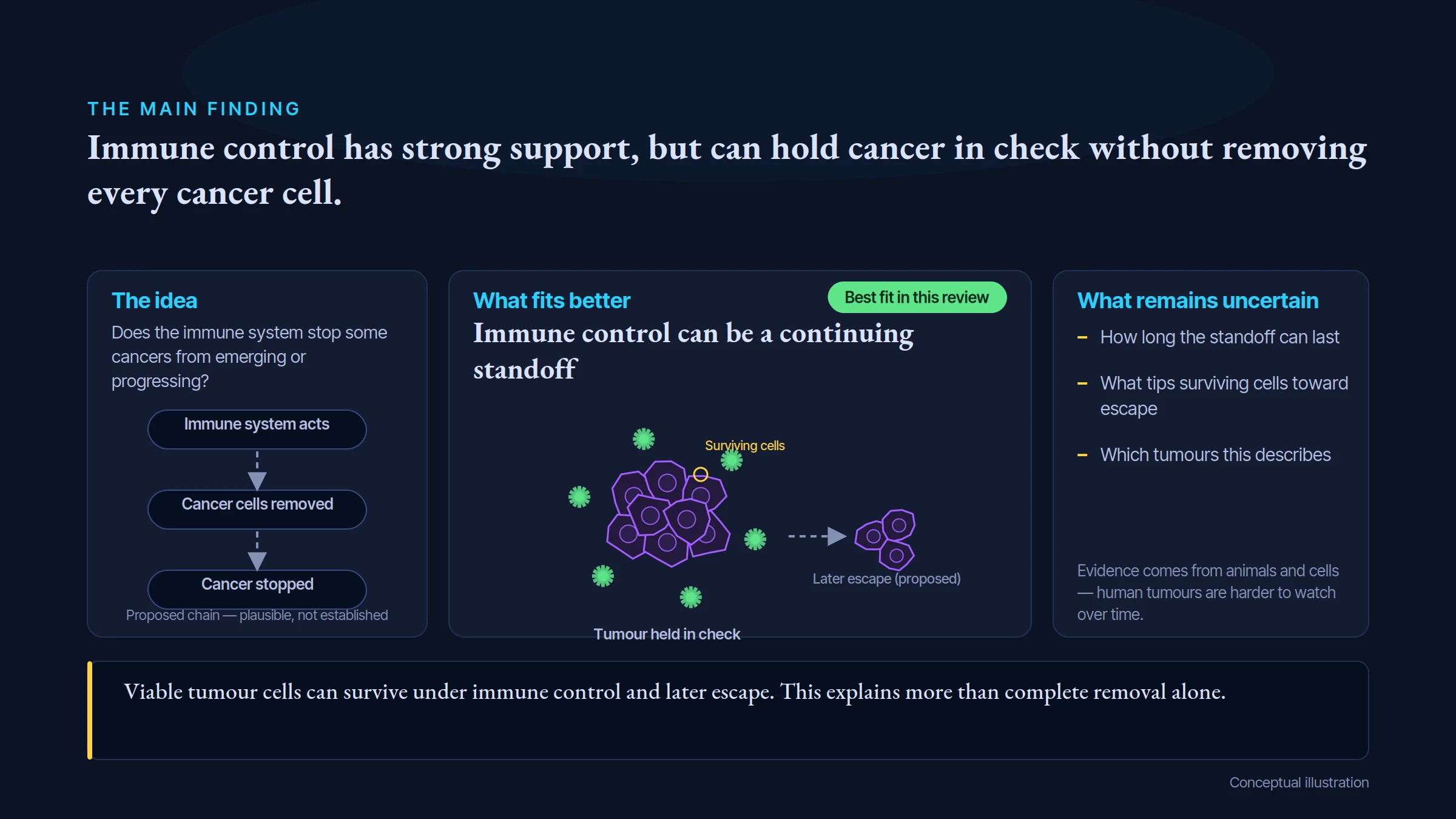
THE MAIN FINDING
Immune control has strong support, but can hold cancer in check without removing every cancer cell.
The idea
What fits better
What remains uncertain
Does the immune system stop some cancers from emerging or progressing?
Immune system acts
Cancer cells removed
Cancer stopped
Proposed chain — plausible, not established
Immune control can be a continuing standoff
Best fit in this review
Tumour held in check
Surviving cells
Later escape (proposed)
How long the standoff can last
What tips surviving cells toward escape
Which tumours this describes
Evidence comes from animals and cells — human tumours are harder to watch over time.
Viable tumour cells can survive under immune control and later escape. This explains more than complete removal alone.
Conceptual illustration
This is the specific idea being tested.
Viable tumour cells can survive under immune control and later escape. This explains more than complete removal alone.
A higher rank means a better fit to the evidence in this comparison. It does not prove every part of the leading explanation.
The reviewed hypothesis ranks 2 among 5 models compared; 1 alternative model(s) hold first rank for this stated claim.
Claim under review: rank 2 among 5 compared models.
Leading explanation: Immune equilibrium and context-dependent editing.
Position in this comparison: Next after leading rank.
The causal grade asks how well the stated causal claim is established. This comparison asks which of the assessed explanations fits the reviewed findings better. A leading explanation can remain unproven. Models can overlap or include the tested mechanism; an alternative ahead does not make that mechanism irrelevant. These ordinal ranks apply within this review; they do not measure the size of a difference or rank scientific strength across topics.
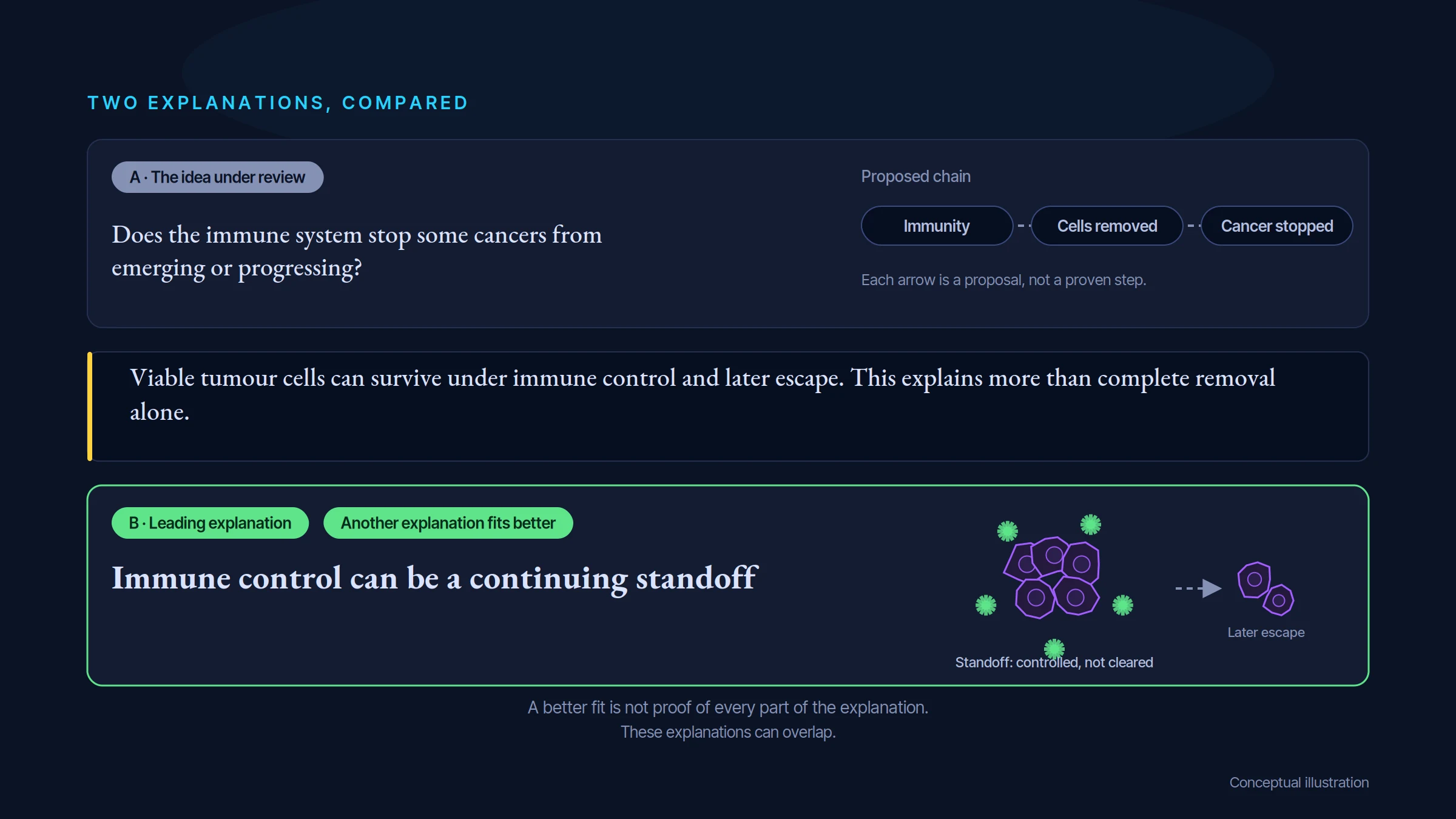
TWO EXPLANATIONS, COMPARED
A · The idea under review
Does the immune system stop some cancers from emerging or progressing?
Proposed chain
Immunity
Cells removed
Cancer stopped
Each arrow is a proposal, not a proven step.
Viable tumour cells can survive under immune control and later escape. This explains more than complete removal alone.
B · Leading explanation
Immune control can be a continuing standoff
Another explanation fits better
Standoff: controlled, not cleared
Later escape
A better fit is not proof of every part of the explanation.
These explanations can overlap.
Conceptual illustration
Strong, scope-limited evidence for the stated claim.
Viable tumour cells can survive under immune control and later escape. This explains more than complete removal alone.
These explanations can overlap. Ranking their fit to the evidence is separate from deciding how firmly a cause has been established.
Rank 1: Immune equilibrium and context-dependent editing — Immune cells can suppress outgrowth while viable cells survive and escape.
Rank 2: Immune recognition and elimination — Transformed-cell recognition can remove susceptible cells and shape tumour emergence.
Rank 3: Cell-intrinsic stealth and quiescence — Latent cells reduce cycling and recognition to survive.
Rank 4: Niche and competition-mediated dormancy — Mechanical, stromal and cell-competition contexts restrain or promote residual cells.
Rank 5: Inflammatory or microbial promotion — Some immune or microbial states accelerate tumour growth or impair therapy.
Evidence rating: Ζ · Moderate confidence. How the evidence was assessed.
Viable tumour cells can survive under immune control and later escape. This explains more than complete removal alone.
This is an assessment of a causal explanation, not proof that a particular supplement, diet, test, or treatment improves health. A treatment claim needs studies that test the intervention in people and measure meaningful benefits and harms. These findings can help frame research and informed clinical questions, but they do not identify what is right for one person.
Look for the proposed factor and the outcome, in the people or systems covered by the claim.
Immune control can be a continuing standoff. Viable tumour cells can survive under immune control and later escape. This explains more than complete removal alone.
Track surviving tumour cells while changing immune control and checking later regrowth.
These illustrations show the key questions tested in the review. They are conceptual drawings, not microscope images or experimental results.
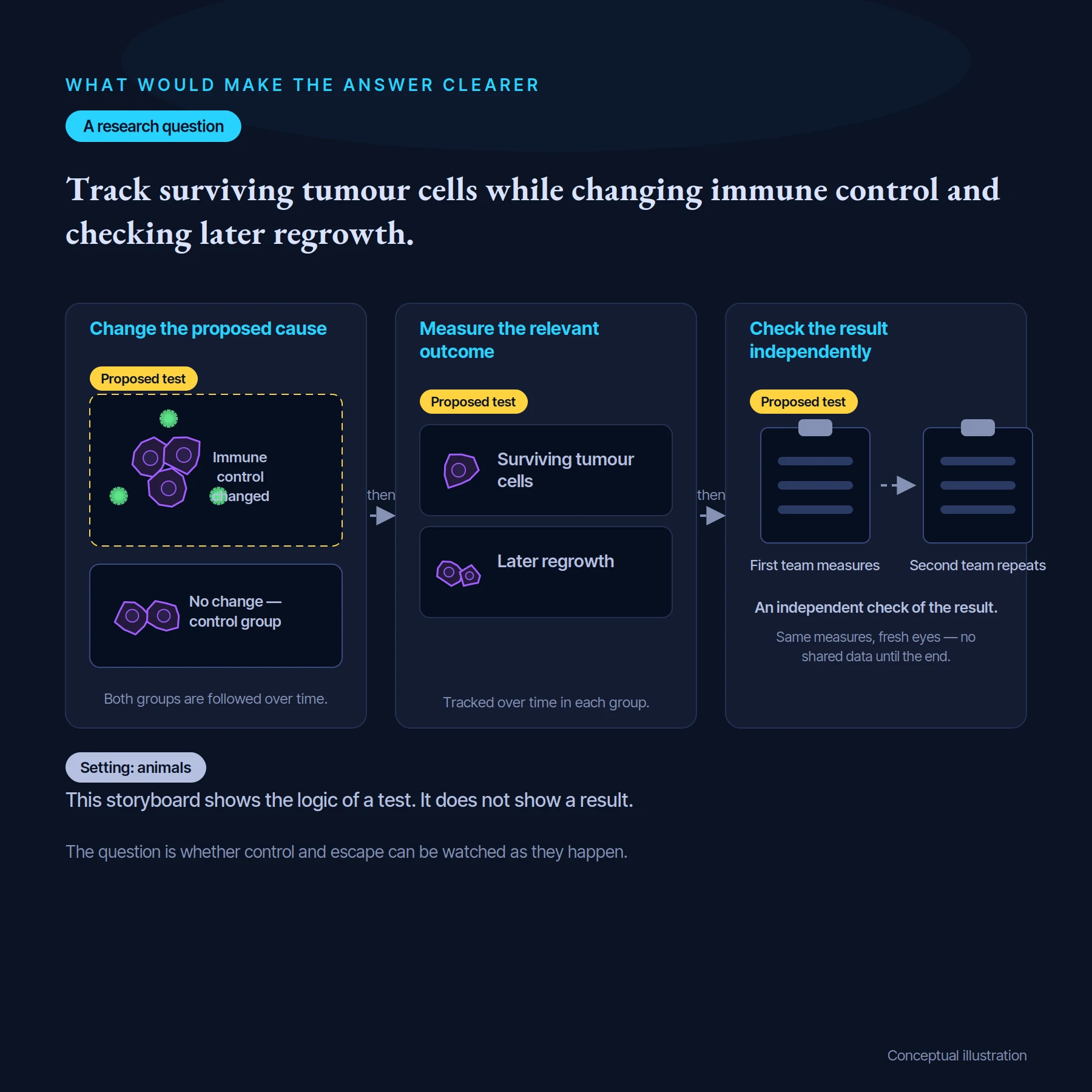
WHAT WOULD MAKE THE ANSWER CLEARER
A research question
Track surviving tumour cells while changing immune control and checking later regrowth.
then
then
Change the proposed cause
Proposed test
Measure the relevant outcome
Proposed test
Check the result independently
Proposed test
Immune control changed
No change — control group
Surviving tumour cells
Later regrowth
Tracked over time in each group.
First team measures
Second team repeats
An independent check of the result.
Same measures, fresh eyes — no shared data until the end.
Both groups are followed over time.
Setting: animals
This storyboard shows the logic of a test. It does not show a result.
The question is whether control and escape can be watched as they happen.
Conceptual illustration
Track surviving tumour cells while changing immune control and checking later regrowth.
Check that the intended change really happened.
Allow for other factors and compare with suitable controls.
Look for independent confirmation and the limits of the effect.
These are questions for research, not a claim that the proposed studies have already succeeded.
Proposed tests: 1 test design(s) are registered in the scorecard.
In plain terms, researchers would change the proposed cause, check that it changed as intended, then measure a meaningful outcome while controlling plausible alternatives. The result should be able to support or count against the claim—not only show that a pathway exists.
Study design: Prospectively trace antigen-defined premalignant clones in a prespecified high-risk human tissue and pair serial viable-cell/immune-contact measures with a narrowly targeted, ethically acceptable interception or rigorous natural immune-pathway contrast.
What would be measured: Clone survival, malignant conversion, immune engagement and subsequent clinical emergence
Important controls: Baseline antigen-negative clones, virus status, intrinsic growth traits and surveillance intensity; distinguish viable dormancy from absent detection
Result that would support the claim: Selective recognition engagement reduces conversion/outgrowth with a mediator-consistent contrast and independent replication
Result that would count against it: Engagement changes immune markers without clone fate or clinical emergence, or nonimmune traits fully explain the contrast
Follow the studies, detailed comparisons and evidence ratings behind this guide.
Open the scientific review →