The question
Does Epitalon activate telomerase and extend healthy life in people?
This is the specific idea being tested.
Does Epitalon activate telomerase and extend healthy life in people?
What you need to knowCell experiments do not establish that Epitalon extends healthy human life.Relative explanatory fit: Alternative ranked ahead
Why the alternative fits better: Some cultured cells respond, but human tissue delivery, telomere effects and health benefits have not been established.
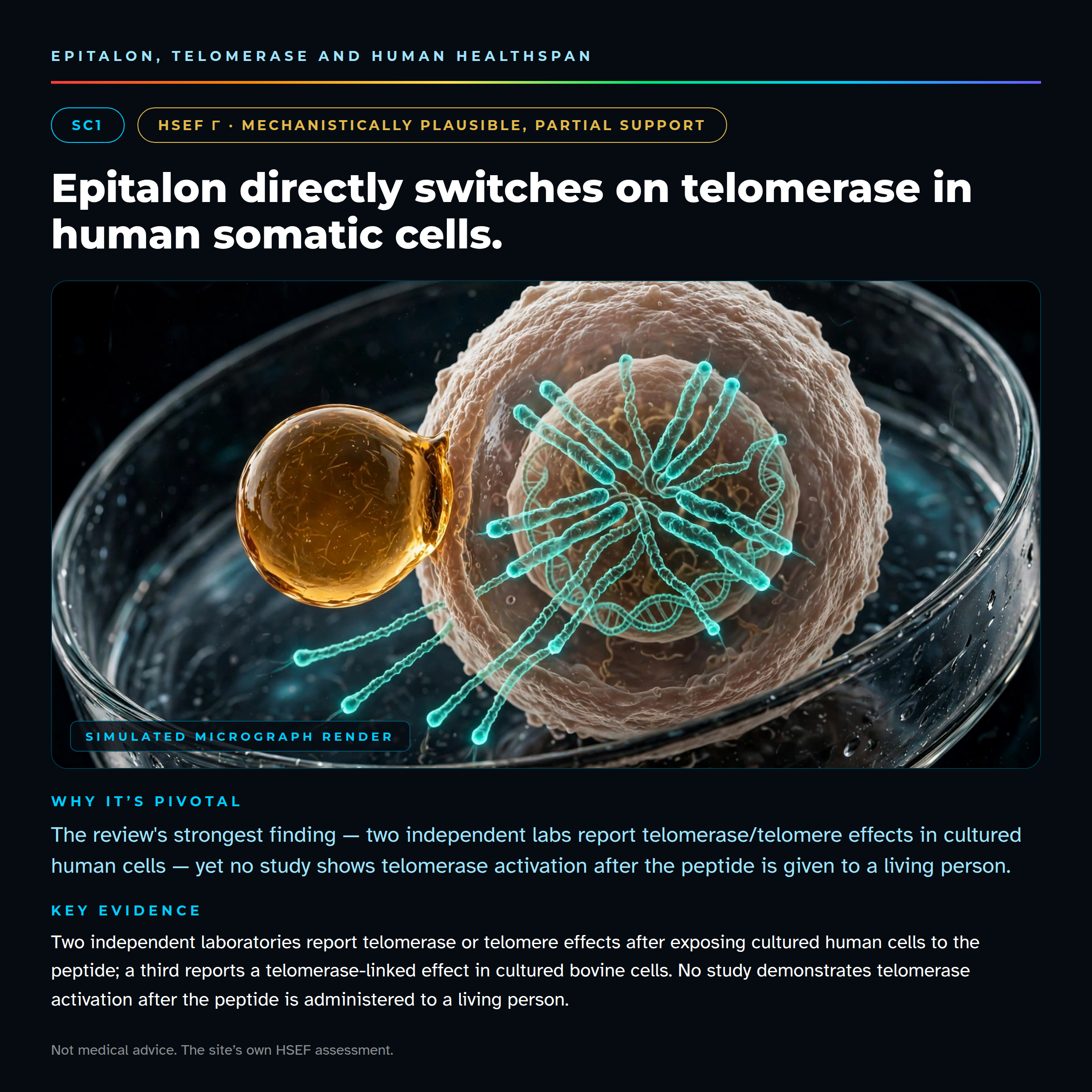
Claim assessed: In humans, administration of the synthetic tetrapeptide Epitalon activates telomerase in somatic cells, produces durable telomere maintenance with net elongation, and thereby slows age-related functional decline sufficiently to extend healthspan.
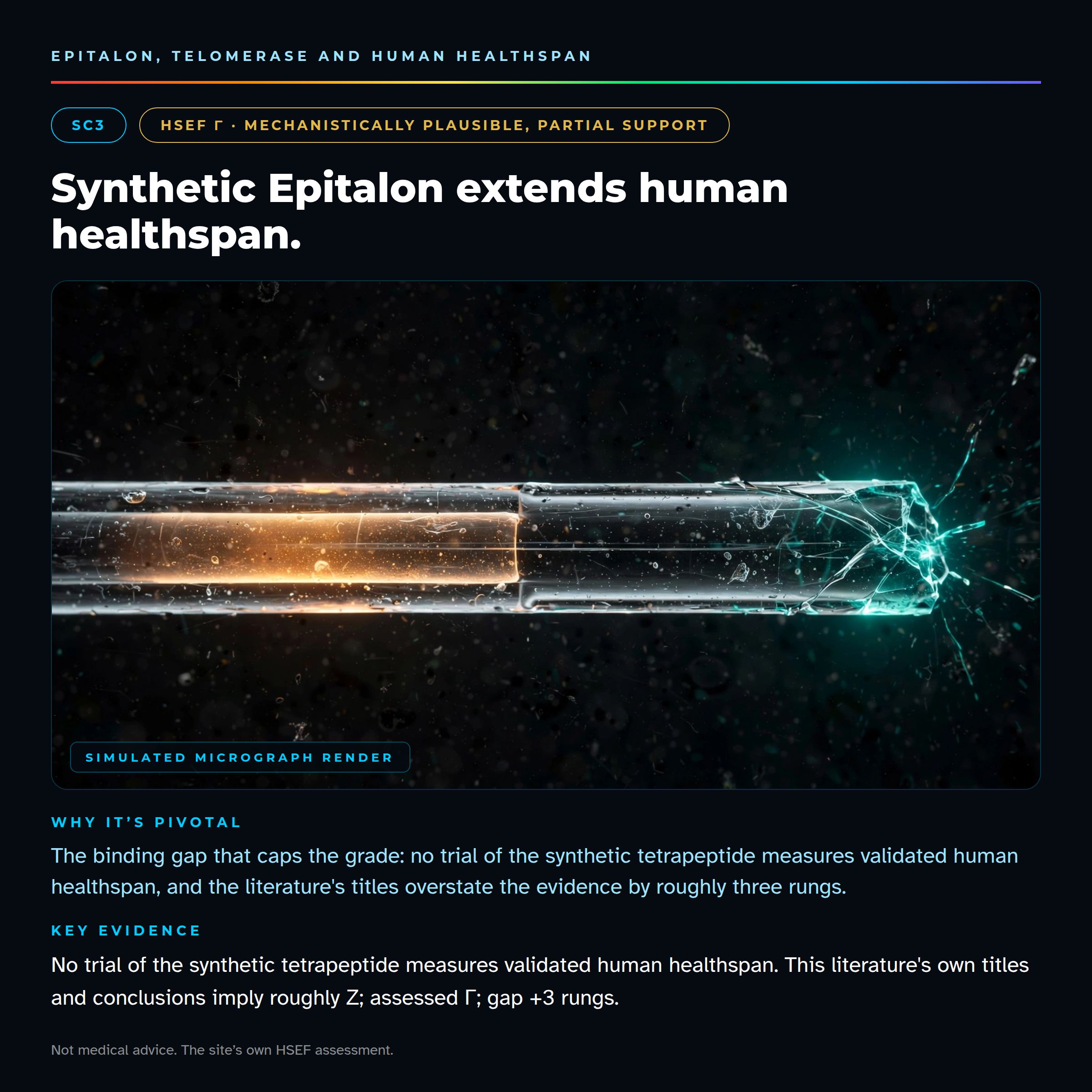
Finding: Cultured-cell findings in three laboratories make telomerase activation mechanistically plausible. The claim cannot cross Δ because no intervention with this peptide demonstrates telomerase activation in living humans, durable human telomere maintenance, or extension of validated human healthspan, and no study in any system establishes telomerase mediation. At the claimed human scope there is no evidence at all; the level is carried by cell-culture and animal systems, which is what Γ describes.
Evidence scope: Primary literature and accessible regulatory and registry context through 2026-09-30. Every identifier was resolved with PubMed tools in the red-team pass; ClinicalTrials.gov was re-searched; the FDA evaluation was re-read. Full text was read where machine-readable. Two primaries are image-only scans and are treated at abstract-and-metadata depth, with the specifics that only those scans supported withdrawn.
The grade applies to the stated claim. Model rankings and individual subclaim grades remain separate from the overall causal-evidence grade.
Full scientific assessment and references · Scorecard (JSON) · Review source (Markdown)
THE MAIN FINDING
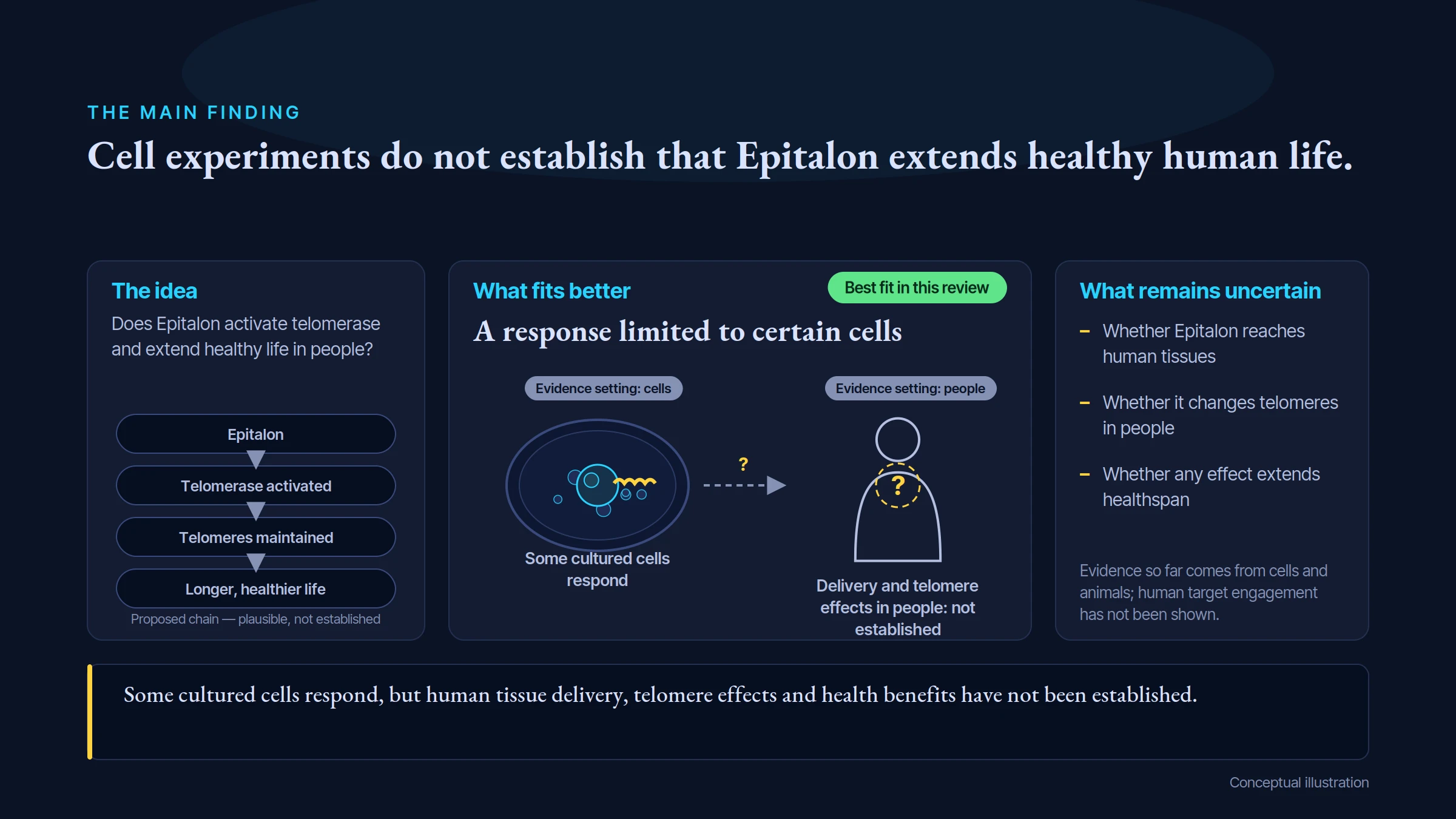
Cell experiments do not establish that Epitalon extends healthy human life.
The idea
Does Epitalon activate telomerase and extend healthy life in people?
Epitalon
Telomerase activated
Telomeres maintained
Longer, healthier life
Proposed chain — plausible, not established
What fits better
A response limited to certain cells
Best fit in this review
Evidence setting: cells
Some cultured cells respond
Evidence setting: people
Delivery and telomere effects in people: not established
What remains uncertain
Whether Epitalon reaches human tissues
Whether it changes telomeres in people
Whether any effect extends healthspan
Evidence so far comes from cells and animals; human target engagement has not been shown.
Some cultured cells respond, but human tissue delivery, telomere effects and health benefits have not been established.
Conceptual illustration
This is the specific idea being tested.
Some cultured cells respond, but human tissue delivery, telomere effects and health benefits have not been established.
A higher rank means a better fit to the evidence in this comparison. It does not prove every part of the leading explanation.
The reviewed hypothesis ranks 2 among 4 models compared; 1 alternative model(s) hold first rank for this stated claim.
Claim under review: rank 2 among 4 compared models.
Leading explanation: Context-limited cellular telomere response.
Position in this comparison: Next after leading rank.
The causal grade asks how well the stated causal claim is established. This comparison asks which of the assessed explanations fits the reviewed findings better. A leading explanation can remain unproven. Models can overlap or include the tested mechanism; an alternative ahead does not make that mechanism irrelevant. These ordinal ranks apply within this review; they do not measure the size of a difference or rank scientific strength across topics.
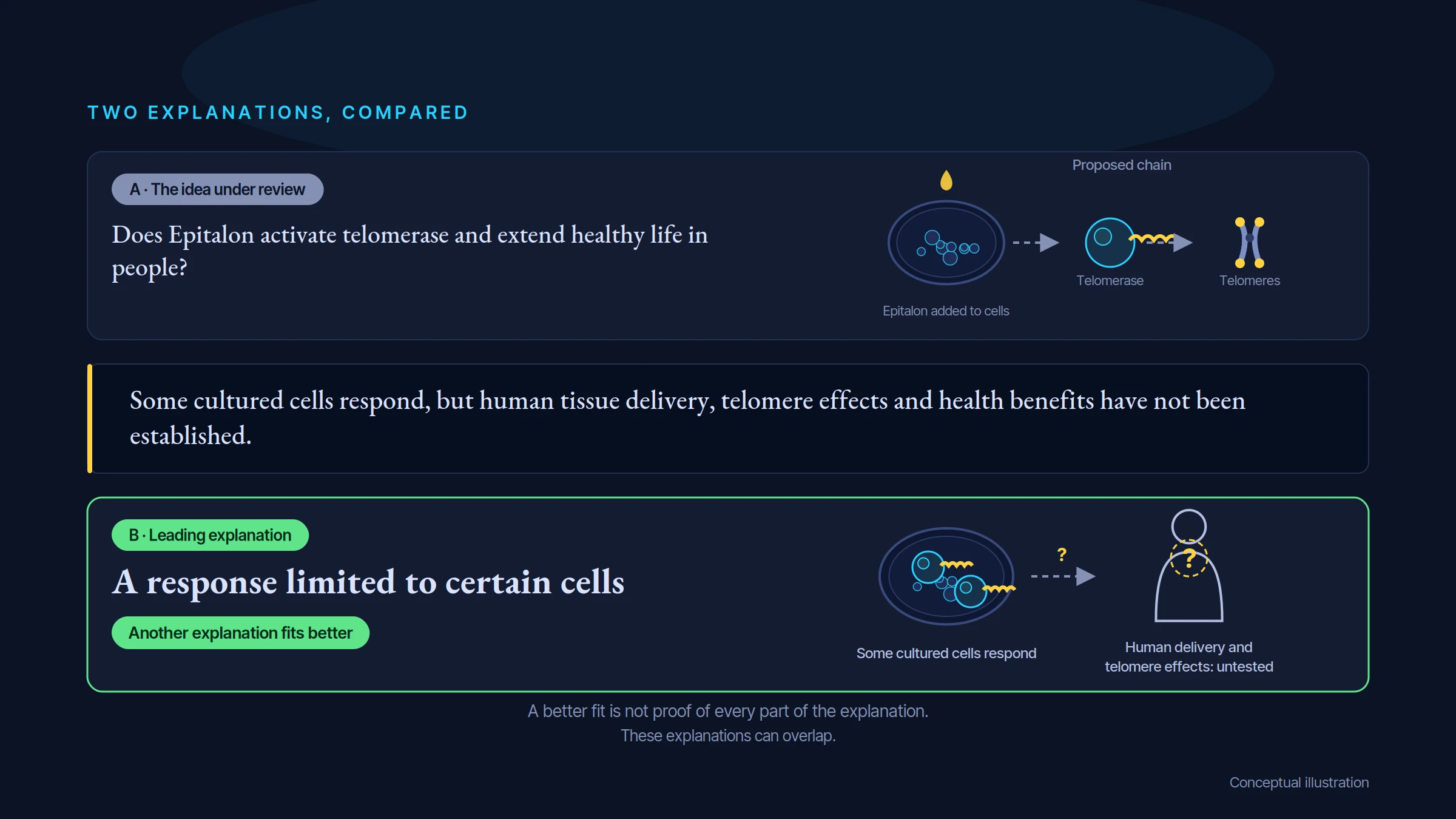
TWO EXPLANATIONS, COMPARED
A · The idea under review
Does Epitalon activate telomerase and extend healthy life in people?
Epitalon added to cells
Telomerase
Telomeres
Proposed chain
Some cultured cells respond, but human tissue delivery, telomere effects and health benefits have not been established.
B · Leading explanation
A response limited to certain cells
Another explanation fits better
Some cultured cells respond
Human delivery and telomere effects: untested
A better fit is not proof of every part of the explanation.
These explanations can overlap.
Conceptual illustration
Plausible, not established for the stated claim.
Some cultured cells respond, but human tissue delivery, telomere effects and health benefits have not been established.
These explanations can overlap. Ranking their fit to the evidence is separate from deciding how firmly a cause has been established.
Rank 1: Context-limited cellular telomere response — Epitalon can alter telomerase or telomere biology in some proliferating cultured cells without an established organism-level healthspan effect.
Rank 2: Telomerase-mediated human geroprotection — Epitalon activates telomerase after human administration, maintains telomeres, and thereby extends healthspan.
Rank 3: Non-telomerase pleiotropic effect (circadian, neuroendocrine, antioxidant) — The peptide may alter melatonin, clock-gene, oxidative-stress or senescence-marker physiology without telomerase mediating a human healthspan effect.
Rank 4: Assay or research-program artifact — The apparent molecular, animal, and clinical signals reflect assay sensitivity, selective analysis, context dependence, or correlated bias rather than a reproducible geroprotective action.
Evidence rating: Γ · Low confidence. How the evidence was assessed.
Some cultured cells respond, but human tissue delivery, telomere effects and health benefits have not been established.
The practical implication is caution around anti-ageing marketing, not a proven rejuvenation therapy. A useful human study would first need to show the identity and exposure of the peptide, target engagement, meaningful functional outcomes, and long-term safety. Established prevention and treatment for current health conditions should not be displaced by a speculative intervention because a cell-culture mechanism sounds compelling.
Look for the proposed factor and the outcome, in the people or systems covered by the claim.
A response limited to certain cells. Some cultured cells respond, but human tissue delivery, telomere effects and health benefits have not been established.
Test delivery and telomere effects in people before claiming health or lifespan benefits.
These illustrations show the key questions tested in the review. They are conceptual drawings, not microscope images or experimental results.
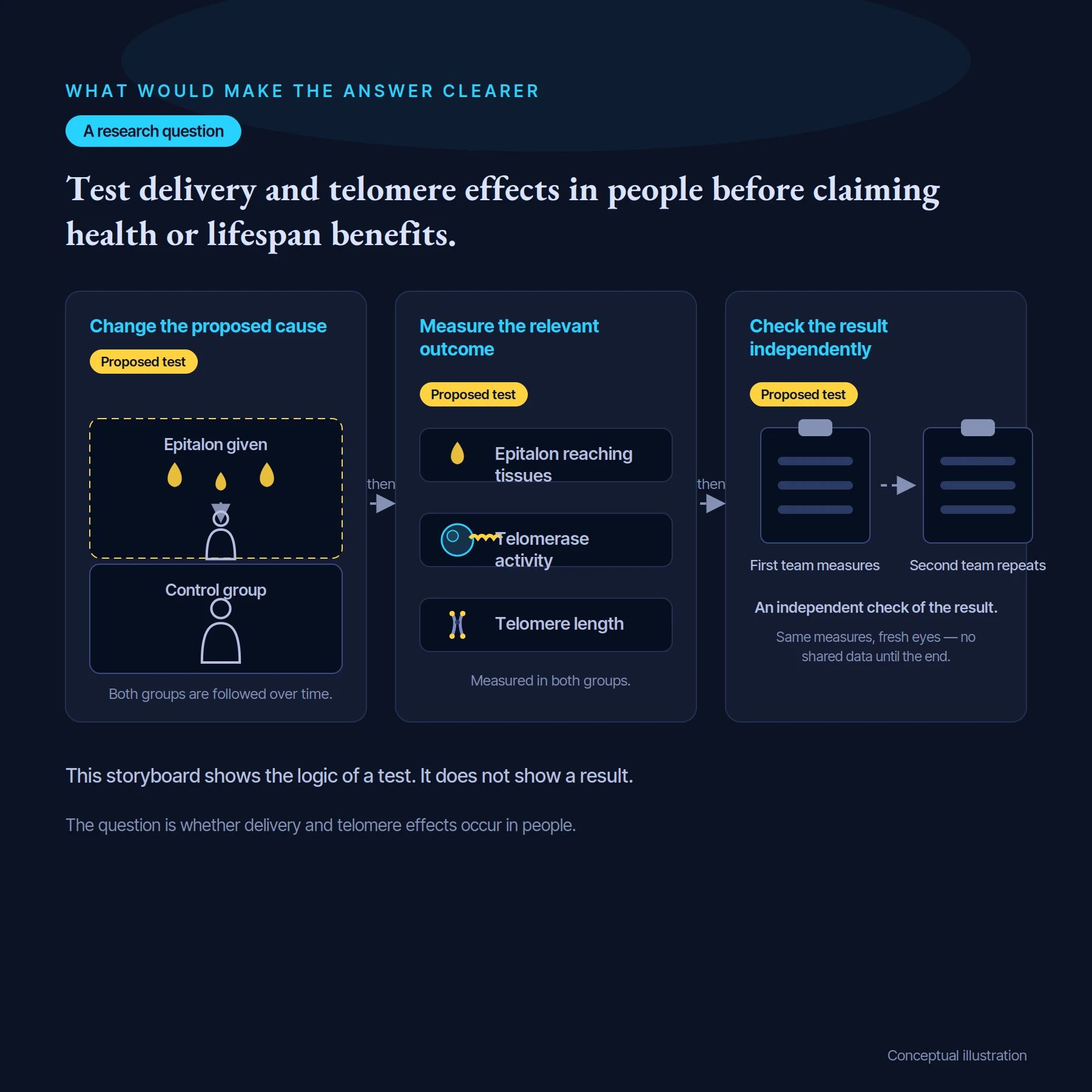
WHAT WOULD MAKE THE ANSWER CLEARER
A research question
Test delivery and telomere effects in people before claiming health or lifespan benefits.
then
then
Change the proposed cause
Proposed test
Epitalon given
Control group
Both groups are followed over time.
Measure the relevant outcome
Proposed test
Epitalon reaching tissues
Telomerase activity
Telomere length
Measured in both groups.
Check the result independently
Proposed test
First team measures
Second team repeats
An independent check of the result.
Same measures, fresh eyes — no shared data until the end.
This storyboard shows the logic of a test. It does not show a result.
The question is whether delivery and telomere effects occur in people.
Conceptual illustration
Test delivery and telomere effects in people before claiming health or lifespan benefits.
Check that the intended change really happened.
Allow for other factors and compare with suitable controls.
Look for independent confirmation and the limits of the effect.
These are questions for research, not a claim that the proposed studies have already succeeded.
Proposed tests: 3 test design(s) are registered in the scorecard.
In plain terms, researchers would change the proposed cause, check that it changed as intended, then measure a meaningful outcome while controlling plausible alternatives. The result should be able to support or count against the claim—not only show that a pathway exists.
Study design: A preregistered, double-blind randomized trial of synthetic Epitalon of documented identity and purity in an older population, with baseline stratification fixed before outcomes and follow-up long enough to measure functional ageing and to be informative about cancer incidence.
What would be measured: Direct telomerase activity in prospectively sampled tissues, tissue-appropriate telomere dynamics, a validated multidomain healthspan or disability-free-survival endpoint, morbidity, and systematic adverse outcomes.
Important controls: Placebo, blinded allocation and analysis, batch identity and pharmacokinetics, cell-composition adjustment, prespecified multiplicity control, and a plan separating transient biomarker change from durable functional benefit.
Result that would support the claim: Replicated target engagement and telomere preservation accompanied by a prespecified clinically meaningful healthspan improvement and acceptable long-term net outcomes.
Result that would count against it: Adequate exposure without in-vivo telomerase engagement, or target engagement without durable functional benefit.
Study design: Use matched human primary-cell and tissue systems in which Epitalon exposure is combined with selective TERT or telomerase-pathway inhibition and a pathway-specific rescue.
What would be measured: Telomerase activity, shortest-telomere burden, replicative function, senescence-independent cell fitness, and off-target transcriptomic responses.
Important controls: Matched vehicle, telomerase inhibition alone, a rescue that restores telomerase without reproducing unrelated peptide effects, a sequence-scrambled or otherwise inactive peptide control by analogy with the catalytically inactive enzyme arm that made the mouse gene-therapy result mechanism-specific, and blinded assay replication in an independent laboratory. The proximal chromatin step should be tested in the same design with specificity against global transcriptional disruption.
Result that would support the claim: Selective blockade abolishes the telomere and functional effects, while pathway-specific rescue restores them.
Result that would count against it: Epitalon-related cellular effects persist when telomerase is selectively blocked or cannot be restored by pathway-specific rescue.
Study design: Independent laboratories administer synthetic Epitalon of documented identity beginning late in life in at least two mammalian backgrounds, both sexes, under a standard light cycle and with a circadian-disrupted arm, since the existing rat signal appears only under disrupted lighting.
What would be measured: Survival, frailty, physical and cognitive function, morbidity, food intake, body weight, tumor incidence, pharmacokinetics, tissue telomerase activity, and telomere dynamics.
Important controls: Late-life start, pair-feeding or intake adjustment given the higher food consumption observed in treated mice, blinded allocation and outcome scoring, a prospectively specified primary endpoint, and full-cohort survival analysis reporting mean and median rather than the longest-lived tail.
Result that would support the claim: Concordant late-life healthspan benefit across independent laboratories and backgrounds with target engagement and no major trade-off.
Result that would count against it: No reproducible lifespan or healthspan benefit despite adequate exposure, or apparent benefit explained by sickness, intake, development, or one background.
Follow the studies, detailed comparisons and evidence ratings behind this guide.
Open the scientific review →