The question
Does brain inflammation independently start and drive nerve-cell degeneration?
This is the specific idea being tested.
Does brain inflammation independently start and drive nerve-cell degeneration?
What you need to knowBrain inflammation can worsen injury, but is not established as the universal first cause.Relative explanatory fit: Alternative ranked ahead
Why the alternative fits better: Some brain immune-cell states respond to damaged proteins and worsen later degeneration. Timing helps explain the results.
Claim assessed: Chronic microglial and astrocytic activation is a causal driver of neurodegeneration rather than a reactive response to it.
Finding: The registered weakest-link conjunction returns Γ because disease-class human generalization remains unresolved. Defined glial states have real causal effects on neuronal loss and progression, including reactive amplifiers. This evidence is not dismissed for being downstream. Opposite effects of protective immune programs and negative or harmful human interventions prevent treating chronic activation as one broadly pathogenic exposure. The limiting gate is generalization and state-specific human mediation, not an added obligation to initiate disease.
Evidence scope: 69 primary reports; literature cutoff 2026-10-06; source examination UTC date 2026-10-06; bounded critical review, not exhaustive systematic review.
The grade applies to the stated claim. Model rankings and individual subclaim grades remain separate from the overall causal-evidence grade.
Full scientific assessment and references · Scorecard (JSON) · Review source (Markdown)
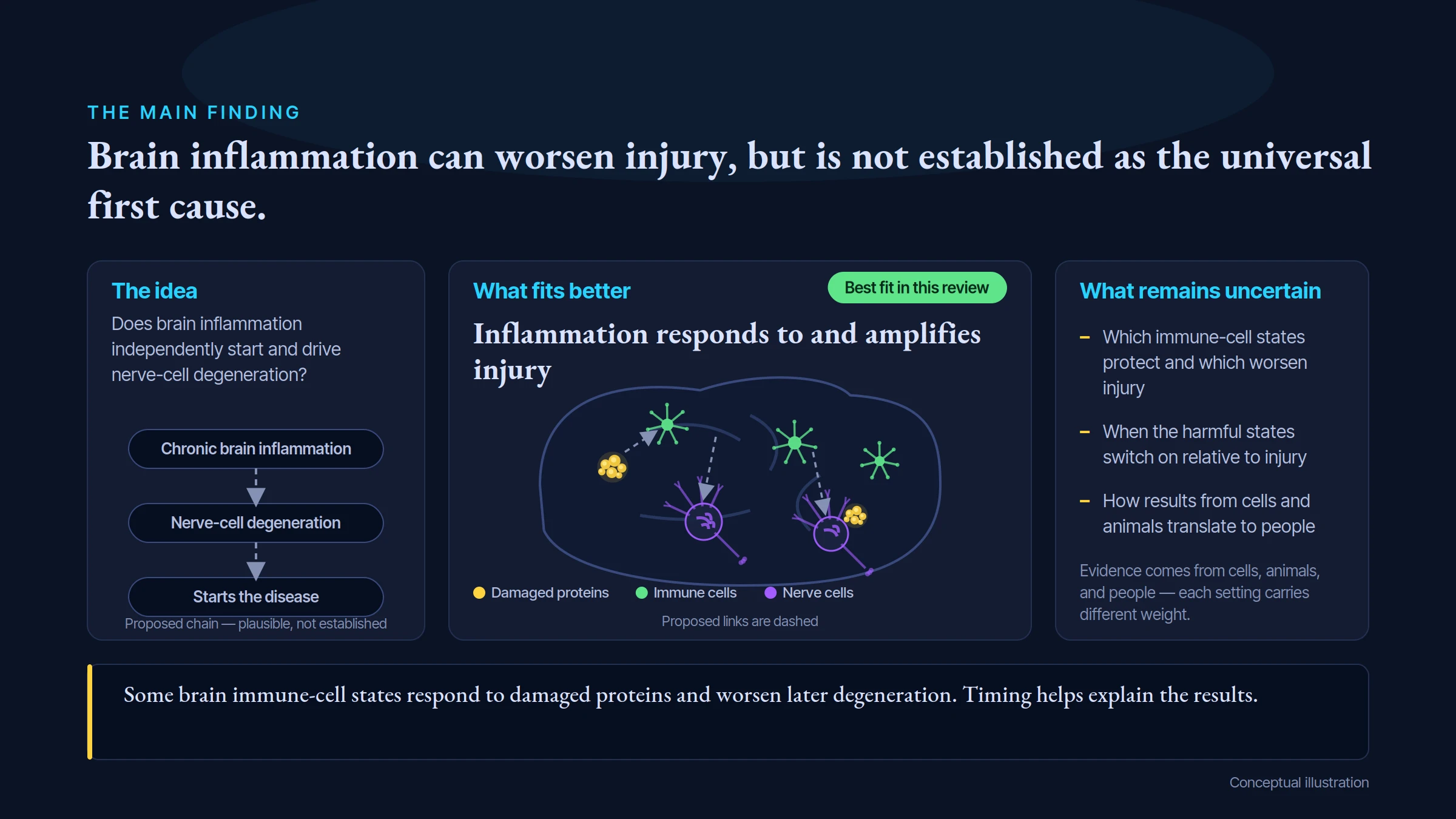
THE MAIN FINDING
Brain inflammation can worsen injury, but is not established as the universal first cause.
The idea
Does brain inflammation independently start and drive nerve-cell degeneration?
Chronic brain inflammation
Nerve-cell degeneration
Starts the disease
Proposed chain — plausible, not established
What fits better
Inflammation responds to and amplifies injury
Best fit in this review
Damaged proteins
Immune cells
Nerve cells
Proposed links are dashed
What remains uncertain
Which immune-cell states protect and which worsen injury
When the harmful states switch on relative to injury
How results from cells and animals translate to people
Evidence comes from cells, animals, and people — each setting carries different weight.
Some brain immune-cell states respond to damaged proteins and worsen later degeneration. Timing helps explain the results.
Conceptual illustration
This is the specific idea being tested.
Some brain immune-cell states respond to damaged proteins and worsen later degeneration. Timing helps explain the results.
A higher rank means a better fit to the evidence in this comparison. It does not prove every part of the leading explanation.
The reviewed hypothesis ranks 5 among 5 models compared; 1 alternative model(s) hold first rank for this stated claim.
Claim under review: rank 5 among 5 compared models.
Leading explanation: Reactive but causal amplifier.
Position in this comparison: Last recorded rank.
The causal grade asks how well the stated causal claim is established. This comparison asks which of the assessed explanations fits the reviewed findings better. A leading explanation can remain unproven. Models can overlap or include the tested mechanism; an alternative ahead does not make that mechanism irrelevant. These ordinal ranks apply within this review; they do not measure the size of a difference or rank scientific strength across topics.
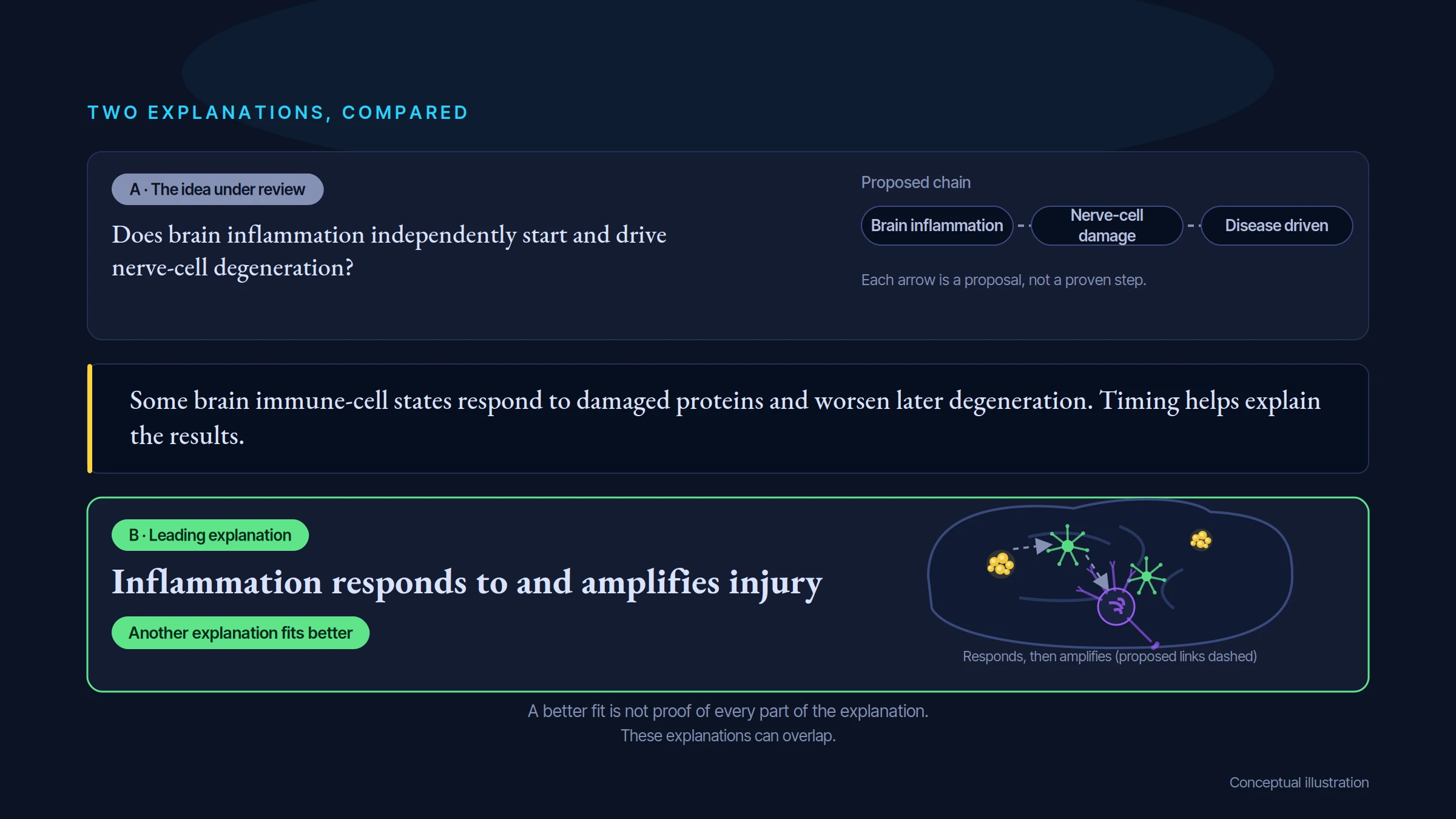
TWO EXPLANATIONS, COMPARED
A · The idea under review
Does brain inflammation independently start and drive nerve-cell degeneration?
Proposed chain
Brain inflammation
Nerve-cell damage
Disease driven
Each arrow is a proposal, not a proven step.
Some brain immune-cell states respond to damaged proteins and worsen later degeneration. Timing helps explain the results.
B · Leading explanation
Inflammation responds to and amplifies injury
Another explanation fits better
Responds, then amplifies (proposed links dashed)
A better fit is not proof of every part of the explanation.
These explanations can overlap.
Conceptual illustration
Plausible, not established for the stated claim.
Some brain immune-cell states respond to damaged proteins and worsen later degeneration. Timing helps explain the results.
These explanations can overlap. Ranking their fit to the evidence is separate from deciding how firmly a cause has been established.
Rank 1: Reactive but causal amplifier — Defined glial states respond to proteinopathy and causally worsen subsequent degeneration.
Rank 2: Protective clearance and immune failure — Some activated states preserve tissue through clearance, containment and immune coordination.
Rank 3: Neuron-autonomous proteinopathy — Intrinsic neuronal protein dysfunction initiates injury that glia then modify.
Rank 4: Peripheral immune contribution — Adaptive and peripheral innate signals interact with glia and alter defined model trajectories.
Rank 5: Primary chronic glial driver — Chronic harmful glial activation broadly drives degeneration.
Evidence rating: Γ · Moderate confidence. How the evidence was assessed.
Some brain immune-cell states respond to damaged proteins and worsen later degeneration. Timing helps explain the results.
This is an assessment of a causal explanation, not proof that a particular supplement, diet, test, or treatment improves health. A treatment claim needs studies that test the intervention in people and measure meaningful benefits and harms. These findings can help frame research and informed clinical questions, but they do not identify what is right for one person.
Look for the proposed factor and the outcome, in the people or systems covered by the claim.
Inflammation responds to and amplifies injury. Some brain immune-cell states respond to damaged proteins and worsen later degeneration. Timing helps explain the results.
Change a defined immune-cell state before and after injury and measure nerve-cell survival.
These illustrations show the key questions tested in the review. They are conceptual drawings, not microscope images or experimental results.
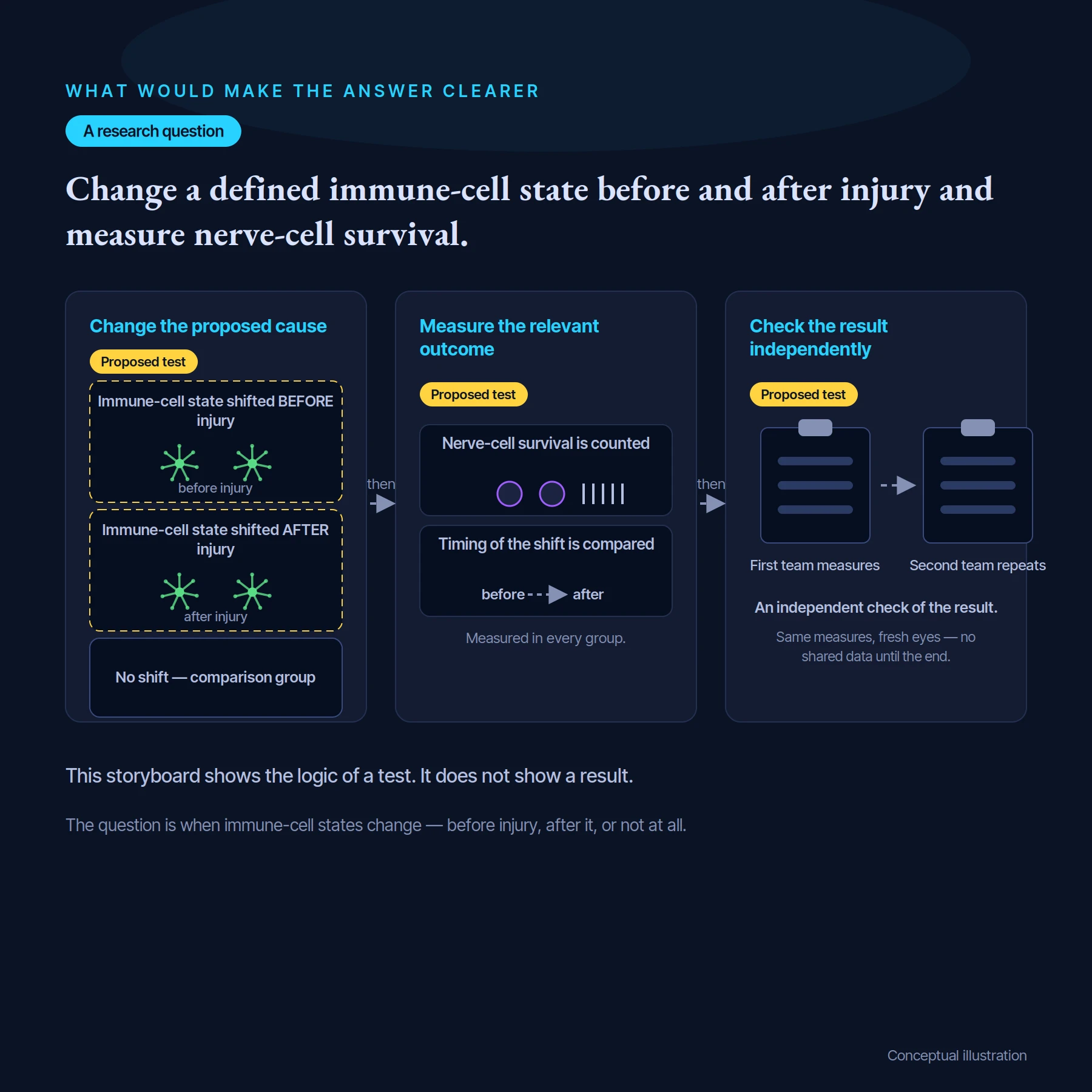
WHAT WOULD MAKE THE ANSWER CLEARER
A research question
Change a defined immune-cell state before and after injury and measure nerve-cell survival.
then
then
Change the proposed cause
Proposed test
Immune-cell state shifted BEFORE injury
before injury
Immune-cell state shifted AFTER injury
after injury
No shift — comparison group
Measure the relevant outcome
Proposed test
Nerve-cell survival is counted
Timing of the shift is compared
before
after
Measured in every group.
Check the result independently
Proposed test
First team measures
Second team repeats
An independent check of the result.
Same measures, fresh eyes — no shared data until the end.
This storyboard shows the logic of a test. It does not show a result.
The question is when immune-cell states change — before injury, after it, or not at all.
Conceptual illustration
Change a defined immune-cell state before and after injury and measure nerve-cell survival.
Check that the intended change really happened.
Allow for other factors and compare with suitable controls.
Look for independent confirmation and the limits of the effect.
These are questions for research, not a claim that the proposed studies have already succeeded.
Proposed tests: 1 test design(s) are registered in the scorecard.
In plain terms, researchers would change the proposed cause, check that it changed as intended, then measure a meaningful outcome while controlling plausible alternatives. The result should be able to support or count against the claim—not only show that a pathway exists.
Study design: Induce loss of a prespecified harmful glial program after comparable neuronal pathology begins, preserve protective clearance and peripheral immune function, then restore the same mediator with cell-specific rescue in independent AD, PD and ALS settings.
What would be measured: Blinded neuron counts, functional decline, survival where relevant, and direct cell-state/target engagement
Important controls: Matched initiating protein burden, stage, neuronal viability, clearance, peripheral immunity and rescue expression
Result that would support the claim: Post-onset suppression slows loss and functional decline; matched rescue restores both with replicated prespecified state boundaries
Result that would count against it: Verified selective loss leaves degeneration unchanged, or protection is explained wholly by altered initial protein burden or nonspecific immune effects
Follow the studies, detailed comparisons and evidence ratings behind this guide.
Open the scientific review →