The question
Is brain infection a necessary trigger for many cases of Alzheimer's disease?
This is the specific idea being tested.
Is brain infection a necessary trigger for many cases of Alzheimer's disease?
What you need to knowInfection is not established as a required starting point for Alzheimer's disease.Relative explanatory fit: Alternative ranked ahead
Why the alternative fits better: Amyloid production and protein handling can affect risk without showing infection as a necessary link.
Claim assessed: CNS infection by specific pathogens is a necessary initiating event in a substantial fraction of sporadic Alzheimer's disease.
Finding: Γ for the preregistered SC3 etiologic gate. Scope-matched and primary-subclaim rules return Γ; weakest-link Β is shown separately for unverified enrichment/entry-order gates. No blanket Gamma cap is imposed on the vaccine/genetic/intervention set. The unmet positive burden is pathogen-specific CNS initiation with a measured substantial human fraction; dementia prevention, antimicrobial activity and imposed infection capability do not jointly measure it. Defined antimicrobial competence earns Ε and vaccine effects on recorded dementia receive full causal credit separately.
Evidence scope: 65 primary reports; literature cutoff 2026-10-05; source examination UTC date 2026-10-06; bounded critical review, not exhaustive systematic review.
The grade applies to the stated claim. Model rankings and individual subclaim grades remain separate from the overall causal-evidence grade.
Full scientific assessment and references · Scorecard (JSON) · Review source (Markdown)
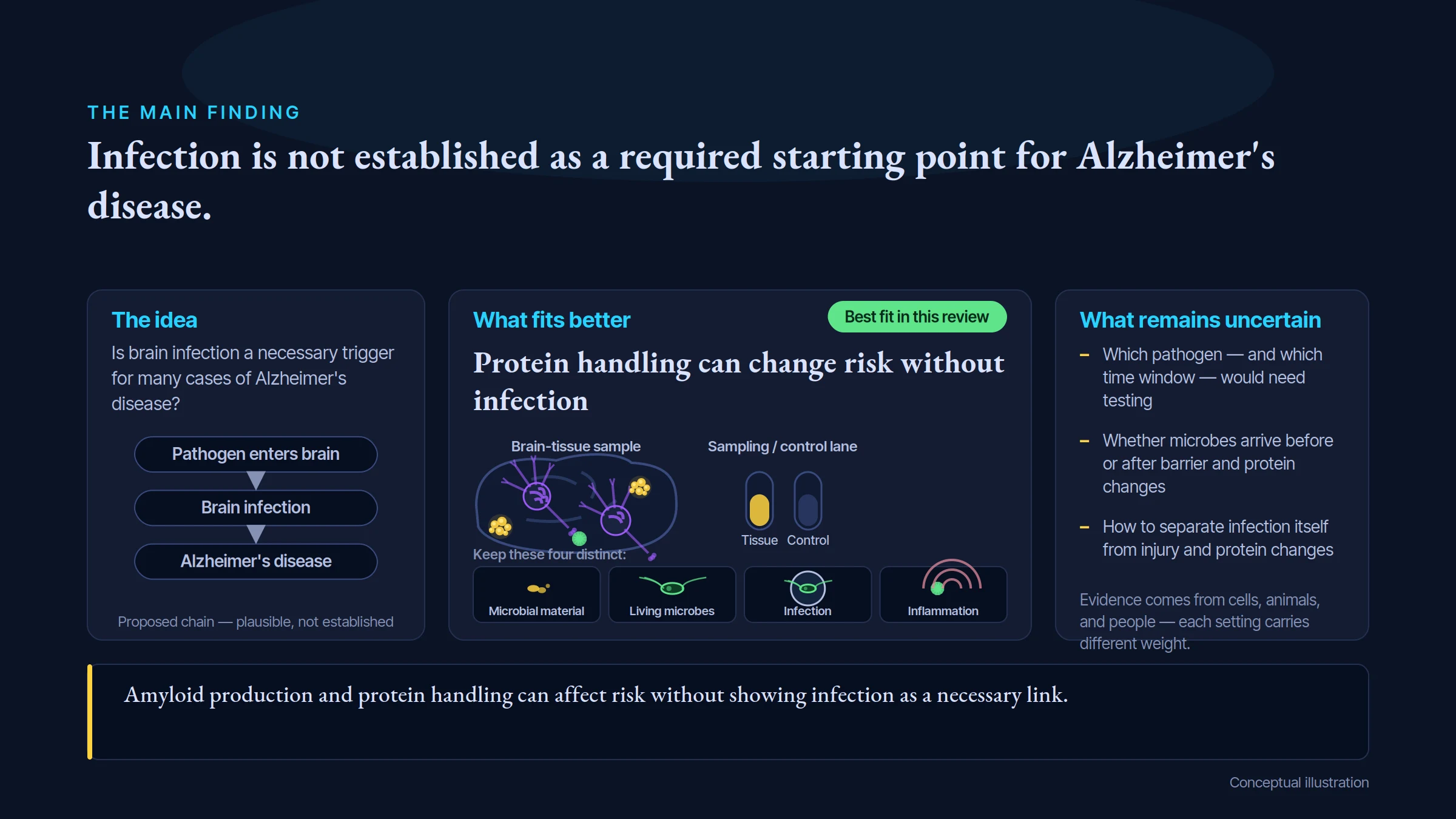
THE MAIN FINDING
Infection is not established as a required starting point for Alzheimer's disease.
The idea
Is brain infection a necessary trigger for many cases of Alzheimer's disease?
Pathogen enters brain
Brain infection
Alzheimer's disease
Proposed chain — plausible, not established
What fits better
Best fit in this review
Protein handling can change risk without infection
Brain-tissue sample
Sampling / control lane
Tissue sample
Control lane
Keep these four distinct
Microbial material
Living microbes
Infection
Inflammation
What remains uncertain
Which pathogen — and which time window — would need testing
Whether microbes arrive before or after barrier and protein changes
How to separate infection itself from injury and protein changes
Evidence comes from cells, animals, and people — each setting carries different weight.
Amyloid production and protein handling can affect risk without showing infection as a necessary link.
Conceptual illustration
This is the specific idea being tested.
Amyloid production and protein handling can affect risk without showing infection as a necessary link.
A higher rank means a better fit to the evidence in this comparison. It does not prove every part of the leading explanation.
The reviewed hypothesis ranks 5 among 5 models compared; 1 alternative model(s) hold first rank for this stated claim.
Claim under review: rank 5 among 5 compared models.
Leading explanation: Noninfectious APP/proteostasis contribution.
Position in this comparison: Last recorded rank.
The causal grade asks how well the stated causal claim is established. This comparison asks which of the assessed explanations fits the reviewed findings better. A leading explanation can remain unproven. Models can overlap or include the tested mechanism; an alternative ahead does not make that mechanism irrelevant. These ordinal ranks apply within this review; they do not measure the size of a difference or rank scientific strength across topics.
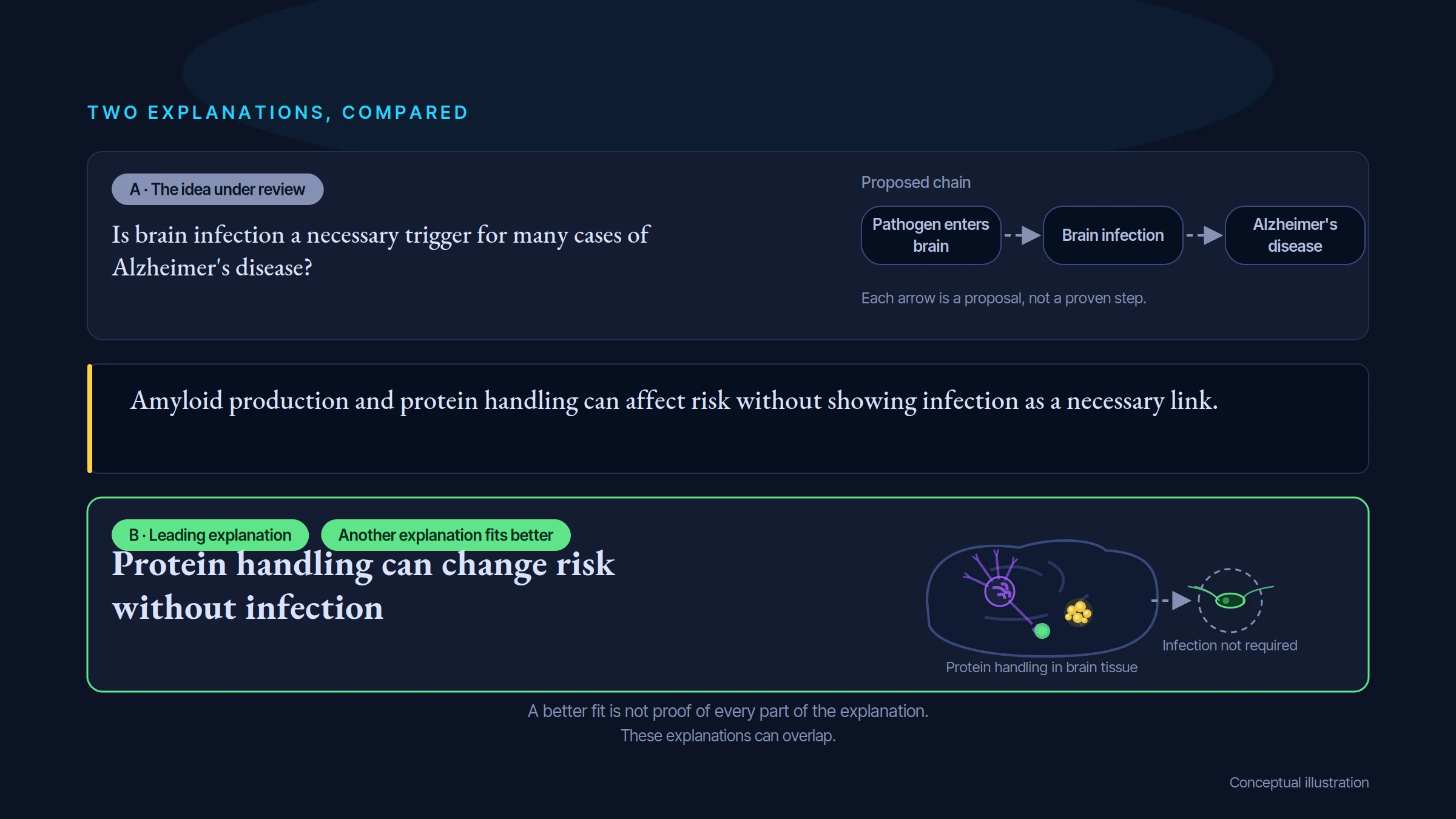
TWO EXPLANATIONS, COMPARED
A · The idea under review
Is brain infection a necessary trigger for many cases of Alzheimer's disease?
Proposed chain
Pathogen enters brain
Brain infection
Alzheimer's disease
Each arrow is a proposal, not a proven step.
Amyloid production and protein handling can affect risk without showing infection as a necessary link.
B · Leading explanation
Another explanation fits better
Protein handling can change risk without infection
Protein handling in brain tissue
Infection not required
A better fit is not proof of every part of the explanation.
These explanations can overlap.
Conceptual illustration
Plausible, not established for the stated claim.
Amyloid production and protein handling can affect risk without showing infection as a necessary link.
These explanations can overlap. Ranking their fit to the evidence is separate from deciding how firmly a cause has been established.
Rank 1: Noninfectious APP/proteostasis contribution — APP processing and proteostasis can alter disease risk without demonstrating infection as an obligatory mediator.
Rank 2: Sterile/systemic immune and vascular contribution — Systemic inflammatory and immune states can influence vulnerability without CNS pathogen initiation.
Rank 3: Secondary entry after barrier/lesion changes — Established pathology/barrier dysfunction permits microbial material to enter or persist.
Rank 4: Bounded early infectious hit — A specified pathogen at a specified early stage triggers a later autonomous cascade.
Rank 5: Necessary CNS initiation in a substantial sporadic fraction — A CNS pathogen is an indispensable initiating event for a prespecified human fraction.
Evidence rating: Γ · Moderate confidence. How the evidence was assessed.
Amyloid production and protein handling can affect risk without showing infection as a necessary link.
This is an assessment of a causal explanation, not proof that a particular supplement, diet, test, or treatment improves health. A treatment claim needs studies that test the intervention in people and measure meaningful benefits and harms. These findings can help frame research and informed clinical questions, but they do not identify what is right for one person.
Look for the proposed factor and the outcome, in the people or systems covered by the claim.
Protein handling can change risk without infection. Amyloid production and protein handling can affect risk without showing infection as a necessary link.
Test a specified pathogen while separating infection from injury and protein changes.
These illustrations show the key questions tested in the review. They are conceptual drawings, not microscope images or experimental results.
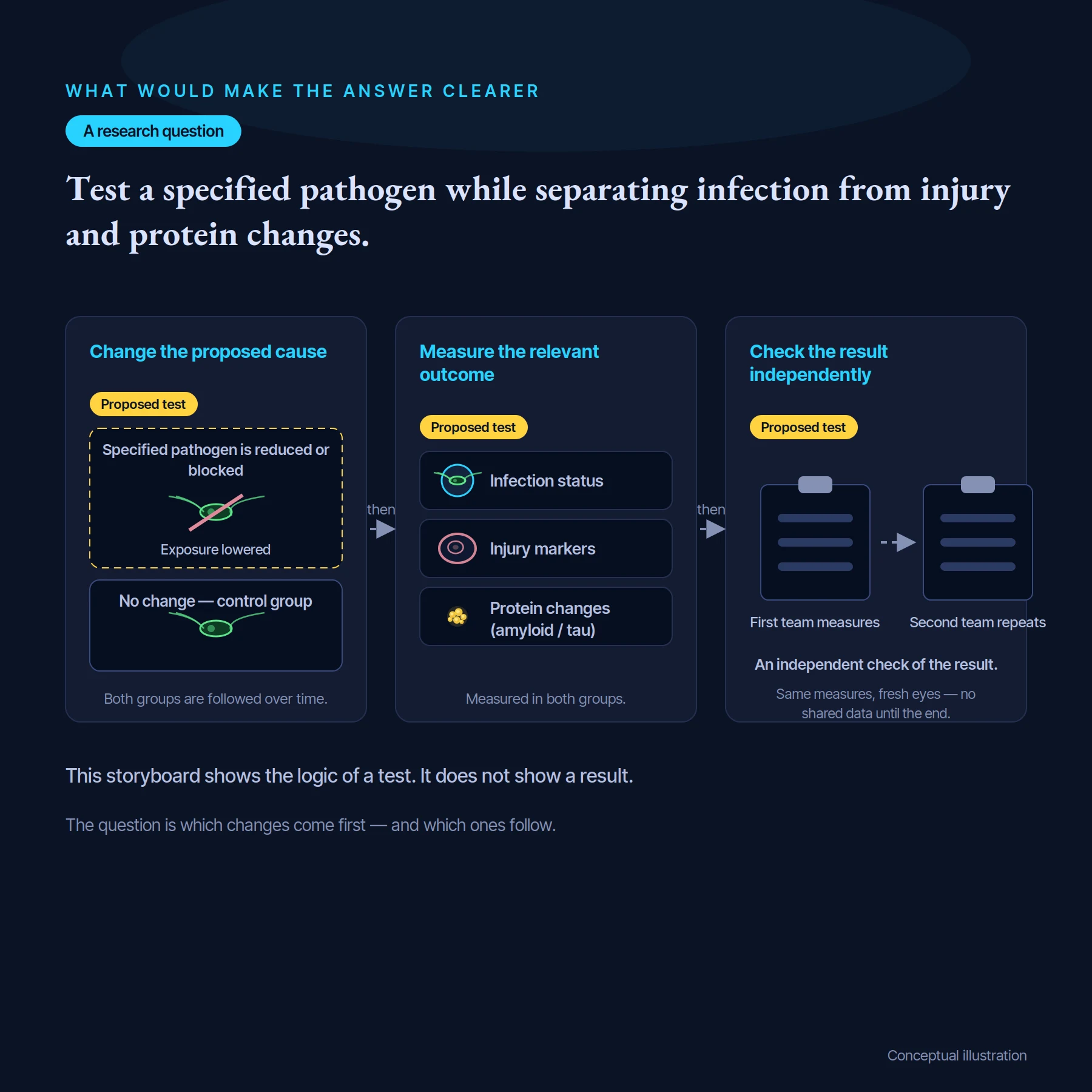
WHAT WOULD MAKE THE ANSWER CLEARER
A research question
Test a specified pathogen while separating infection from injury and protein changes.
then
then
Change the proposed cause
Proposed test
Specified pathogen is reduced or blocked
Exposure lowered
No change — control group
Both groups are followed over time.
Measure the relevant outcome
Infection status
Injury markers
Protein changes (amyloid / tau)
Measured in both groups.
Check the result independently
First team measures
Second team repeats
An independent check of the result.
Same measures, fresh eyes — no shared data until the end.
This storyboard shows the logic of a test. It does not show a result.
The question is which changes come first — and which ones follow.
Conceptual illustration
Test a specified pathogen while separating infection from injury and protein changes.
Check that the intended change really happened.
Allow for other factors and compare with suitable controls.
Look for independent confirmation and the limits of the effect.
These are questions for research, not a claim that the proposed studies have already succeeded.
Proposed tests: 1 test design(s) are registered in the scorecard.
In plain terms, researchers would change the proposed cause, check that it changed as intended, then measure a meaningful outcome while controlling plausible alternatives. The result should be able to support or count against the claim—not only show that a pathway exists.
Study design: Predefine one pathogen, a susceptible sporadic population and an early time window, then follow CNS pathogen-positive and negative biomarker-negative participants with validated paired fluid/barrier and amyloid/tau measures; apply a selective prevention/removal instrument where feasible.
What would be measured: Biomarker-confirmed incident AD, functional trajectory and CNS mediator clearance before conversion
Important controls: Extraction blanks/spike-ins, active systemic versus CNS infection, immune off-target effects, pathogen-negative participants and negative-control diagnoses
Result that would support the claim: Selective antecedent CNS clearance changes conversion with measured mediation and a replicated prespecified attributable fraction
Result that would count against it: Clearance affects infection but not AD conversion, or CNS positivity begins only after lesions/barrier dysfunction
Follow the studies, detailed comparisons and evidence ratings behind this guide.
Open the scientific review →