The question
Do cancers mainly escape immunity by permanently exhausting immune cells?
This is the specific idea being tested.
Do cancers mainly escape immunity by permanently exhausting immune cells?
What you need to knowImmune exhaustion matters, but it is not established as the one main route by which solid tumours escape.Relative explanatory fit: Alternative ranked ahead
Why the alternative fits better: Responsive immune-cell precursors and their surroundings help sustain tumour control. Other barriers also affect treatment response.
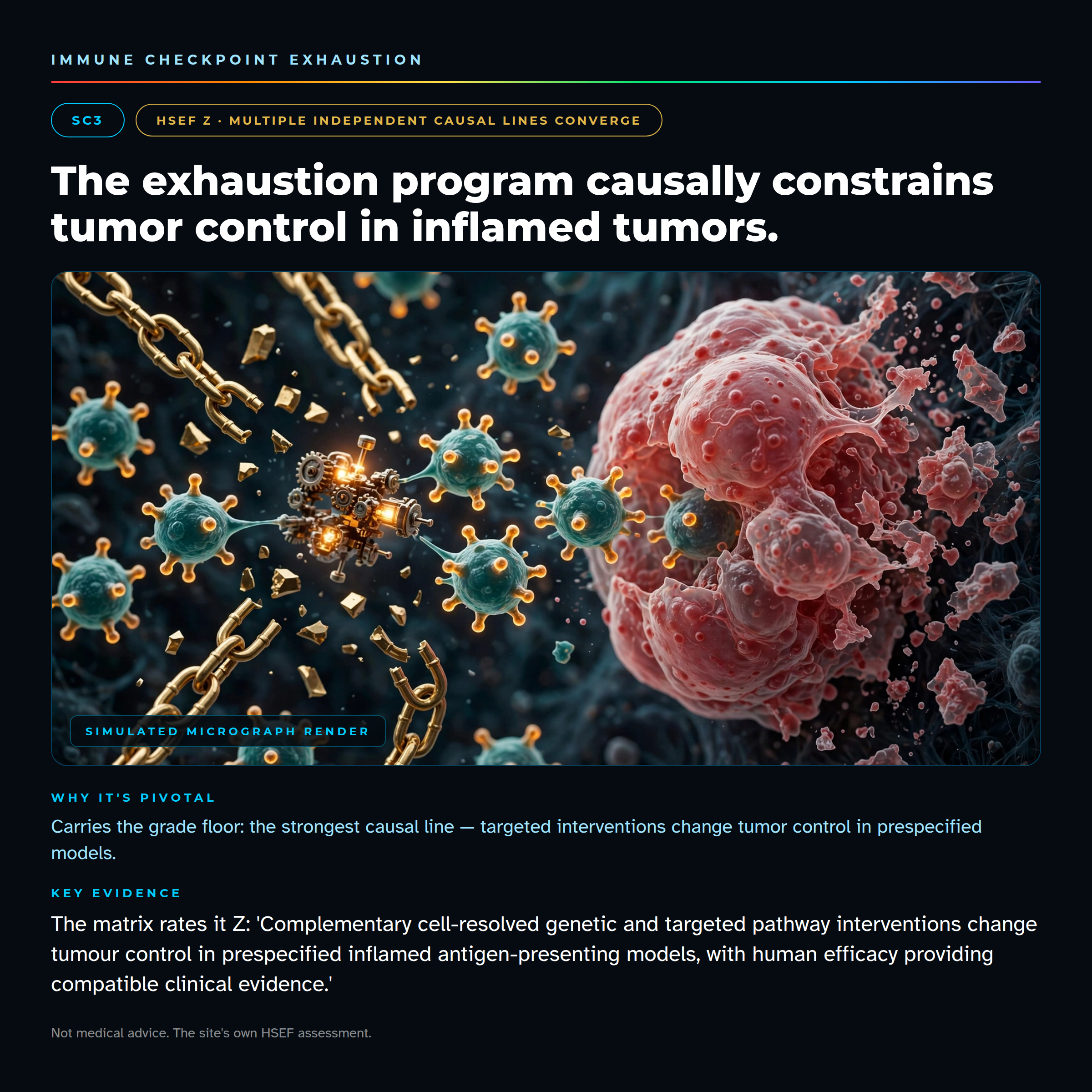
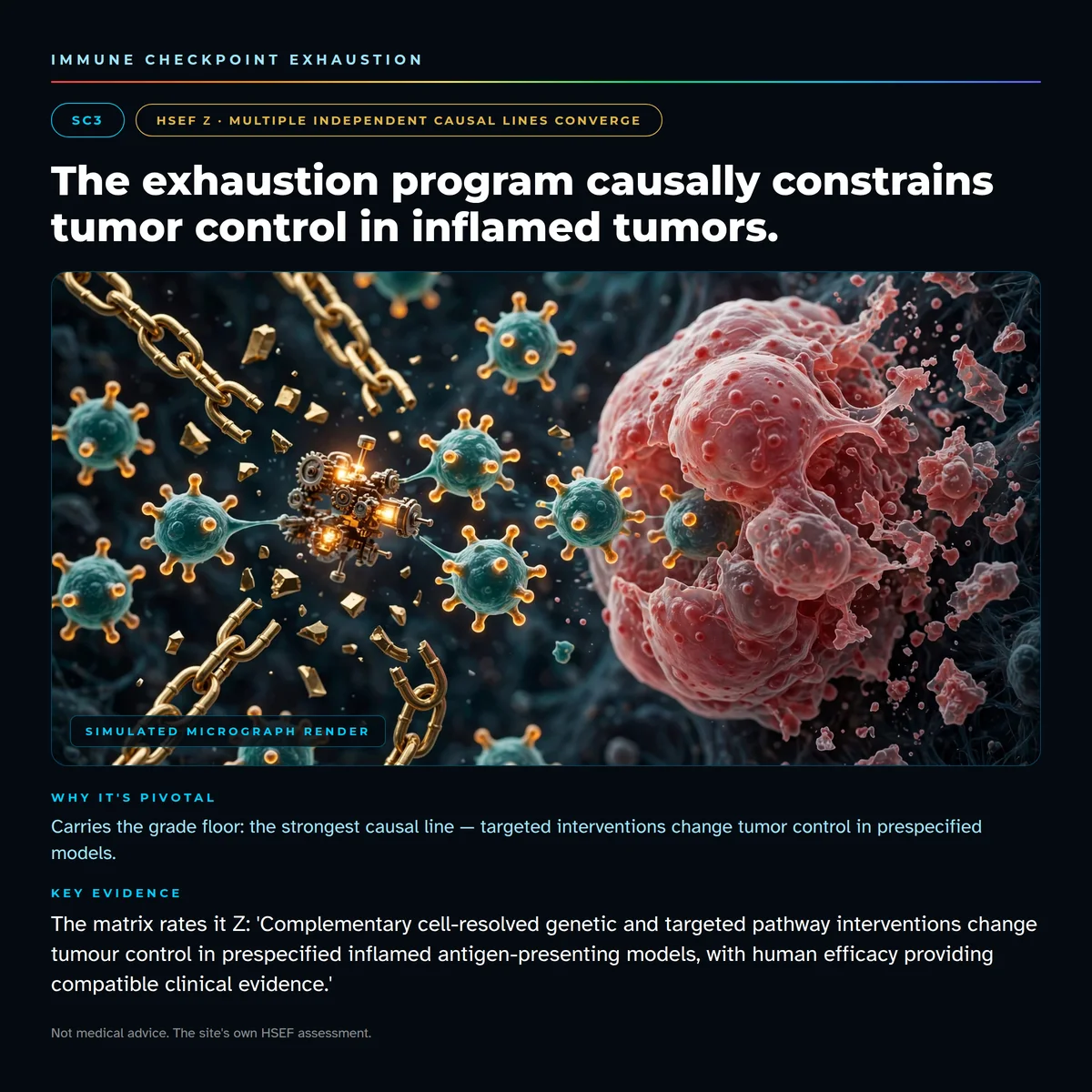
Claim assessed: Checkpoint-driven, epigenetically fixed CD8+ T-cell exhaustion is the dominant mechanism by which human solid tumours evade immune control.
Finding: The preregistered scope-matched gate SC5 yields Γ. Defined experimental lineage and tumour-control sensitivities reach Ζ; clinical checkpoint efficacy alone can reach Η in selected indications, but neither establishes terminal-state mediation or cross-solid-tumour dominance. The weakest-link bundle would be Β because of the observational existence subclaim; it is not the registered gate.
Evidence scope: 69 primary reports; cutoff 2026-10-05; bounded critical review, not exhaustive systematic review.
The grade applies to the stated claim. Model rankings and individual subclaim grades remain separate from the overall causal-evidence grade.
Full scientific assessment and references · Scorecard (JSON) · Review source (Markdown)
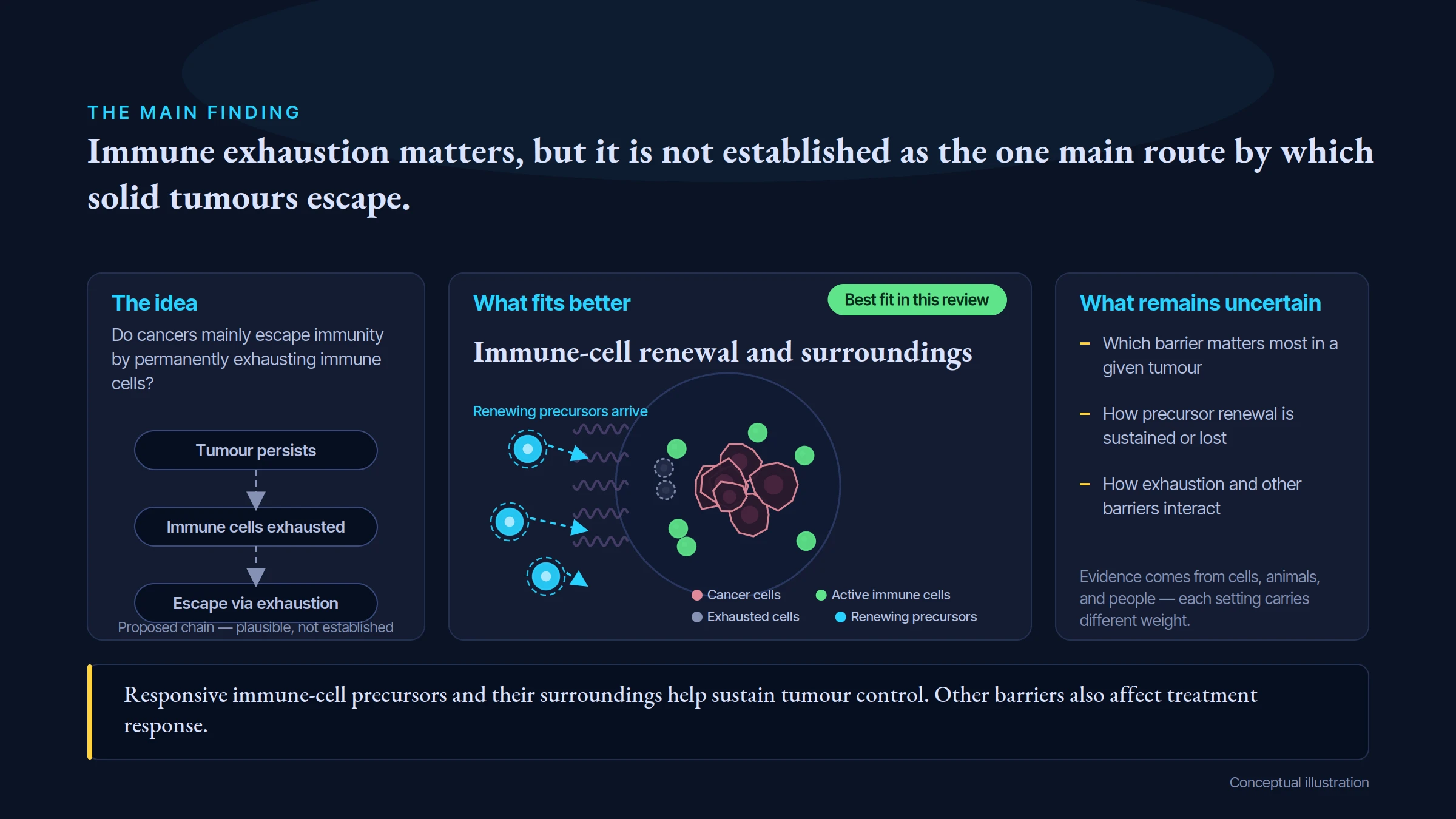
THE MAIN FINDING
Immune exhaustion matters, but it is not established as the one main route by which solid tumours escape.
The idea
Do cancers mainly escape immunity by permanently exhausting immune cells?
Tumour persists
Immune cells exhausted
Escape via exhaustion
Proposed chain — plausible, not established
What fits better
Best fit in this review
Immune-cell renewal and surroundings
Renewing precursors arrive
Cancer cells
Active immune cells
Exhausted cells
Renewing precursors
What remains uncertain
Which barrier matters most in a given tumour
How precursor renewal is sustained or lost
How exhaustion and other barriers interact
Evidence comes from cells, animals, and people — each setting carries different weight.
Responsive immune-cell precursors and their surroundings help sustain tumour control. Other barriers also affect treatment response.
Conceptual illustration
This is the specific idea being tested.
Responsive immune-cell precursors and their surroundings help sustain tumour control. Other barriers also affect treatment response.
A higher rank means a better fit to the evidence in this comparison. It does not prove every part of the leading explanation.
The reviewed hypothesis ranks 5 among 5 models compared; 1 alternative model(s) hold first rank for this stated claim.
Claim under review: rank 5 among 5 compared models.
Leading explanation: Progenitor-supported contextual immune control.
Position in this comparison: Last recorded rank.
The causal grade asks how well the stated causal claim is established. This comparison asks which of the assessed explanations fits the reviewed findings better. A leading explanation can remain unproven. Models can overlap or include the tested mechanism; an alternative ahead does not make that mechanism irrelevant. These ordinal ranks apply within this review; they do not measure the size of a difference or rank scientific strength across topics.
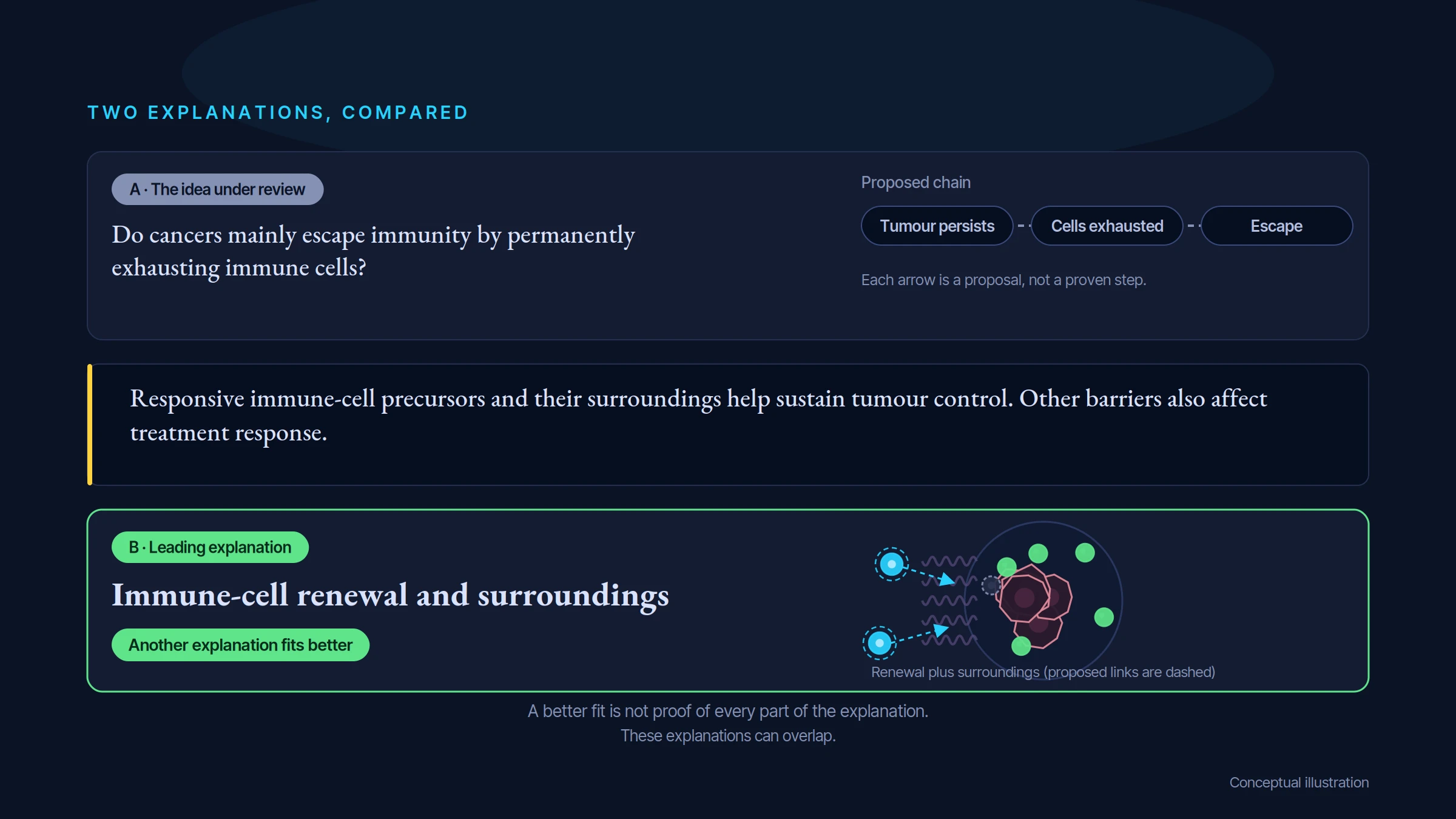
TWO EXPLANATIONS, COMPARED
A · The idea under review
Do cancers mainly escape immunity by permanently exhausting immune cells?
Proposed chain
Tumour persists
Cells exhausted
Escape
Each arrow is a proposal, not a proven step.
Responsive immune-cell precursors and their surroundings help sustain tumour control. Other barriers also affect treatment response.
B · Leading explanation
Immune-cell renewal and surroundings
Another explanation fits better
Renewal plus surroundings (proposed links are dashed)
A better fit is not proof of every part of the explanation.
These explanations can overlap.
Conceptual illustration
Plausible, not established for the stated claim.
Responsive immune-cell precursors and their surroundings help sustain tumour control. Other barriers also affect treatment response.
These explanations can overlap. Ranking their fit to the evidence is separate from deciding how firmly a cause has been established.
Rank 1: Progenitor-supported contextual immune control — Responsive precursors, niches and ongoing differentiation sustain antitumour immunity.
Rank 2: Antigen-presentation loss and immunoediting — Tumour recognition fails through HLA, B2M or IFNgamma pathway defects.
Rank 3: Stromal exclusion and niche failure — Fibroblast programs and absent APC niches limit access or support.
Rank 4: Myeloid and regulatory-cell suppression — TAM, Treg and glucocorticoid circuits restrain effector immunity and priming.
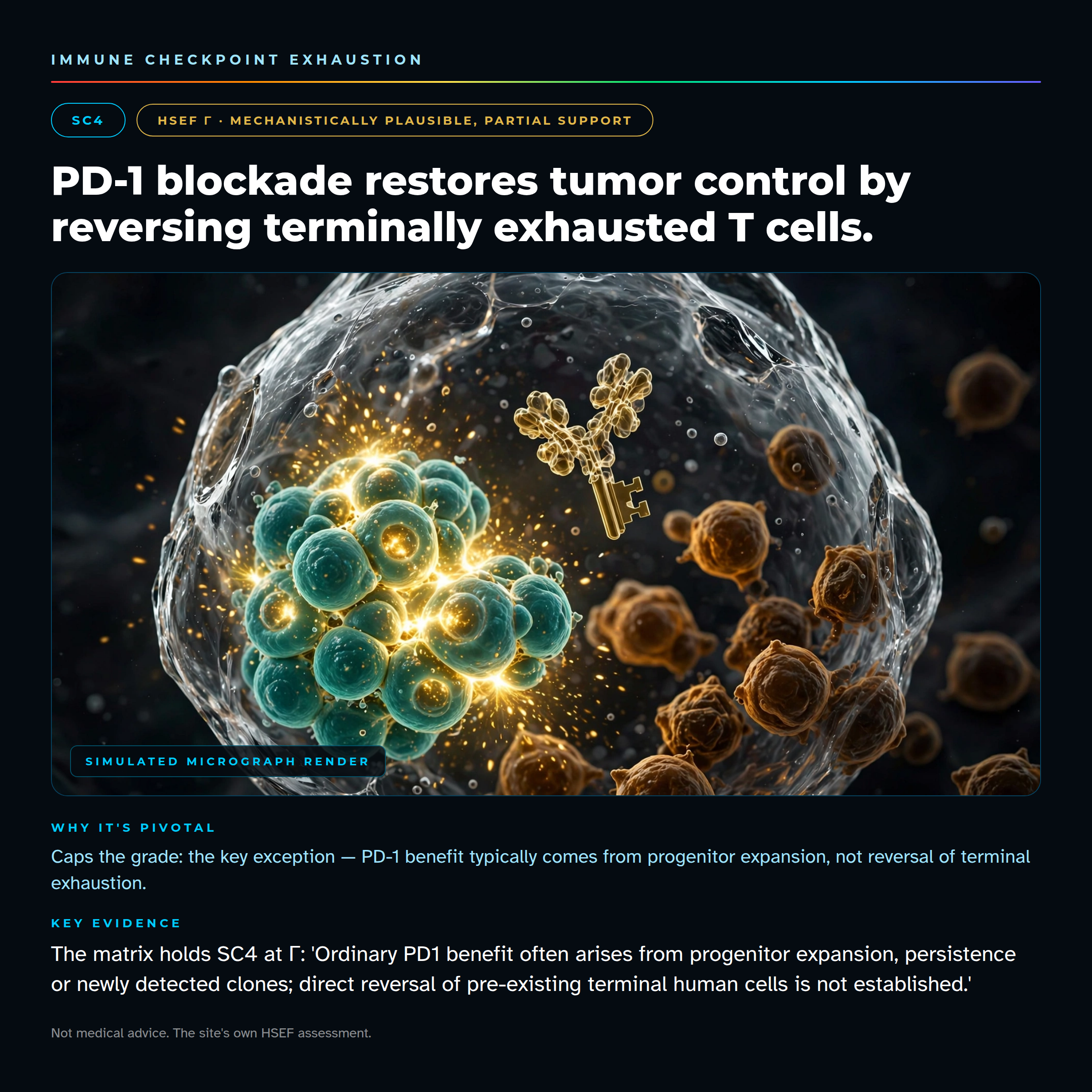
Rank 5: Dominant fixed checkpoint exhaustion — A checkpoint-induced irreversible CD8 program is the central escape mechanism across human solid tumours.
Evidence rating: Γ · Moderate confidence. How the evidence was assessed.
Responsive immune-cell precursors and their surroundings help sustain tumour control. Other barriers also affect treatment response.
This is an assessment of a causal explanation, not proof that a particular supplement, diet, test, or treatment improves health. A treatment claim needs studies that test the intervention in people and measure meaningful benefits and harms. These findings can help frame research and informed clinical questions, but they do not identify what is right for one person.
Look for the proposed factor and the outcome, in the people or systems covered by the claim.
Immune-cell renewal and surroundings. Responsive immune-cell precursors and their surroundings help sustain tumour control. Other barriers also affect treatment response.
Track immune-cell families and test separate barriers to tumour control in the same setting.
These illustrations show the key questions tested in the review. They are conceptual drawings, not microscope images or experimental results.
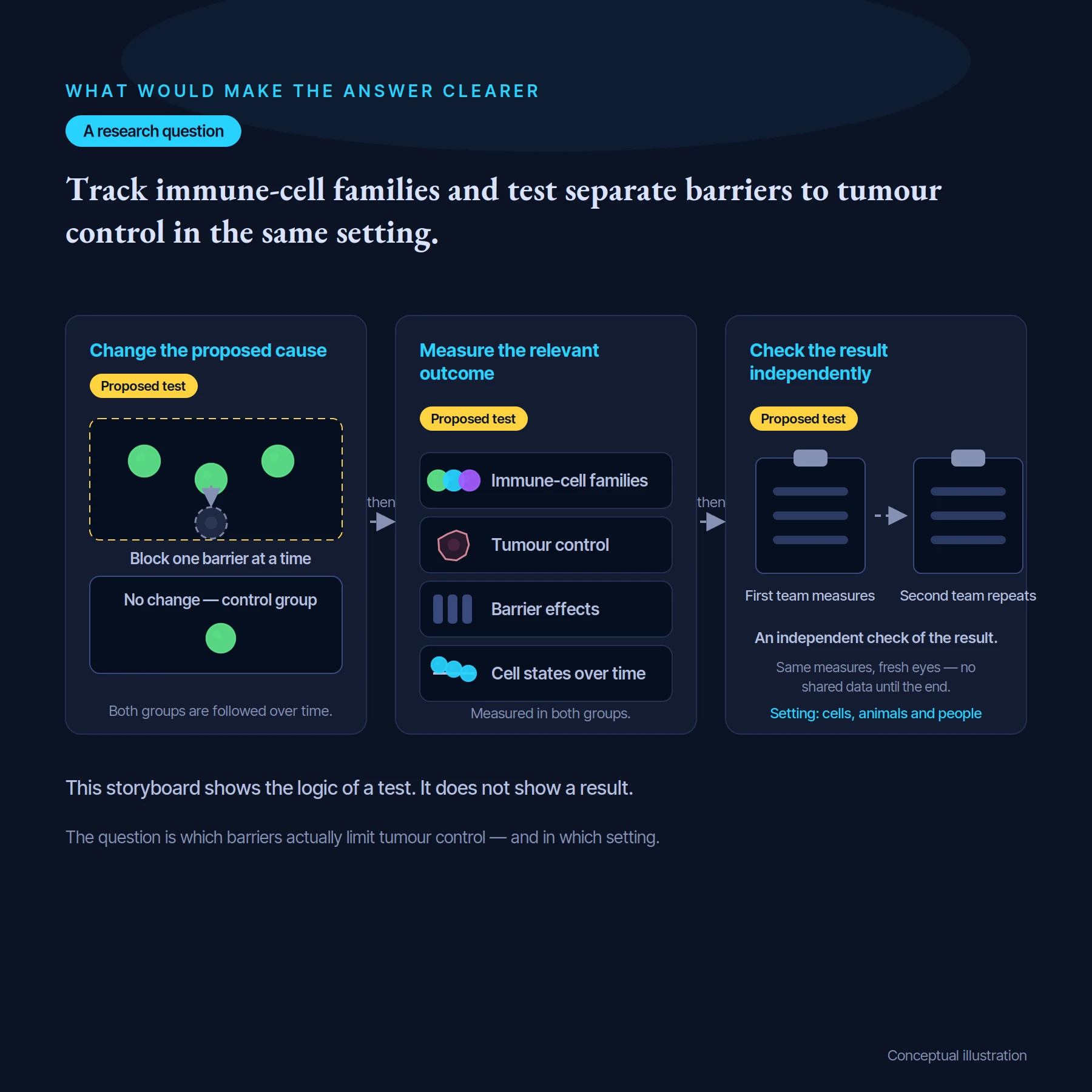
WHAT WOULD MAKE THE ANSWER CLEARER
A research question
Track immune-cell families and test separate barriers to tumour control in the same setting.
then
then
Change the proposed cause
Proposed test
Block one barrier at a time
No change — control group
Both groups are followed over time.
Measure the relevant outcome
Immune-cell families
Tumour control
Barrier effects
Cell states over time
Measured in both groups.
Check the result independently
First team measures
Second team repeats
An independent check of the result.
Same measures, fresh eyes — no shared data until the end.
Setting: cells, animals and people
This storyboard shows the logic of a test. It does not show a result.
The question is which barriers actually limit tumour control — and in which setting.
Conceptual illustration
Track immune-cell families and test separate barriers to tumour control in the same setting.
Check that the intended change really happened.
Allow for other factors and compare with suitable controls.
Look for independent confirmation and the limits of the effect.
These are questions for research, not a claim that the proposed studies have already succeeded.
Proposed tests: 1 test design(s) are registered in the scorecard.
In plain terms, researchers would change the proposed cause, check that it changed as intended, then measure a meaningful outcome while controlling plausible alternatives. The result should be able to support or count against the claim—not only show that a pathway exists.
Study design: A prospective multicancer study enrolls prespecified inflamed antigen-presenting, excluded and presentation-defective strata; randomizes matched checkpoint, lineage-reprogramming and alternative-barrier interventions; tracks pretreatment terminal and progenitor tumour-reactive clones separately with state, function and durable tumour outcomes.
What would be measured: Clonal survival versus recruitment, durable chromatin and cytotoxic changes, objective tumour control and progression or survival, analyzed by baseline stratum
Important controls: Antigen-specific and bystander controls, receptor-signature versus killing assays, equivalent target engagement, terminal versus progenitor tracing, and matched stromal or presentation rescue
Result that would support the claim: In most representative strata direct exhaustion-program reversal accounts for the largest causal control effect, traced terminal clones recover durably, and alternative barrier removal adds little with verified engagement
Result that would count against it: Benefit depends on progenitors, new clones or another baseline barrier, or terminal signatures change without function and persistence
Follow the studies, detailed comparisons and evidence ratings behind this guide.
Open the scientific review →