The question
Does a short period of greater brain plasticity cause lasting psilocybin benefit?
This is the specific idea being tested.

Does a short period of greater brain plasticity cause lasting psilocybin benefit?
What you need to knowClinical improvement and its proposed brain-plasticity mechanism are separate questions.Relative explanatory fit: Alternative ranked ahead
Why the alternative fits better: Some people improve in structured studies. That does not demonstrate a measured brain-plasticity window as the cause.
Claim assessed: Psilocybin causes a sustained reduction in human depressive symptoms by inducing a temporary increase in cortical plasticity.
Finding: SC1 protocol-level clinical response and SC3 adult experimental cortical effects reach Ε; approximately twelve-week persistence is a qualified Δ. The temporary human cortical-plasticity interval and its causal contribution to sustained symptoms each remain Γ under rubric 07's acute-pharmacodynamic and mediation-by-correlation rules. Weakest-link therefore returns Γ. The red-team pass changed neither the overall letter nor any subclaim level.
Evidence scope: Targeted primary-literature review through 2026-09-28. Supplied packet treated as methodology and schema. Every reference was re-resolved by PMID/DOI in the red-team pass; access depth is recorded as verified in that pass, which is stricter than the original edition. Company and regulatory documents on the phase 3 program are reported as context and excluded from the graded evidence base under the framework source-tier rule.
The grade applies to the stated claim. Model rankings and individual subclaim grades remain separate from the overall causal-evidence grade.
Full scientific assessment and references · Scorecard (JSON) · Review source (Markdown)
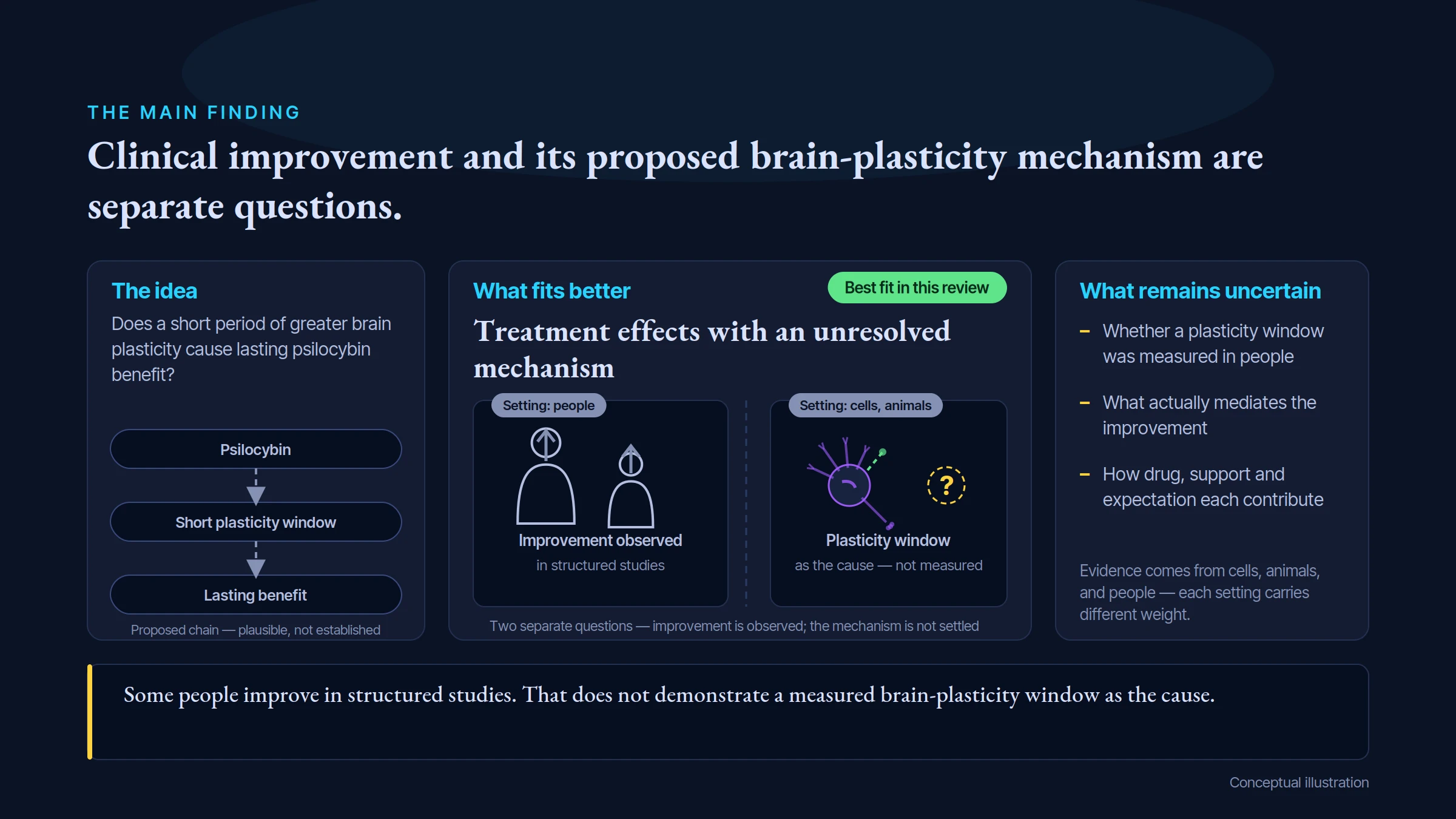
THE MAIN FINDING
Clinical improvement and its proposed brain-plasticity mechanism are separate questions.
The idea
Does a short period of greater brain plasticity cause lasting psilocybin benefit?
Psilocybin
Short plasticity window
Lasting benefit
Proposed chain — plausible, not established
What fits better
Treatment effects with an unresolved mechanism
Best fit in this review
Improvement observed in structured studies
Setting: people
Plasticity window as the cause — not measured
Setting: cells, animals
Two separate questions — improvement is observed; the mechanism is not settled
What remains uncertain
Whether a plasticity window was measured in people
What actually mediates the improvement
How drug, support and expectation each contribute
Evidence comes from cells, animals, and people — each setting carries different weight.
Some people improve in structured studies. That does not demonstrate a measured brain-plasticity window as the cause.
Conceptual illustration
This is the specific idea being tested.
Some people improve in structured studies. That does not demonstrate a measured brain-plasticity window as the cause.
A higher rank means a better fit to the evidence in this comparison. It does not prove every part of the leading explanation.
The reviewed hypothesis ranks 2 among 3 models compared; 1 alternative model(s) hold first rank for this stated claim.
Claim under review: rank 2 among 3 compared models.
Leading explanation: Context-dependent treatment response with unresolved mediators (including expectancy).
Position in this comparison: Next after leading rank.
The causal grade asks how well the stated causal claim is established. This comparison asks which of the assessed explanations fits the reviewed findings better. A leading explanation can remain unproven. Models can overlap or include the tested mechanism; an alternative ahead does not make that mechanism irrelevant. These ordinal ranks apply within this review; they do not measure the size of a difference or rank scientific strength across topics.
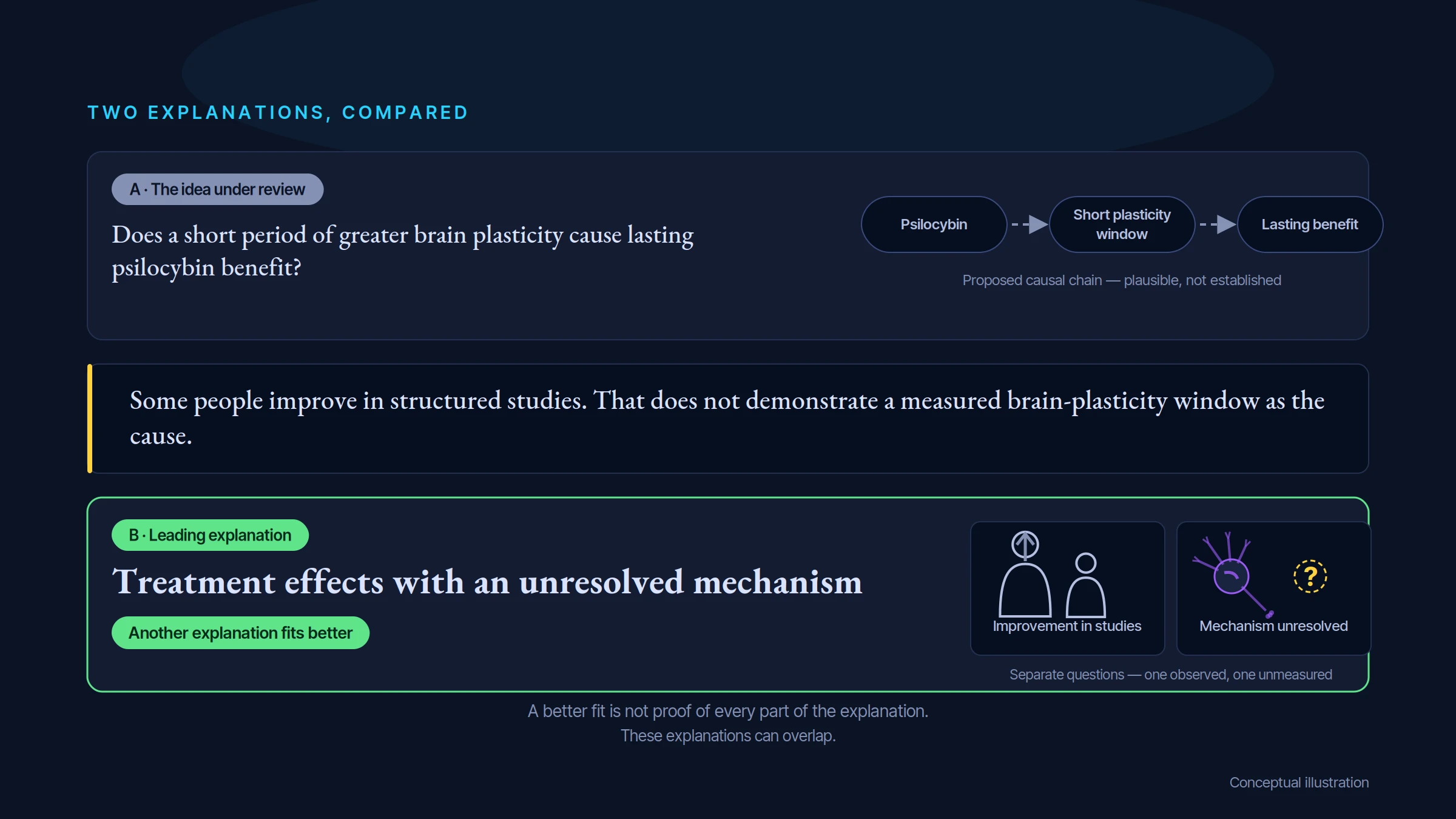
TWO EXPLANATIONS, COMPARED
A · The idea under review
Does a short period of greater brain plasticity cause lasting psilocybin benefit?
Psilocybin
Short plasticity window
Lasting benefit
Proposed causal chain — plausible, not established
Some people improve in structured studies. That does not demonstrate a measured brain-plasticity window as the cause.
B · Leading explanation
Treatment effects with an unresolved mechanism
Another explanation fits better
Improvement in studies (people)
Mechanism unresolved (cells, animals)
Separate questions — one observed, one unmeasured
A better fit is not proof of every part of the explanation.
These explanations can overlap.
Conceptual illustration
Plausible, not established for the stated claim.
Some people improve in structured studies. That does not demonstrate a measured brain-plasticity window as the cause.
These explanations can overlap. Ranking their fit to the evidence is separate from deciding how firmly a cause has been established.
Rank 1: Context-dependent treatment response with unresolved mediators (including expectancy) — Assignment to a supported psilocybin protocol reduces symptoms in some clinical contexts through an unresolved combination of pharmacological, experiential and learning processes.
Rank 2: Temporary enhanced cortical plasticity mediates durable benefit — A drug-induced interval of increased cortical capacity for change carries sustained human depressive-symptom improvement.
Rank 3: Persistent circuit-function adaptation without persistent structural excess — Lasting changes in circuit function contribute to clinical improvement without requiring a demonstrated extended interval of structural growth.
Evidence rating: Γ · Moderate confidence. How the evidence was assessed.
Some people improve in structured studies. That does not demonstrate a measured brain-plasticity window as the cause.
The evidence justifies continued, carefully controlled clinical research and nuanced discussion of protocol-based treatment—not claims that a brain 'reset' is established or that an unsupervised experience reproduces trial care. Trial results depend on selected participants, preparation, supervision, follow-up, the treatment setting, and concurrent support. A mechanism being uncertain does not mean symptom benefit is impossible; it means the pathway, durability, and who is likely to benefit still need direct tests.
Look for the proposed factor and the outcome, in the people or systems covered by the claim.
Treatment effects with an unresolved mechanism. Some people improve in structured studies. That does not demonstrate a measured brain-plasticity window as the cause.
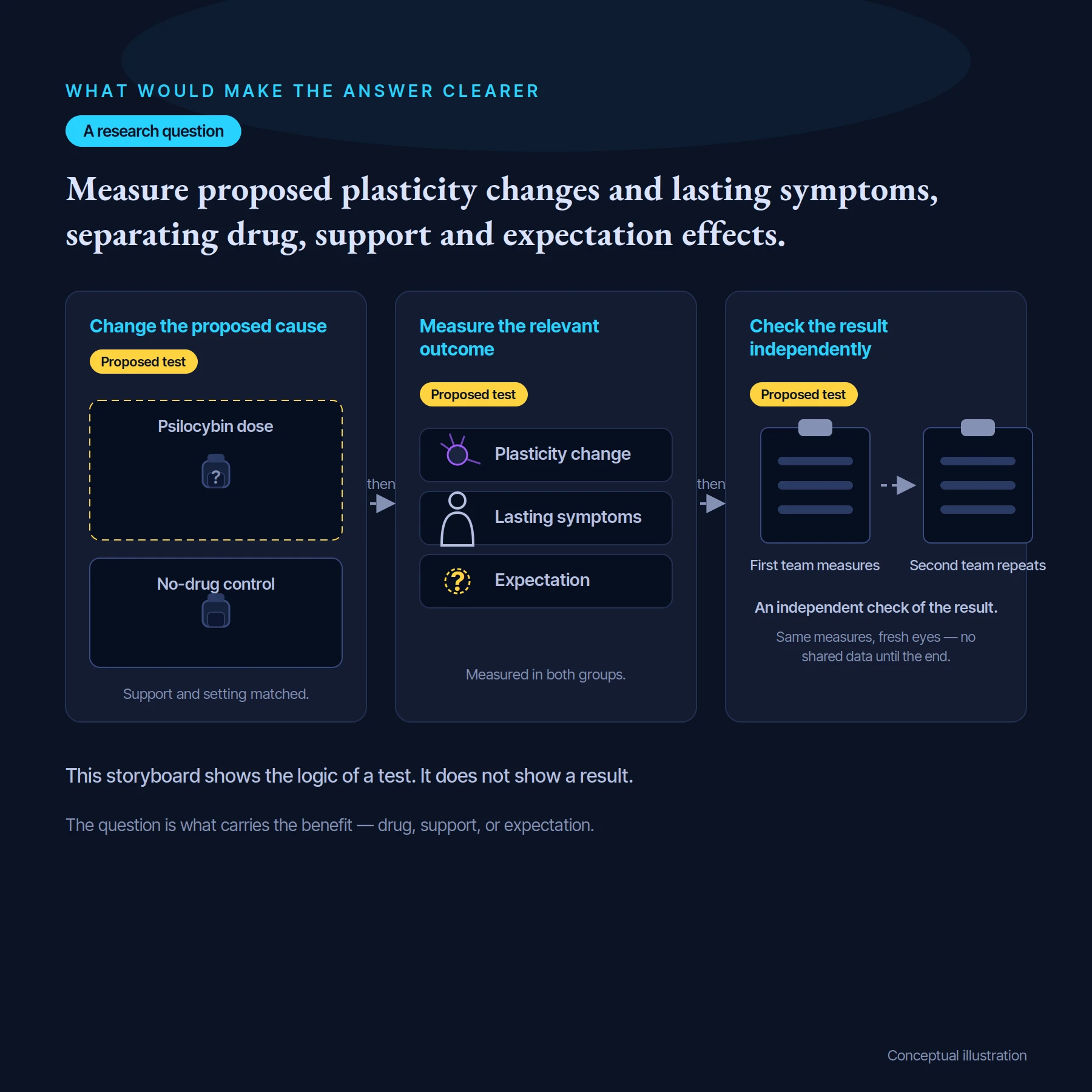
Measure proposed plasticity changes and lasting symptoms, separating drug, support and expectation effects.
These illustrations show the key questions tested in the review. They are conceptual drawings, not microscope images or experimental results.
WHAT WOULD MAKE THE ANSWER CLEARER
A research question
Measure proposed plasticity changes and lasting symptoms, separating drug, support and expectation effects.
then
then
Change the proposed cause
Proposed test
Psilocybin dose
No-drug control
Support and setting matched.
Measure the relevant outcome
Proposed test
Plasticity change
Lasting symptoms
Expectation
Measured in both groups.
Check the result independently
Proposed test
First team measures
Second team repeats
An independent check of the result.
Same measures, fresh eyes — no shared data until the end.
This storyboard shows the logic of a test. It does not show a result.
The question is what carries the benefit — drug, support, or expectation.
Conceptual illustration
Measure proposed plasticity changes and lasting symptoms, separating drug, support and expectation effects.
Check that the intended change really happened.
Allow for other factors and compare with suitable controls.
Look for independent confirmation and the limits of the effect.
These are questions for research, not a claim that the proposed studies have already succeeded.
Proposed tests: 3 test design(s) are registered in the scorecard.
In plain terms, researchers would change the proposed cause, check that it changed as intended, then measure a meaningful outcome while controlling plausible alternatives. The result should be able to support or count against the claim—not only show that a pathway exists.
Study design: Interrupt a validated growth/functional-plasticity effector after acute psilocybin exposure, with an independent rescue and laboratory replication.
What would be measured: Direct cortical spine formation and physiology, multiple sustained stress-related behavioral endpoints, motor function and general learning.
Important controls: Preserved drug exposure and acute cortical activity, selectivity of effector interruption, animal-level replication and blinded analysis.
Result that would support the claim: Selective loss and rescue of plasticity and sustained behavior within the defined model.
Result that would count against it: Sustained behavior intact despite verified loss of the specified plasticity process.
Study design: Randomize a prospectively defined depressed population to psilocybin or credible active control under matched support; independently randomize equivalent learning within a measured candidate window or later.
What would be measured: Validated cortical inducibility/excitability assay plus complementary imaging over hours/days/weeks; clinician-rated symptoms at six/twelve weeks and six months.
Important controls: Drug×timing interaction, justified exclusion restrictions, blinding guesses, participant-level analysis, multiplicity, attrition, treatment-policy and rescue-sensitive estimands.
Result that would support the claim: Prespecified replicated drug×timing interaction supported by measured inducibility and selective mediation assumptions; timing alone is insufficient.
Result that would count against it: Verified window without sustained symptom advantage attributable to its timing/mediator contrast.
Study design: Randomize depressed participants to psilocybin with and without 5-HT2A antagonist pretreatment (or conditions that suppress the acute experience), with randomized order and setting, a preregistered plasticity readout and a prespecified sustained symptom endpoint, powered for the mediation contrast rather than for feasibility.
What would be measured: Validated cortical inducibility measure plus a static synaptic marker, with clinician-rated symptoms at six and twelve weeks and six months.
Important controls: Measured allocation guessing and expectancy in participants and raters; drug exposure verified; randomized rather than sequential assignment of setting and order.
Result that would support the claim: Blockade that removes both the measured plasticity response and the sustained symptom benefit, with exposure and support held constant.
Result that would count against it: Sustained symptom benefit preserved when the plasticity response is verifiably blocked, or a verified plasticity interval with no related symptom advantage.
Follow the studies, detailed comparisons and evidence ratings behind this guide.
Open the scientific review →