The question
Do failing cell energy systems start Alzheimer's disease?
This is the specific idea being tested.
Do failing cell energy systems start Alzheimer's disease?
What you need to knowCell energy failure can contribute, but interacting genes, proteins and inflammation fit better.Relative explanatory fit: Alternative ranked ahead
Why the alternative fits better: Genes, damaged proteins and inflammation affect cell energy systems and feed back on one another.
Claim assessed: Age-related mitochondrial bioenergetic failure is a primary upstream causal driver of neurodegeneration, initiating rather than following proteinopathies in sporadic Alzheimer’s, Parkinson’s, Huntington’s disease and ALS.
Finding: Scope-matched SC5 gives Γ. Endogenous mitochondrial lesions demonstrate convergent model causality (SC2 Ζ), and HD biogenesis has contextual contribution (SC3 Ε). Neither set identifies age-related respiratory failure as the spontaneous upstream cause across disease classes. The registered phrase sporadic Huntington disease is scientifically ill-posed: the examined HTT disease is genetically initiated, and is retained as an explicit counterexample rather than silently recast.
Evidence scope: 70 primary reports; literature cutoff 2026-10-07; source examination UTC date 2026-10-07; bounded critical review, not exhaustive systematic review.
The grade applies to the stated claim. Model rankings and individual subclaim grades remain separate from the overall causal-evidence grade.
Full scientific assessment and references · Scorecard (JSON) · Review source (Markdown)
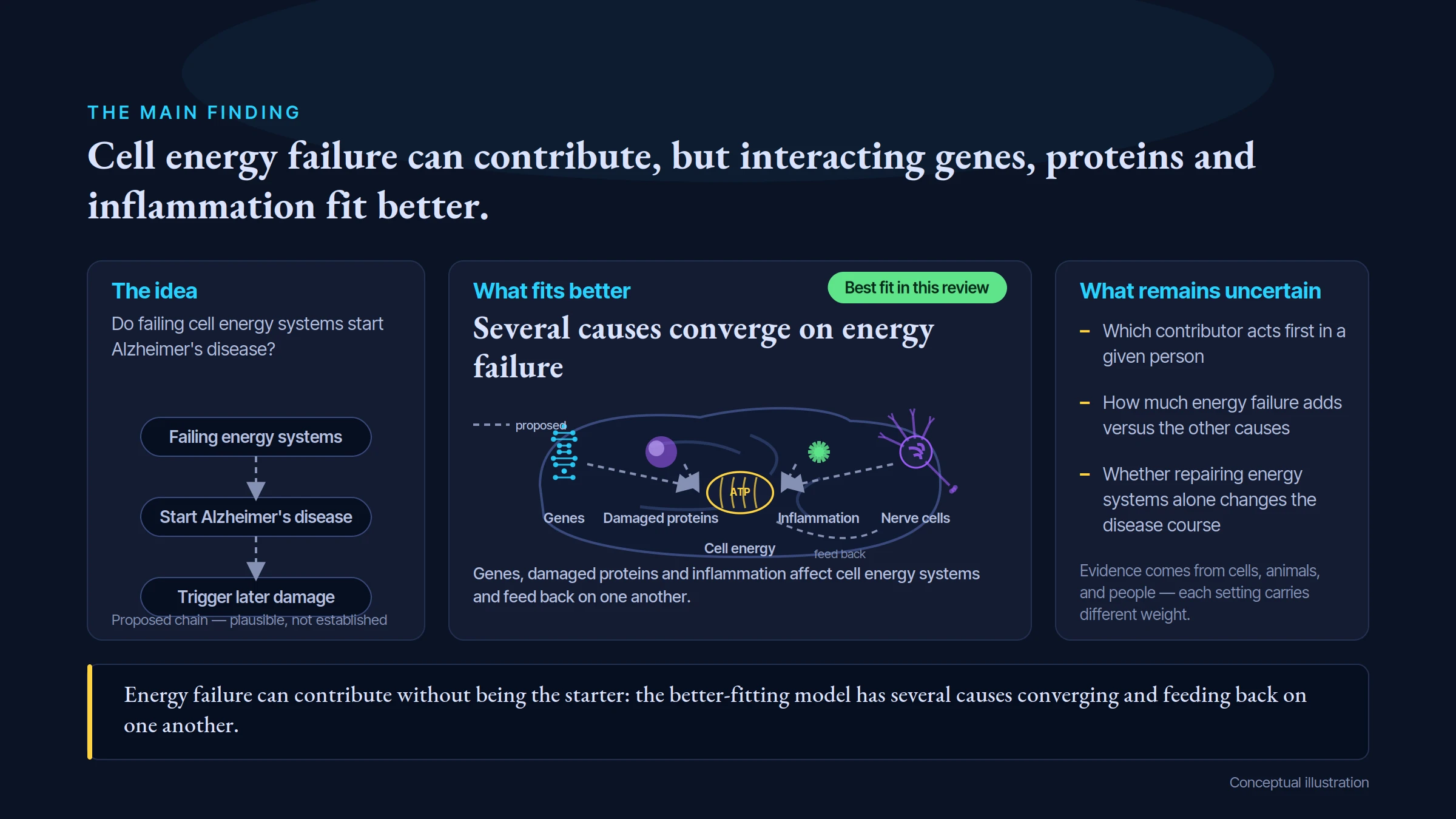
THE MAIN FINDING
Cell energy failure can contribute, but interacting genes, proteins and inflammation fit better.
The idea
Do failing cell energy systems start Alzheimer's disease?
Failing energy systems
Start Alzheimer's disease
Trigger later damage
Proposed chain — plausible, not established
What fits better
Several causes converge on energy failure
Best fit in this review
Genes, proteins and inflammation converge on cell energy (proposed links, dashed)
Genes
Damaged proteins
Inflammation
Nerve cells
Cell energy systems
feed back on one another
dashed line: proposed relationship
Genes, damaged proteins and inflammation affect cell energy systems and feed back on one another.
What remains uncertain
Which contributor acts first in a given person
How much energy failure adds versus the other causes
Whether repairing energy systems alone changes the disease course
Evidence comes from cells, animals, and people — each setting carries different weight.
Energy failure can contribute without being the starter: the better-fitting model has several causes converging and feeding back on one another.
Conceptual illustration
This is the specific idea being tested.
Genes, damaged proteins and inflammation affect cell energy systems and feed back on one another.
A higher rank means a better fit to the evidence in this comparison. It does not prove every part of the leading explanation.
The reviewed hypothesis ranks 4 among 5 models compared; 1 alternative model(s) hold first rank for this stated claim.
Claim under review: rank 4 among 5 compared models.
Leading explanation: Multi-hit convergent loop.
Position in this comparison: Between leading and last ranks.
The causal grade asks how well the stated causal claim is established. This comparison asks which of the assessed explanations fits the reviewed findings better. A leading explanation can remain unproven. Models can overlap or include the tested mechanism; an alternative ahead does not make that mechanism irrelevant. These ordinal ranks apply within this review; they do not measure the size of a difference or rank scientific strength across topics.
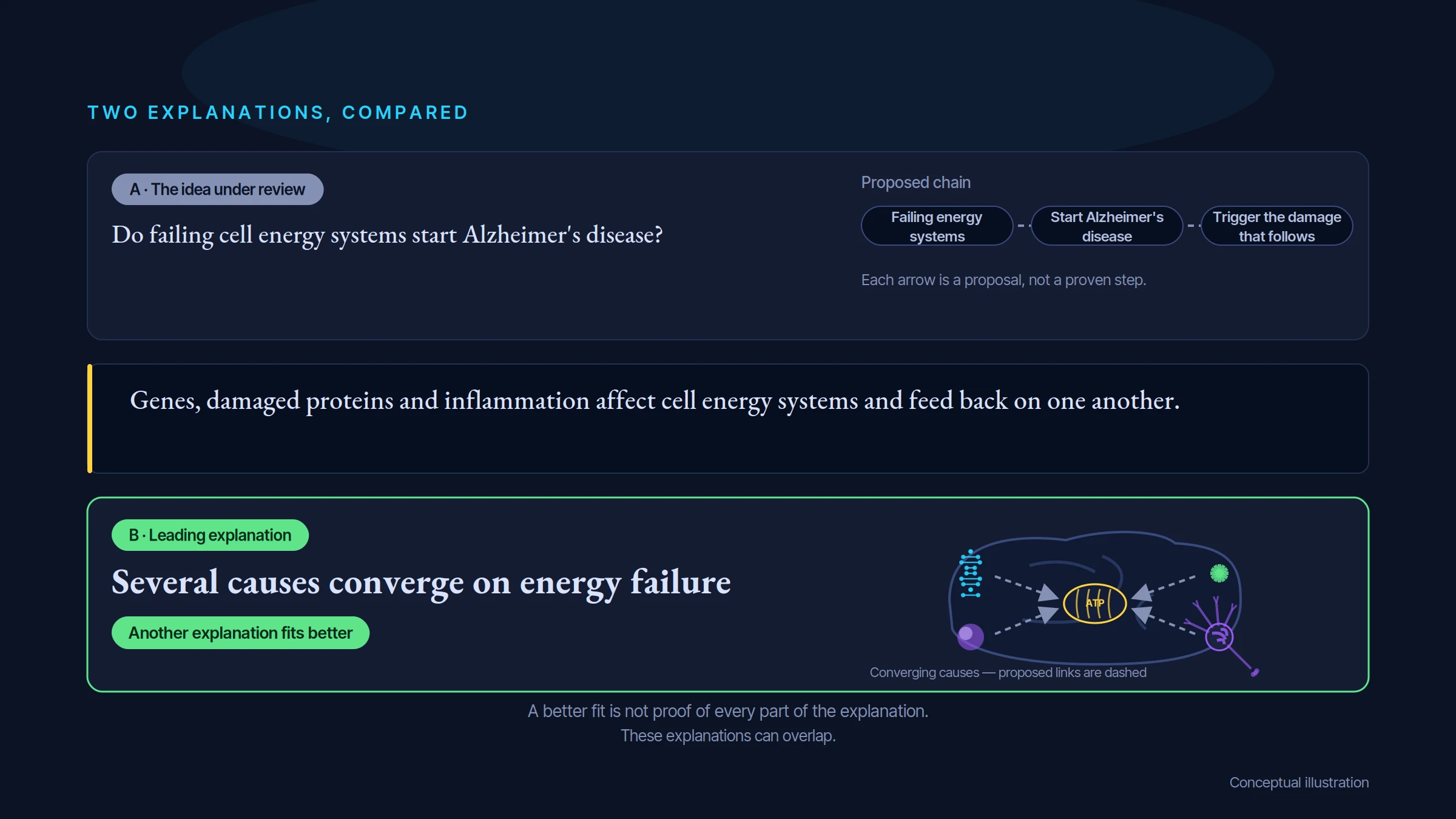
TWO EXPLANATIONS, COMPARED
A · The idea under review
Do failing cell energy systems start Alzheimer's disease?
Proposed chain
Failing energy systems
Start Alzheimer's disease
Trigger the damage that follows
Each arrow is a proposal, not a proven step.
Genes, damaged proteins and inflammation affect cell energy systems and feed back on one another.
B · Leading explanation
Several causes converge on energy failure
Another explanation fits better
Several causes converge on energy failure (proposed links, dashed)
Converging causes — proposed links are dashed
A better fit is not proof of every part of the explanation.
These explanations can overlap.
Conceptual illustration
Plausible, not established for the stated claim.
Genes, damaged proteins and inflammation affect cell energy systems and feed back on one another.
These explanations can overlap. Ranking their fit to the evidence is separate from deciding how firmly a cause has been established.
Rank 1: Multi-hit convergent loop — Genotype, proteinopathy, organelle quality control and inflammation converge on conditional metabolic vulnerability.
Rank 2: Selective vulnerability and permissive threshold — Mitochondrial reserve and compartmental demand determine injury after defined stresses.
Rank 3: Proteinopathy-first amplification — Pathogenic proteins initiate organelle disruption and mitochondrial changes amplify pathology.
Rank 4: Mitochondrial-first cascade — Ordinary age-related mitochondrial failure initiates the common proteinopathies.
Rank 5: Oxidative damage primacy — ROS injury is the decisive common initiator rather than one downstream mediator.
Evidence rating: Γ · Moderate confidence. How the evidence was assessed.
Genes, damaged proteins and inflammation affect cell energy systems and feed back on one another.
Scope-matched SC5 gives Γ. Endogenous mitochondrial lesions demonstrate convergent model causality (SC2 Ζ), and HD biogenesis has contextual contribution (SC3 Ε). Neither set identifies age-related respiratory failure as the spontaneous upstream cause across disease classes. The registered phrase sporadic Huntington disease is scientifically ill-posed: the examined HTT disease is genetically initiated, and is retained as an explicit counterexample rather than silently recast.
Look for the proposed factor and the outcome, in the people or systems covered by the claim.
Several causes converge on energy failure. Genes, damaged proteins and inflammation affect cell energy systems and feed back on one another.
Test energy-system repair separately from protein and inflammatory changes before and after disease begins.
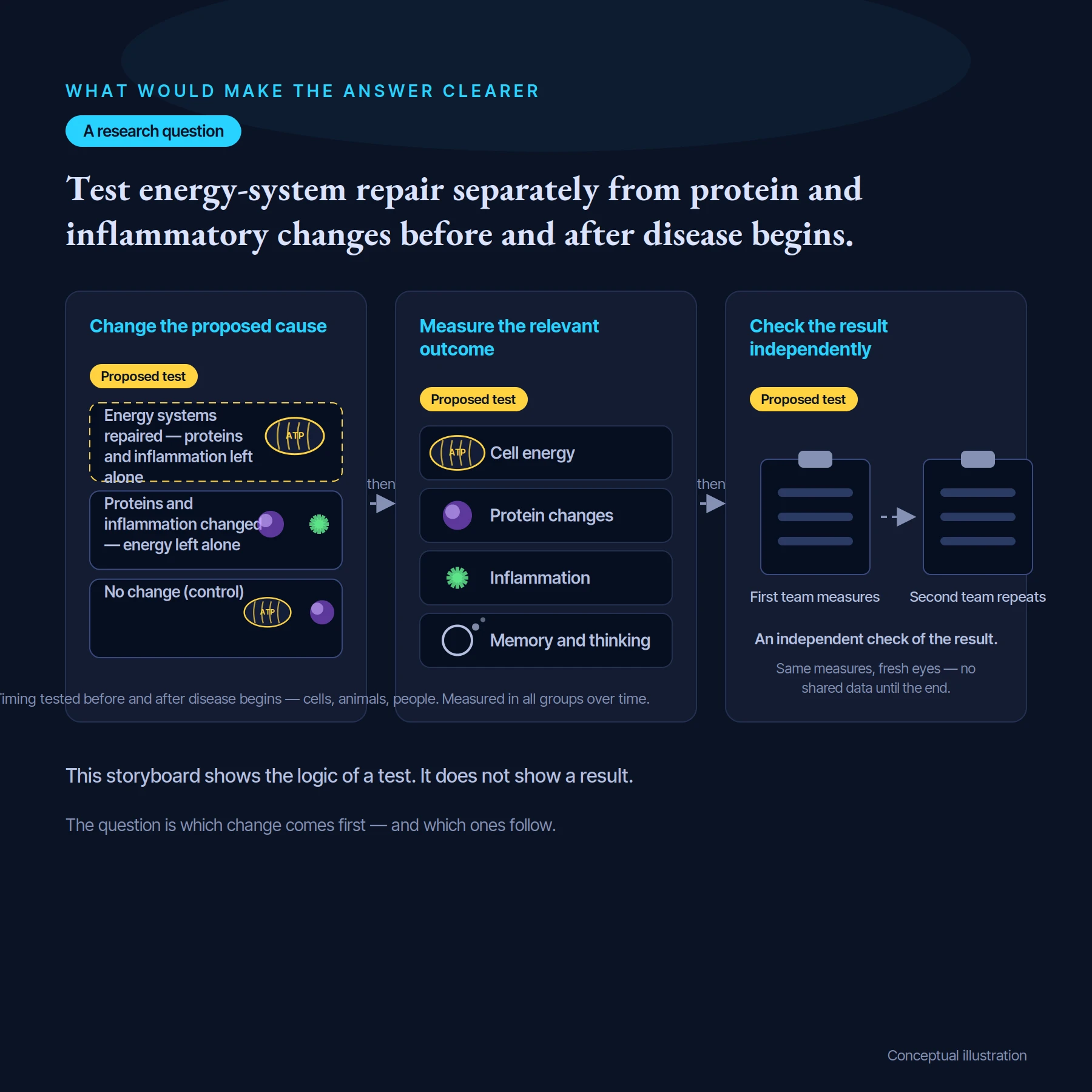
WHAT WOULD MAKE THE ANSWER CLEARER
A research question
Test energy-system repair separately from protein and inflammatory changes before and after disease begins.
then
then
Change the proposed cause
Proposed test
Energy systems repaired — proteins and inflammation left alone
Proteins and inflammation changed — energy left alone
No change (control)
Timing tested before and after disease begins — cells, animals, people.
Measure the relevant outcome
Proposed test
Cell energy
Protein changes
Inflammation
Memory and thinking
Measured in all groups over time.
Check the result independently
Proposed test
First team measures
Second team repeats
An independent check of the result.
Same measures, fresh eyes — no shared data until the end.
This storyboard shows the logic of a test. It does not show a result.
The question is which change comes first — and which ones follow.
Conceptual illustration
Test energy-system repair separately from protein and inflammatory changes before and after disease begins.
Check that the intended change really happened.
Allow for other factors and compare with suitable controls.
Look for independent confirmation and the limits of the effect.
These are questions for research, not a claim that the proposed studies have already succeeded.
Proposed tests: 1 test design(s) are registered in the scorecard.
In plain terms, researchers would change the proposed cause, check that it changed as intended, then measure a meaningful outcome while controlling plausible alternatives. The result should be able to support or count against the claim—not only show that a pathway exists.
Study design: In baseline genotype-, reserve- and protein-state-defined aged cohorts or validated natural-instrument cohorts, selectively preserve the implicated mitochondrial process before protein pathology, with matched protein-directed perturbation and mechanistic rescue. Follow incident disease, cell fate and function. Predefine disease-specific boundaries rather than pooling genetic HD with sporadic syndromes.
What would be measured: Incident adjudicated disease, chronological protein/mitochondrial change, labelled neuronal and axonal survival, motor/cognitive function and lifespan
Important controls: Cell-specific engagement, general viability, genotype, baseline reserve, protein burden, developmental compensation, treatment timing and symptomatic medication; selective lesion reinstatement
Result that would support the claim: Mitochondrial preservation prevents protein pathology and disease in the predicted baseline strata, with matched rescue and independent natural or clinical confirmation
Result that would count against it: Adequate early mitochondrial correction leaves onset unchanged, protein-directed perturbation prevents the mitochondrial lesion, or reserve thresholds fail to predict vulnerability
Follow the studies, detailed comparisons and evidence ratings behind this guide.
Open the scientific review →