The question
Do a tumour's surroundings generally dominate its internal genetic drivers?
This is the specific idea being tested.
Do a tumour's surroundings generally dominate its internal genetic drivers?
What you need to knowA tumour's surroundings matter, but can restrain or promote cancer depending on the setting.Relative explanatory fit: Alternative ranked ahead
Why the alternative fits better: Immune cells, support tissue and its scaffold have different effects at different stages. One dominant external cause misses this.
Claim assessed: Tumor-microenvironment factors are primary drivers of malignant maintenance and progression, dominating cell-autonomous genetic and epigenetic drivers.
Finding: Preregistered primary-subclaim SC2 returns Γ. Weakest-link and scope-matched sensitivities also return Γ; SC1 influence reaches Η independently. A narrow macrophage-dependent acquired-resistance state can cross Ε contribution/conditional dominance, but it does not replace the registered broad maintenance/progression claim.
Evidence scope: 64 primary reports; literature cutoff 2026-10-08; source examination UTC date 2026-10-08; bounded critical review, not exhaustive systematic review.
The grade applies to the stated claim. Model rankings and individual subclaim grades remain separate from the overall causal-evidence grade.
Full scientific assessment and references · Scorecard (JSON) · Review source (Markdown)
THE MAIN FINDING
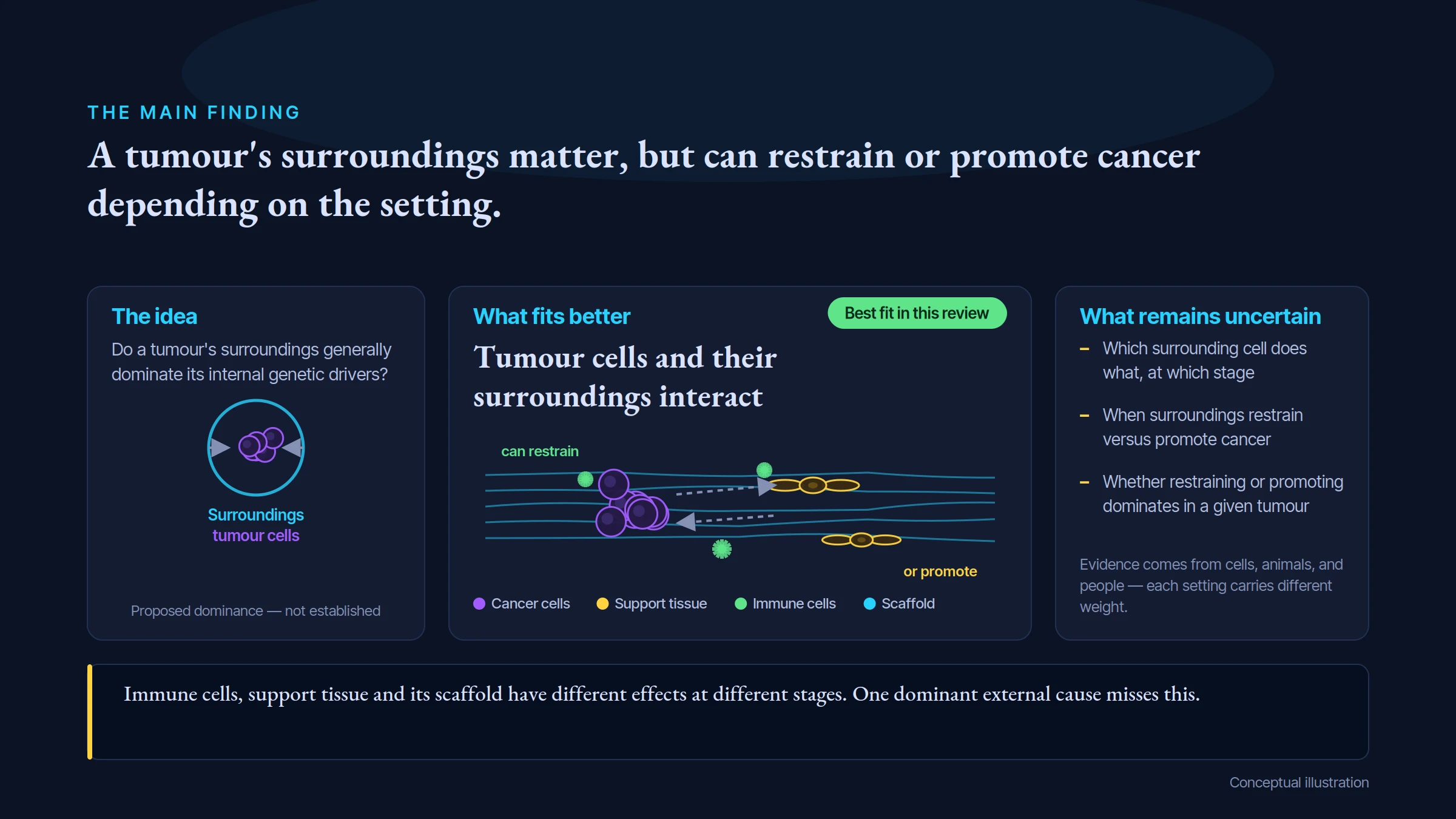
A tumour's surroundings matter, but can restrain or promote cancer depending on the setting.
The idea
Do a tumour's surroundings generally dominate its internal genetic drivers?
Surroundings (proposed dominant cause)
Proposed dominance — not established
What fits better
Tumour cells and their surroundings interact
Best fit in this review
can restrain
or promote
Cancer cells
Support tissue
Immune cells
Scaffold
What remains uncertain
Which surrounding cell does what, at which stage
When surroundings restrain versus promote cancer
Whether restraining or promoting dominates in a given tumour
Evidence comes from cells, animals, and people — each setting carries different weight.
Immune cells, support tissue and its scaffold have different effects at different stages. One dominant external cause misses this.
Conceptual illustration
This is the specific idea being tested.
Immune cells, support tissue and its scaffold have different effects at different stages. One dominant external cause misses this.
A higher rank means a better fit to the evidence in this comparison. It does not prove every part of the leading explanation.
The reviewed hypothesis ranks 5 among 5 models compared; 1 alternative model(s) hold first rank for this stated claim.
Claim under review: rank 5 among 5 compared models.
Leading explanation: Dual-function context-dependent stroma.
Position in this comparison: Last recorded rank.
The causal grade asks how well the stated causal claim is established. This comparison asks which of the assessed explanations fits the reviewed findings better. A leading explanation can remain unproven. Models can overlap or include the tested mechanism; an alternative ahead does not make that mechanism irrelevant. These ordinal ranks apply within this review; they do not measure the size of a difference or rank scientific strength across topics.
WHY THE COMPARISON MATTERS
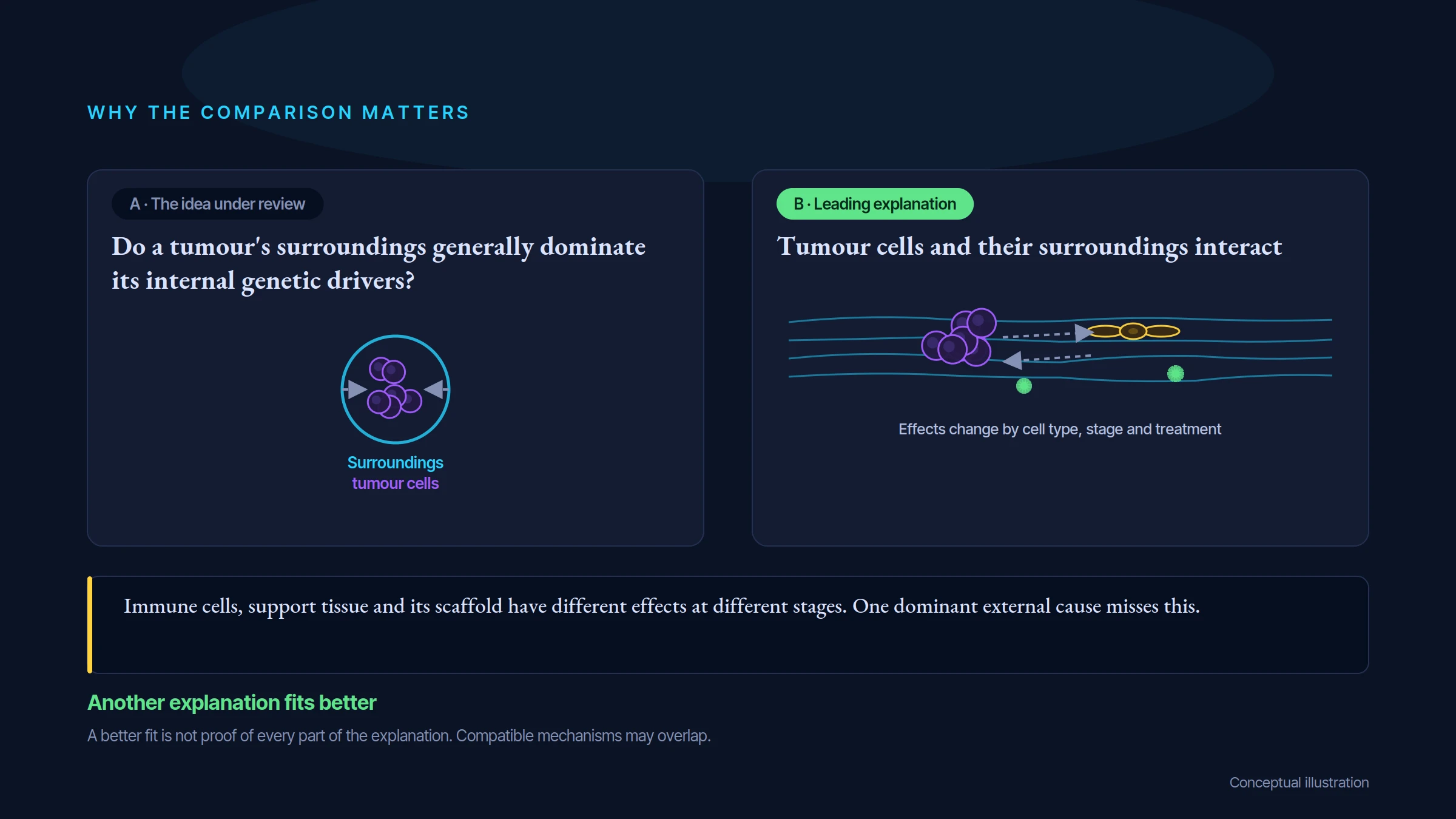
A · The idea under review
Do a tumour's surroundings generally dominate its internal genetic drivers?
Surroundings proposed as dominant cause
B · Leading explanation
Tumour cells and their surroundings interact
Effects change by cell type, stage and treatment
Immune cells, support tissue and its scaffold have different effects at different stages. One dominant external cause misses this.
Another explanation fits better
A better fit is not proof of every part of the explanation. Compatible mechanisms may overlap.
Conceptual illustration
Plausible, not established for the stated claim.
Immune cells, support tissue and its scaffold have different effects at different stages. One dominant external cause misses this.
These explanations can overlap. Ranking their fit to the evidence is separate from deciding how firmly a cause has been established.
Rank 1: Dual-function context-dependent stroma — Immune, stromal and matrix compartments interact with intrinsic programs, with effects changing sign by cell subset, stage and treatment.
Rank 2: Immune-compartment causality — Defined immune effectors causally control malignant escape and durable treatment outcomes.
Rank 3: Cell-autonomous drivers with permissive niche — Intrinsic drivers remain required while host conditions supply support or determine eradication/escape.
Rank 4: Stroma as host containment — Selected matrix/myofibroblast and immune programs restrain growth or maintain dormancy.
Rank 5: Microenvironment primacy — Host factors generally dominate intrinsic malignant maintenance/progression.
Evidence rating: Γ · Moderate confidence. How the evidence was assessed.
Immune cells, support tissue and its scaffold have different effects at different stages. One dominant external cause misses this.
A result about how a disease works is a separate question from whether a treatment improves health.
Look for the proposed factor and the outcome, in the people or systems covered by the claim.
Tumour cells and their surroundings interact. Immune cells, support tissue and its scaffold have different effects at different stages. One dominant external cause misses this.
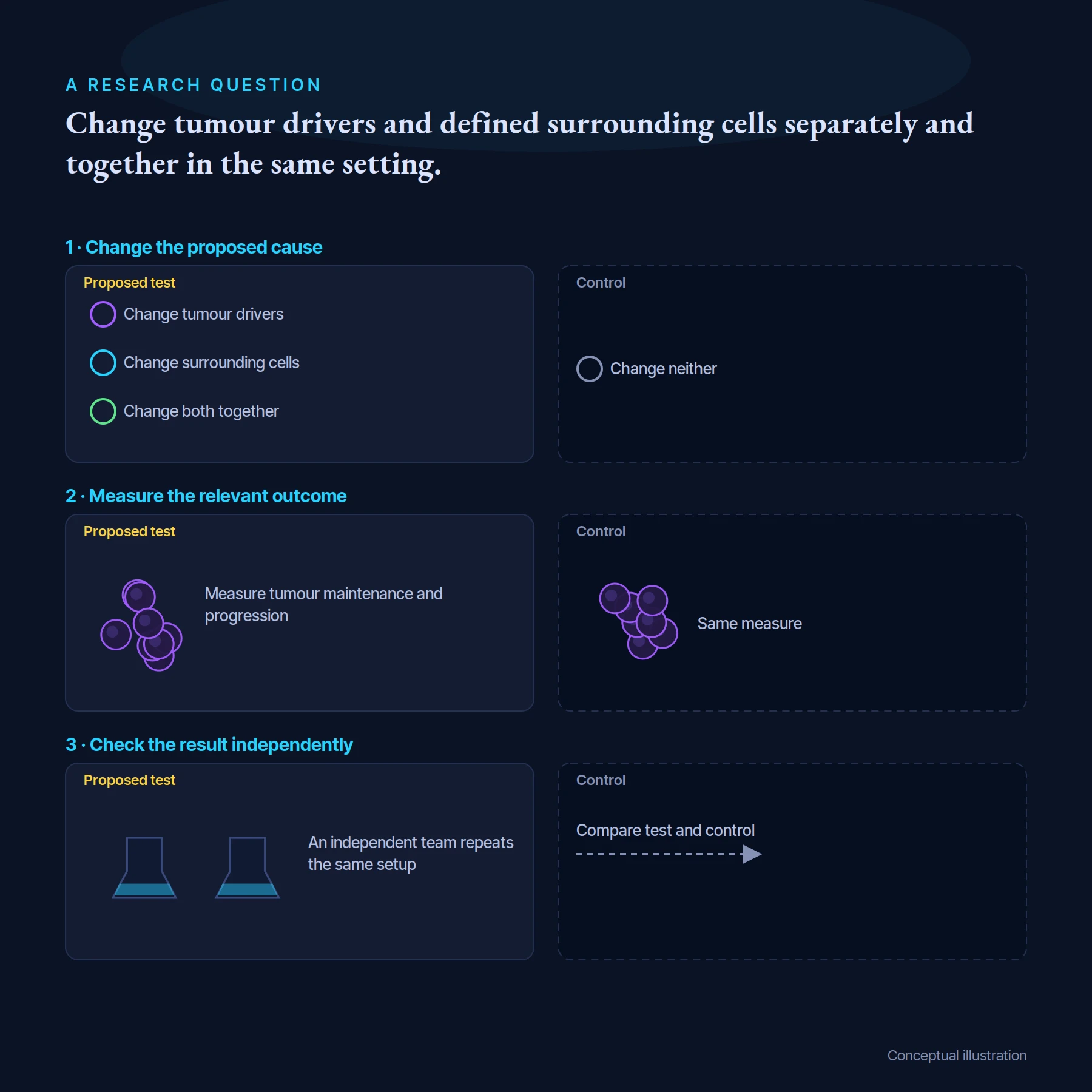
Change tumour drivers and defined surrounding cells separately and together in the same setting.
A research question
Change tumour drivers and defined surrounding cells separately and together in the same setting.
1 · Change the proposed cause
2 · Measure the relevant outcome
3 · Check the result independently
Proposed test
Change tumour drivers
Change surrounding cells
Change both together
Control: no change
Change neither
Proposed test
Measure tumour maintenance and progression
Control
Same measure in control
Proposed test
An independent team repeats the same setup
Control
Compare test and control
Conceptual illustration
Change tumour drivers and defined surrounding cells separately and together in the same setting.
Check that the intended change really happened.
Allow for other factors and compare with suitable controls.
Look for independent confirmation and the limits of the effect.
These are questions for research, not a claim that the proposed studies have already succeeded.
Proposed tests: 1 test design(s) are registered in the scorecard.
In plain terms, researchers would change the proposed cause, check that it changed as intended, then measure a meaningful outcome while controlling plausible alternatives. The result should be able to support or count against the claim—not only show that a pathway exists.
Study design: In several endogenous genotype-defined tumors at matched stages, preregister a factorial intrinsic-driver withdrawal and lineage-specific host perturbation, restoring each separately; track clones and host state through treatment-free relapse and orthogonal immune/metabolic bypass.
What would be measured: Engagement in tumor and host, absolute tumor burden, metastasis, survival, residual clones and recurrence after restoration
Important controls: Equal initial burden, littermate/lineage controls, tumor-only versus host-only editing, depletion efficiency, pharmacokinetics, injury/toxicity and clone-matched reimplantation controls
Result that would support the claim: Host perturbation repeatedly controls maintenance despite retained intrinsic drivers, with host restoration restoring growth and no driver-only dependency across the registered contexts
Result that would count against it: Driver withdrawal remains necessary, host effect is conditional on driver/immune state, or sign reverses across prespecified compartments
Follow the studies, detailed comparisons and evidence ratings behind this guide.
Open the scientific review →