The question
Are changes in DNA packaging the primary cause of cancer?
This is the specific idea being tested.
Are changes in DNA packaging the primary cause of cancer?
What you need to knowDNA packaging can help cancer begin or persist, but it works alongside genetic and tissue changes.Relative explanatory fit: Alternative ranked ahead
Why the alternative fits better: Packaging changes can contribute to cancer and treatment response without always being the first or main cause.
Claim assessed: Chromatin dysregulation can autonomously initiate malignant transformation in mammals and is a primary driver of human cancer rather than a consequence of genetic oncogenic lesions.
Finding: Scope-matched SC4 yields Γ for the registered mammalian-autonomy and general human-primacy claim. Transient fly initiation is Ε and its circuit perturbations provide Δ causal contribution, while mammalian epimutational and reprogramming causality is retained in defined engineered/predisposition settings. These positive settings do not establish representative autonomous chromatin-first human origin.
Evidence scope: 60 primary reports; literature cutoff 2026-10-08; source examination UTC date 2026-10-09; bounded critical review, not exhaustive systematic review.
The grade applies to the stated claim. Model rankings and individual subclaim grades remain separate from the overall causal-evidence grade.
Full scientific assessment and references · Scorecard (JSON) · Review source (Markdown)
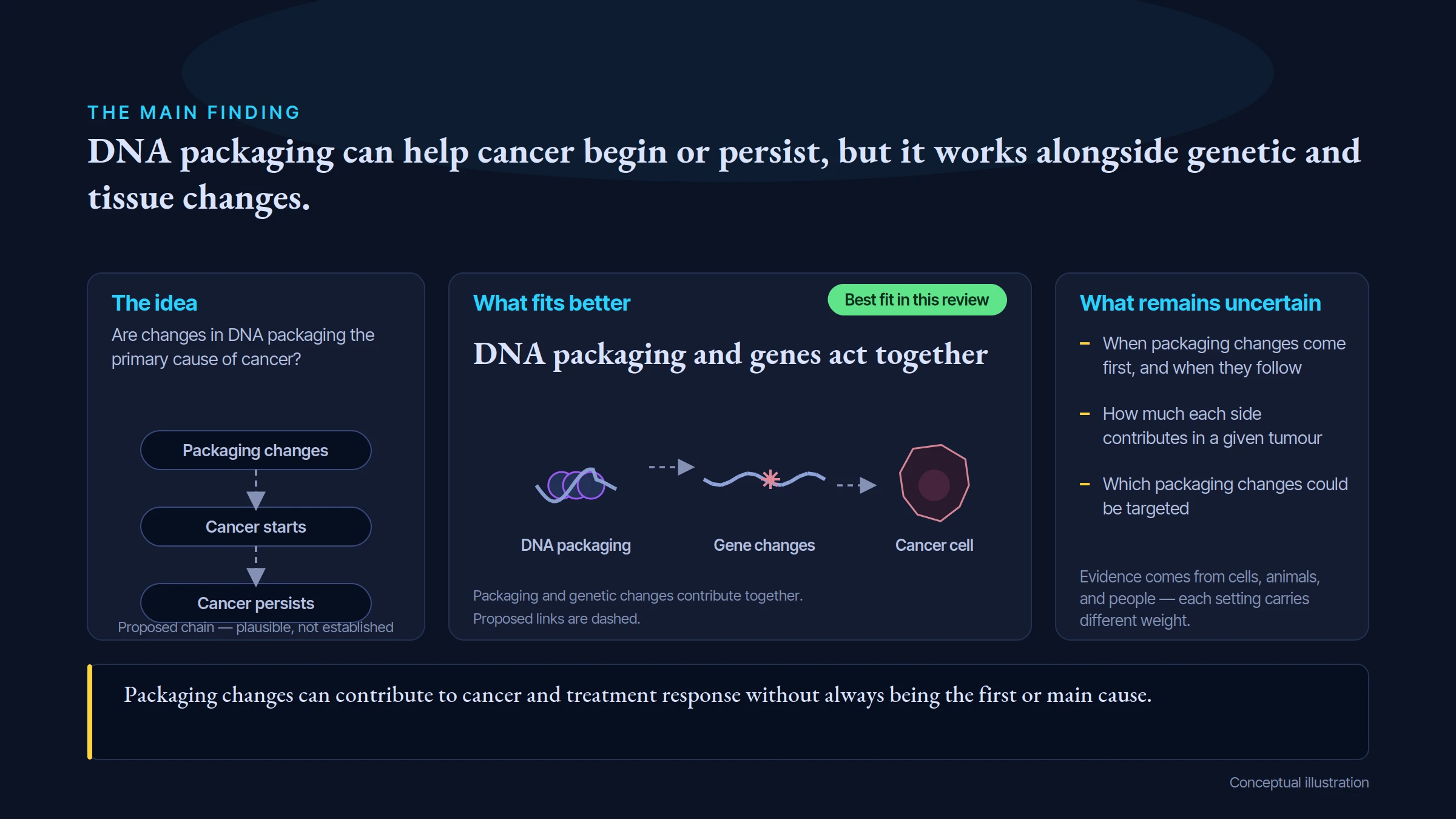
THE MAIN FINDING
DNA packaging can help cancer begin or persist, but it works alongside genetic and tissue changes.
The idea
Are changes in DNA packaging the primary cause of cancer?
Packaging changes
Cancer starts
Cancer persists
Proposed chain — plausible, not established
What fits better
Best fit in this review
DNA packaging and genes act together
DNA packaging
Gene changes
Cancer cell
Packaging and genetic changes contribute together.
Proposed links are dashed.
What remains uncertain
When packaging changes come first, and when they follow
How much each side contributes in a given tumour
Which packaging changes could be targeted
Evidence comes from cells, animals, and people — each setting carries different weight.
Packaging changes can contribute to cancer and treatment response without always being the first or main cause.
Conceptual illustration
This is the specific idea being tested.
Packaging changes can contribute to cancer and treatment response without always being the first or main cause.
A higher rank means a better fit to the evidence in this comparison. It does not prove every part of the leading explanation.
The reviewed hypothesis ranks 5 among 5 models compared; 1 alternative model(s) hold first rank for this stated claim.
Claim under review: rank 5 among 5 compared models.
Leading explanation: Epigenetic co-driver and maintenance dependency.
Position in this comparison: Last recorded rank.
The causal grade asks how well the stated causal claim is established. This comparison asks which of the assessed explanations fits the reviewed findings better. A leading explanation can remain unproven. Models can overlap or include the tested mechanism; an alternative ahead does not make that mechanism irrelevant. These ordinal ranks apply within this review; they do not measure the size of a difference or rank scientific strength across topics.
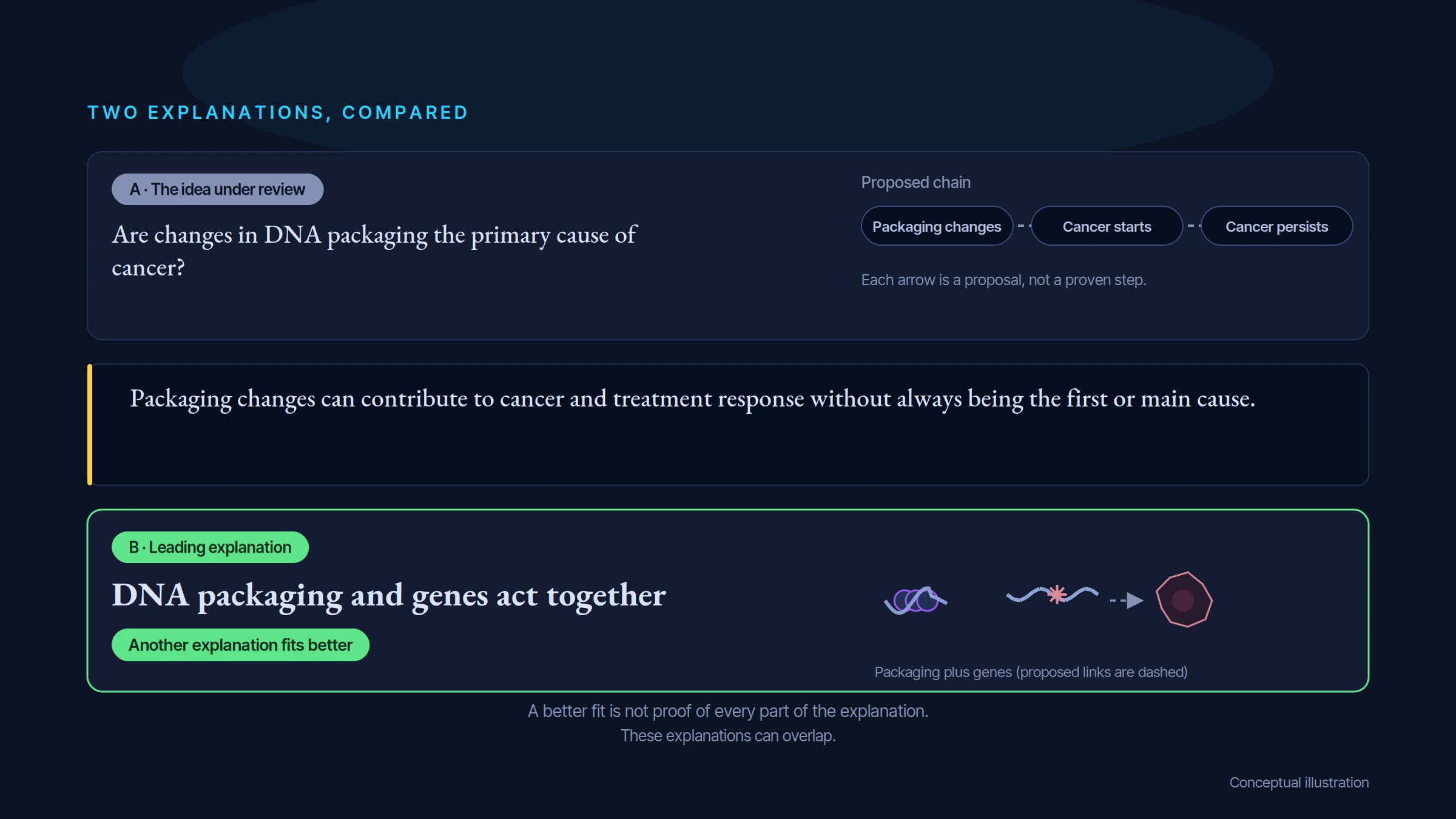
TWO EXPLANATIONS, COMPARED
A · The idea under review
Are changes in DNA packaging the primary cause of cancer?
Proposed chain
Packaging changes
Cancer starts
Cancer persists
Each arrow is a proposal, not a proven step.
Packaging changes can contribute to cancer and treatment response without always being the first or main cause.
B · Leading explanation
DNA packaging and genes act together
Another explanation fits better
Packaging plus genes (proposed links are dashed)
A better fit is not proof of every part of the explanation.
These explanations can overlap.
Conceptual illustration
Plausible, not established for the stated claim.
Packaging changes can contribute to cancer and treatment response without always being the first or main cause.
These explanations can overlap. Ranking their fit to the evidence is separate from deciding how firmly a cause has been established.
Rank 1: Epigenetic co-driver and maintenance dependency — Chromatin state and regulators contribute to initiation, persistence and therapy response alongside genotype.
Rank 2: Genetic oncogenesis with epigenetic adaptation — Genetic lesions can initiate disease and remodel chromatin; adapted states can be causal thereafter.
Rank 3: Lineage plasticity and reversible state — Malignant cells can change differentiation and drug tolerance through reversible regulatory programmes.
Rank 4: Chromatin-protein pleiotropy with DNA-damage initiation — Some chromatin perturbations cause repair failure, insertional events or chromosome changes that cooperate in malignancy.
Rank 5: Autonomous epigenetic initiation — Chromatin state alone is the autonomous initiating cause and primary explanation of human cancer.
Evidence rating: Γ · Moderate confidence. How the evidence was assessed.
Packaging changes can contribute to cancer and treatment response without always being the first or main cause.
Scope-matched SC4 yields Γ for the registered mammalian-autonomy and general human-primacy claim. Transient fly initiation is Ε and its circuit perturbations provide Δ causal contribution, while mammalian epimutational and reprogramming causality is retained in defined engineered/predisposition settings. These positive settings do not establish representative autonomous chromatin-first human origin.
Look for the proposed factor and the outcome, in the people or systems covered by the claim.
DNA packaging and genes act together. Packaging changes can contribute to cancer and treatment response without always being the first or main cause.
Change DNA packaging and genetic drivers separately, then compare tumour formation and survival.
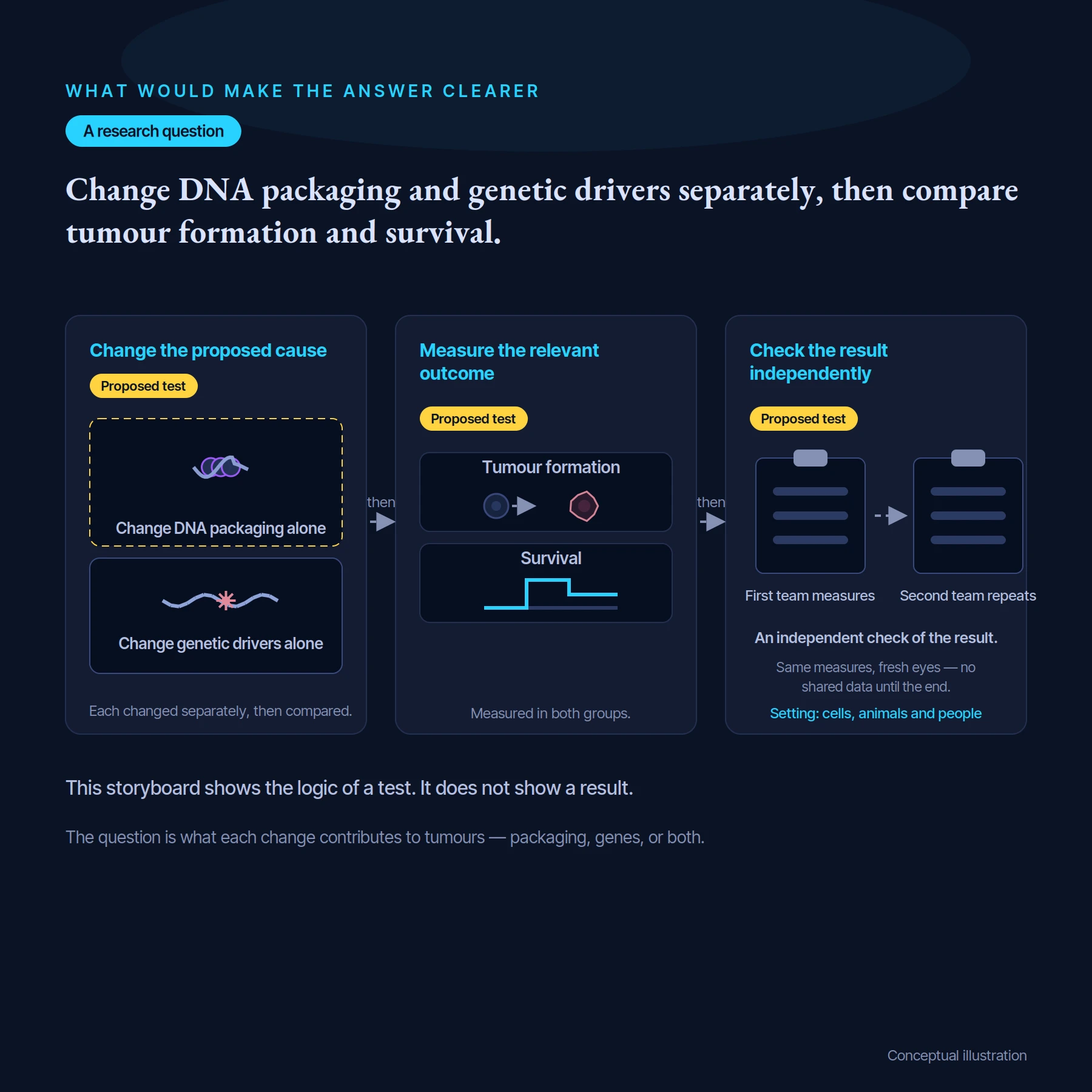
WHAT WOULD MAKE THE ANSWER CLEARER
A research question
Change DNA packaging and genetic drivers separately, then compare tumour formation and survival.
then
then
Change the proposed cause
Proposed test
Change DNA packaging alone
Change genetic drivers alone
Each changed separately, then compared.
Measure the relevant outcome
Tumour formation
Survival
Measured in both groups.
Check the result independently
First team measures
Second team repeats
An independent check of the result.
Same measures, fresh eyes — no shared data until the end.
Setting: cells, animals and people
This storyboard shows the logic of a test. It does not show a result.
The question is what each change contributes to tumours — packaging, genes, or both.
Conceptual illustration
Change DNA packaging and genetic drivers separately, then compare tumour formation and survival.
Check that the intended change really happened.
Allow for other factors and compare with suitable controls.
Look for independent confirmation and the limits of the effect.
These are questions for research, not a claim that the proposed studies have already succeeded.
Proposed tests: 1 test design(s) are registered in the scorecard.
In plain terms, researchers would change the proposed cause, check that it changed as intended, then measure a meaningful outcome while controlling plausible alternatives. The result should be able to support or count against the claim—not only show that a pathway exists.
Study design: Independent native mammalian transient chromatin-state induction and restoration with longitudinal malignant lineage and genome ascertainment
What would be measured: Persistent endogenous malignant behavior after state-initiator restoration, clone-linked genome/epigenome trajectories and context-matched normal controls.
Important controls: Match genotype, baseline lineage, regulator abundance and nonchromatin functions; use orthogonal local-state rescue and genomic-driver positive/negative controls.
Result that would support the claim: Multiple independent native lineages acquire persistent malignancy after a reversible state-only initiating change, with convergent controls excluding measured genetic and pleiotropic alternatives; human natural equivalents show the same order.
Result that would count against it: Malignancy requires permissive genomic lesions, fails after state restoration, tracks acquired genetic events or shows only reversible proliferation/differentiation without malignant behavior.
Follow the studies, detailed comparisons and evidence ratings behind this guide.
Open the scientific review →