The question
Does failed insulin signalling in brain cells start Alzheimer's disease?
This is the specific idea being tested.
Does failed insulin signalling in brain cells start Alzheimer's disease?
What you need to knowInsulin-related problems may worsen disease, but are not established as its primary starting cause.Relative explanatory fit: Alternative ranked ahead
Why the alternative fits better: Alzheimer's-related injury disrupts insulin signalling, which may add to dysfunction. This fits better than one insulin-first route.
Claim assessed: Primary dysfunction of neuronal insulin/IGF-1 signalling initiates and drives sporadic Alzheimer's disease, and correcting this dysfunction modifies the disease trajectory.
Finding: Γ follows the preregistered weakest-link bundle (Γ,Ε,Γ,Γ); primary-SC3 and scope-matched sensitivities also return Γ. Model-specific causal contribution earns Ε, while primary sporadic neuronal initiation and clinically proven correction remain unestablished. Functional tissue resistance, acute memory effects, peripheral prevention and FDG changes are kept distinct. Positive models and valid human causal equivalents are assessed together, without automatically re-capping their weaker observational members.
Evidence scope: 68 primary reports; literature cutoff 2026-10-05; source examination UTC date 2026-10-06; bounded critical review, not exhaustive systematic review.
The grade applies to the stated claim. Model rankings and individual subclaim grades remain separate from the overall causal-evidence grade.
Full scientific assessment and references · Scorecard (JSON) · Review source (Markdown)
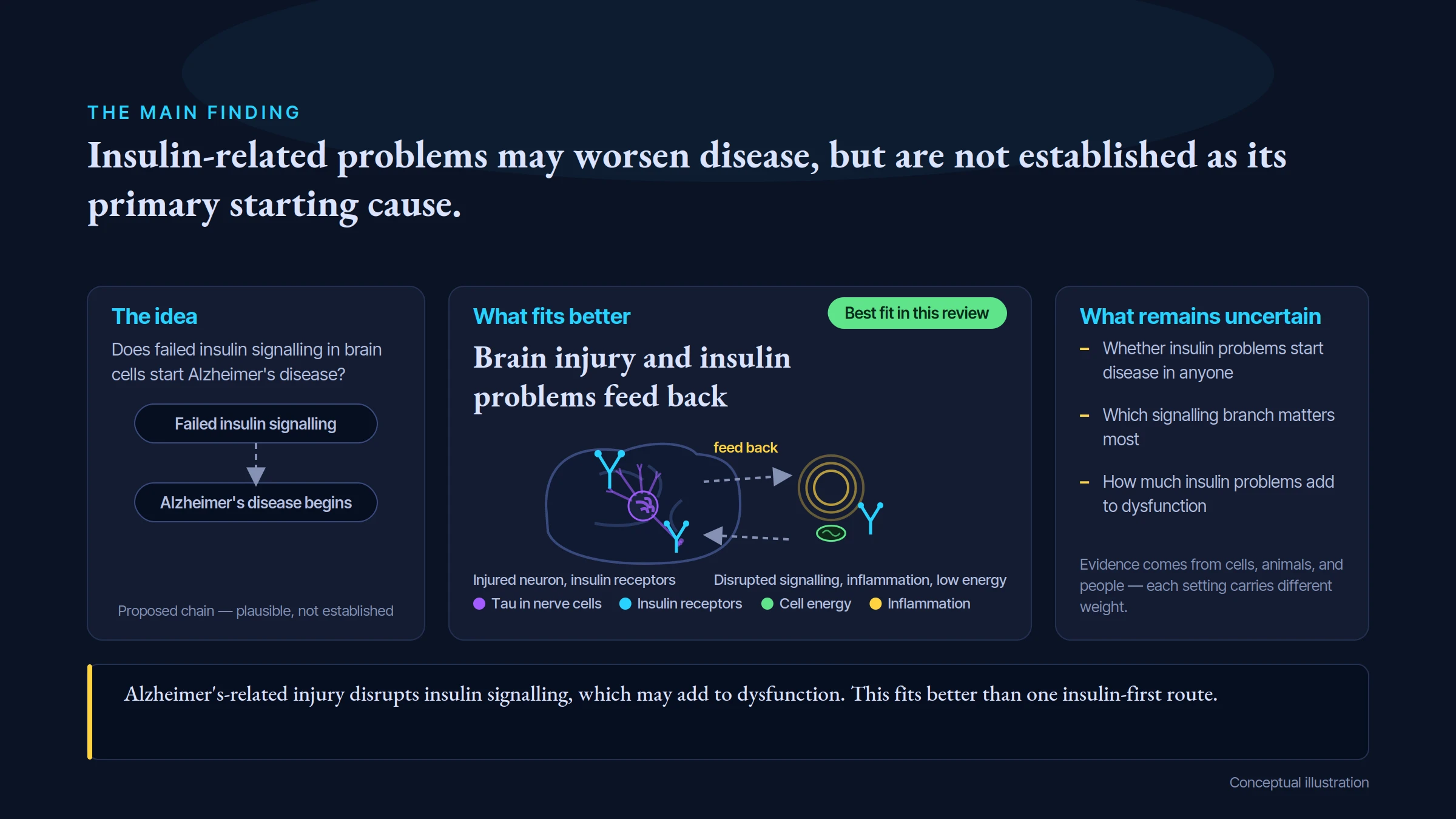
THE MAIN FINDING
Insulin-related problems may worsen disease, but are not established as its primary starting cause.
The idea
Does failed insulin signalling in brain cells start Alzheimer's disease?
Failed insulin signalling
Alzheimer's disease begins
Proposed chain — plausible, not established
What fits better
Brain injury and insulin problems feed back
Best fit in this review
Injured neuron with insulin receptors
Disrupted signalling, inflammation, low energy
feed back
Tau in nerve cells
Insulin receptors
Cell energy
Inflammation
What remains uncertain
Whether insulin problems start disease in anyone
Which signalling branch matters most
How much insulin problems add to dysfunction
Evidence comes from cells, animals, and people — each setting carries different weight.
Alzheimer's-related injury disrupts insulin signalling, which may add to dysfunction. This fits better than one insulin-first route.
Conceptual illustration
This is the specific idea being tested.
Alzheimer's-related injury disrupts insulin signalling, which may add to dysfunction. This fits better than one insulin-first route.
A higher rank means a better fit to the evidence in this comparison. It does not prove every part of the leading explanation.
The reviewed hypothesis ranks 5 among 5 models compared; 1 alternative model(s) hold first rank for this stated claim.
Claim under review: rank 5 among 5 compared models.
Leading explanation: Amyloid/tau-induced resistance with feedback.
Position in this comparison: Last recorded rank.
The causal grade asks how well the stated causal claim is established. This comparison asks which of the assessed explanations fits the reviewed findings better. A leading explanation can remain unproven. Models can overlap or include the tested mechanism; an alternative ahead does not make that mechanism irrelevant. These ordinal ranks apply within this review; they do not measure the size of a difference or rank scientific strength across topics.
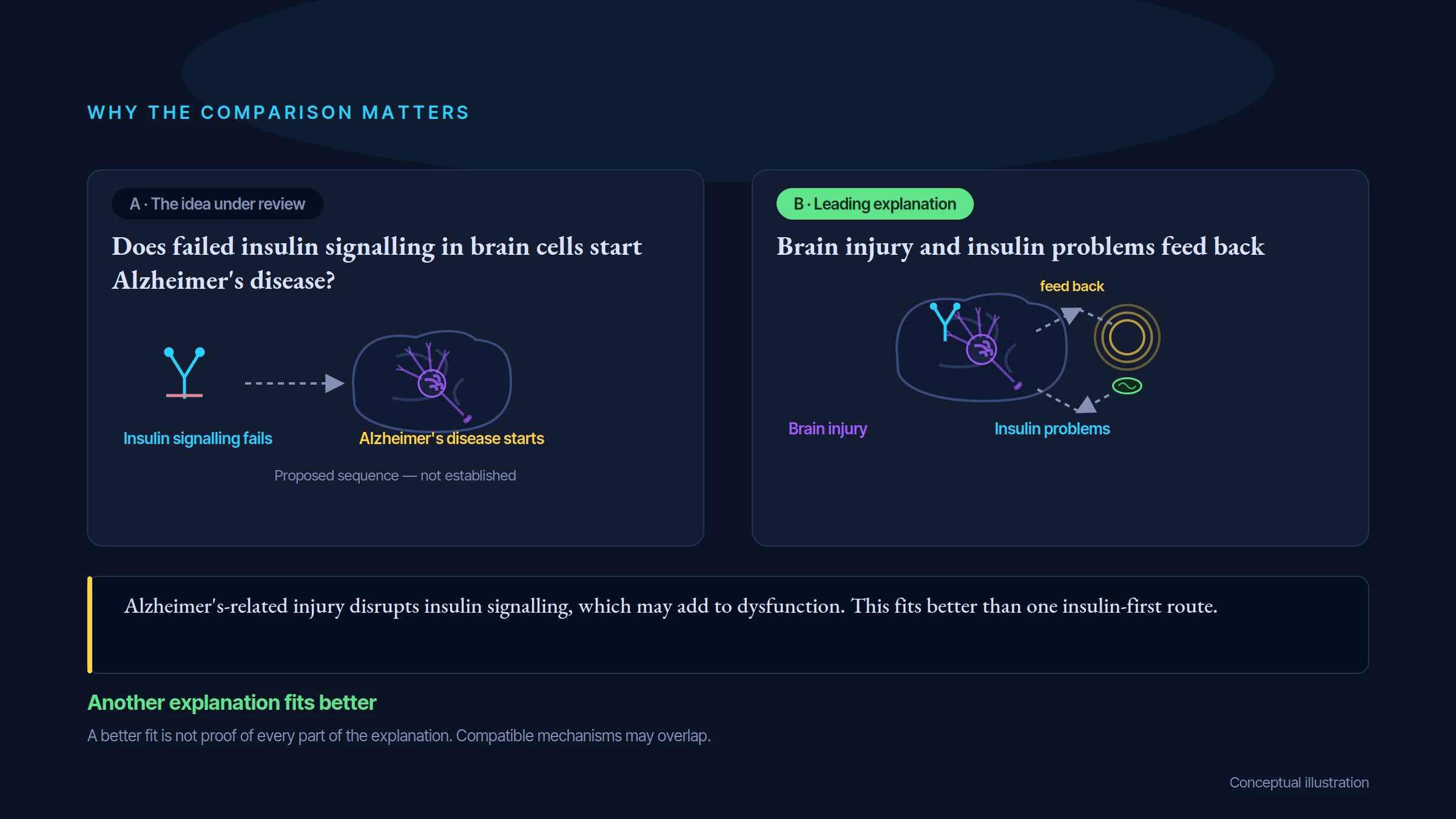
WHY THE COMPARISON MATTERS
A · The idea under review
Does failed insulin signalling in brain cells start Alzheimer's disease?
B · Leading explanation
Brain injury and insulin problems feed back
Alzheimer's-related injury disrupts insulin signalling, which may add to dysfunction. This fits better than one insulin-first route.
Another explanation fits better
A better fit is not proof of every part of the explanation. Compatible mechanisms may overlap.
Conceptual illustration
Insulin signalling fails
Alzheimer's disease starts (proposed consequence)
Proposed sequence — not established
Brain injury
Insulin signalling problems
feed back
Plausible, not established for the stated claim.
Alzheimer's-related injury disrupts insulin signalling, which may add to dysfunction. This fits better than one insulin-first route.
These explanations can overlap. Ranking their fit to the evidence is separate from deciding how firmly a cause has been established.
Rank 1: Amyloid/tau-induced resistance with feedback — AD-related injury can disrupt insulin-related signalling, which can amplify subsequent dysfunction.
Rank 2: Permissive neurotrophic support — Insulin-related signalling supports synapses and memory without constituting a primary AD trigger.
Rank 3: Neurovascular/peripheral metabolic contribution — Metabolic risk can act through systemic and vascular routes without primary neuronal receptor failure.
Rank 4: Reduced synaptic demand and secondary glucose change — Loss of synapses/cells or altered transport can produce FDG and tissue-glucose abnormalities.
Rank 5: Primary neuronal insulin/IGF failure — A native neuronal signalling defect precedes and drives sporadic AD, and correcting it modifies clinical trajectory.
Evidence rating: Γ · Moderate confidence. How the evidence was assessed.
Alzheimer's-related injury disrupts insulin signalling, which may add to dysfunction. This fits better than one insulin-first route.
This is an assessment of a causal explanation, not proof that a particular supplement, diet, test, or treatment improves health. A treatment claim needs studies that test the intervention in people and measure meaningful benefits and harms. These findings can help frame research and informed clinical questions, but they do not identify what is right for one person.
Look for the proposed factor and the outcome, in the people or systems covered by the claim.
Brain injury and insulin problems feed back. Alzheimer's-related injury disrupts insulin signalling, which may add to dysfunction. This fits better than one insulin-first route.
Correct signalling selectively, testing prevention of early amyloid, tau and functional changes.
These illustrations show the key questions tested in the review. They are conceptual drawings, not microscope images or experimental results.
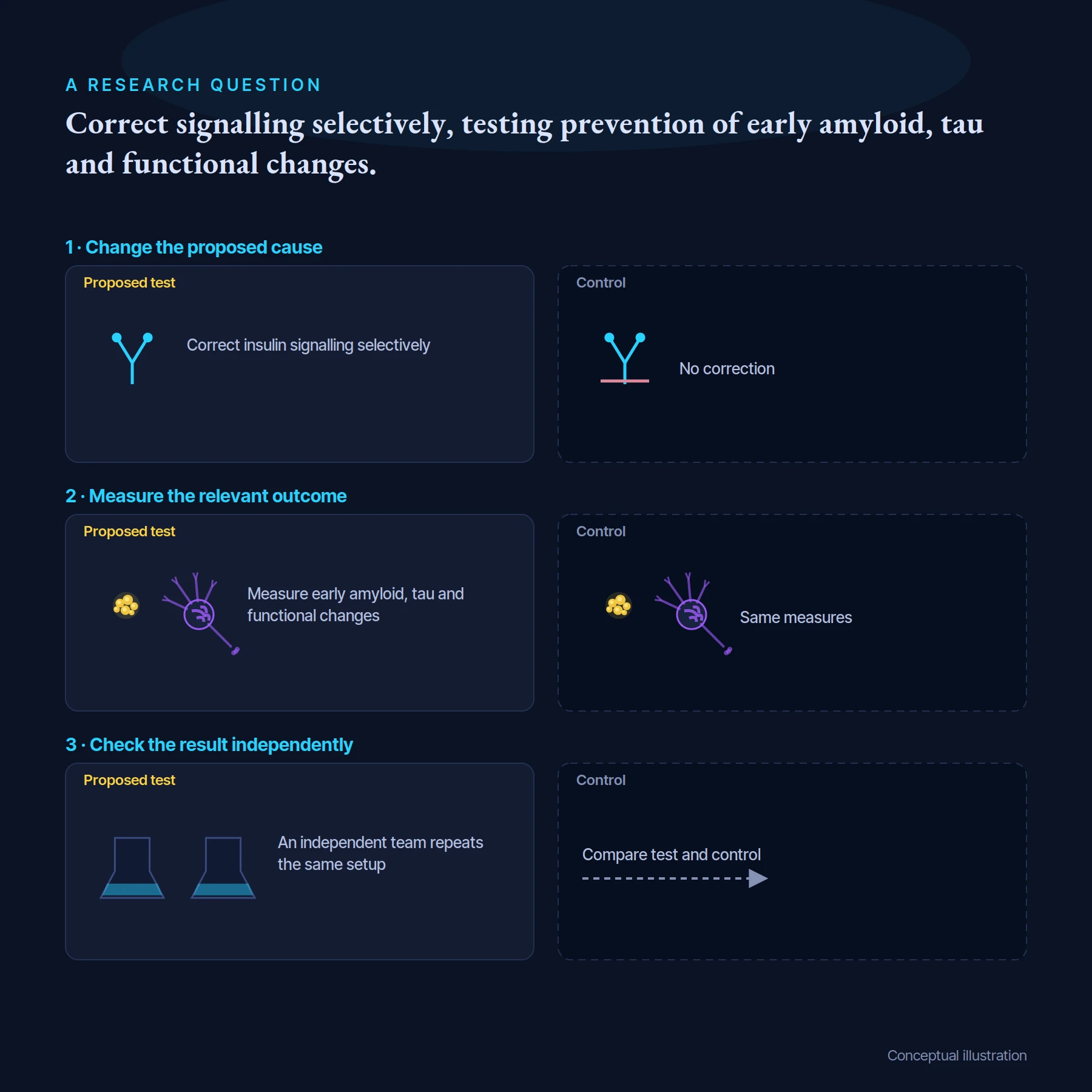
A research question
Correct signalling selectively, testing prevention of early amyloid, tau and functional changes.
1 · Change the proposed cause
Proposed test
Control
Correct insulin signalling selectively
No signalling correction
2 · Measure the relevant outcome
Proposed test
Control
Measure early amyloid, tau and functional changes
Same measures in control
3 · Check the result independently
Proposed test
Control
An independent team repeats the same setup
Compare test and control
Conceptual illustration
Correct signalling selectively, testing prevention of early amyloid, tau and functional changes.
Check that the intended change really happened.
Allow for other factors and compare with suitable controls.
Look for independent confirmation and the limits of the effect.
These are questions for research, not a claim that the proposed studies have already succeeded.
Proposed tests: 1 test design(s) are registered in the scorecard.
In plain terms, researchers would change the proposed cause, check that it changed as intended, then measure a meaningful outcome while controlling plausible alternatives. The result should be able to support or count against the claim—not only show that a pathway exists.
Study design: Predefine an amyloid/tau-negative sporadic-risk cohort with validated live neuron-specific insulin-response measurements; triangulate a selective neuronal exposure instrument and an early CNS-delivered intervention that corrects that response, with matched adult conditional model loss/rescue and repeated pathology/function follow-up.
What would be measured: Incident biomarker-confirmed AD and durable cognitive/daily-function trajectory with temporal neuronal mediator correction
Important controls: Peripheral glycemia, vascular perfusion, intake/weight, IGF branch, glial engagement, validated delivery device, inactive exposure and prespecified multiplicity
Result that would support the claim: Resistance precedes lesions and selective correction prevents conversion through measured neuronal mediation, independently replicated
Result that would count against it: Resistance follows lesions or selective correction changes signalling without pathology/functional benefit, while systemic/vascular effects explain treatment associations
Follow the studies, detailed comparisons and evidence ratings behind this guide.
Open the scientific review →