The question
Does the brain's fluid-clearance system explain how sleep affects diseases such as dementia?
This is the specific idea being tested.
Does the brain's fluid-clearance system explain how sleep affects diseases such as dementia?
What you need to knowFluid moves through the brain, but its role in the course of ordinary human brain disease is still uncertain.Relative explanatory fit: Alternative ranked ahead
Why the alternative fits better: Changing these pathways in mice can change fluid transport and some disease-related outcomes. Studies disagree about sleep's effects, and human measurements can mix changes in substance production with changes in removal.
For health decisions: Good sleep supports health, but this review does not establish 'brain-cleansing' routines or products as ways to prevent dementia.
Claim assessed: Sleep-dependent glymphatic flow clears amyloid-beta and other solutes from brain interstitium, and its age-related failure causally contributes to neurodegeneration.
Finding: Overall Γ follows the registered SC3 clinical disease link, while narrow transport SC1–SC2 retain Ε under an explicit physiological rubric-fit adaptation. Mouse disease perturbations strengthen plausibility and mapped context, but artificial proteinopathy/injury and AQP4's multiple functions restrict human inference. Independent human clinical mediation remains uncrossed. This does not erase the causal transport results or the genuine contradictory measurements.
Evidence scope: 60 primary reports; literature cutoff 2026-10-09; source examination UTC date 2026-10-12; bounded critical review, not exhaustive systematic review.
The grade applies to the stated claim. Model rankings and individual subclaim grades remain separate from the overall causal-evidence grade.
Full scientific assessment and references · Scorecard (JSON) · Review source (Markdown)
HYPOTHESIS CRITIC  /  REVIEW EXPLAINER
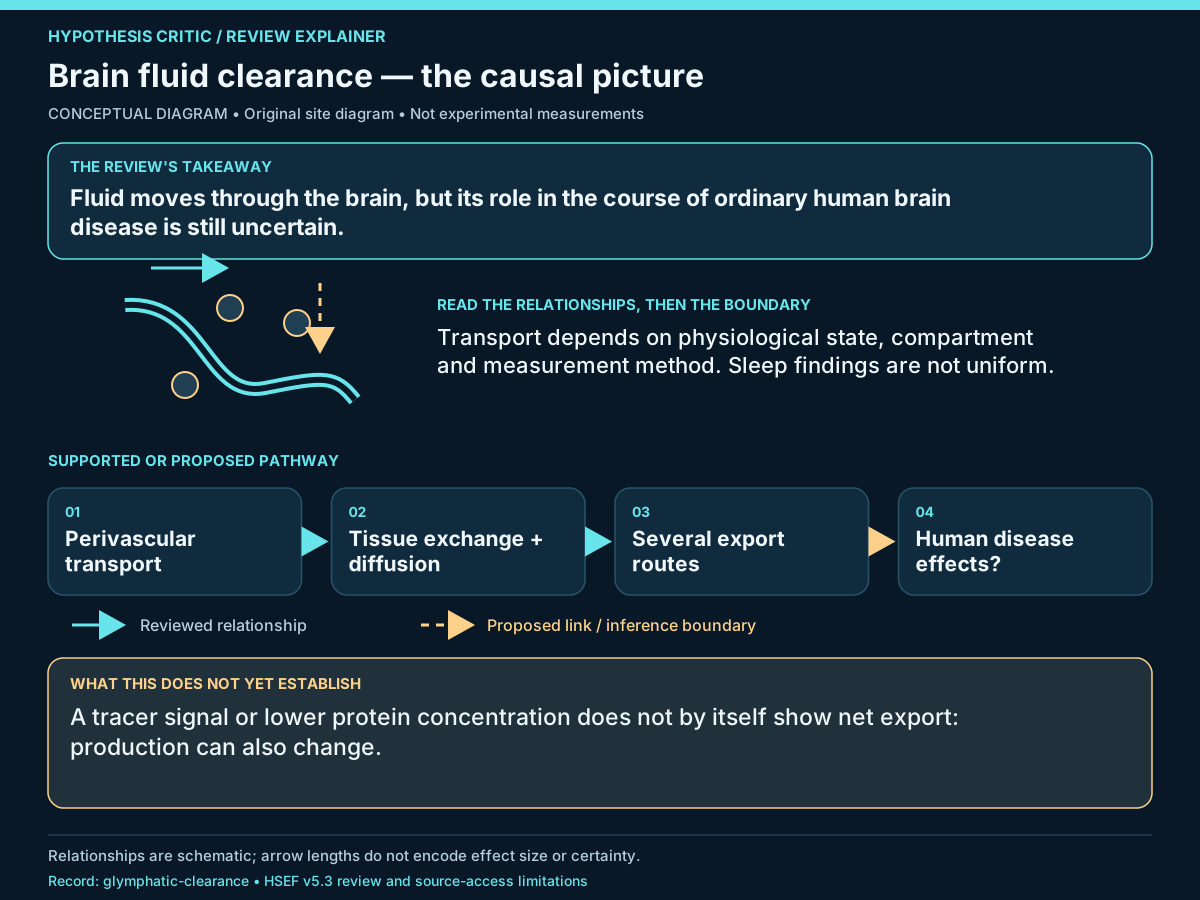
Brain fluid clearance — the causal picture
CONCEPTUAL DIAGRAM  •  Original site diagram  •  Not experimental measurements
THE REVIEW'S TAKEAWAY
Fluid moves through the brain, but its role in the course of ordinary human brain disease is still uncertain.
READ THE RELATIONSHIPS, THEN THE BOUNDARY
Transport depends on physiological state, compartment and measurement method. Sleep findings are not uniform.
SUPPORTED OR PROPOSED PATHWAY
01
Perivascular transport
02
Tissue exchange + diffusion
03
Several export routes
04
Human disease effects?
Reviewed relationship
Proposed link / inference boundary
WHAT THIS DOES NOT YET ESTABLISH
A tracer signal or lower protein concentration does not by itself show net export: production can also change.
Relationships are schematic; arrow lengths do not encode effect size or certainty.
Record: glymphatic-clearance  •  HSEF v5.3 review and source-access limitations
This is the specific idea being tested.
Changing these pathways in mice can change fluid transport and some disease-related outcomes. Studies disagree about sleep's effects, and human measurements can mix changes in substance production with changes in removal.
A higher rank means a better fit to the evidence in this comparison. It does not prove every part of the leading explanation.
The reviewed hypothesis ranks 3 among 4 models compared; 1 alternative model(s) hold first rank for this stated claim.
Claim under review: rank 3 among 4 compared models.
Leading explanation: Compartment-specific exchange and diffusion.
Position in this comparison: Between leading and last ranks.
The causal grade asks how well the stated causal claim is established. This comparison asks which of the assessed explanations fits the reviewed findings better. A leading explanation can remain unproven. Models can overlap or include the tested mechanism; an alternative ahead does not make that mechanism irrelevant. These ordinal ranks apply within this review; they do not measure the size of a difference or rank scientific strength across topics.
HYPOTHESIS CRITIC  /  REVIEW EXPLAINER
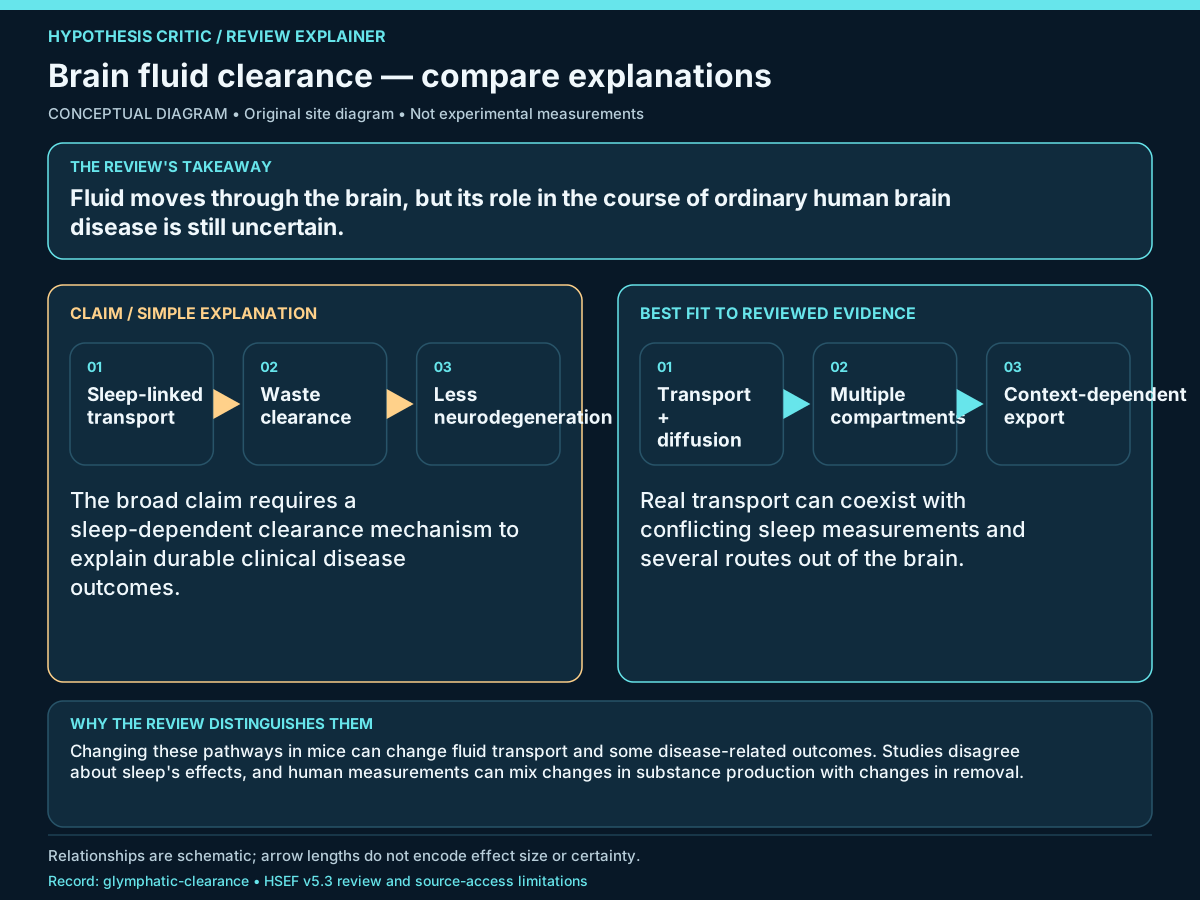
Brain fluid clearance — compare explanations
CONCEPTUAL DIAGRAM  •  Original site diagram  •  Not experimental measurements
THE REVIEW'S TAKEAWAY
Fluid moves through the brain, but its role in the course of ordinary human brain disease is still uncertain.
CLAIM / SIMPLE EXPLANATION
01
Sleep-linked transport
02
Waste clearance
03
Less neurodegeneration
The broad claim requires a sleep-dependent clearance mechanism to explain durable clinical disease outcomes.
BEST FIT TO REVIEWED EVIDENCE
01
Transport + diffusion
02
Multiple compartments
03
Context-dependent export
Real transport can coexist with conflicting sleep measurements and several routes out of the brain.
WHY THE REVIEW DISTINGUISHES THEM
Changing these pathways in mice can change fluid transport and some disease-related outcomes. Studies disagree about sleep's effects, and human measurements can mix changes in substance production with changes in removal.
Relationships are schematic; arrow lengths do not encode effect size or certainty.
Record: glymphatic-clearance  •  HSEF v5.3 review and source-access limitations
Plausible, not established for the stated claim.
Changing these pathways in mice can change fluid transport and some disease-related outcomes. Studies disagree about sleep's effects, and human measurements can mix changes in substance production with changes in removal.
These explanations can overlap. Ranking their fit to the evidence is separate from deciding how firmly a cause has been established.
Rank 1: Compartment-specific exchange and diffusion — Perivascular advection combines with local diffusion and route-specific efflux.
Rank 2: Parallel vascular and lymphatic drainage — Several exit routes and vascular mechanics shape solute export.
Rank 3: Sleep-dependent glymphatic disease contribution — Sleep-active AQP4-associated transport protects aging brains from neurodegeneration.
Rank 4: Bidirectional degeneration and fluid dysfunction — Disease and vascular/sleep disruption can impair transport that also amplifies pathology.
Evidence rating: Γ · Moderate confidence. How the evidence was assessed.
Changing these pathways in mice can change fluid transport and some disease-related outcomes. Studies disagree about sleep's effects, and human measurements can mix changes in substance production with changes in removal.
Sleep is important for health, independent of whether this particular clearance explanation proves correct. The reviewed evidence does not show that improving a fluid-transport measurement prevents or treats dementia in people. Animal results and human imaging clues are useful research leads, but they do not validate a sleep routine or product advertised as a brain-cleansing treatment.
Further reading: NIH: sleep and health.
Look for the proposed factor and the outcome, in the people or systems covered by the claim.
Several fluid routes and transport processes work together, with different effects in different conditions. Changing these pathways in mice can change fluid transport and some disease-related outcomes. Studies disagree about sleep's effects, and human measurements can mix changes in substance production with changes in removal.
Measure how much of a substance is made and how much leaves the brain separately, then test whether a targeted change improves lasting brain function.
HYPOTHESIS CRITIC  /  REVIEW EXPLAINER
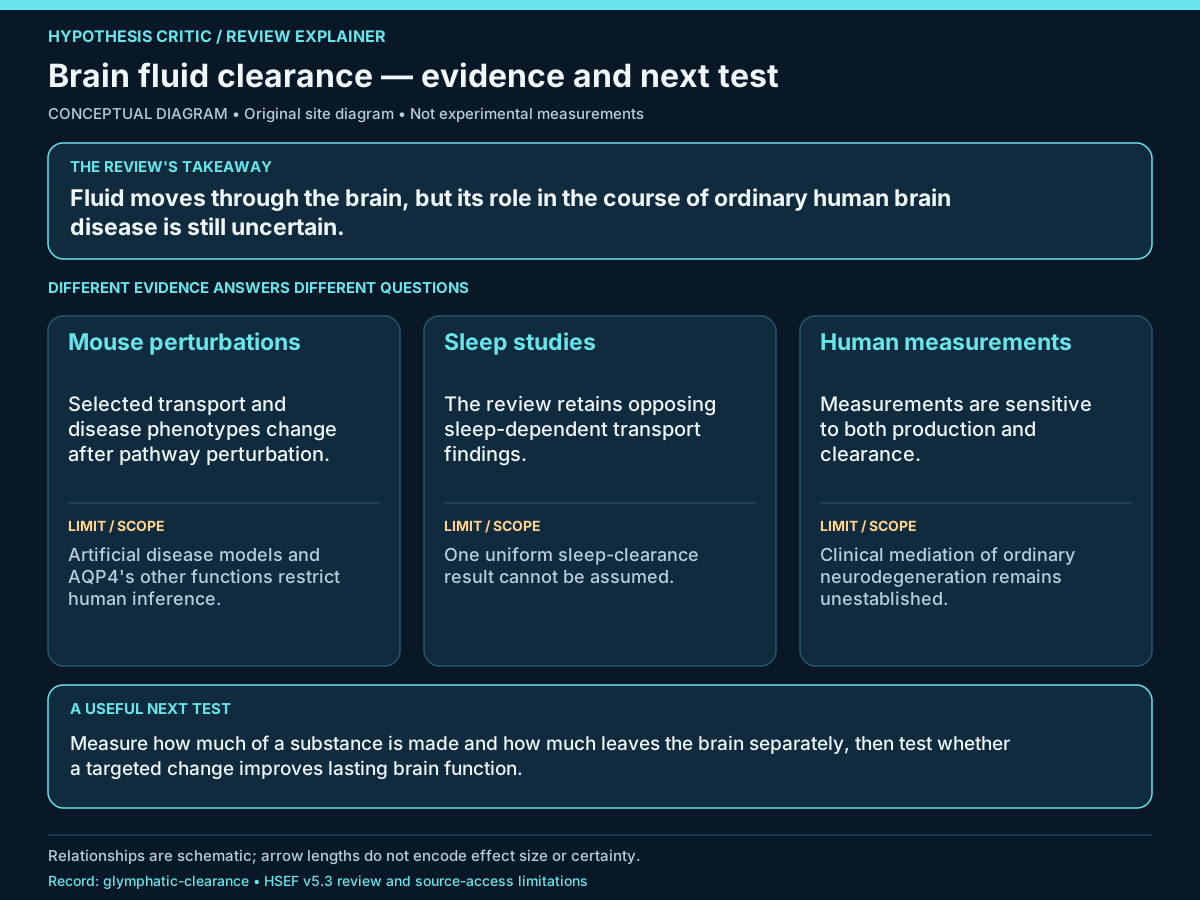
Brain fluid clearance — evidence and next test
CONCEPTUAL DIAGRAM  •  Original site diagram  •  Not experimental measurements
THE REVIEW'S TAKEAWAY
Fluid moves through the brain, but its role in the course of ordinary human brain disease is still uncertain.
DIFFERENT EVIDENCE ANSWERS DIFFERENT QUESTIONS
Mouse perturbations
Selected transport and disease phenotypes change after pathway perturbation.
LIMIT / SCOPE
Artificial disease models and AQP4's other functions restrict human inference.
Sleep studies
The review retains opposing sleep-dependent transport findings.
LIMIT / SCOPE
One uniform sleep-clearance result cannot be assumed.
Human measurements
Measurements are sensitive to both production and clearance.
LIMIT / SCOPE
Clinical mediation of ordinary neurodegeneration remains unestablished.
A USEFUL NEXT TEST
Measure how much of a substance is made and how much leaves the brain separately, then test whether a targeted change improves lasting brain function.
Relationships are schematic; arrow lengths do not encode effect size or certainty.
Record: glymphatic-clearance  •  HSEF v5.3 review and source-access limitations
Measure how much of a substance is made and how much leaves the brain separately, then test whether a targeted change improves lasting brain function.
Check that the intended change really happened.
Allow for other factors and compare with suitable controls.
Look for independent confirmation and the limits of the effect.
These are questions for research, not a claim that the proposed studies have already succeeded.
Proposed tests: 1 test design(s) are registered in the scorecard.
In plain terms, researchers would change the proposed cause, check that it changed as intended, then measure a meaningful outcome while controlling plausible alternatives. The result should be able to support or count against the claim—not only show that a pathway exists.
Study design: Prospectively register a selective adult pathway manipulation in a predefined aging/neurodegeneration setting, measure endogenous-solute production and net export with independent methods, and follow neuronal/functional trajectory. Match circadian timing, natural sleep, vascular dynamics and delivery pressure; add mediator rescue or epistasis before translating the physiological target to a human clinical trial.
What would be measured: Compartment-resolved clearance rate, production/degradation and prespecified disease/function trajectory
Important controls: Pressure and injection trauma, solute size, EEG state, sleep microarchitecture, vascular/autonomic effects, water homeostasis, model genotype and independent analysis
Result that would support the claim: Selective engagement improves verified export and durable trajectory with mediation and independent replication
Result that would count against it: Target engagement changes tracer entry or device signal without net export or functional benefit, or production/parallel exits explain the apparent effect
Follow the studies, detailed comparisons and evidence ratings behind this guide.
Open the scientific review →