The question
Do some established cancers remain dependent on one dominant cancer-driving gene?
This is the specific idea being tested.
Do some established cancers remain dependent on one dominant cancer-driving gene?
What you need to knowSome defined cancers remain strongly dependent on a dominant driver, despite other genetic changes.Relative explanatory fit: Leading among models compared
Why the evidence supports this: Turning off the driver limits tumour survival in tested settings. This does not apply automatically to every cancer.
Claim assessed: Cancers with prospectively defined driver–tumor pairs depend on continuous dominant oncogene signaling for maintenance, so selective signaling withdrawal produces tumor regression.
Finding: The preregistered scope-matched rule reports SC1 at Η: endogenous conditional-driver and common-conduit interventions, genetic withdrawal, mechanistic resistance/rescue and baseline molecularly defined clinical trials converge on tumor-maintenance dependence across named pairs. Significant primary nonresponse, host/apoptosis dependence and persistence prevent Θ or Ω. SC2 pan-cancer one-driver generalization and SC3 residual-cell eradication remain Γ as broader mechanistic claims without matching general causal validation.
Evidence scope: 66 primary reports; literature cutoff 2026-10-08; source examination UTC date 2026-10-09; bounded critical review, not exhaustive systematic review.
The grade applies to the stated claim. Model rankings and individual subclaim grades remain separate from the overall causal-evidence grade.
Full scientific assessment and references · Scorecard (JSON) · Review source (Markdown)
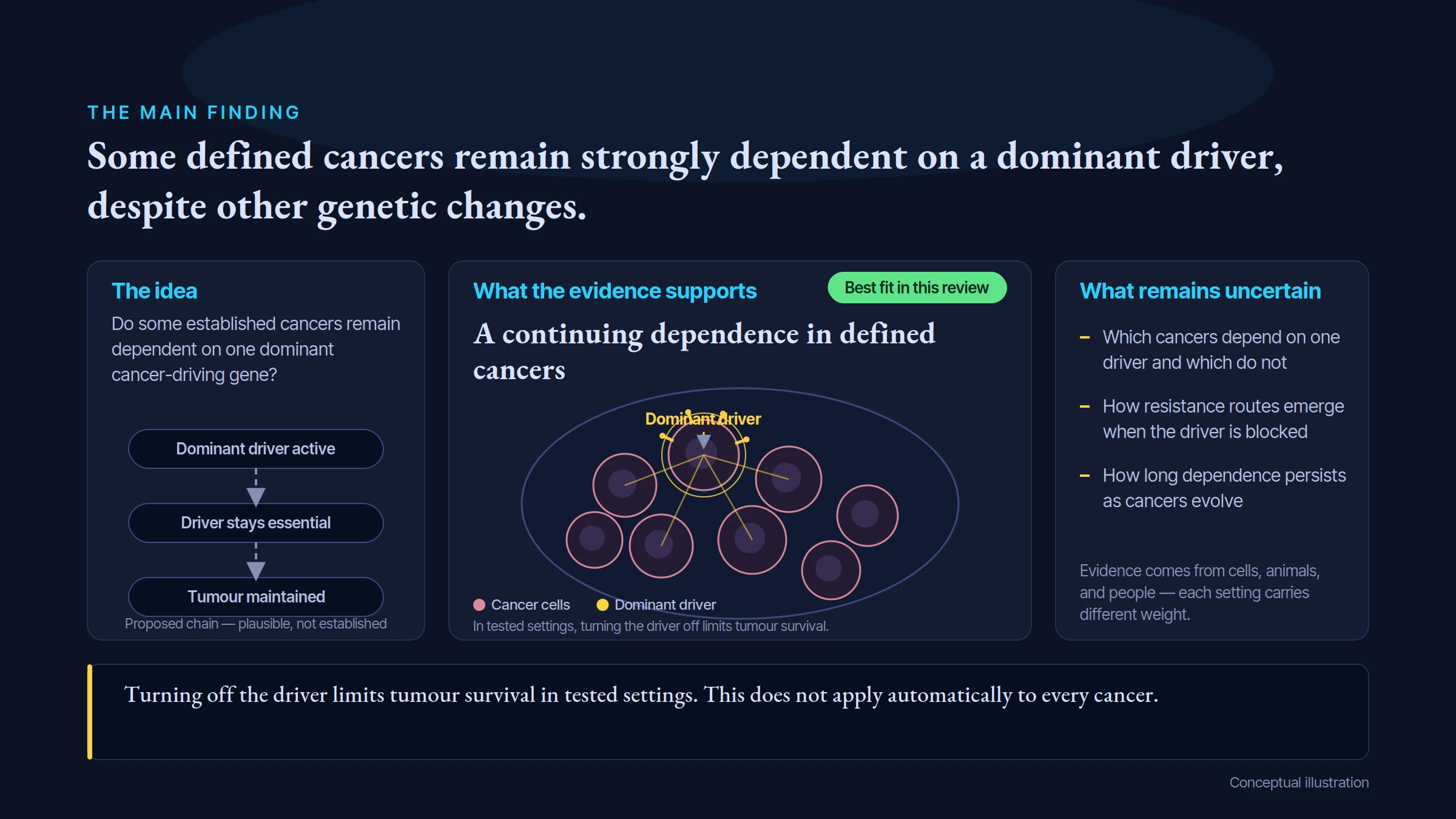
THE MAIN FINDING
Some defined cancers remain strongly dependent on a dominant driver, despite other genetic changes.
The idea
Do some established cancers remain dependent on one dominant cancer-driving gene?
Dominant driver active
Driver stays essential
Tumour maintained
Proposed chain — plausible, not established
What the evidence supports
A continuing dependence in defined cancers
Best fit in this review
Dominant driver
Cancer cells
Dominant driver
In tested settings, turning the driver off limits tumour survival.
What remains uncertain
Which cancers depend on one driver and which do not
How resistance routes emerge when the driver is blocked
How long dependence persists as cancers evolve
Evidence comes from cells, animals, and people — each setting carries different weight.
Turning off the driver limits tumour survival in tested settings. This does not apply automatically to every cancer.
Conceptual illustration
This is the specific idea being tested.
Turning off the driver limits tumour survival in tested settings. This does not apply automatically to every cancer.
This conclusion applies to the people, conditions and outcomes covered by the review.
The reviewed hypothesis ranks first among 5 models compared for this stated claim.
Claim under review: rank 1 among 5 compared models.
Leading explanation: Scoped dominant-oncogene maintenance dependence.
Position in this comparison: First rank.
The causal grade asks how well the stated causal claim is established. This comparison asks which of the assessed explanations fits the reviewed findings better. A leading explanation can remain unproven. Models can overlap or include the tested mechanism; an alternative ahead does not make that mechanism irrelevant. These ordinal ranks apply within this review; they do not measure the size of a difference or rank scientific strength across topics.
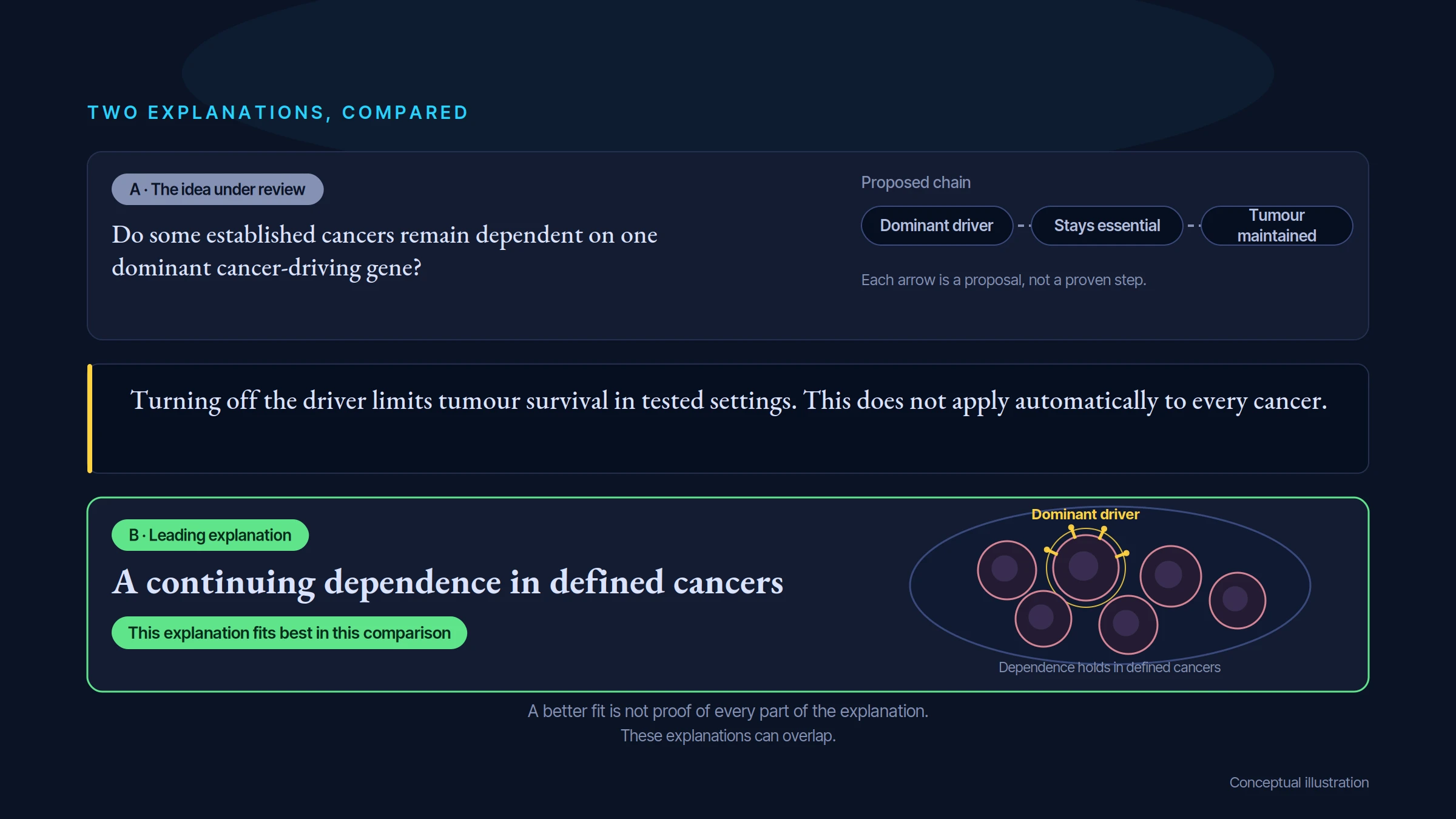
TWO EXPLANATIONS, COMPARED
A · The idea under review
Do some established cancers remain dependent on one dominant cancer-driving gene?
Proposed chain
Dominant driver
Stays essential
Tumour maintained
Each arrow is a proposal, not a proven step.
Turning off the driver limits tumour survival in tested settings. This does not apply automatically to every cancer.
B · Leading explanation
A continuing dependence in defined cancers
This explanation fits best in this comparison
Dominant driver
Dependence holds in defined cancers
A better fit is not proof of every part of the explanation.
These explanations can overlap.
Conceptual illustration
Strong causal evidence for the stated claim.
Turning off the driver limits tumour survival in tested settings. This does not apply automatically to every cancer.
These explanations can overlap. Ranking their fit to the evidence is separate from deciding how firmly a cause has been established.
Rank 1: Scoped dominant-oncogene maintenance dependence — A defined baseline driver can remain a rate-limiting maintenance node despite other genomic changes.
Rank 2: Clonal bypass and lineage plasticity — Selection restores drug-resistant target signaling or substitutes a different maintenance route.
Rank 3: Reversible drug-tolerant state — A reversibly altered cellular state survives treatment and can seed later resistance.
Rank 4: Non-addicted residual reservoir — A residual compartment can survive strong signaling inhibition while the bulk regresses.
Rank 5: Non-oncogene stress-support dependency — Residual tumor states can acquire requirements for unmutated stress-support functions.
Evidence rating: Η · Moderate confidence. How the evidence was assessed.
Turning off the driver limits tumour survival in tested settings. This does not apply automatically to every cancer.
The preregistered scope-matched rule reports SC1 at Η: endogenous conditional-driver and common-conduit interventions, genetic withdrawal, mechanistic resistance/rescue and baseline molecularly defined clinical trials converge on tumor-maintenance dependence across named pairs. Significant primary nonresponse, host/apoptosis dependence and persistence prevent Θ or Ω. SC2 pan-cancer one-driver generalization and SC3 residual-cell eradication remain Γ as broader mechanistic claims without matching general causal validation.
Look for the proposed factor and the outcome, in the people or systems covered by the claim.
A continuing dependence in defined cancers. Turning off the driver limits tumour survival in tested settings. This does not apply automatically to every cancer.
Turn off and restore the driver in the same cancer setting, tracking survival and resistance.
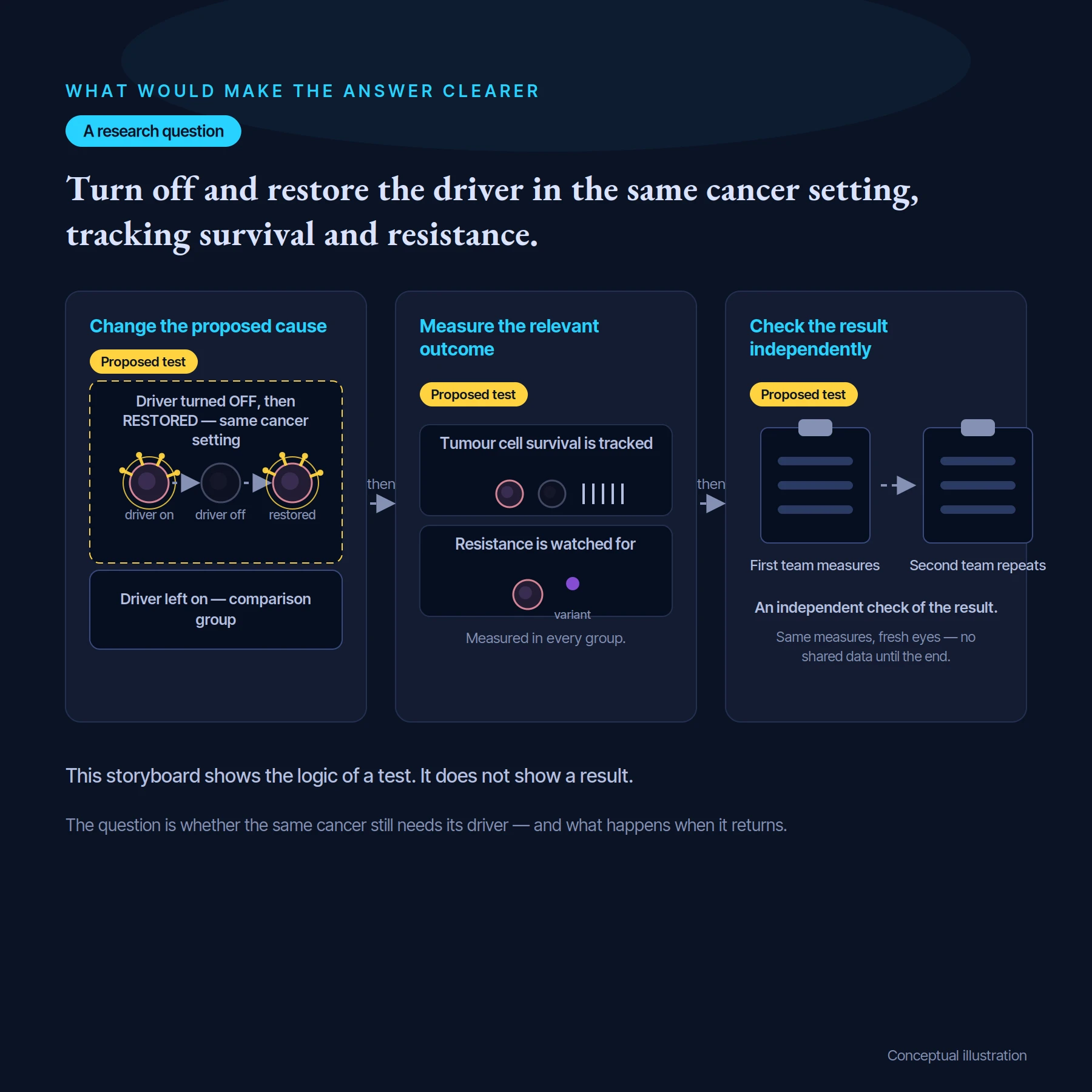
WHAT WOULD MAKE THE ANSWER CLEARER
A research question
Turn off and restore the driver in the same cancer setting, tracking survival and resistance.
then
then
Change the proposed cause
Proposed test
Driver turned OFF, then RESTORED — same cancer setting
driver on
driver off
restored
Driver left on — comparison group
Measure the relevant outcome
Proposed test
Tumour cell survival is tracked
Resistance is watched for
variant
Measured in every group.
Check the result independently
Proposed test
First team measures
Second team repeats
An independent check of the result.
Same measures, fresh eyes — no shared data until the end.
This storyboard shows the logic of a test. It does not show a result.
The question is whether the same cancer still needs its driver — and what happens when it returns.
Conceptual illustration
Turn off and restore the driver in the same cancer setting, tracking survival and resistance.
Check that the intended change really happened.
Allow for other factors and compare with suitable controls.
Look for independent confirmation and the limits of the effect.
These are questions for research, not a claim that the proposed studies have already succeeded.
Proposed tests: 1 test design(s) are registered in the scorecard.
In plain terms, researchers would change the proposed cause, check that it changed as intended, then measure a meaningful outcome while controlling plausible alternatives. The result should be able to support or count against the claim—not only show that a pathway exists.
Study design: In baseline molecularly defined driver–tumor cohorts and matched native models, combine allele-specific withdrawal with direct engagement measures, matched driver restoration and longitudinal lineage-resolved residual-cell tracking. Prospectively include nonresponders; perturb candidate bypass and reservoir dependencies separately. Follow sustained control both during treatment and after predefined cessation.
What would be measured: Bulk regression, apoptosis, driver signaling, residual clone fate, lineage transition, relapse and treatment-free survival over a prespecified interval
Important controls: Restoration at native abundance, non-target genotype controls, equal initial tumor burden, host/apoptosis strata, inhibitor-resistant alleles, barcode collision and rare-clone detection controls, matched cessation eligibility
Result that would support the claim: Independent native models and baseline patient strata show driver-specific regression, while identified modifiers explain most initial failures and residual survival; selective residual-dependency correction adds sustained treatment-free control
Result that would count against it: Fully verified selective withdrawal leaves substantial bulk tumors unchanged across baseline-defined pairs, or restored driver cannot reverse a purported withdrawal effect; residual populations recur despite candidate rescue and elimination controls
Follow the studies, detailed comparisons and evidence ratings behind this guide.
Open the scientific review →