The question
Are ongoing DNA and chromosome errors the general root cause of cancer?
This is the specific idea being tested.
Are ongoing DNA and chromosome errors the general root cause of cancer?
What you need to knowDNA errors can help cancers evolve, but their effects vary and can also restrict tumour growth.Relative explanatory fit: Alternative ranked ahead
Why the alternative fits better: Errors create variation that cancer cells may exploit. Effects depend on the cells and genetic changes already present.
Claim assessed: Ongoing genome instability is the primary root cause of cancer initiation and malignant progression rather than a consequence of oncogenic transformation or a context-dependent accelerator.
Finding: The preregistered general-root gate SC4 remains Γ. Endogenous repair and segregation perturbations establish defined cancer-susceptibility routes (SC2 Ζ), and rate-specific progression or resistance interventions support context-valid causality (SC3 Ε). Associations and fixed abnormal states cannot establish the temporal root of all cancer.
Evidence scope: 61 primary reports; literature cutoff 2026-10-08; source examination UTC date 2026-10-09; bounded critical review, not exhaustive systematic review.
The grade applies to the stated claim. Model rankings and individual subclaim grades remain separate from the overall causal-evidence grade.
Full scientific assessment and references · Scorecard (JSON) · Review source (Markdown)
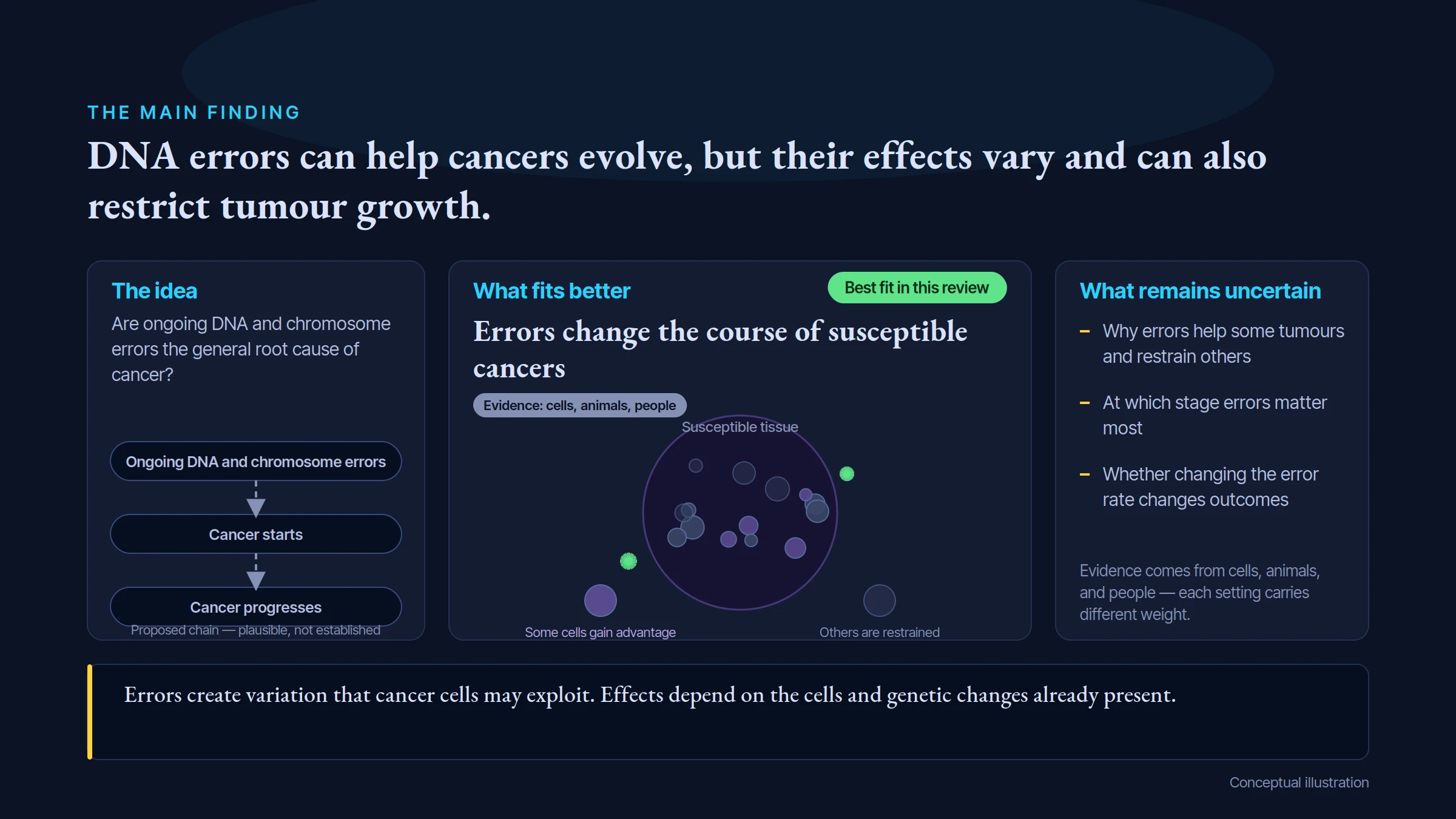
THE MAIN FINDING
DNA errors can help cancers evolve, but their effects vary and can also restrict tumour growth.
The idea
Are ongoing DNA and chromosome errors the general root cause of cancer?
Ongoing DNA and chromosome errors
Cancer starts
Cancer progresses
Proposed chain — plausible, not established
What fits better
Errors change the course of susceptible cancers
Best fit in this review
Susceptible tissue
Some cells gain advantage
Others are restrained
Evidence: cells, animals, people
What remains uncertain
Why errors help some tumours and restrain others
At which stage errors matter most
Whether changing the error rate changes outcomes
Evidence comes from cells, animals, and people — each setting carries different weight.
Errors create variation that cancer cells may exploit. Effects depend on the cells and genetic changes already present.
Conceptual illustration
This is the specific idea being tested.
Errors create variation that cancer cells may exploit. Effects depend on the cells and genetic changes already present.
A higher rank means a better fit to the evidence in this comparison. It does not prove every part of the leading explanation.
The reviewed hypothesis ranks 5 among 5 models compared; 1 alternative model(s) hold first rank for this stated claim.
Claim under review: rank 5 among 5 compared models.
Leading explanation: Context-dependent evolutionary accelerator.
Position in this comparison: Last recorded rank.
The causal grade asks how well the stated causal claim is established. This comparison asks which of the assessed explanations fits the reviewed findings better. A leading explanation can remain unproven. Models can overlap or include the tested mechanism; an alternative ahead does not make that mechanism irrelevant. These ordinal ranks apply within this review; they do not measure the size of a difference or rank scientific strength across topics.
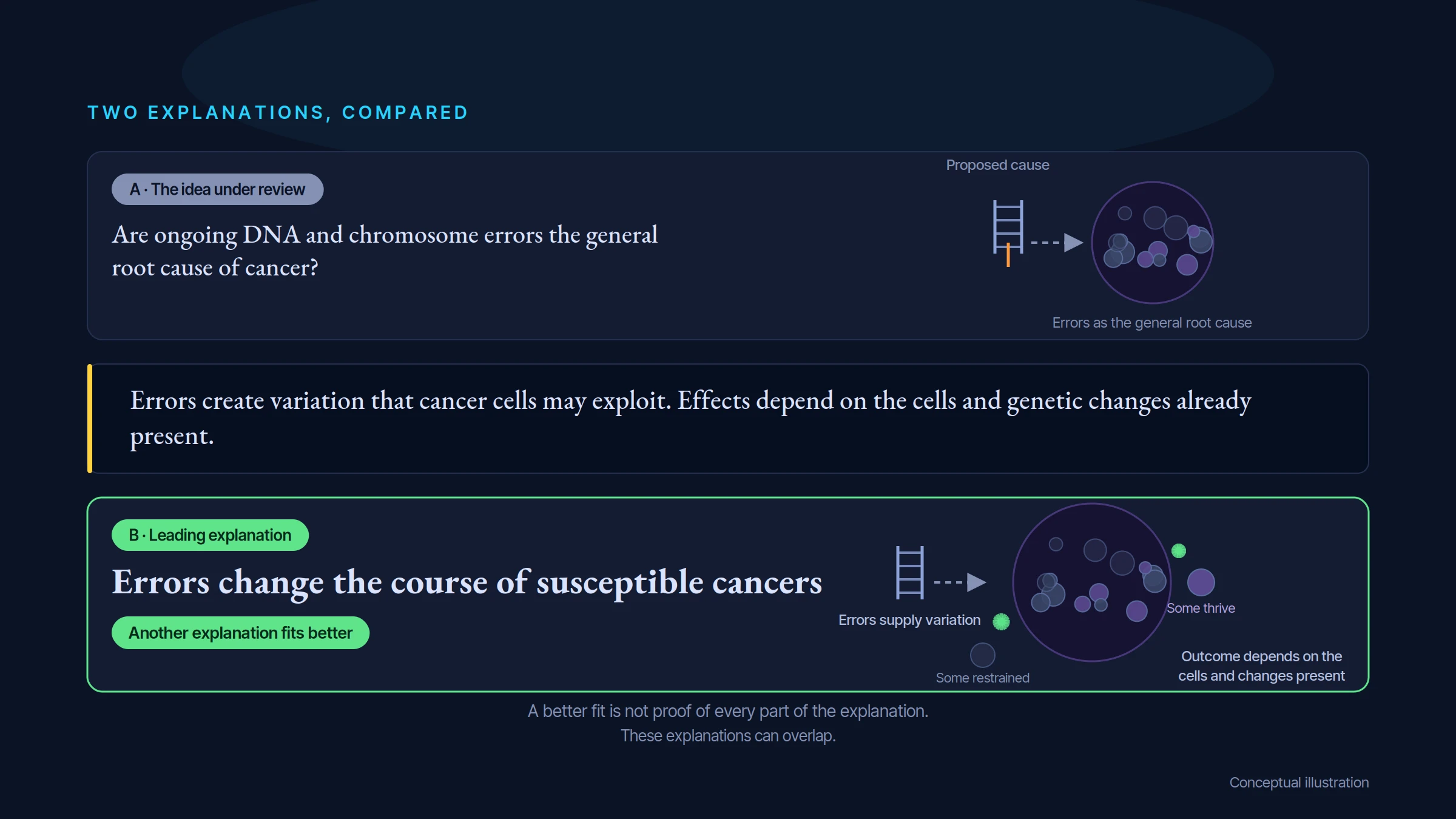
TWO EXPLANATIONS, COMPARED
A · The idea under review
Are ongoing DNA and chromosome errors the general root cause of cancer?
Errors as the general root cause
Proposed cause
Errors create variation that cancer cells may exploit. Effects depend on the cells and genetic changes already present.
B · Leading explanation
Errors change the course of susceptible cancers
Another explanation fits better
Errors supply variation
Some thrive
Some restrained
Outcome depends on the cells and changes present
A better fit is not proof of every part of the explanation.
These explanations can overlap.
Conceptual illustration
Plausible, not established for the stated claim.
Errors create variation that cancer cells may exploit. Effects depend on the cells and genetic changes already present.
These explanations can overlap. Ranking their fit to the evidence is separate from deciding how firmly a cause has been established.
Rank 1: Context-dependent evolutionary accelerator — Instability supplies selectable diversity or signaling in already susceptible or oncogene-driven tumors.
Rank 2: Oncogene-first stress with barrier escape — Upstream oncogenic activity creates replication/segregation stress, and checkpoint barriers determine survival.
Rank 3: Genome-stress immune signaling — Cytosolic DNA changes tumor and host immune states with context-dependent consequences.
Rank 4: Rate-dependent fitness and tumor barrier — Excess instability or stress can impair viability and tumor progression.
Rank 5: General instability-first root — Instability can precede and enable transforming changes.
Evidence rating: Γ · Moderate confidence. How the evidence was assessed.
Errors create variation that cancer cells may exploit. Effects depend on the cells and genetic changes already present.
The preregistered general-root gate SC4 remains Γ. Endogenous repair and segregation perturbations establish defined cancer-susceptibility routes (SC2 Ζ), and rate-specific progression or resistance interventions support context-valid causality (SC3 Ε). Associations and fixed abnormal states cannot establish the temporal root of all cancer.
Look for the proposed factor and the outcome, in the people or systems covered by the claim.
Errors change the course of susceptible cancers. Errors create variation that cancer cells may exploit. Effects depend on the cells and genetic changes already present.
Change the error rate at defined stages and measure whether tumours start, grow, shrink or stay unchanged.
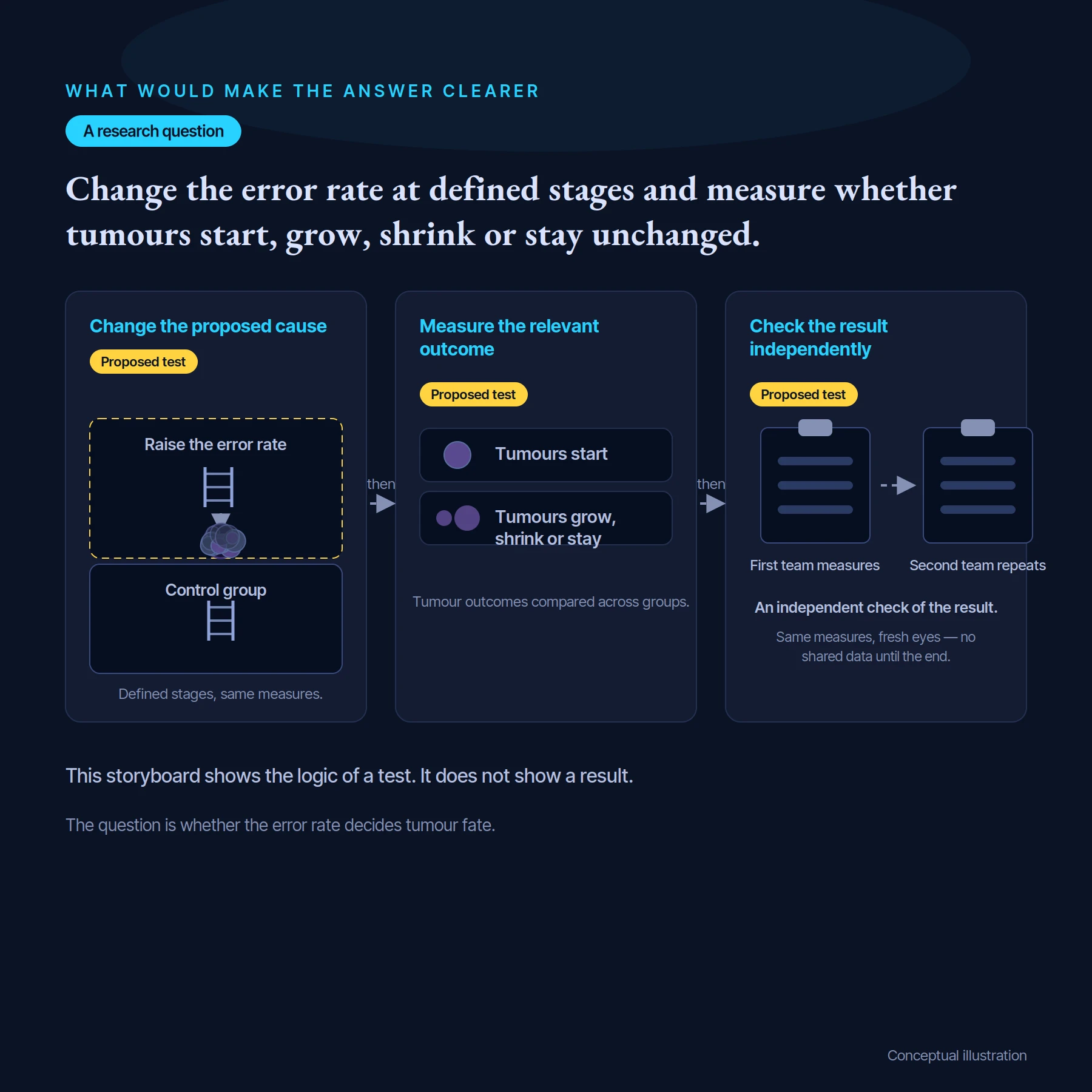
WHAT WOULD MAKE THE ANSWER CLEARER
A research question
Change the error rate at defined stages and measure whether tumours start, grow, shrink or stay unchanged.
then
then
Change the proposed cause
Proposed test
Raise the error rate
Control group
Defined stages, same measures.
Measure the relevant outcome
Proposed test
Tumours start
Tumours grow, shrink or stay
Tumour outcomes compared across groups.
Check the result independently
Proposed test
First team measures
Second team repeats
An independent check of the result.
Same measures, fresh eyes — no shared data until the end.
This storyboard shows the logic of a test. It does not show a result.
The question is whether the error rate decides tumour fate.
Conceptual illustration
Change the error rate at defined stages and measure whether tumours start, grow, shrink or stay unchanged.
Check that the intended change really happened.
Allow for other factors and compare with suitable controls.
Look for independent confirmation and the limits of the effect.
These are questions for research, not a claim that the proposed studies have already succeeded.
Proposed tests: 1 test design(s) are registered in the scorecard.
In plain terms, researchers would change the proposed cause, check that it changed as intended, then measure a meaningful outcome while controlling plausible alternatives. The result should be able to support or count against the claim—not only show that a pathway exists.
Study design: Across prospectively defined sporadic tissues, trace native clones before transformation while measuring division-level mutation/segregation rates and driver activation. Selectively normalize the relevant rate without removing fixed drivers or changing p53, proliferation or centrosome signaling; reinstate the rate and repeat in independent autochthonous models.
What would be measured: Clonal initiation hazard, driver timing, measured rates, tumor latency, primary growth, metastasis and treatment-free trajectory
Important controls: Driver-matched rate-stable controls, equal proliferation, host immune strata, abundance-matched allele restoration, negative lineages and blinded serial tracking
Result that would support the claim: Selective rate normalization prevents initiation across predefined settings and rate reinstatement restores it before driver acquisition; post-onset dependence is separately demonstrated
Result that would count against it: Initiation proceeds with normalized rates or instability consistently follows driver activation; only resistance or metastasis changes in restricted contexts
Follow the studies, detailed comparisons and evidence ratings behind this guide.
Open the scientific review →