The question
Is too much glutamate activity the main cause of nerve-cell loss in ALS?
This is the specific idea being tested.
Is too much glutamate activity the main cause of nerve-cell loss in ALS?
What you need to knowExcess glutamate can add stress, but disruption of RNA handling fits more of the reviewed evidence.Relative explanatory fit: Alternative ranked ahead
Why the alternative fits better: RNA-processing and nerve-fibre support problems can precede or bring on glutamate stress.
Claim assessed: Excitotoxicity—excess glutamatergic signaling from impaired astrocytic EAAT2/GLT-1 clearance and calcium-permeable AMPA receptors—is the causal driver of motor-neuron death in ALS.
Finding: Preregistered scope-matched SC4 returns Γ. SC2 Ζ is a bounded forced-lesion result, and SC3 Ε is a SOD1 progression result. Weakest-link sensitivity is Β from descriptive SC1, so that aggregation would mix association depth with a distinct causal-driver question.
Evidence scope: 69 primary reports; literature cutoff 2026-10-08; source examination UTC date 2026-10-08; bounded critical review, not exhaustive systematic review.
The grade applies to the stated claim. Model rankings and individual subclaim grades remain separate from the overall causal-evidence grade.
Full scientific assessment and references · Scorecard (JSON) · Review source (Markdown)
THE MAIN FINDING
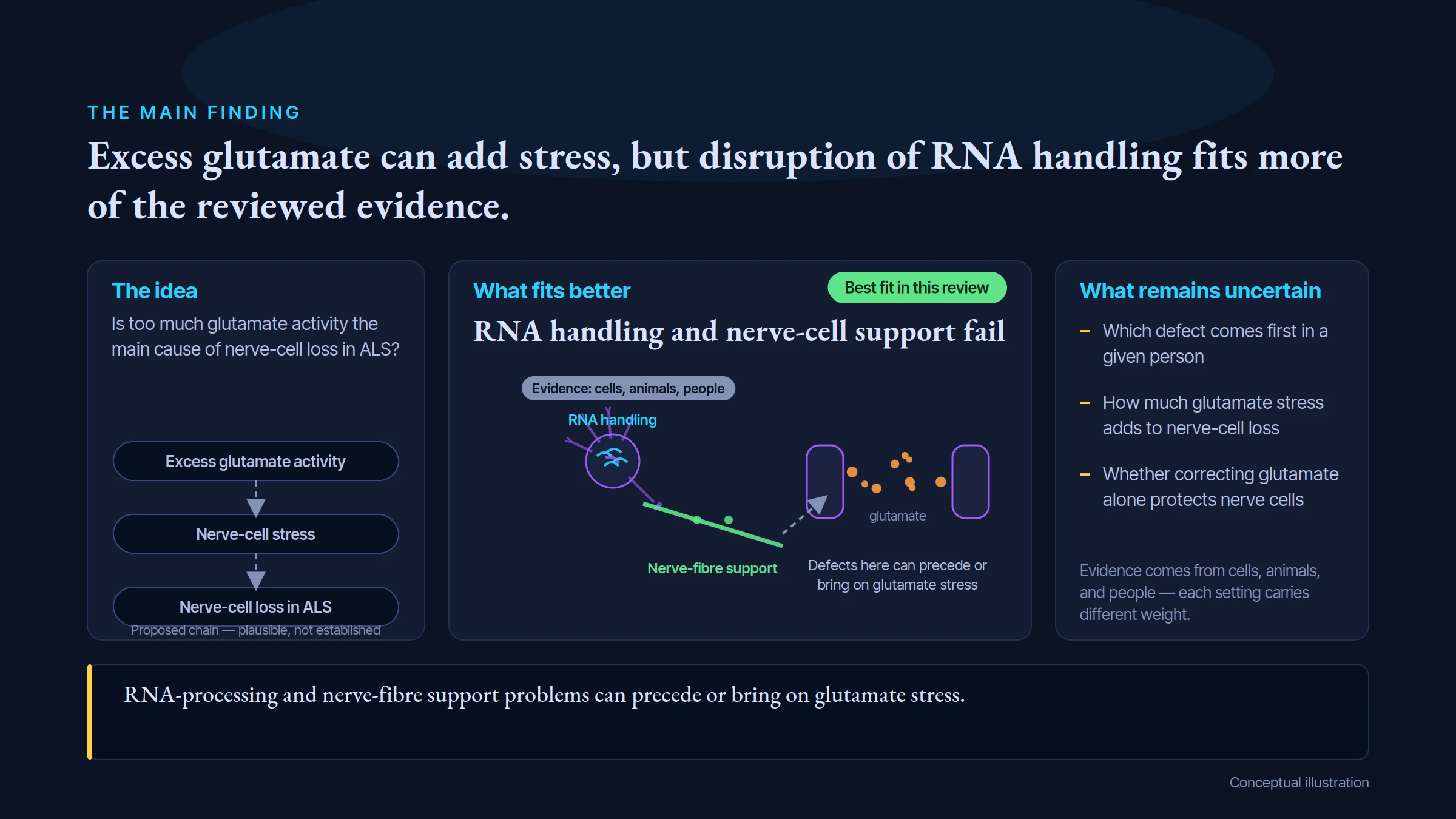
Excess glutamate can add stress, but disruption of RNA handling fits more of the reviewed evidence.
The idea
Is too much glutamate activity the main cause of nerve-cell loss in ALS?
Excess glutamate activity
Nerve-cell stress
Nerve-cell loss in ALS
Proposed chain — plausible, not established
What fits better
RNA handling and nerve-cell support fail
Best fit in this review
RNA handling
Nerve-fibre support
Defects here can precede or bring on glutamate stress
Evidence: cells, animals, people
What remains uncertain
Which defect comes first in a given person
How much glutamate stress adds to nerve-cell loss
Whether correcting glutamate alone protects nerve cells
Evidence comes from cells, animals, and people — each setting carries different weight.
RNA-processing and nerve-fibre support problems can precede or bring on glutamate stress.
Conceptual illustration
This is the specific idea being tested.
RNA-processing and nerve-fibre support problems can precede or bring on glutamate stress.
A higher rank means a better fit to the evidence in this comparison. It does not prove every part of the leading explanation.
The reviewed hypothesis ranks 2 among 5 models compared; 1 alternative model(s) hold first rank for this stated claim.
Claim under review: rank 2 among 5 compared models.
Leading explanation: TDP-43/RBP proteostasis failure.
Position in this comparison: Next after leading rank.
The causal grade asks how well the stated causal claim is established. This comparison asks which of the assessed explanations fits the reviewed findings better. A leading explanation can remain unproven. Models can overlap or include the tested mechanism; an alternative ahead does not make that mechanism irrelevant. These ordinal ranks apply within this review; they do not measure the size of a difference or rank scientific strength across topics.
TWO EXPLANATIONS, COMPARED
A · The idea under review
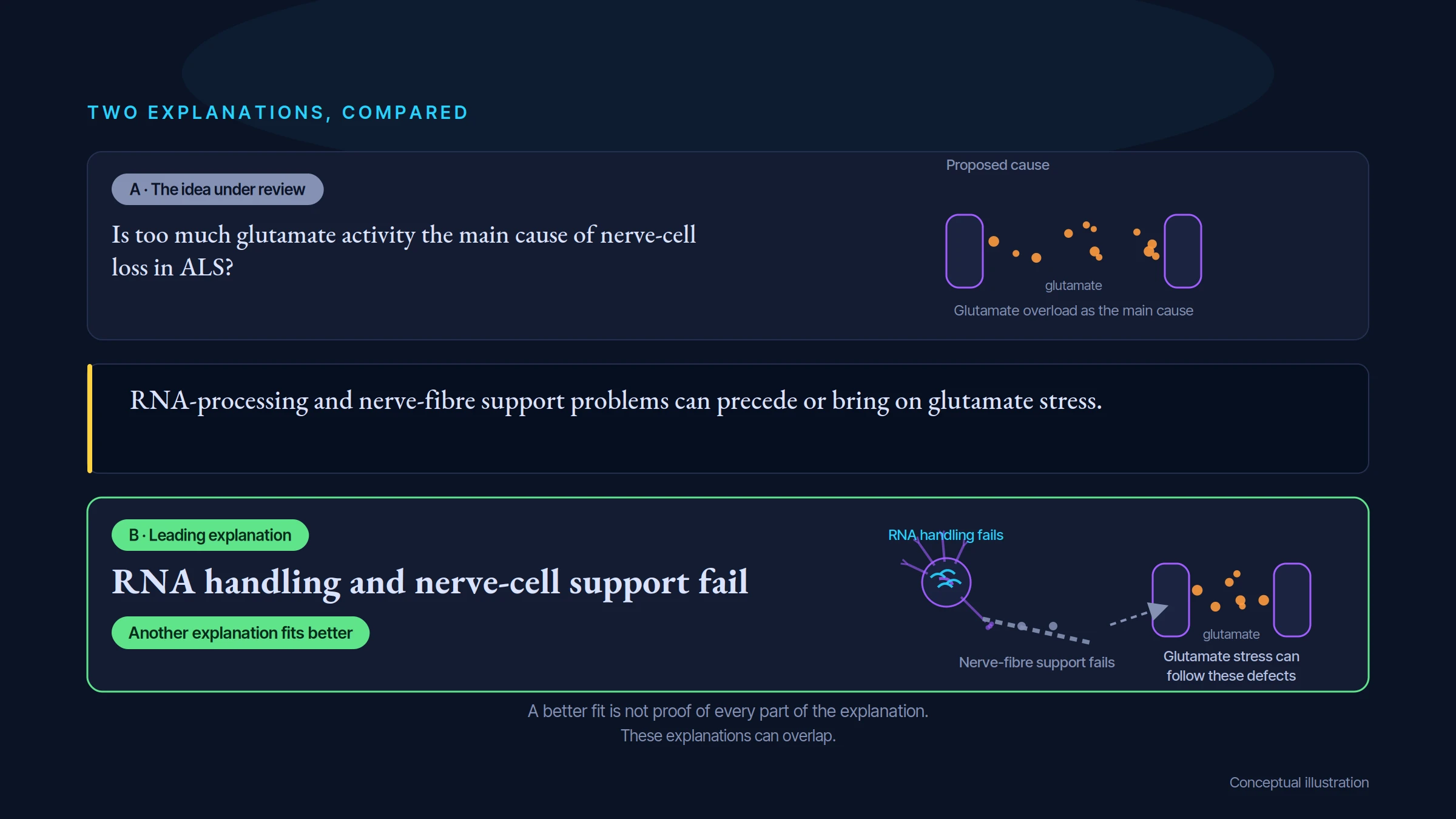
Is too much glutamate activity the main cause of nerve-cell loss in ALS?
Glutamate overload as the main cause
Proposed cause
RNA-processing and nerve-fibre support problems can precede or bring on glutamate stress.
B · Leading explanation
RNA handling and nerve-cell support fail
Another explanation fits better
RNA handling fails
Nerve-fibre support fails
Glutamate stress can follow these defects
A better fit is not proof of every part of the explanation.
These explanations can overlap.
Conceptual illustration
Plausible, not established for the stated claim.
RNA-processing and nerve-fibre support problems can precede or bring on glutamate stress.
These explanations can overlap. Ranking their fit to the evidence is separate from deciding how firmly a cause has been established.
Rank 1: TDP-43/RBP proteostasis failure — RNA processing and axonal-support defects can precede or recruit excitotoxic stress.
Rank 2: Excitotoxicity — Excess glutamate/calcium stress amplifies motor-neuron injury.
Rank 3: Distal axonopathy/dying-back — Axonal support/destruction can drive distal loss before cell bodies fail.
Rank 4: Astroglial toxicity beyond glutamate — Inflammatory and metabolic glial changes interact with neurons.
Rank 5: Homeostatic excitability compensation — Excitation can recruit protective signaling in vulnerable motor neurons.
Evidence rating: Γ · Moderate confidence. How the evidence was assessed.
RNA-processing and nerve-fibre support problems can precede or bring on glutamate stress.
A result about how a disease works is a separate question from whether a treatment improves health.
Look for the proposed factor and the outcome, in the people or systems covered by the claim.
RNA handling and nerve-cell support fail. RNA-processing and nerve-fibre support problems can precede or bring on glutamate stress.
Compare correction of glutamate activity with correction of RNA and nerve-fibre defects.
WHAT WOULD MAKE THE ANSWER CLEARER
A research question
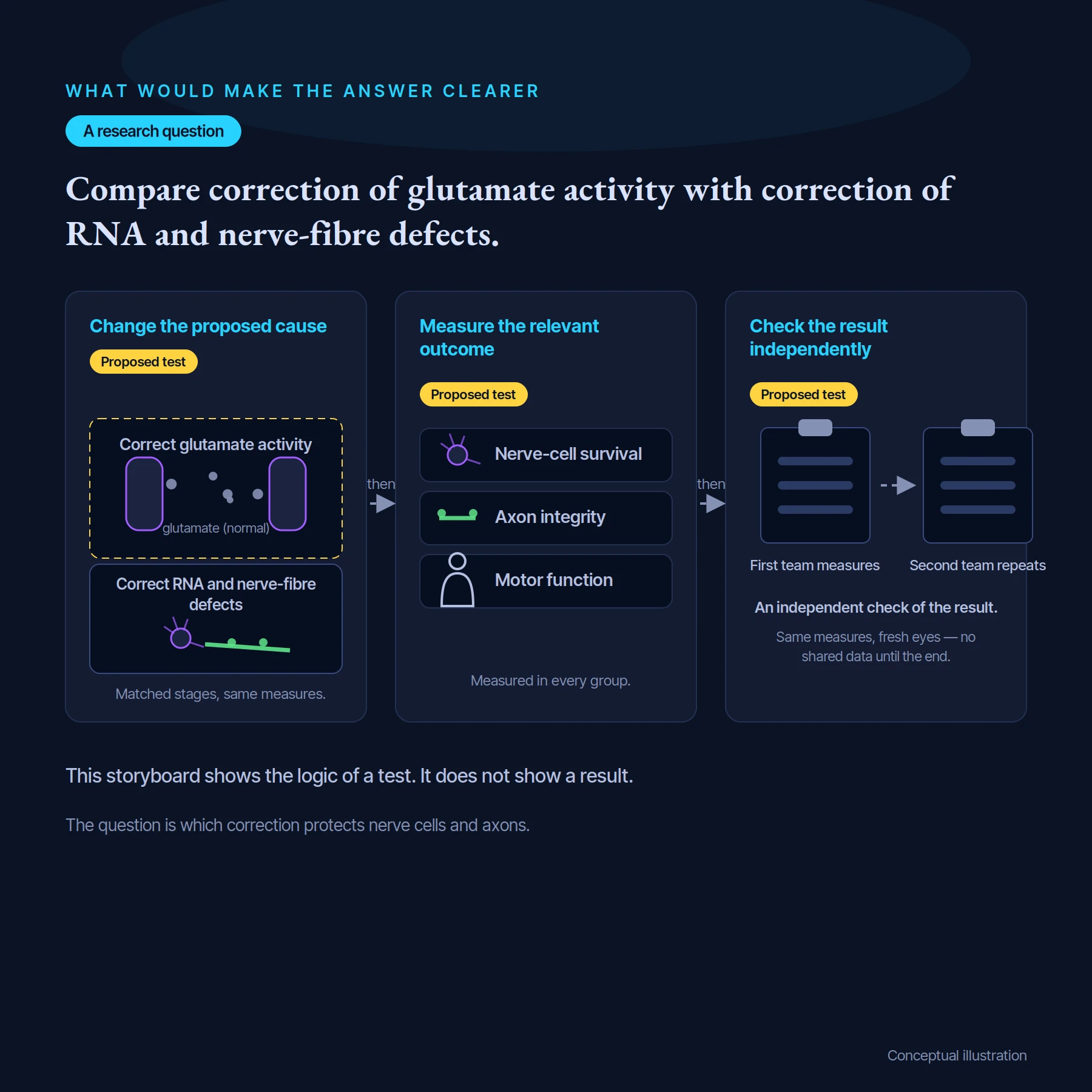
Compare correction of glutamate activity with correction of RNA and nerve-fibre defects.
then
then
Change the proposed cause
Proposed test
Correct glutamate activity
Correct RNA and nerve-fibre defects
Matched stages, same measures.
Measure the relevant outcome
Proposed test
Nerve-cell survival
Axon integrity
Motor function
Measured in every group.
Check the result independently
Proposed test
First team measures
Second team repeats
An independent check of the result.
Same measures, fresh eyes — no shared data until the end.
This storyboard shows the logic of a test. It does not show a result.
The question is which correction protects nerve cells and axons.
Conceptual illustration
Compare correction of glutamate activity with correction of RNA and nerve-fibre defects.
Check that the intended change really happened.
Allow for other factors and compare with suitable controls.
Look for independent confirmation and the limits of the effect.
These are questions for research, not a claim that the proposed studies have already succeeded.
Proposed tests: 1 test design(s) are registered in the scorecard.
In plain terms, researchers would change the proposed cause, check that it changed as intended, then measure a meaningful outcome while controlling plausible alternatives. The result should be able to support or count against the claim—not only show that a pathway exists.
Study design: Prospectively stratify sporadic ALS by prespecified stage and cell-specific editing/clearance status, then compare selective CP-AMPA or EAAT2 correction with a mechanistically orthogonal RNA/axonal intervention in matched human-derived systems and an adult-onset disease model before a target-engaged clinical trajectory trial.
What would be measured: Receptor/clearance engagement, neuron counts, axon/NMJ integrity, motor function and survival measured separately
Important controls: Edited-GluA2 versus nonediting rescue, transporter-dead control, physiological excitation preservation, isogenic comparator and blinded attrition-aware analysis
Result that would support the claim: Selective correction suppresses degeneration across prespecified contexts and adds no protection when the mediator is already normalized
Result that would count against it: Confirmed normalization leaves death/progression intact while orthogonal correction rescues it, or suppression worsens function in the proposed target context
Follow the studies, detailed comparisons and evidence ratings behind this guide.
Open the scientific review →